Catalogue
Modern World Coins
Machine-struck national coinage from the nineteenth century onwards.
Catalogue entries (1,985)
Filter by era, country, maker or material817–864 of 1,985 entries
Rijksmuseum, Amsterdam
modern coins
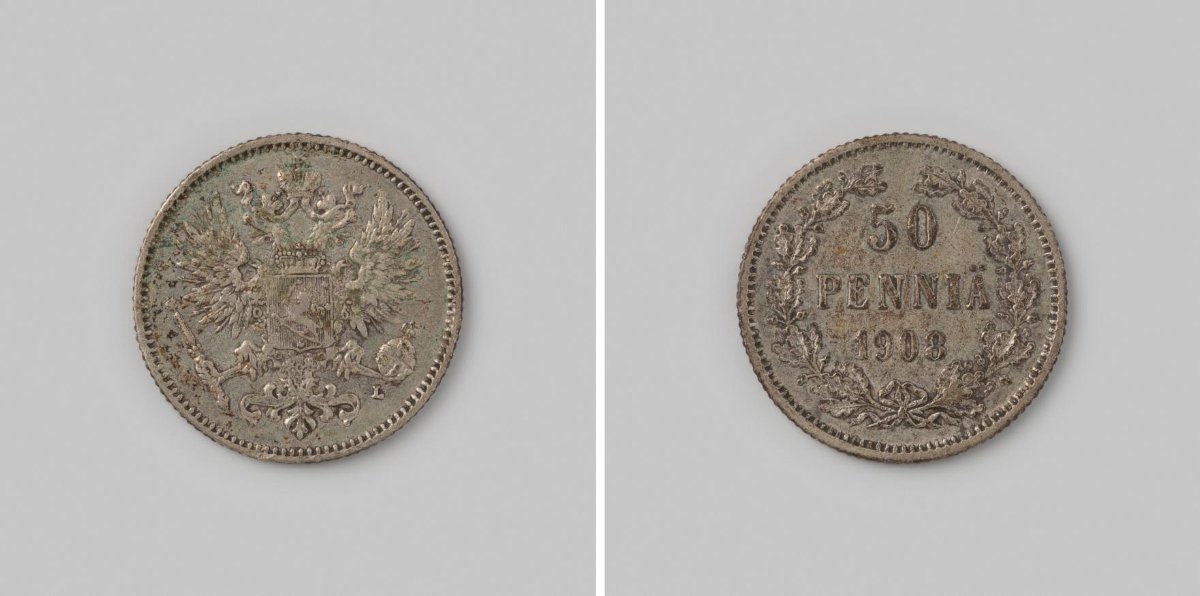
Finland, Tsar Nicholas II, 50 penniä, 1908
1908
Silver coin. Obverse: double-headed crowned eagle with spread wings and on its breast a coat of arms of Finland encircled by an order of knighthood, and in its talons a sceptre and a crowned orb. Above the eagle a crown with ribbon. Reverse: between two tied branches, value indication in two lines, below which the y…
Partial type record
Rijksmuseum, Amsterdam
modern coins
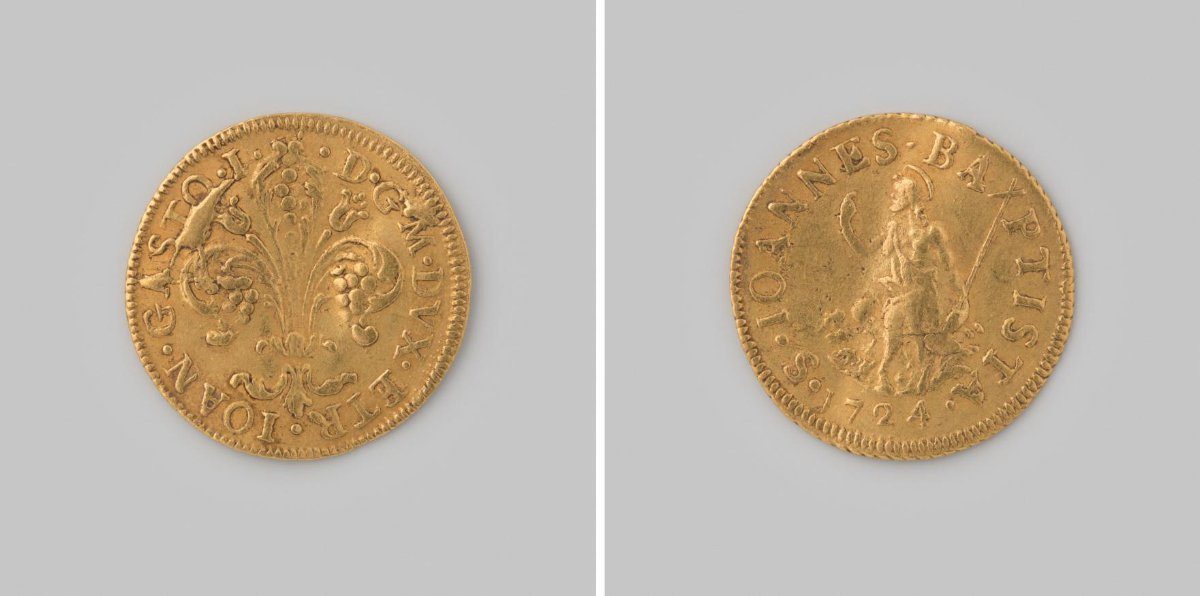
Fiorino or zecchino from the Grand Duchy of Tuscany, Florence, of Gian Gastone de' Medici, 1724
1724
Gold coin. Obverse: lily. Reverse: Saint John with a cross in his left hand, walking to the left. Date at the bottom. Cable border. Note: irregularities on the obverse of the coin flan. The Rijksmuseum, Amsterdam, holds this object as KOG-MP-1-3181; its record gives material recorded as gold (metal); technique strik…
Partial type record
Rijksmuseum, Amsterdam
modern coins
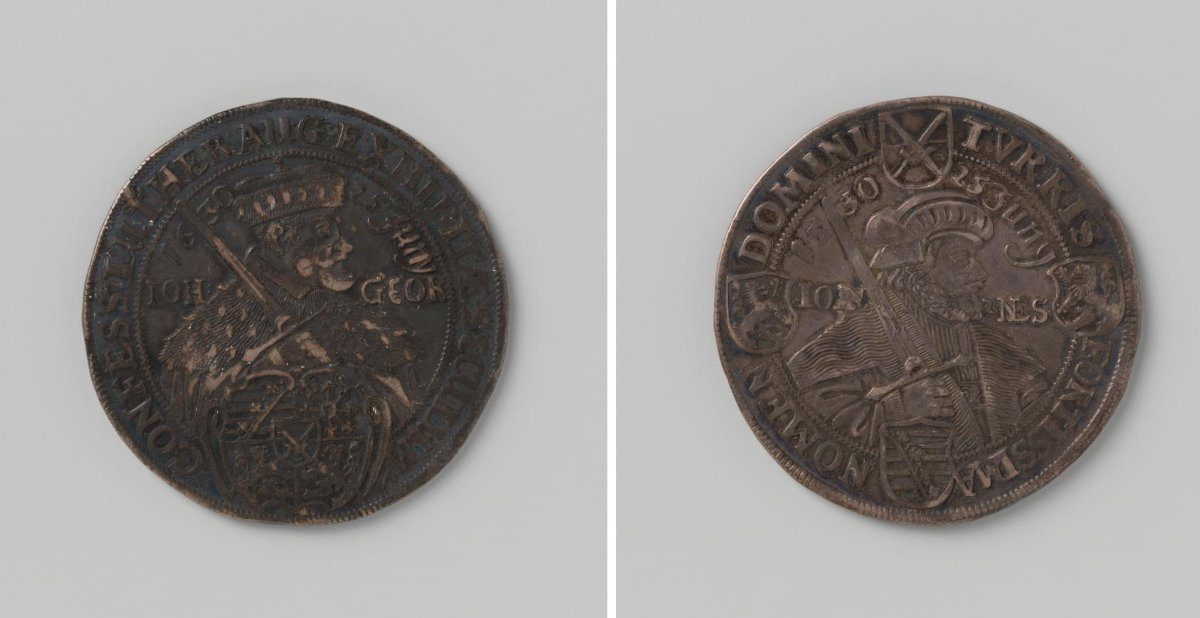
First centenary of the presentation of the Augsburg Confession at the Diet
1630
Obverse: bust of a man with a sword above a coat of arms within an inscription. Reverse: bust of a man within an inscription interrupted by four coats of arms. The Rijksmuseum, Amsterdam, holds this object as NG-VG-1-689; its record gives material recorded as silver (metal); technique striking (metalworking); measur…
Partial type record
Paweł Pokrzywiński via Wikimedia Commons
modern coins
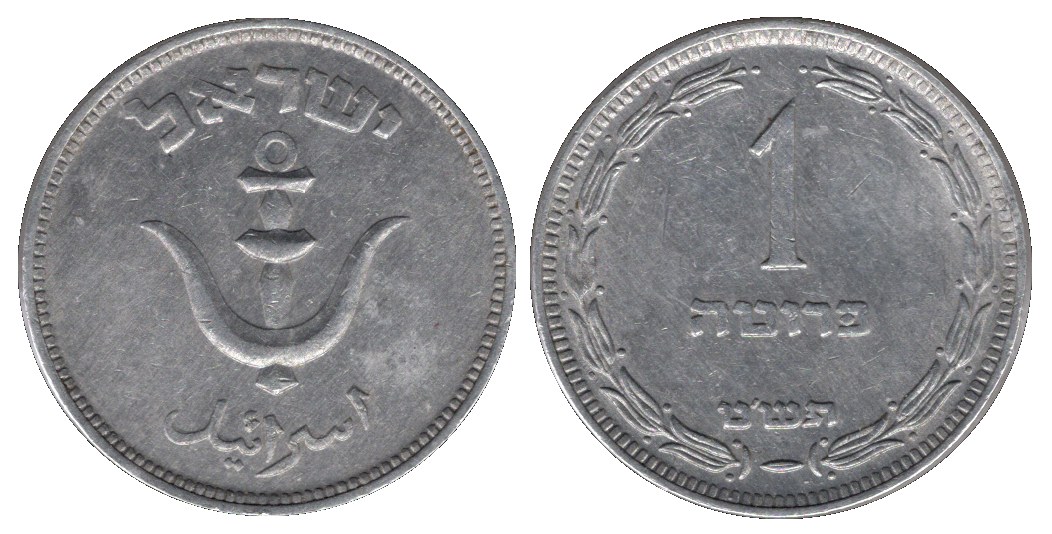
First coinage of the State of Israel
From 1948
The first coinage of the State of Israel encompasses the earliest coins issued by the new state following its independence, beginning with releases in 1949. Struck while the Palestine pound was still circulating before the formal introduction of the Israeli pound in 1952, these coins were the first currency pieces t…
Partial type record
Rijksmuseum, Amsterdam
modern coins
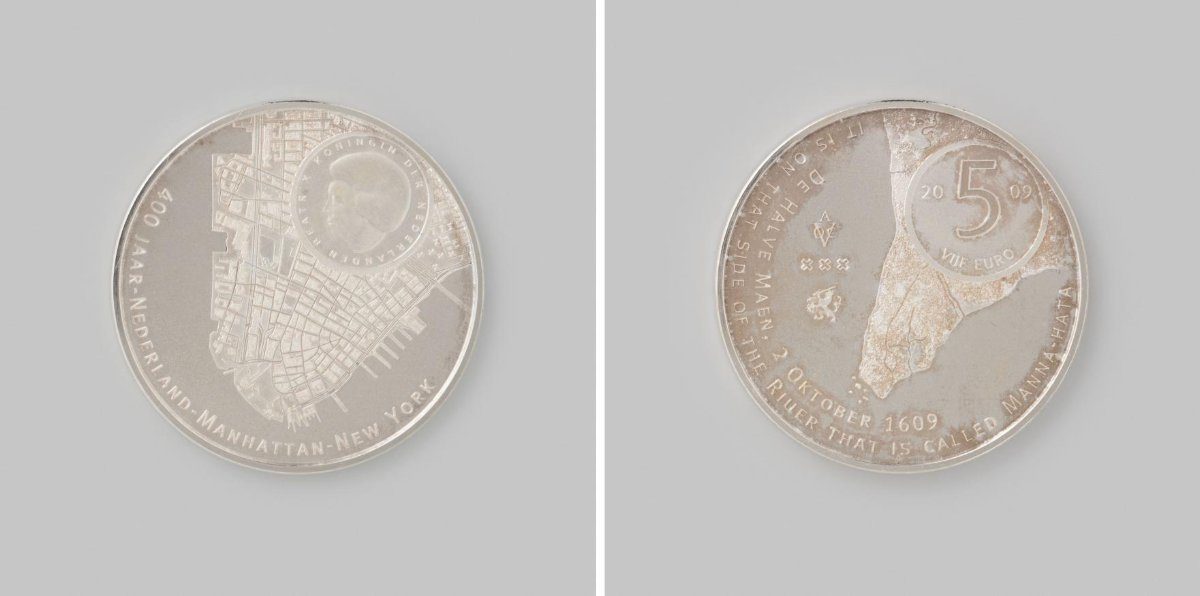
First strike: 400 Years Netherlands-Manhattan
2009
Silver five-euro coin, struck on the occasion of the Hudson Year 2009. Obverse: map of Manhattan, New York, in 2009 with coin-within-a-coin effigy of Queen Beatrix and circumscription. Reverse: map of Manhattan around 1609 with coin-within-a-coin the denomination and circumscription. Edge lettering. Coin set in Pers…
Partial type record
Rijksmuseum, Amsterdam
modern coins
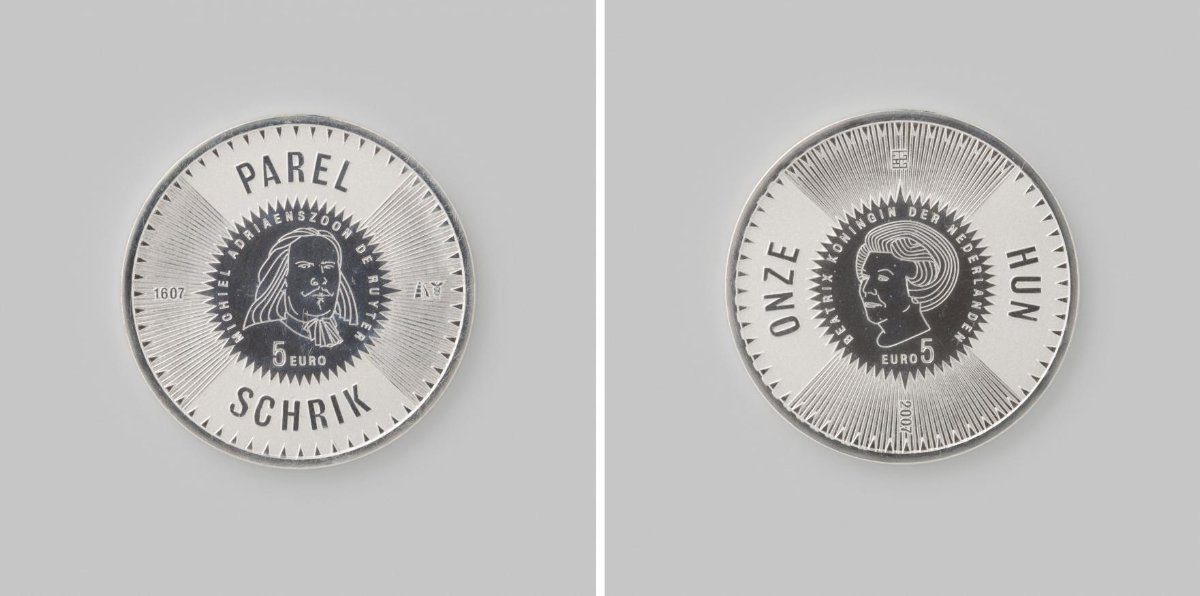
First strike: Michiel de Ruyter Five-Euro Coin
2007 - before 2007-03-24
Silver five-euro coin. Obverse: portrait of Michiel Adriaenszoon de Ruyter turned half right, within inscription, with nominal value and mark and sixty tapering 'teeth or rays'. Reverse: portrait of Queen Beatrix turned left, within inscription, with nominal value and mark and sixty tapering 'teeth or rays'. Edge le…
Partial type record
Rijksmuseum, Amsterdam
modern coins
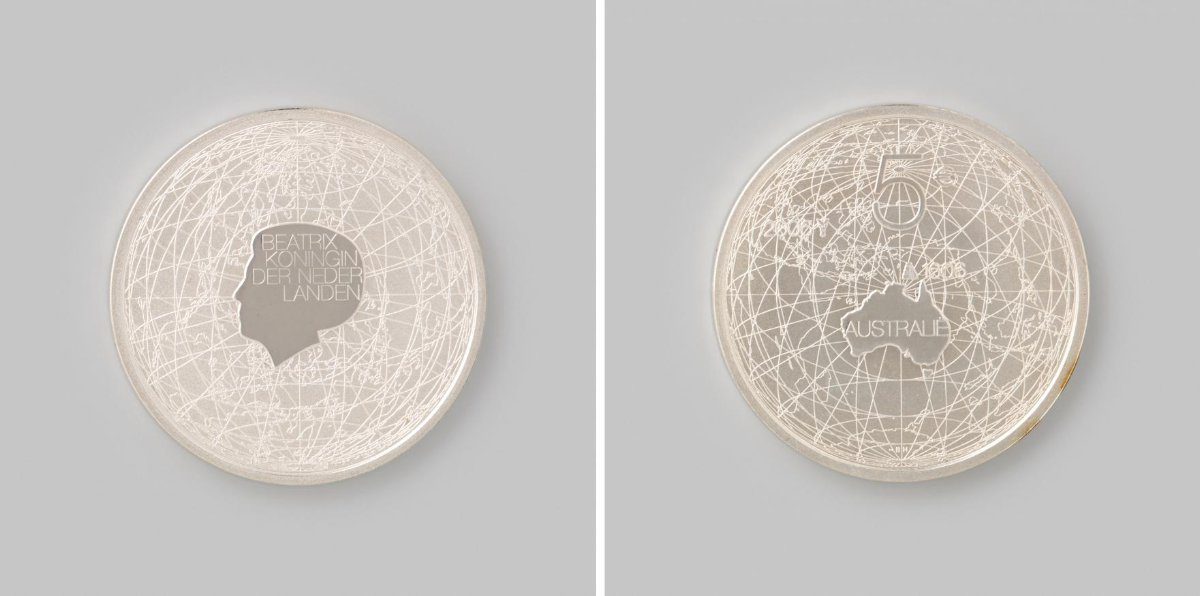
First strike: The Australia Fiver 2006
2005 - before 2006-03-27
Silver five-euro coin. Obverse: flat silhouette of Queen Beatrix facing left, containing inscription, set against an interplay of lines depicting six globes and route lines of the VOC. Reverse: flat stylised Australia with inscription set against the same interplay of lines, with inscription and face value. The Dutc…
Partial type record
Rijksmuseum, Amsterdam
modern coins
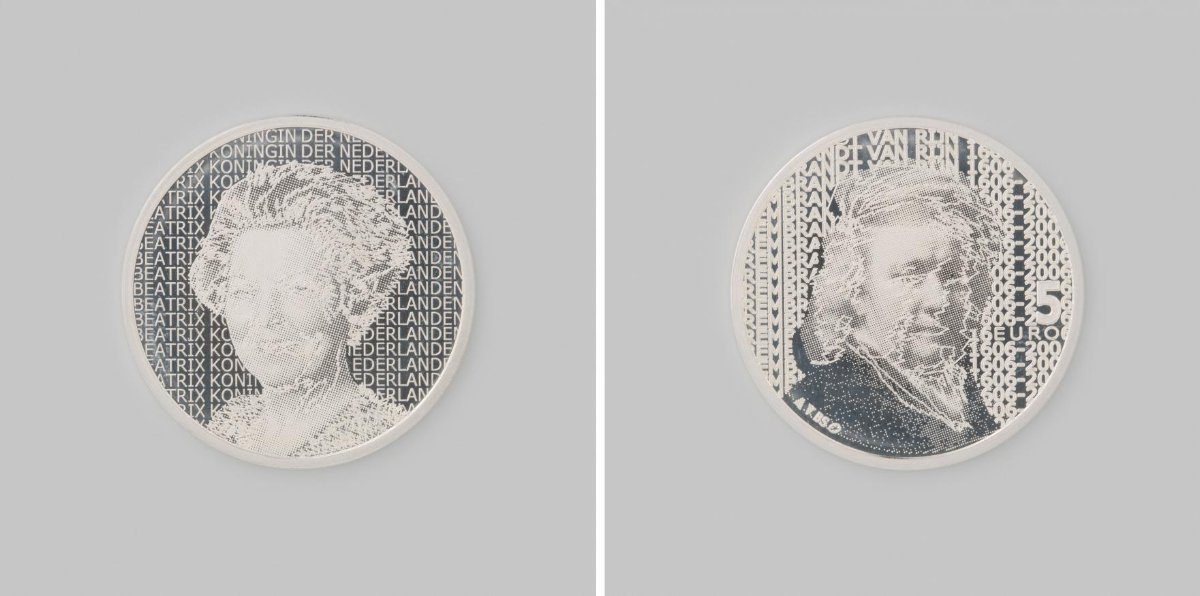
First strike: The Rembrandt Five-Euro Coin
2005 - before 2006-07-07
Silver five-euro coin. Obverse: portrait of Queen Beatrix turned half left, placed on repeated inscription. Reverse: portrait of Rembrandt, placed on repeated inscription, with nominal value and marks. Edge lettering. Various techniques are combined for the portraits: lines of embroidery are modelled on a lasered ph…
Partial type record
Rijksmuseum, Amsterdam
modern coins
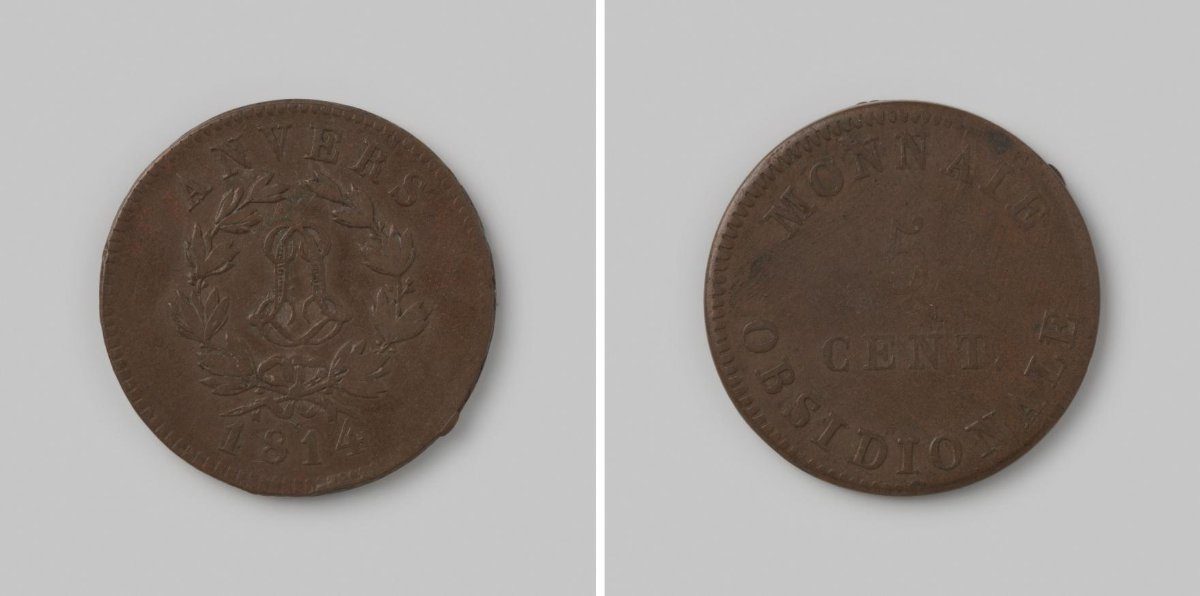
Five centimes, emergency coin from Antwerp in the name of Louis XVIII, 1814
1814
Bronze emergency coin. Obverse: within a wreath of two tied branches, twice the letter L in ligature. At the top, place indication: Anvers and at the bottom the date. Reverse: denomination indication: 5 cent. in two lines. Legend: Monnaie Obsidionale. The Rijksmuseum, Amsterdam, holds this object as KOG-MP-1-2722; i…
Partial type record
Rijksmuseum, Amsterdam
modern coins
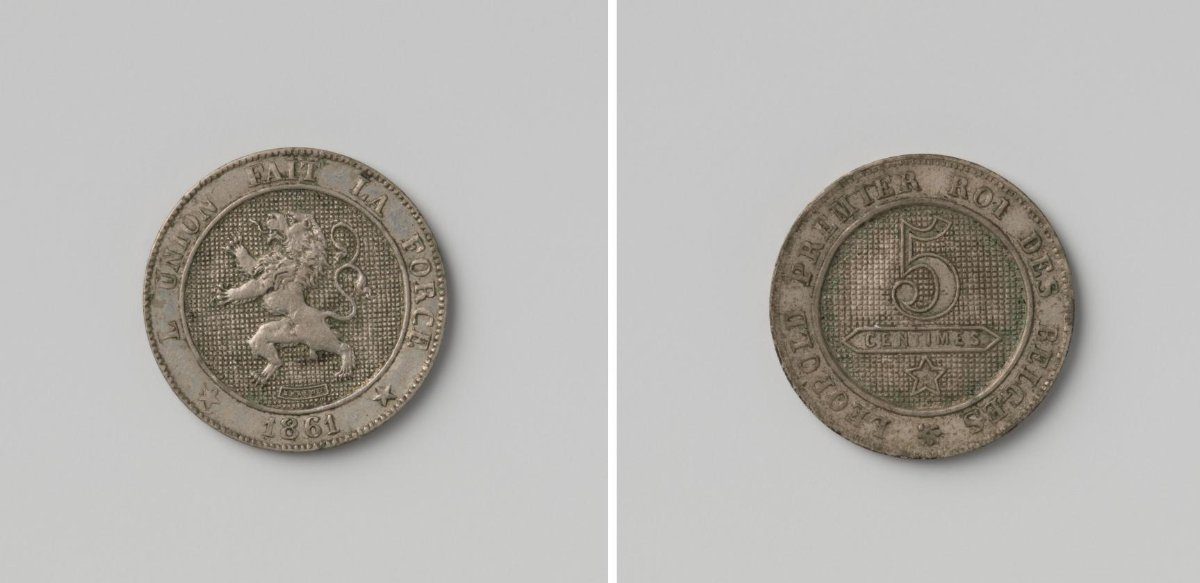
Five cents of Leopold I, King of the Belgians
1861
Obverse: standing lion facing left on a faceted field above a cartouche with signature within an inscription; exergue: inscription and signature. Reverse: digit 5 above cartouche with inscription and five-pointed star within an inscription. The Rijksmuseum, Amsterdam, holds this object as NG-VG-14-11; its record giv…
Partial type record
Rijksmuseum, Amsterdam
modern coins
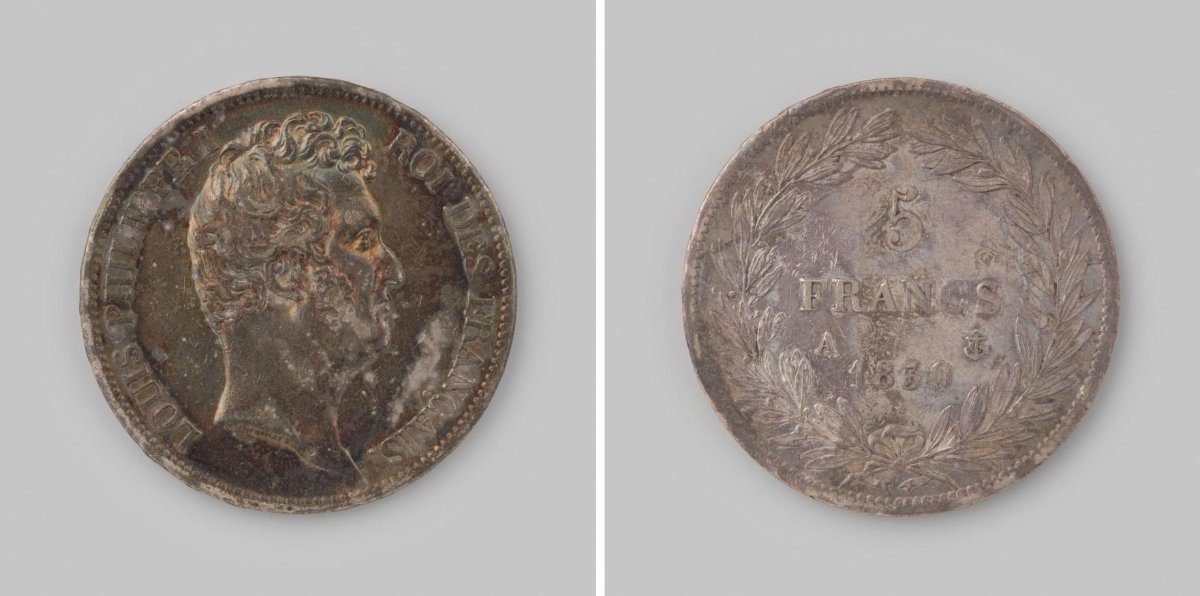
Five francs from the Kingdom of France of Louis Philippe I, 1830
1830
Silver coin. Obverse: head of the king facing right. Legend: "Louis Philippe roi des Francais". Reverse: within two tied laurel branches, denomination in two lines, below which the year. To the left thereof, letter A [=Paris]. Raised edge lettering. The Rijksmuseum, Amsterdam, holds this object as KOG-MP-1-3350A; it…
Partial type record
Rijksmuseum, Amsterdam
modern coins
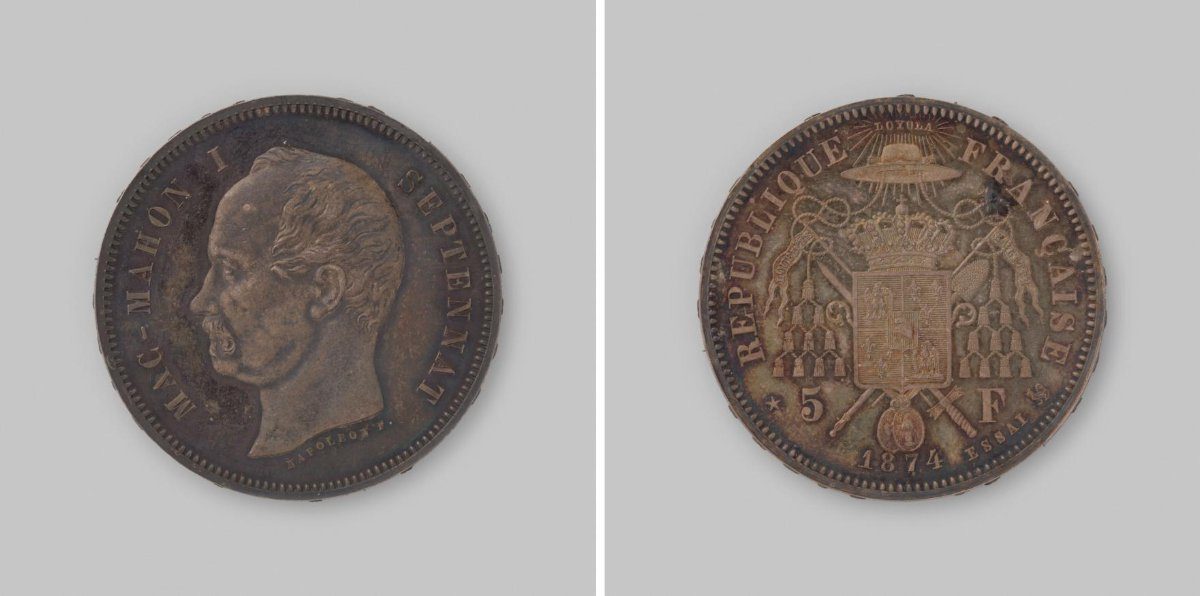
Five francs of Marshal MacMahon, President of the French Republic
1874
Silver medal. Obverse: bust of a man within legend. Reverse: crowned coat of arms beneath cardinal's hat, illuminated by celestial light containing inscription LOYOLA within legend; edge lettering. The Rijksmuseum, Amsterdam, holds this object as NG-VG-1-4297; its record gives material recorded as silver (metal); te…
Partial type record
Rijksmuseum, Amsterdam
modern coins
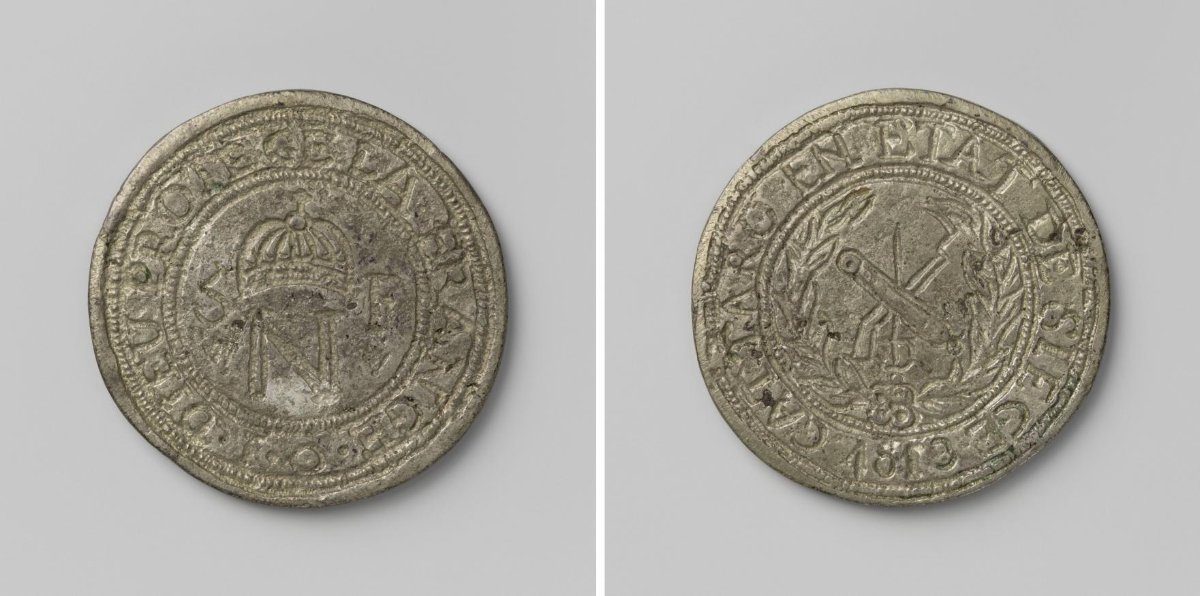
Five francs, emergency coin from Cattaro, struck by the French during the siege
1813
Obverse: crowned letter N between denomination above two exploding grenades within legend. Reverse: sword, cannon and musket within laurel wreath and legend; on edge two marks: letter H and letters PM. The Rijksmuseum, Amsterdam, holds this object as NG-VG-4-543; its record gives material recorded as silver (metal);…
Partial type record
Rijksmuseum, Amsterdam
modern coins
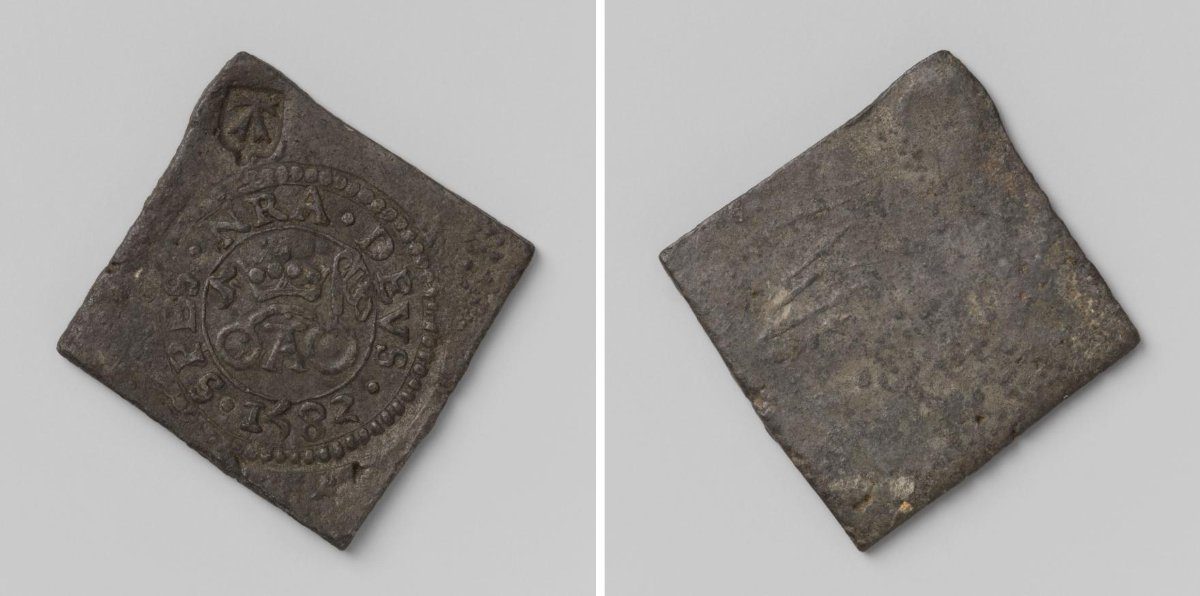
Five groot, siege coin from Oudenaarde struck during the siege
1582-05-30
Uniface, diamond-shaped emergency coin. Obverse: two stamps: countermark: Gothic letter A; below it, a circular stamp: city mark between value indication within an inscription. Reverse: blank. The Rijksmuseum, Amsterdam, holds this object as NG-VG-4-192; its record gives material recorded as tin (metal); technique s…
Partial type record
Cleveland Museum of Art
modern coins
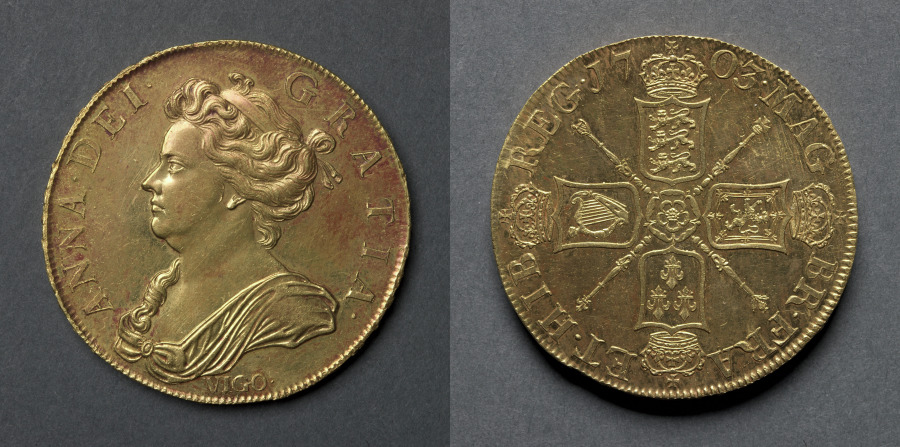
Five Guineas: Anne (obverse); Shields and rose (Cleveland Museum of Art 1969.203)
1703
The coinage during Anne's reign remained fairly constant to the designs inaugurated in 1662. Before the Act of Union with Scotland (1706), the arms of England and Scotland remained separate, as shown. After the act the two arms were conjoined on one shield. The word Vigo denotes that the coins were struck from gold…
Partial type record
Cleveland Museum of Art
modern coins
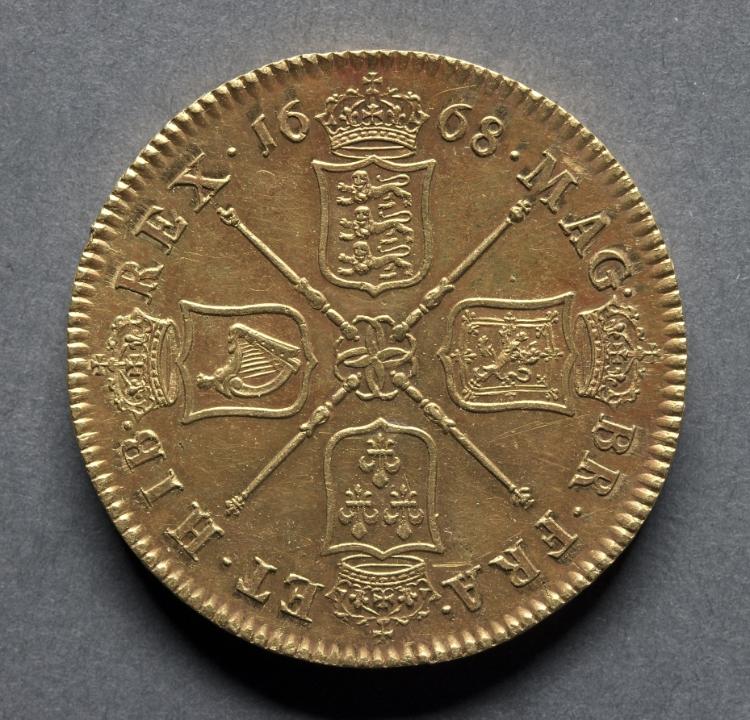
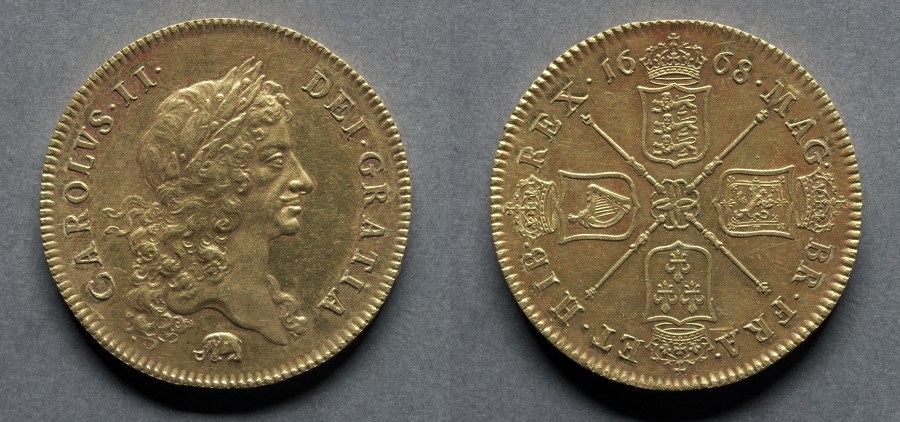
Five Guineas: Charles II (obverse); Four Shields (Cleveland Museum of Art 1969.199)
1668
Once the decision was made to reform the coinage of England, and hammered coinage abandoned, the whole range of money was simplified. The guinea was the unit (like the dollar), and multiples of two and five were struck. One of the reasons for turning to mill coins was the long battle against the clipper (the act of…
Partial type record
Cleveland Museum of Art
modern coins
Five Guineas: Charles II (obverse); Four Shields (reverse)
1668
Five Guineas: Charles II (obverse); Four Shields (reverse) — Coins, by John Roettier (British, 1631–1703), made in England, Charles II, 1660-1685, dated 1668. Once the decision was made to reform the coinage of England, and hammered coinage abandoned, the whole range of money was simplified. The guinea was the unit…
Partial type record
Cleveland Museum of Art
modern coins
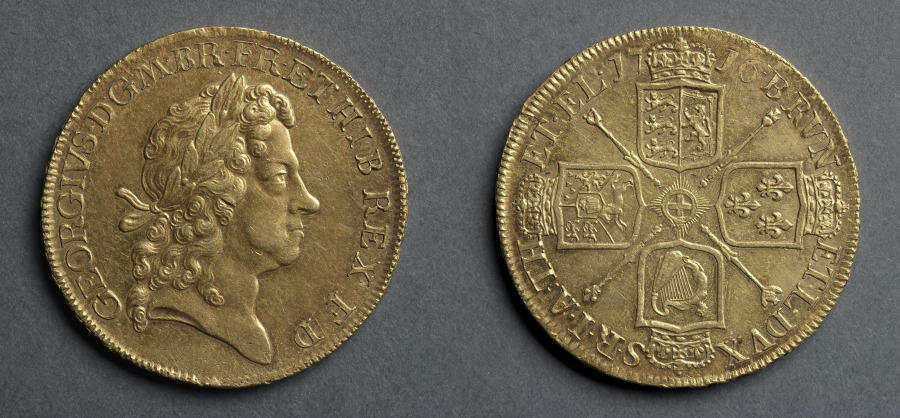
Five Guineas: George I (obverse); Shields and Star of the Order of the Garter (Cleveland Museum of Art 1969.206)
1716
The Act of the Union of 1706 by Queen Anne added the arms of Scotland to those of England. The shields now read as England & Scotland, France, Ireland, and Hanover. Around the shields the many titles of the king are abbreviated to sometimes only one letter: BRVN ET·L·DVX S·I·R·A·TH ET·EL Duke of Brunswick and Lueneb…
Partial type record
Cleveland Museum of Art
modern coins
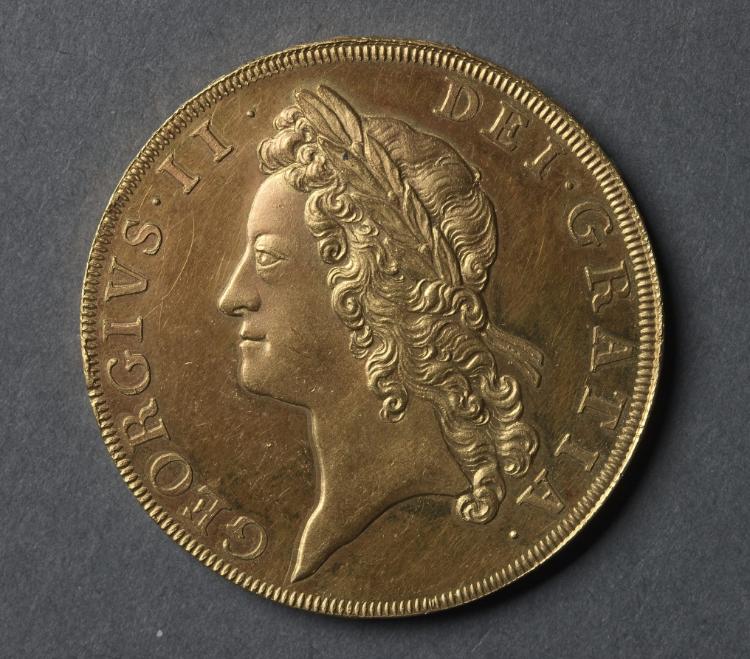
Five Guineas: George II (obverse); Shield of Arms (Cleveland Museum of Art 1969.207)
1731
This coin was probably struck as a proof. Under George II the same denominations of coinage appeared as in previous reigns since the coinage reform of 1662. The elephant, or elephant and castle no longer appear on the obverse. In 1729 the initials E I C appeared below the head on some of the five guineas, and on the…
Partial type record
Cleveland Museum of Art
modern coins
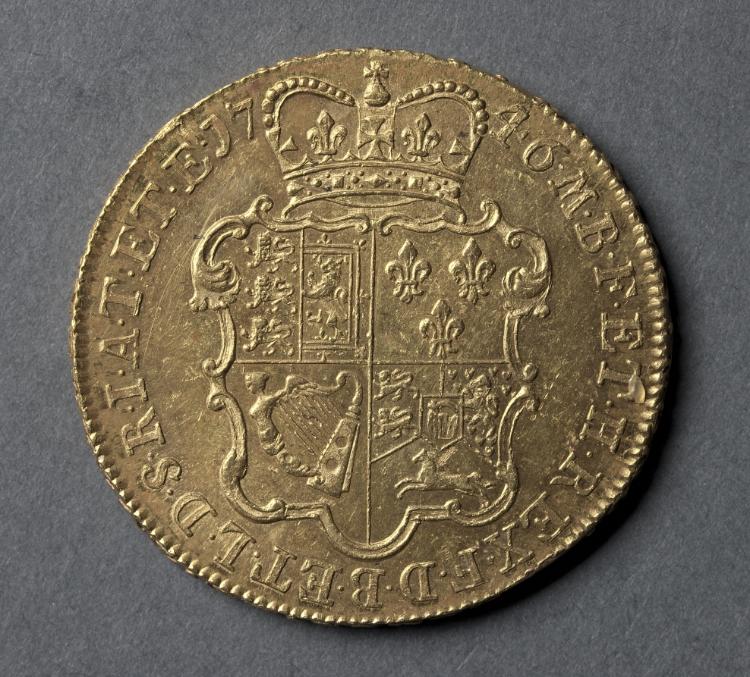
Five Guineas: George II (obverse); Shield of Arms (Cleveland Museum of Art 1969.208)
1746
A new bust now appears on the coinage showing the king as an older man. The word LIMA that appears below the bust on this year only, refers to bullion captured by Admiral Anson from a Spanish plate fleet at Manila during his circumnavigation of the globe (1739–43). It also probably includes bullion supplied by a num…
Partial type record
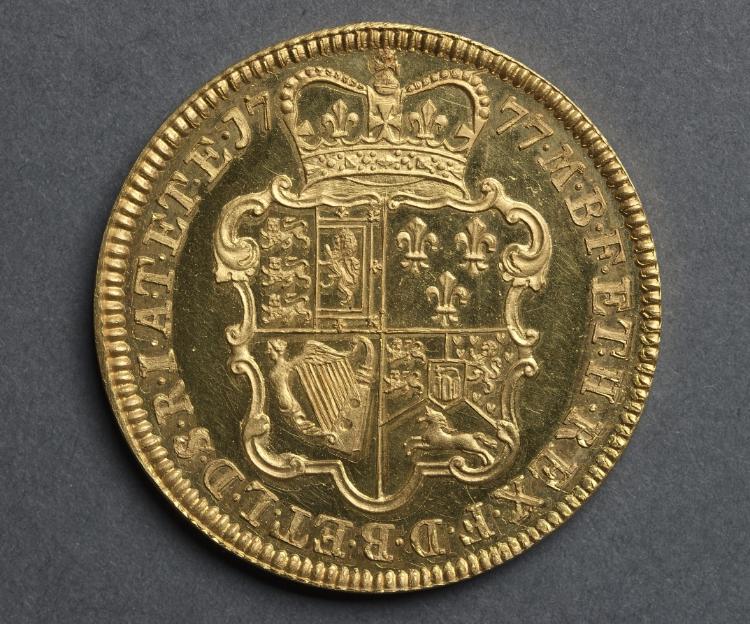
Cleveland Museum of Art
modern coins
Five Guineas: George III (obverse); Shield of Arms (Cleveland Museum of Art 1969.211)
1777
This piece demonstrates the ability of the artist. Richard Yeo was appointed assistant engraver at the Royal Mint in 1749, chief engraver in 1775, and died in 1779. He was responsible for a large number of pattern pieces and for some of the currency coins of the period. Cleveland Museum of Art object 1969.211: Five…
Partial type record

Cleveland Museum of Art
modern coins
Five Guineas: George III (obverse); Shield of Arms (reverse)
1777
Five Guineas: George III (obverse); Shield of Arms (reverse) — Coins, by Richard Yeo (British, 1720–1779), made in England, George III, 1760-1820, dated 1777. This piece demonstrates the ability of the artist. Richard Yeo was appointed assistant engraver at the Royal Mint in 1749, chief engraver in 1775, and died in…
Partial type record
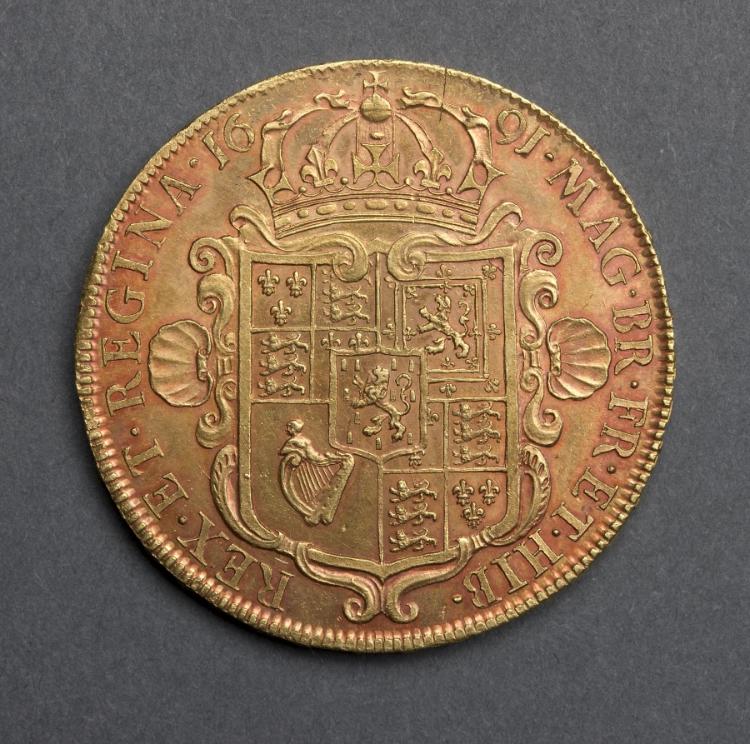
Cleveland Museum of Art
modern coins
Five Guineas: William & Mary (obverse); Crowned Shield of Arms (Cleveland Museum of Art 1969.201)
1691
William of Orange-Nassau, and his wife Mary, daughter of James II, were proclaimed joint monarchs. Thus both their heads appear on their coinage. The only other instance of this in England is in the reign of Philip and Mary, 1554–58. Below them is a small elephant representing Guinea, the origin of the metal. Willia…
Partial type record
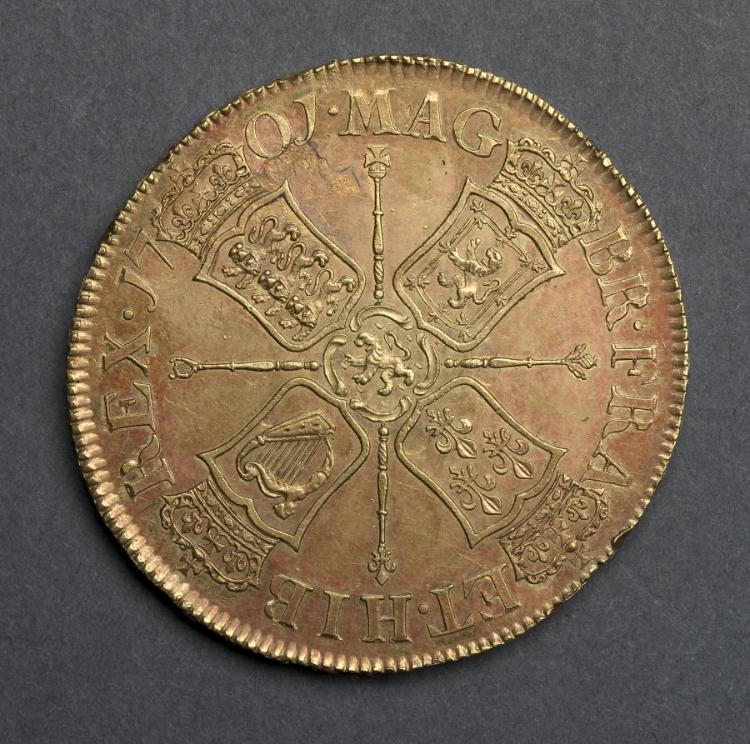
Cleveland Museum of Art
modern coins
Five Guineas: William III (obverse); Four Shields and Lion of Nassau (Cleveland Museum of Art 1969.202)
1701
There were three types used on the five guinea coin of William III, who continued to reign long after the death of Mary. As hammered coinage was still in circulation along with the mill coins, the government decided to call in all the remaining hammered pieces in 1695, completing the reform of the coinage. This affe…
Partial type record
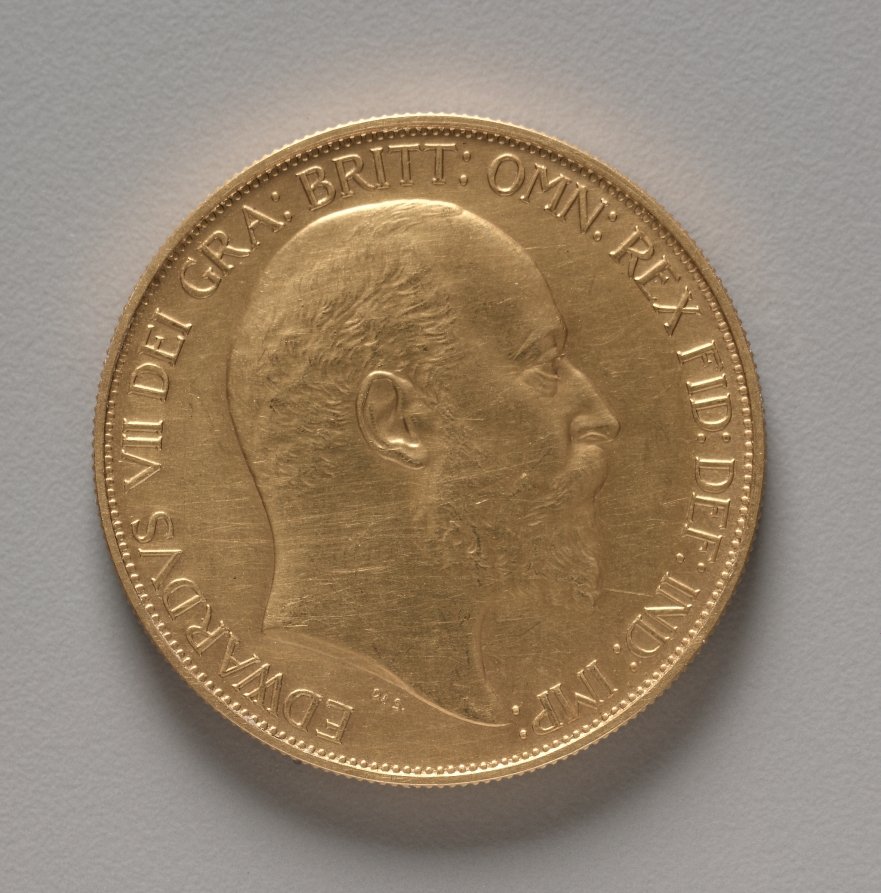
Cleveland Museum of Art
modern coins
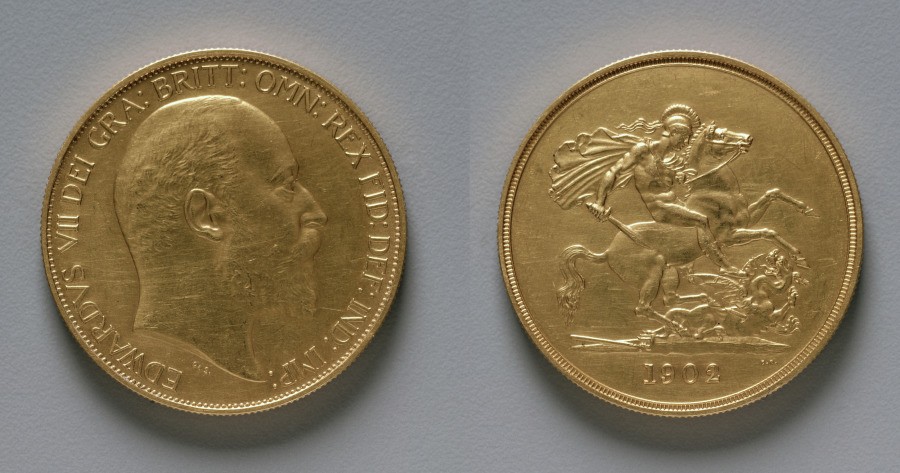
Five Pound Piece: Edward VII (obverse); St. George and the Dragon (Cleveland Museum of Art 1969.221)
1902
Struck for inclusion in the proof commemorative sets of the new coinage of the reign, this piece was unusual in having a frosted or matte surface, produced by the application of acid. Non-proof five-pound pieces were also struck, but not for circulation. George Edward de Saulles was appointed chief engraver at the R…
Partial type record
Cleveland Museum of Art
modern coins
Five Pound Piece: Edward VII (obverse); St. George and the Dragon (reverse)
1902
Five Pound Piece: Edward VII (obverse); St. George and the Dragon (reverse) — Coins, by Benedetto Pistrucci (Italian, 1784–1855); George Edward de Saulles (British), made in England, Edward VII, 1901-1910, dated 1902. Struck for inclusion in the proof commemorative sets of the new coinage of the reign, this piece wa…
Partial type record
Cleveland Museum of Art
modern coins
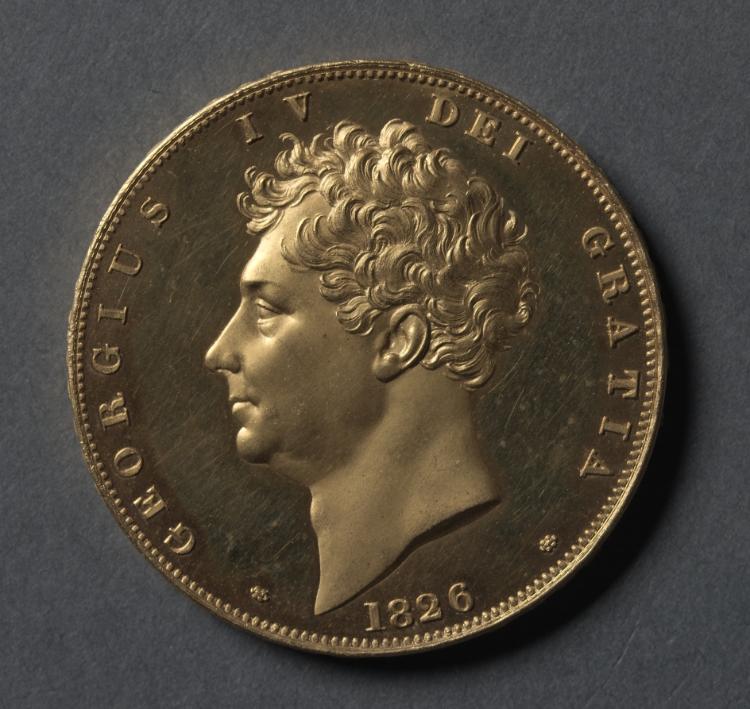
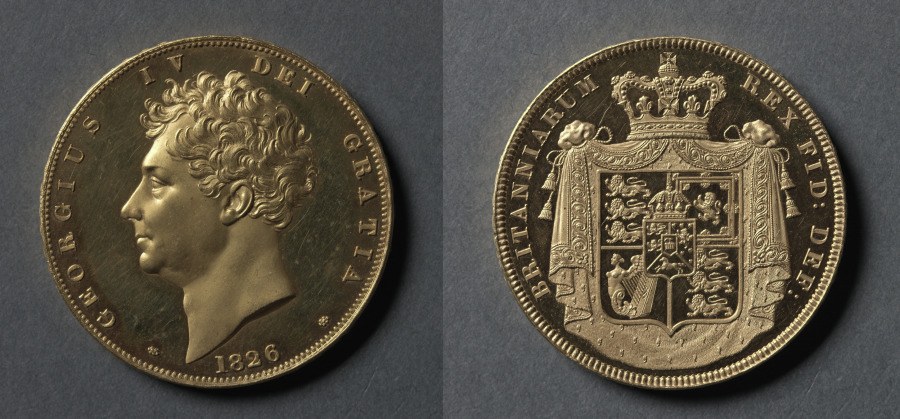
Five Pound Piece: George IV (obverse); Shield of Arms (Cleveland Museum of Art 1969.215)
1826
Only pattern five-pound pieces were struck during the reign of George IV, none being put into circulation. In this reign, specimen proof sets appeared for the first time in 1823, and the pattern five- and two-pound pieces as well as the pattern silver crown were included in the sets. Cleveland Museum of Art object 1…
Partial type record
Cleveland Museum of Art
modern coins
Five Pound Piece: George IV (obverse); Shield of Arms (reverse)
1826
Five Pound Piece: George IV (obverse); Shield of Arms (reverse) — Coins, by Jean Baptiste Merlen (French, 1769–1850), made in England, George IV, 1820-1830, dated 1826. Only pattern five-pound pieces were struck during the reign of George IV, none being put into circulation. In this reign, specimen proof sets appear…
Partial type record
Cleveland Museum of Art
modern coins
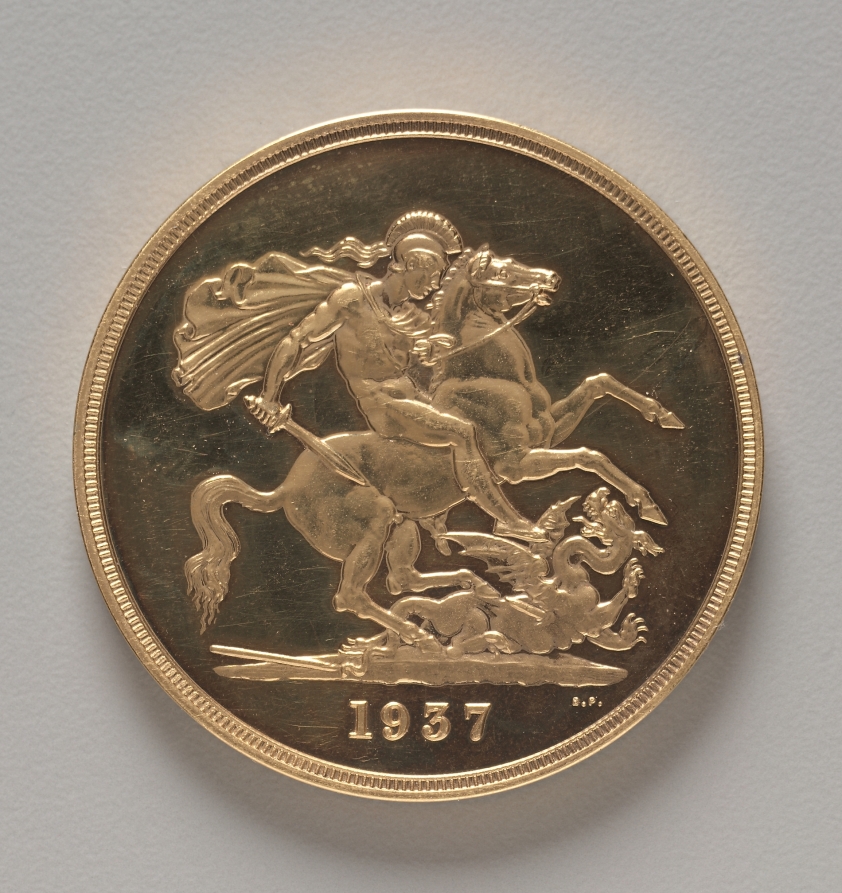
Five Pound Piece: St. George and the Dragon (Cleveland Museum of Art 1969.223)
1937
The of King George VI, shown uncrowned, was designed by Thomas Humphrey Paget, a medal and coin designer who worked for the Royal Mint. The reverse image of St. George and the Dragon was designed by Benedetto Pistrucci, an Italian gem and coin engraver whose work is still used on coinage today. Cleveland Museum of A…
Partial type record
Cleveland Museum of Art
modern coins
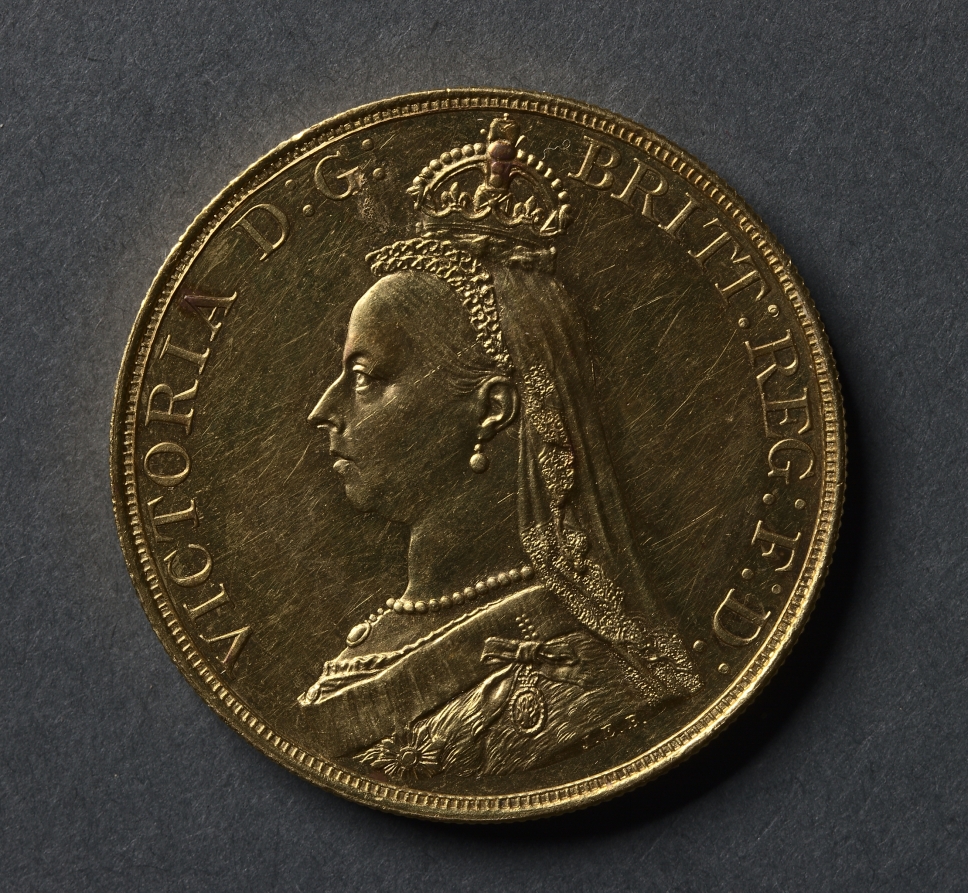
Five Pound Piece: Victoria (obverse); St. George and the Dragon (Cleveland Museum of Art 1969.219)
1887
The obverse design of this piece is usually known as the "Jubilee head," since 1887, the year of its production, was the Golden Jubilee of Queen Victoria. By Sir Joseph Boehm, R.A., sculptor in ordinary to the queen, it caused a minor storm since it was said the tiny crown made the queen look ridiculous. The queen i…
Partial type record
Cleveland Museum of Art
modern coins
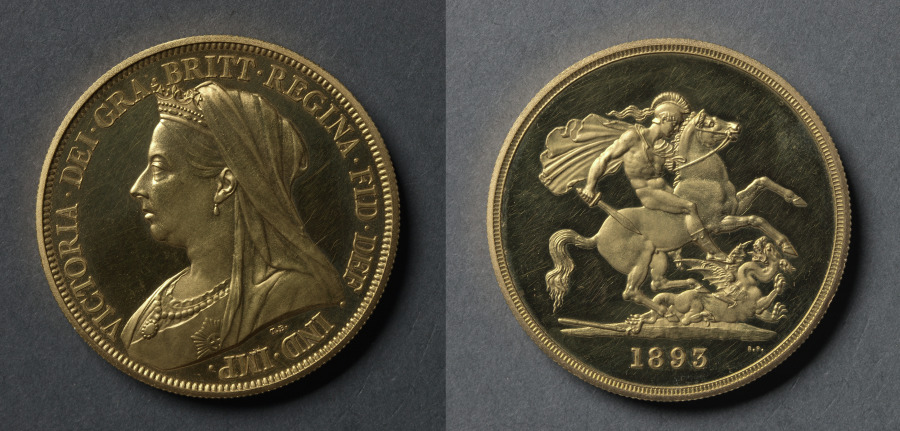
Five Pound Piece: Victoria (obverse); St. George and the Dragon (Cleveland Museum of Art 1969.220)
1893
After the minor storm of dislike which blew up over the 1887 Jubilee design, Thomas Brock, R.A., designed a new obverse, usually known as the "old head" type. Cleveland Museum of Art object 1969.220: Five Pound Piece: Victoria (obverse); St. George and the Dragon (reverse), 1893. Design by after Benedetto Pistrucci…
Partial type record
Cleveland Museum of Art
modern coins
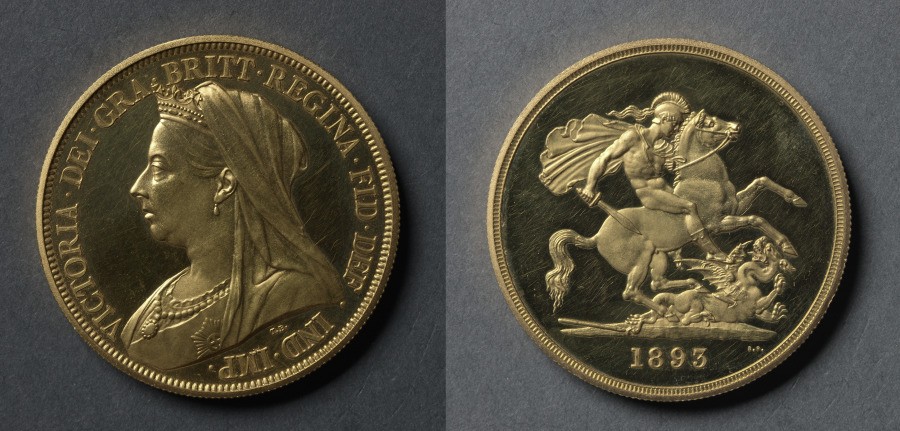
Five Pound Piece: Victoria (obverse); St. George and the Dragon (reverse)
1893
Five Pound Piece: Victoria (obverse); St. George and the Dragon (reverse) — Coins, by Benedetto Pistrucci (Italian, 1784–1855); Thomas Brock (British, 1847–1922), made in England, Victoria, 1837-1901, dated 1893. After the minor storm of dislike which blew up over the 1887 Jubilee design, Thomas Brock, R.A., designe…
Partial type record
Cleveland Museum of Art
modern coins
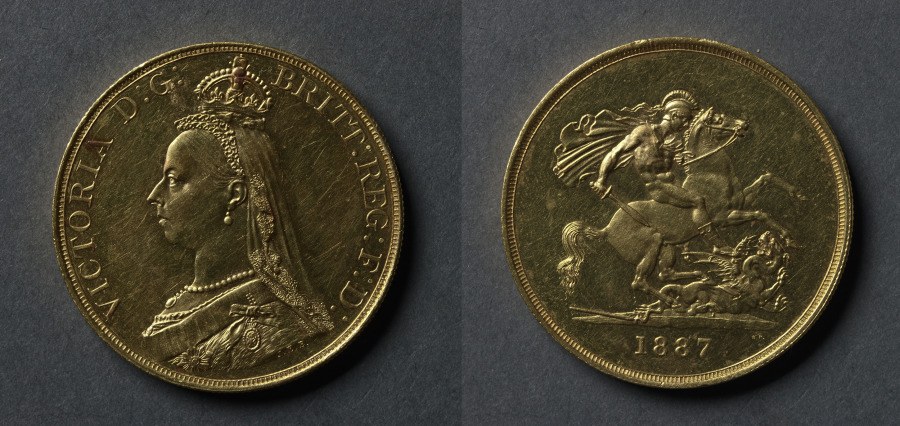
Five Pound Piece: Victoria (obverse); St. George and the Dragon (reverse)
1887
Five Pound Piece: Victoria (obverse); St. George and the Dragon (reverse) — Coins, by Benedetto Pistrucci (Italian, 1784–1855); Joseph Boehm (British, 1834–1890), made in England, Victoria, 1837-1901, dated 1887. The obverse design of this piece is usually known as the "Jubilee head," since 1887, the year of its pro…
Partial type record
Cleveland Museum of Art
modern coins
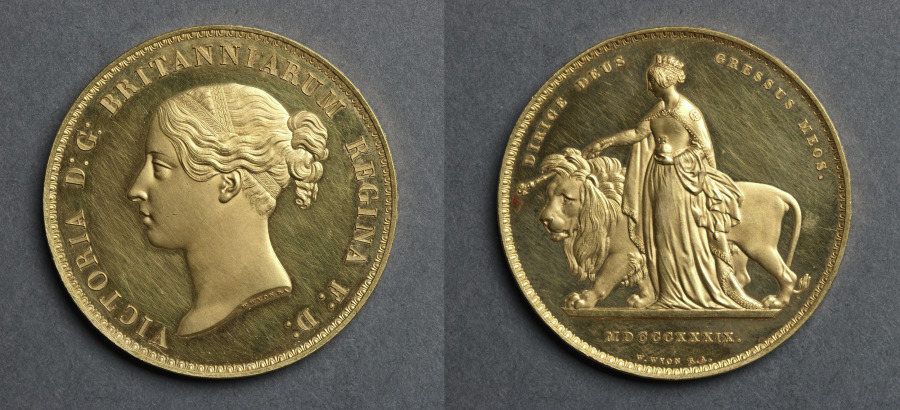
Five Pound Piece: Victoria (obverse); Una (Cleveland Museum of Art 1969.217)
1839
This piece was struck by the Royal Mint from gold purchased for the purpose. The current gold coins, such as the sovereign, were struck from gold supplied by the Bank of England. The larger gold pieces have their origins in the five and two guinea pieces. There are several minor varieties of this piece, designed by…
Partial type record
Cleveland Museum of Art
modern coins
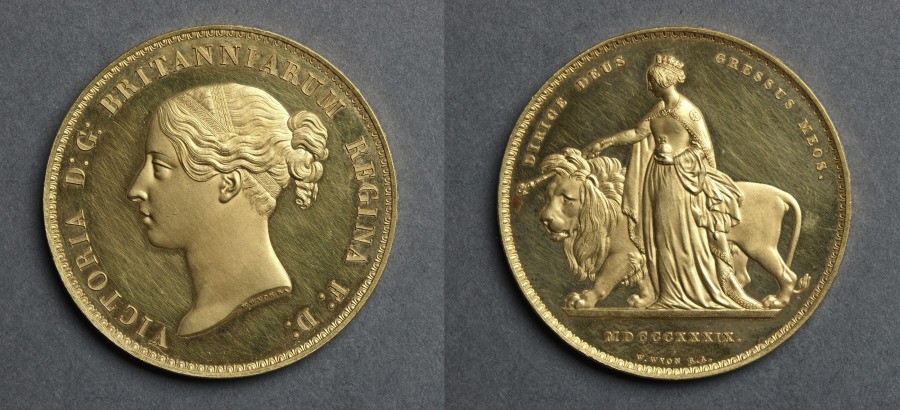
Five Pound Piece: Victoria (obverse); Una (reverse)
1839
Five Pound Piece: Victoria (obverse); Una (reverse) — Coins, by William Wyon (British, 1795–1851), made in England, Victoria, 1837-1901, dated 1839. This piece was struck by the Royal Mint from gold purchased for the purpose. The current gold coins, such as the sovereign, were struck from gold supplied by the Bank o…
Partial type record
Rijksmuseum, Amsterdam
modern coins
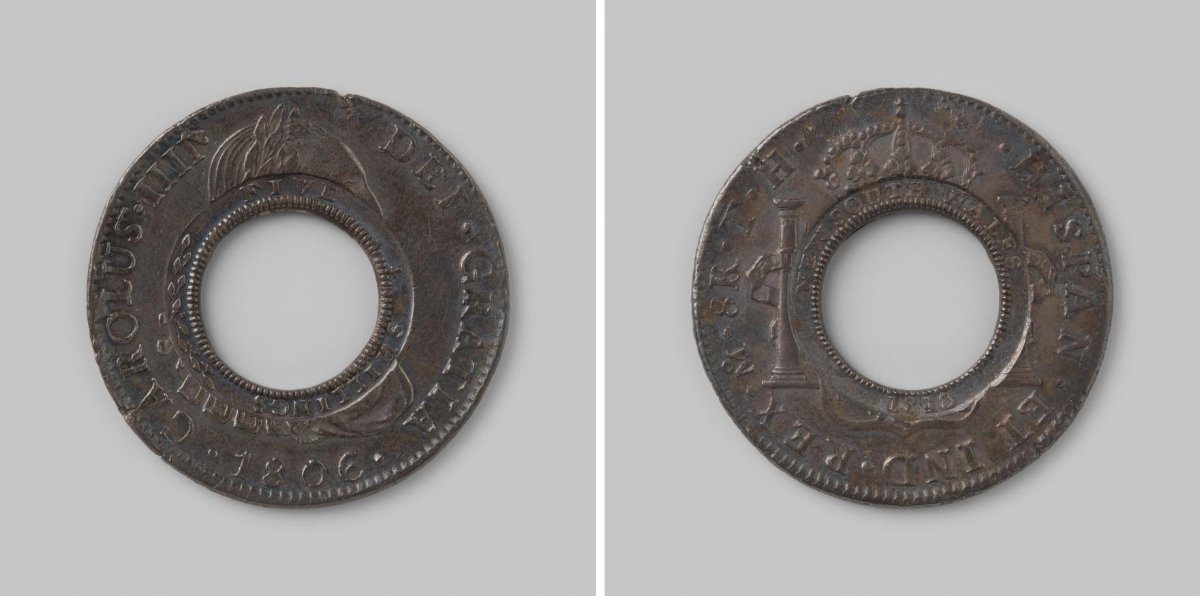
Five shillings from New South Wales, Australia, 1813
1813
Silver coin with a large round hole in the centre. Obverse: laureate head of the Spanish King Charles IV. Below, date: 1806. Around the hole, value designation: five shillings. Reverse: between two pillars with a scroll bearing a motto, crowned composite coat of arms of Spain. In legend, mint mark: Mo [=Mexico City]…
Partial type record
Rijksmuseum, Amsterdam
modern coins
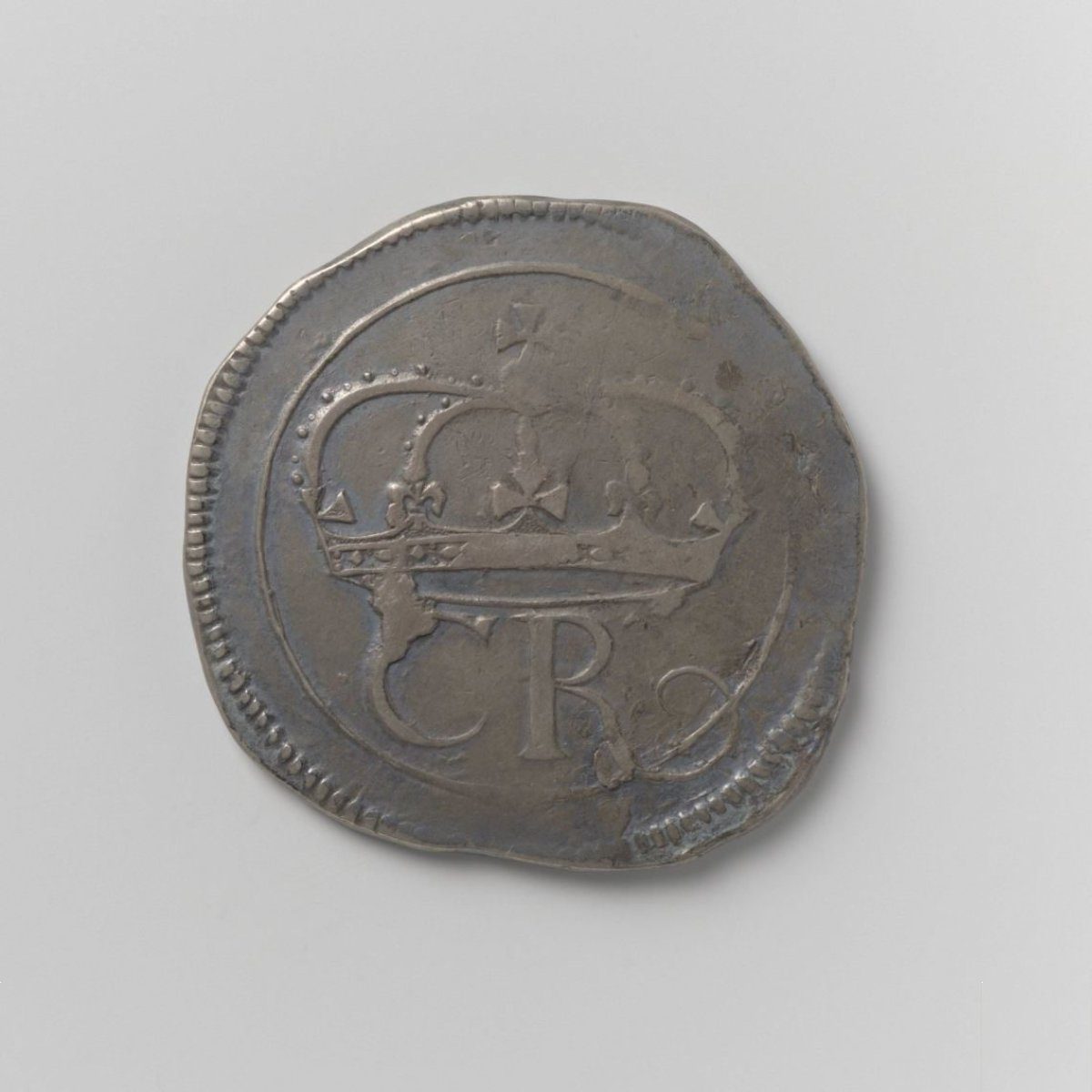
Five shillings, emergency coin of Charles I, King of England, struck in Ormonde from silver provided by the inhabitants
1643
Nearly round silver emergency coin. Obverse: crown above the letters C and R within a beaded rim. Reverse: value indication (five shillings): Roman numeral V beneath the letter S within a beaded rim. Crown. The Rijksmuseum, Amsterdam, holds this object as NG-VG-4-300; its record gives material recorded as silver (me…
Partial type record
Rijksmuseum, Amsterdam
modern coins
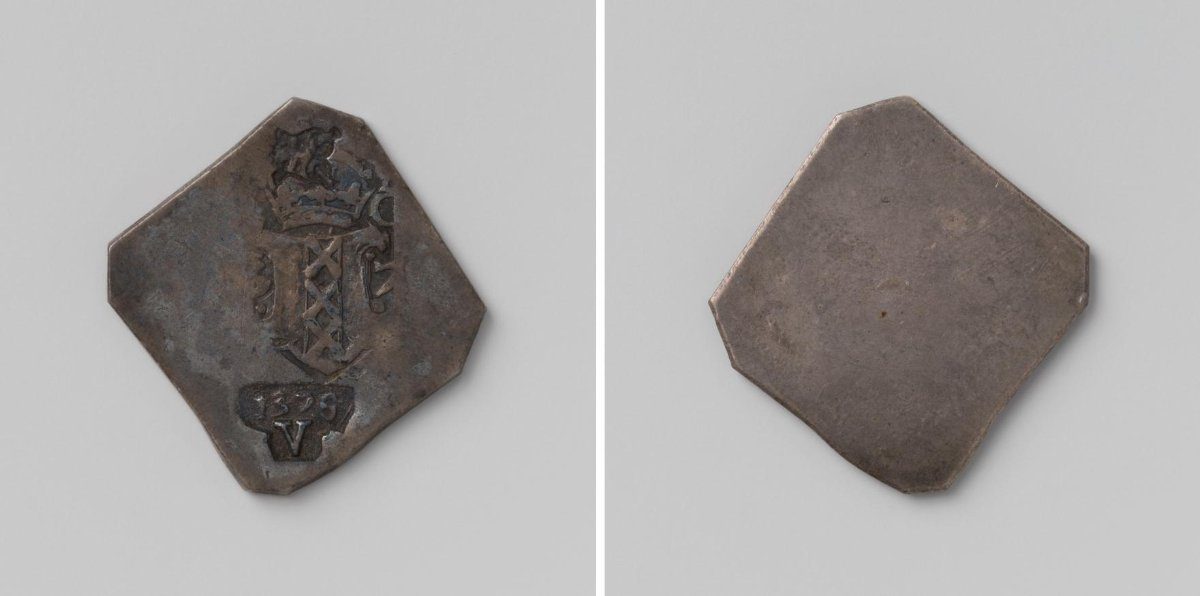
Five stuivers, emergency coin from Amsterdam, struck after the siege
1578 - 1631
Uniface, diamond-shaped emergency coin with bevelled corners. Obverse: three stamps; from bottom to top: mint master's mark: firesteel, partially struck over second stamp: city coat of arms: crowned escutcheon, to the left part of the digit 5 still visible, to the right of 7 visible, to the right of crown: digit 0 v…
Partial type record
Rijksmuseum, Amsterdam
modern coins
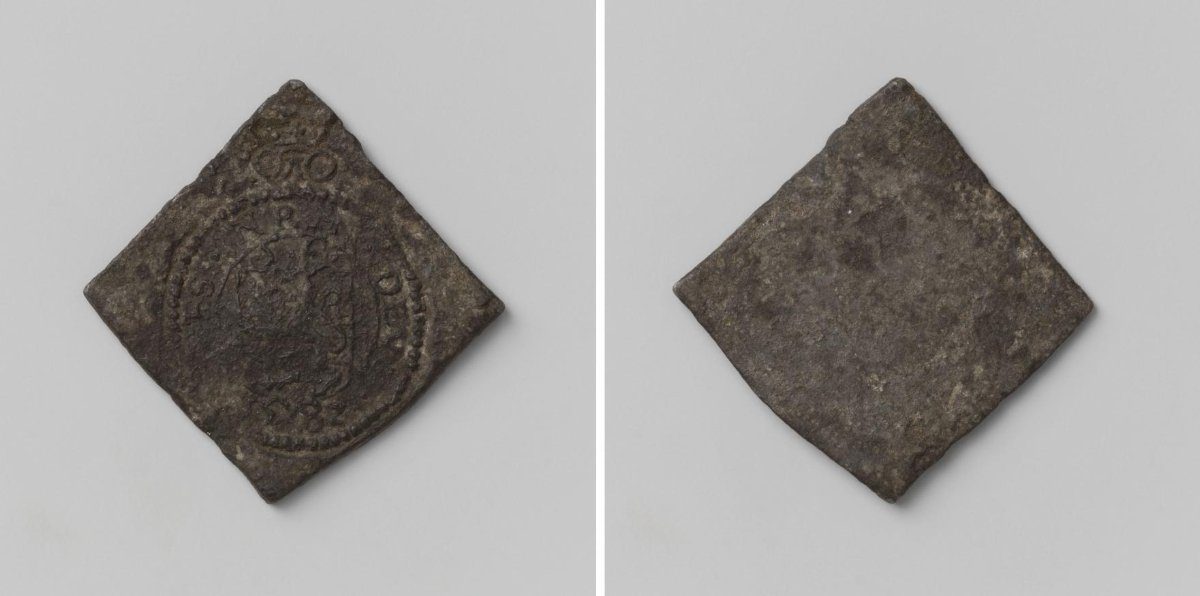
Five stuivers, emergency coin from Oudenaarde struck during the siege
1582-05-30
Uniface, diamond-shaped emergency coin. Obverse: two stamps: countermark: town mark; below it a round stamp: coat of arms beneath denomination within circumscription. Reverse: blank. The Rijksmuseum, Amsterdam, holds this object as NG-VG-4-190; its record gives material recorded as tin (metal); technique striking (m…
Partial type record
Rijksmuseum, Amsterdam
modern coins
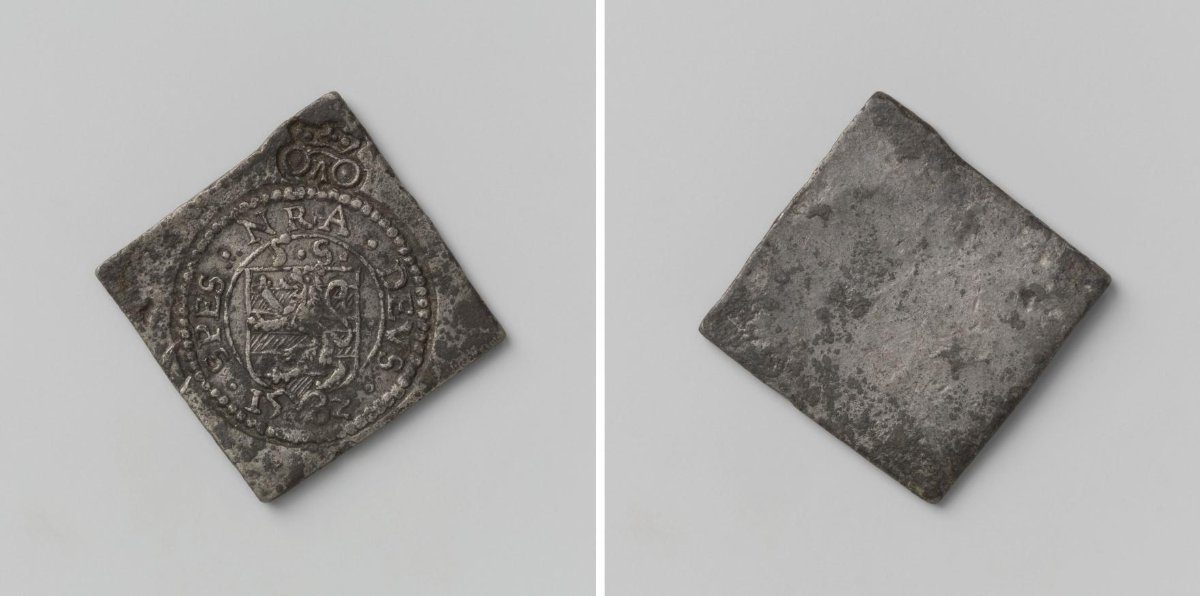
Five stuivers, emergency coin from Oudenaarde, struck during the siege
1582-05-30
Uniface, diamond-shaped emergency coin. Obverse: two stamps: countermark: town mark; below it round stamp: escutcheon below value indication within legend. Reverse: blank. The Rijksmuseum, Amsterdam, holds this object as NG-VG-4-189; its record gives material recorded as tin (metal); technique striking (metalworking…
Partial type record
Rijksmuseum, Amsterdam
modern coins
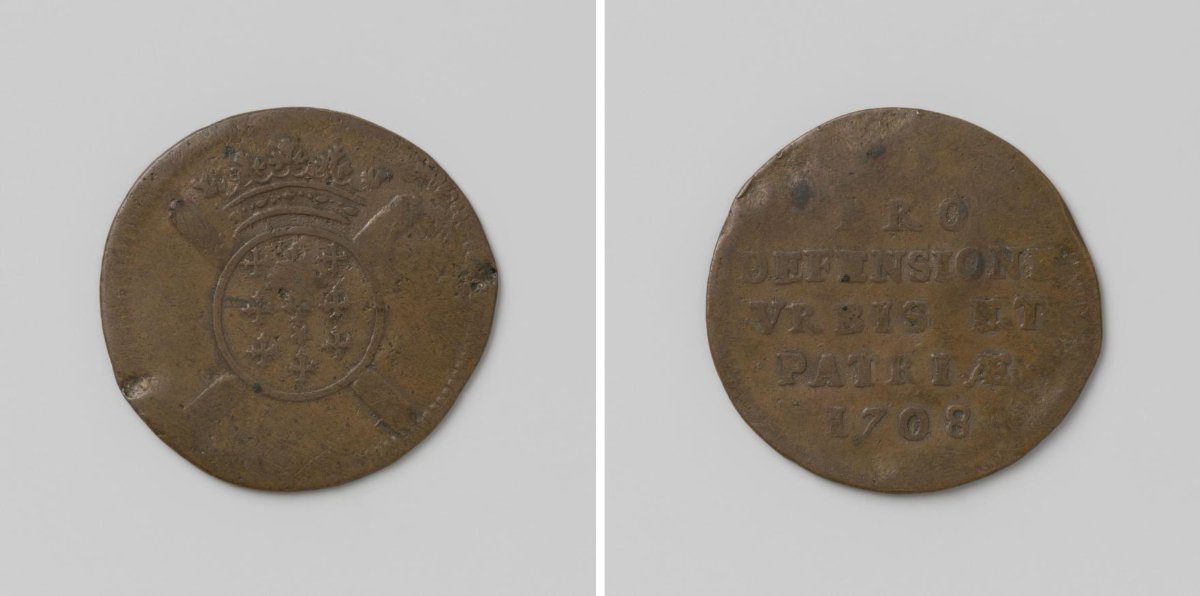
Five stuivers, emergency coin of Lille, captured by the Allies
1708
Obverse: crowned coat of arms on two crossed marshal's batons. Reverse: inscription. The Rijksmuseum, Amsterdam, holds this object as NG-VG-4-449; its record gives material recorded as copper (metal); technique striking (metalworking); measurements diameter 2.1 cm x weight 1.96 g.
Partial type record
Rijksmuseum, Amsterdam
modern coins
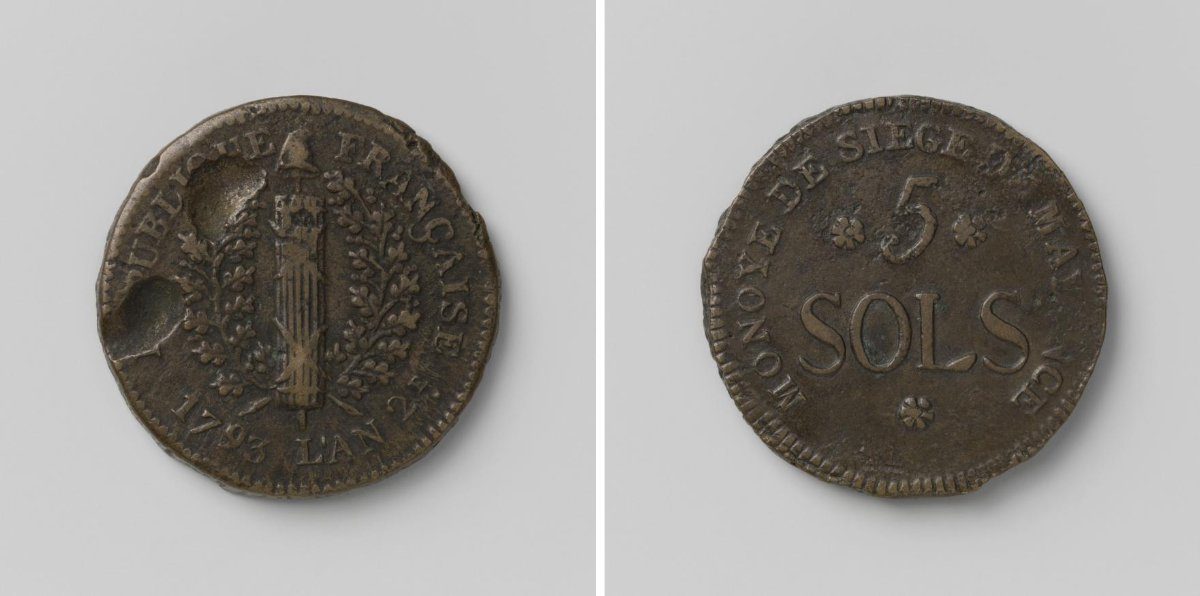
Five stuivers, emergency coin of Mainz, struck during the siege by the Allies
1793
Obverse: fasces with axe, surmounted by a liberty cap within an oak wreath and inscription. Reverse: denomination indication within an inscription. The Rijksmuseum, Amsterdam, holds this object as NG-VG-4-500; its record gives material recorded as copper (metal); technique striking (metalworking); measurements diame…
Partial type record
Rijksmuseum, Amsterdam
modern coins
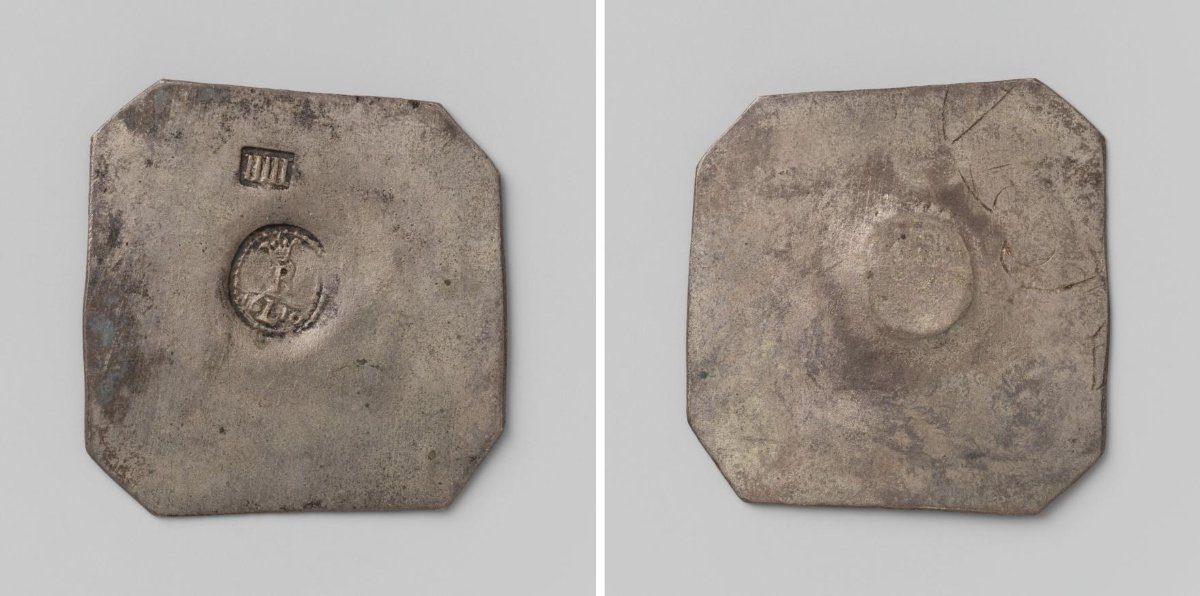
Five units, emergency coin from Jülich, struck during the siege by Maurice, Prince of Orange-Nassau, made by cutting a piece from a plate or bowl and stamped with the monogram of Rudolf II, Holy Roman Emperor
1610-07-29 - 1610-09-02
Irregular, more or less square, uniface silver emergency coin with bevelled corners. Obverse: two stamps: top: value indication Roman numeral IIIII in rectangle; right: crowned letter R; below it year, interrupted by letter L within round beaded border. Reverse: blank. The Rijksmuseum, Amsterdam, holds this object a…
Partial type record
Rijksmuseum, Amsterdam
modern coins
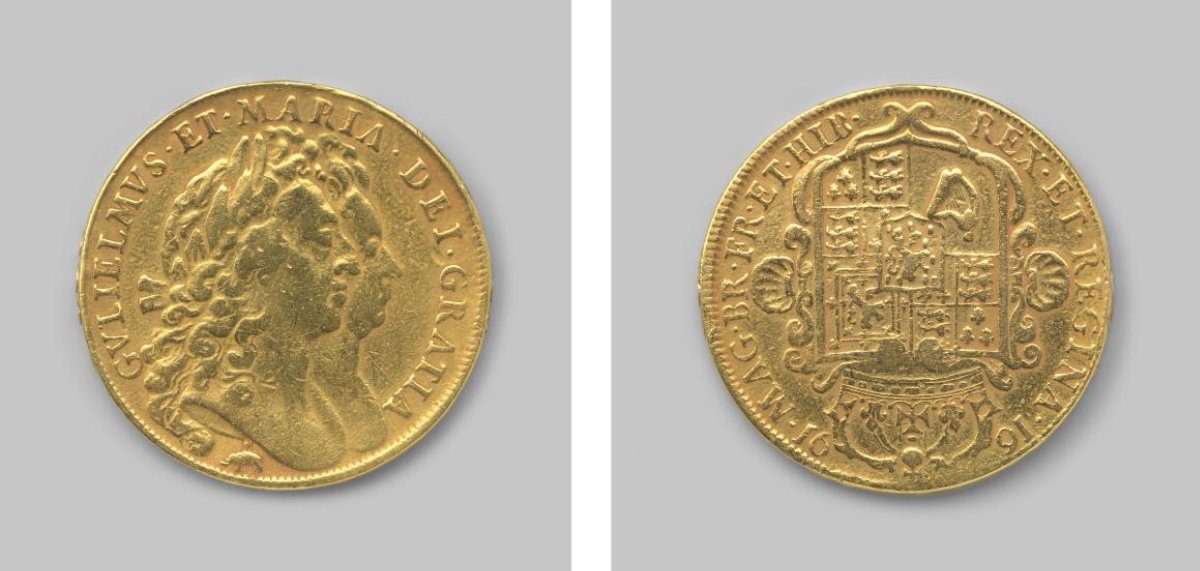
Five-guinea coin from Great Britain with the busts of King-Stadtholder William III and Mary
1691
Gold five-guinea coin from the United Kingdom, with the busts of William & Mary, from 1691, with the mark 'elephant & castle', referring to the Royal African Company, which held the trade monopoly on the West African coast, and to the provenance of the gold mined in West Africa. The Rijksmuseum, Amsterdam, holds thi…
Partial type record
Rijksmuseum, Amsterdam
modern coins
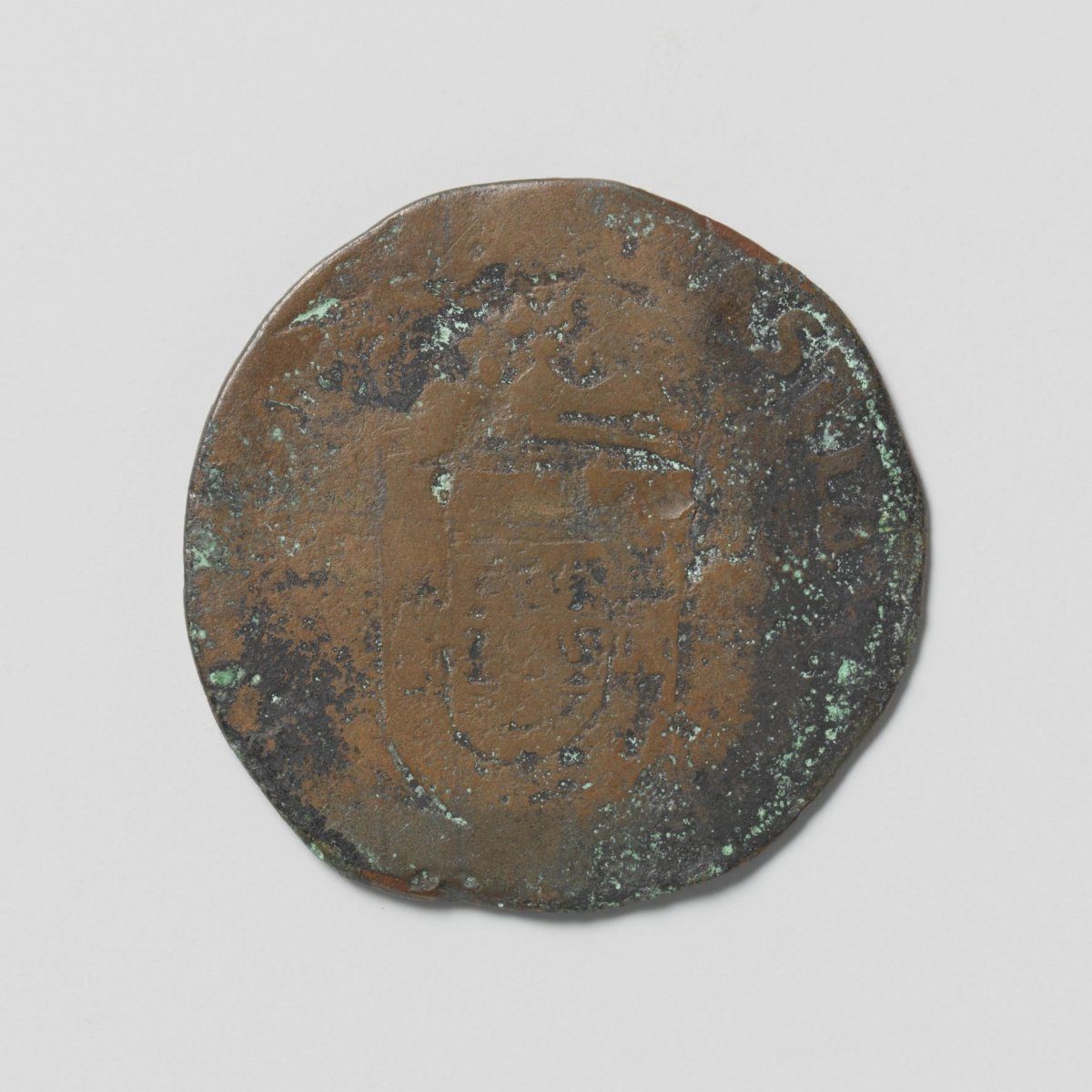
Five-reis piece, Portuguese coin or duit valued at five reis
c. 1590 - c. 1596
Both sides, struck: Coat of arms of Portugal and remainder of text: "bastian". The Rijksmuseum, Amsterdam, holds this object as NG-NM-7747-5; its record gives material recorded as copper (metal); technique striking (metalworking); measurements diameter 3 cm.
Partial type record
Rijksmuseum, Amsterdam
modern coins
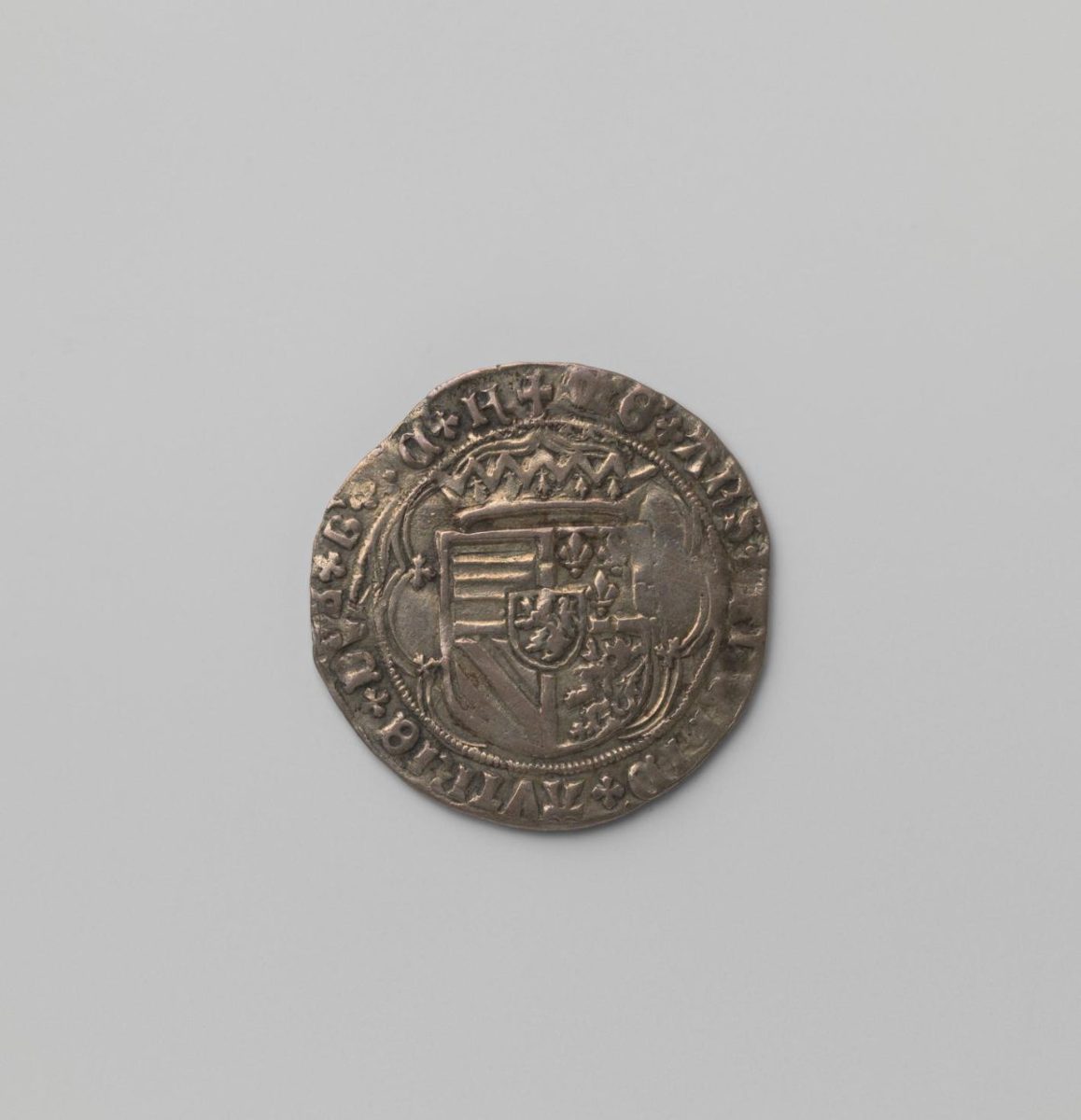
Flanders, Charles V (minor), double stuiver
1506 - 1515
Silver coin. Obverse: crowned composite coat of arms of Burgundy within a polylobe. Reverse: short flowered cross, with a lily in the heart. The Rijksmuseum, Amsterdam, holds this object as KOG-MP-1-2390C; its record gives material recorded as silver (metal); technique striking (metalworking); measurements diameter…
Partial type record
Suffolk County Council, Riccardo Caravello, 2019-11-08 12:44:26 via Wikimedia Commons
modern coins
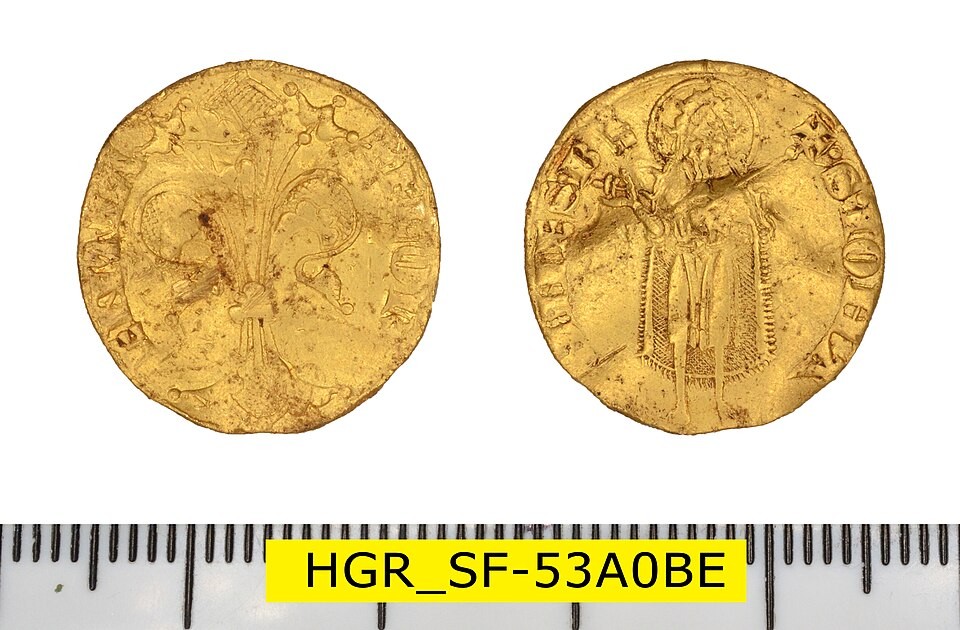
Florentine gold florin
from 1252
The Florentine gold florin, or fiorino d'oro, was a gold coin introduced by the Republic of Florence in 1252. Minted following the disruption of Byzantine gold coinage in the wake of the Fourth Crusade, it became Western Europe's first standard gold coin. Florence struck the florin continuously until 1533 without su…
Partial type record
Rijksmuseum, Amsterdam
modern coins
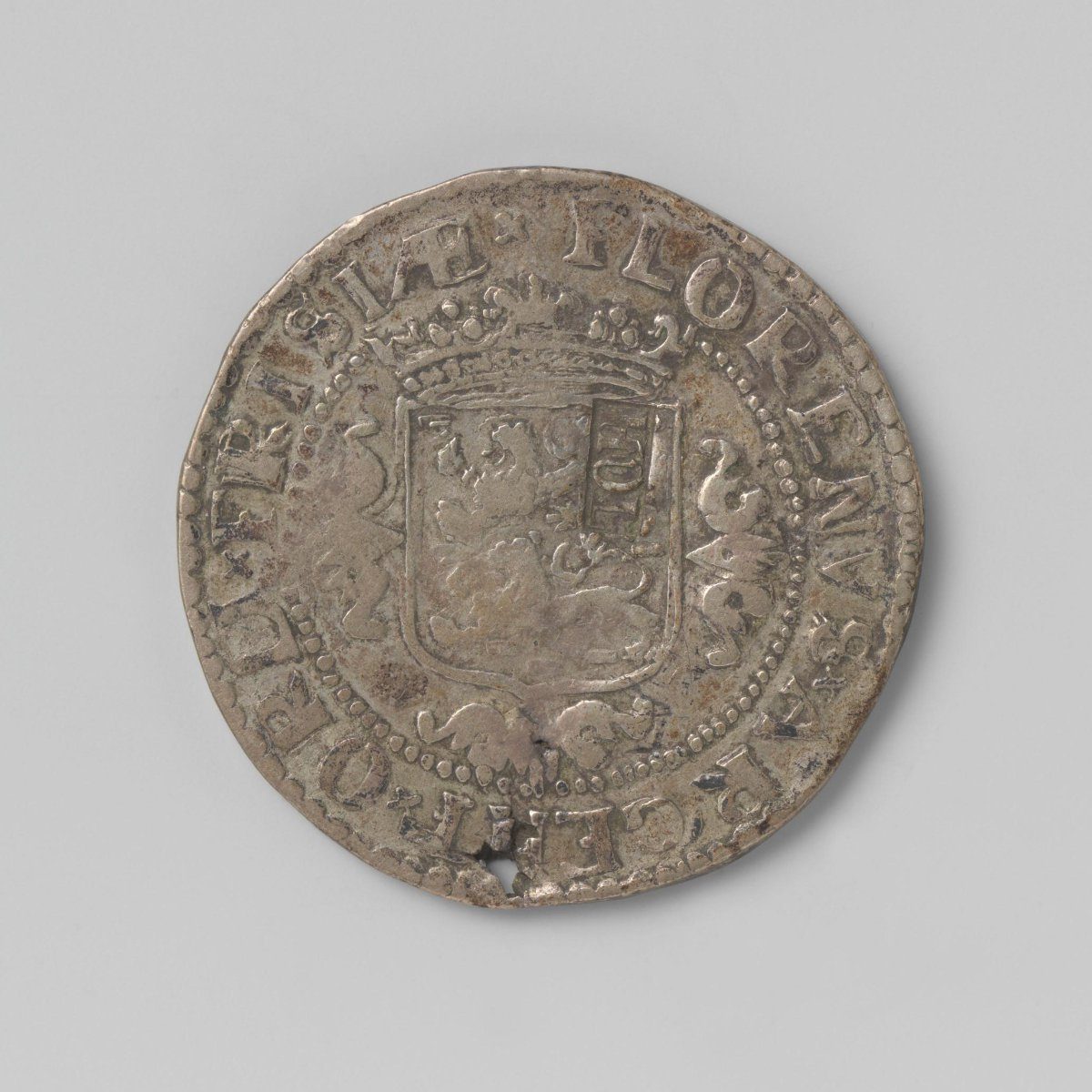
Florin of Friesland, 1665
1665
Silver coin. Obverse: nobleman with cap facing right between value designation. Sword in right hand. Year in legend. Reverse: on short flowered cross, crowned coat of arms of Friesland. On reverse, countermark HOL. The Rijksmuseum, Amsterdam, holds this object as KOG-MP-1-2029; its record gives material recorded as…
Partial type record