Skip to content

Horology

How to identify a clock or sundial

Clocks were made, re-cased, converted and repaired over centuries. Identifying one means reading the form, the case and the movement separately, then checking that they belong together.

Comparison checklist

Form and case
Record and compareCompare mounting, proportions, materials and case construction; distinguish a complete clock from a detached case.
Limits of the evidenceCase style alone cannot date a movement, and a case photograph does not show the train.
Dial and signature
Record and compareTranscribe name, place, numerals and subsidiary displays; keep retailer, clockmaker and cabinetmaker attributions separate.
Limits of the evidencePainted or enamel dials may have been replaced. A signature needs documentary support for authorship.
Power and trains
Record and compareRecord weights, winding apertures, visible fusees and any documented going, striking, chiming or alarm trains.
Limits of the evidenceWinding holes alone do not identify the full mechanism. Do not wind or run an uninspected movement.
Sundial geometry
Record and compareDistinguish portable and fixed dials; record gnomon form, hour scales, compass and latitude wording where visible.
Limits of the evidenceA latitude setting is not proof of a place of manufacture. A dial photograph cannot establish timekeeping accuracy.
Conversions and replacements
Record and compareCompare seat boards, fixing holes, dial feet and movement fit with documented original configurations.
Limits of the evidenceMuseum documentation describes its object; matching its exterior does not establish an original case–movement pairing.

Step by step

  1. 1

    Name the form

    The overall form is the first classification: longcase, bracket, wall, lantern, table, carriage, mantel or turret clock, or a sundial. Each has its own references and period of use.

    • Free-standing, wall-hung, portable or fixed to a building
    • Sundial type: horizontal, vertical, portable or ring dial
    • Museum names in the original language kept alongside the English form
  2. 2

    Describe the case

    Case materials, construction and ornament often point to a region and period, but cases were often replaced or remade. Describe what you see before drawing conclusions.

    • Wood species, veneer, lacquer, gilt metal, marble or other
    • Construction: pegged, glued, screwed; hand-cut or machine-cut
    • Decoration and any cabinet-maker's label
  3. 3

    Read the dial and signature

    Record the dial type, numerals and the name and place written on it. Many dials carry a retailer's name, and painted and enamel dials were frequently restored.

    • Brass, silvered, painted, enamel or engraved dial
    • Name and town as written; no expansion of abbreviations without evidence
    • Subsidiary dials: seconds, date, moon phase, strike/silent
  4. 4

    Examine the movement

    The movement shows how the clock works and when it was likely made. Record plate shape, the wheel trains, the escapement and any striking, chiming or alarm work.

    • Number of trains: going, striking, chiming
    • Escapement: verge, anchor, deadbeat, platform lever or other
    • Signatures or stamps on the back plate
  5. 5

    Identify the power source

    Weight-driven and spring-driven clocks belong to different traditions, and a fusee in a spring clock is a significant technical feature. Sundials record time directly from the sun and should be described by their dial type and latitude if stated.

    • Weights, springs, fusee, electric or none
    • Winding holes and their number
    • Latitude or location engraved on sundials
  6. 6

    Record conversions and marriages

    Escapements were converted, dials replaced and movements moved between cases. These changes are part of an object's history and must be recorded, not hidden.

    • Unused holes, filled screw holes or dial-foot marks
    • Movement fit in the case and seat board
    • Replacement hands, pendulum or weights

Museum specimens for comparison

Compare visible evidence with the museum's documented object. A collection number identifies the museum specimen, not every object of that type; hidden features remain research required.

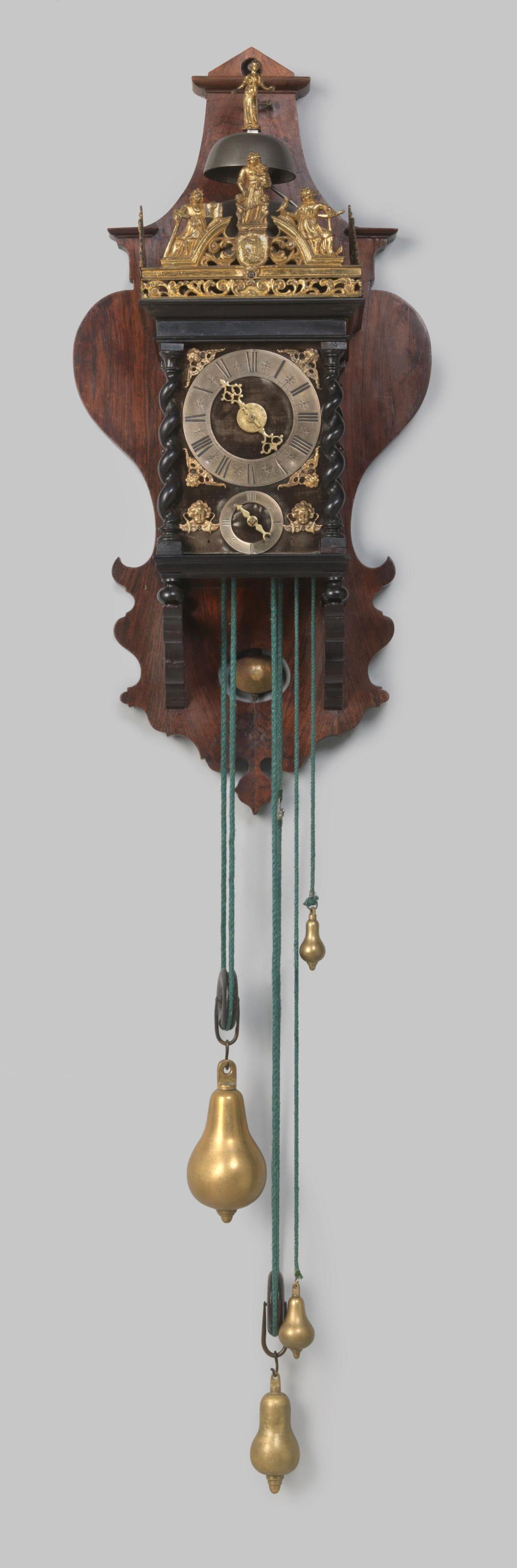
Wall clock with molded base and cornice and twisted corner columns, on a vase-shaped backboard

Rijksmuseum, Amsterdam · Public Domain (Rijksmuseum) · Museum source

Wall clock with molded base and cornice and twisted corner columns, on a vase-shaped backboard

c. 1700

Documented

Wall clock veneered with ebony on an oak core. Mounted on the fretted vase-shaped backboard, which is veneered with rosewood, are black pearwood brackets supporting the case. The latter has a molded base and cornice, twisted corner columns, and glass doors on the sides. The dial is brass, gilded cherubs serve as spandrels; below the dial is a moon-phase indicator, flanked by gilded cherubs. The backing is of black velvet. The case is surmounted in the center by bells, upon which is an allegorical female figure, and on the front and sides cast lead pediments with foliate scrollwork, containing Faith, Hope, and Charity on the front; on the sides are lions bearing the coat of arms of Amsterdam, beneath which is the motto "Nu elck zijn sin". The flat pendulum bob appears in an oval aperture in the backboard. Below it, a gilded cherub is set amid ornamentation. The weights hang from cords. Marked on the dial: D. Engel, Westzaan. The Rijksmuseum, Amsterdam, holds this object as BK-NM-3136; its record gives material recorded as lead (metal), iron (metal), wood (plant material), velvet (fabric weave), pear (wood), rosewood (wood), brass (alloy), glass, oak (wood); measurements height 78 cm x width 36 cm x depth 22.5 cm. Description translated from the museum's Dutch catalogue text; details are those of this museum object, and how far it represents a wider type has not been independently verified.

original title
Hangklok met geprofileerde voet- en kroonlijst en geslingerde hoekstijlen, op vaasvormige blad
holding institution
Rijksmuseum, Amsterdam
museum object number
BK-NM-3136
museum classification
["mechanical clock","furniture","clockwork","clock","wall clocks"]
Read the full record
Table Watch

Rijksmuseum, Amsterdam · Public Domain (Rijksmuseum) · Museum source

Table Watch

1670 - 1685

Documented

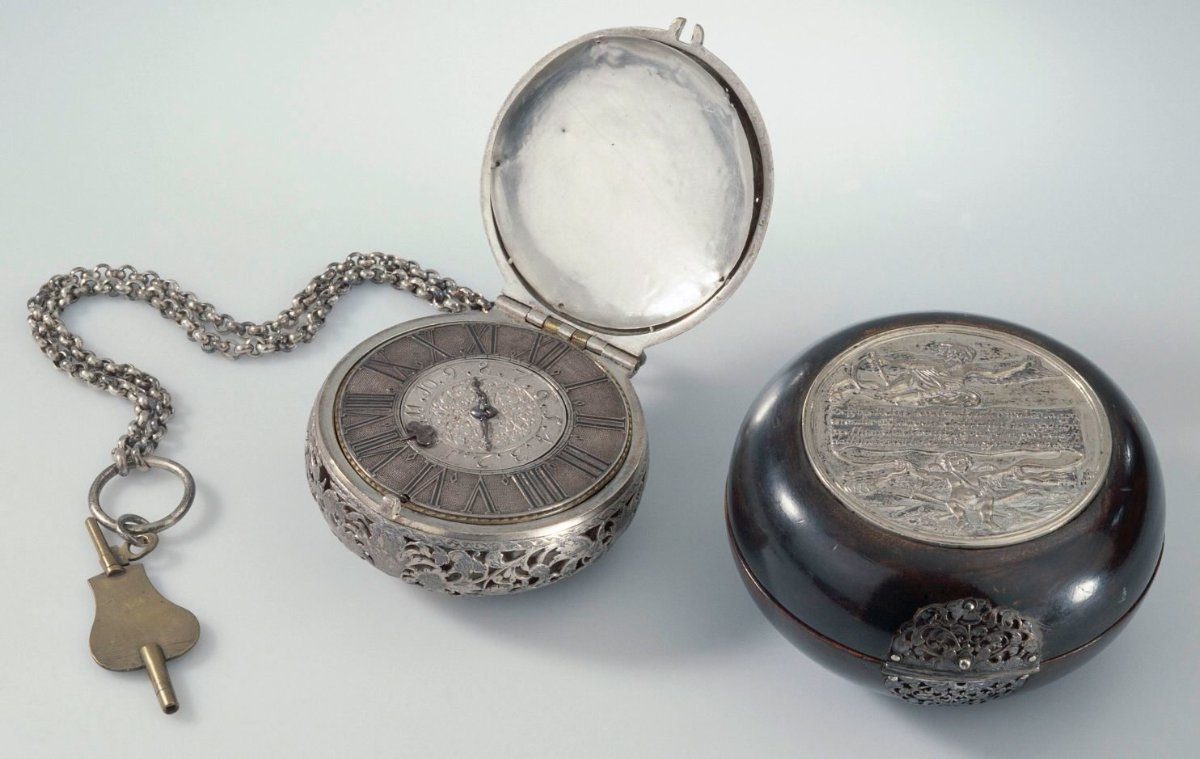
Silver table watch in a wooden case. The movement and the case, worked in openwork with flower and leaf tendrils, are probably European. The lid, decorated with a putto among tendrils in relief, must have been added in Batavia in 1694. The movement is signed: Batavia 1694 Noel Pol. Pol must have been the donor or seller, not the maker. Attached to the watch is a double link chain terminating in a ring with a brass key. In the lid of the wooden case, a silver plaque depicting Time and a motto is inset. Richly decorated silver lock plates and hinges. From Governor-General Willem van Outhoorn (1635-1720), who bequeathed it to Jan Trip, the husband of his granddaughter Petronella Willemina van Hoorn. Following Trip's death, it came into her possession. The Rijksmuseum, Amsterdam, holds this object as AK-RAK-2017-24; its record gives material recorded as copper (metal), metal, wood (plant material), silver (metal); technique engraving; measurements diameter 13 cm x height 7.5 cm x weight 1202 g. Description translated from the museum's Dutch catalogue text; details are those of this museum object, and how far it represents a wider type has not been independently verified.

original title
Tafelhorloge
holding institution
Rijksmuseum, Amsterdam
museum object number
AK-RAK-2017-24
museum classification
["table clock"]
Read the full record
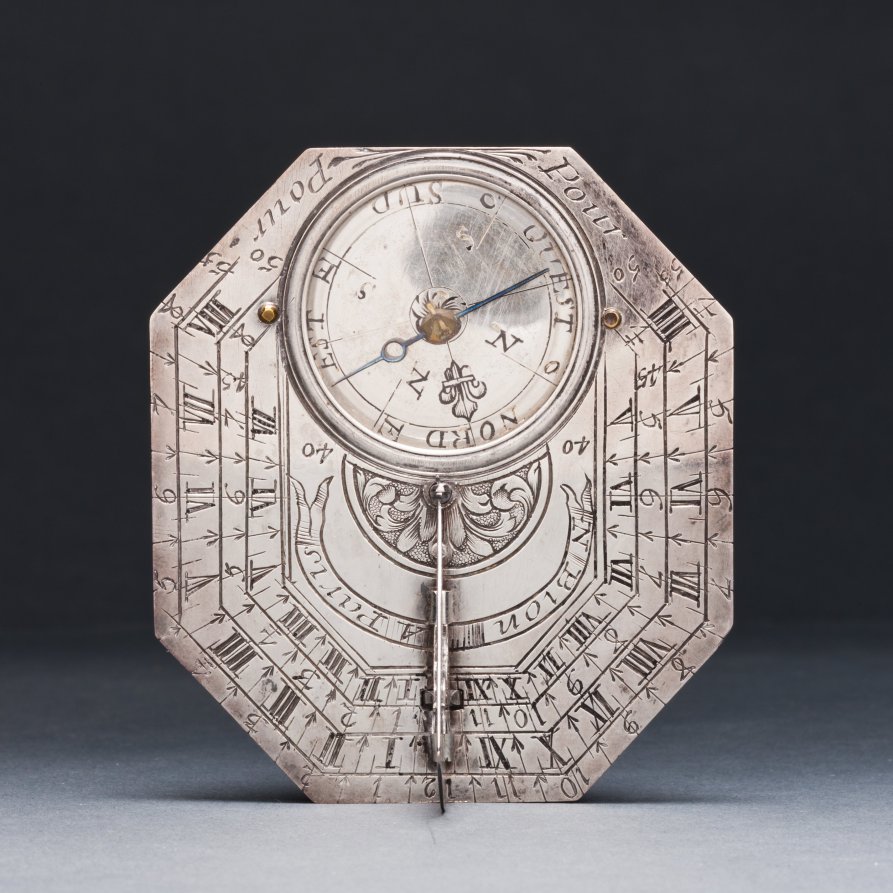
Butterfield Sundial (Cleveland Museum of Art 1942.490)

Cleveland Museum of Art · CC0 1.0 (public domain dedication) · Museum source

Butterfield Sundial (Cleveland Museum of Art 1942.490)

1700s

Documented

Butterfield-type sundials are characterized by their adjustable gnomons, metal flaps that cast a shadow on the dial’s face to indicate the hour, and geographical indices. This sundial has a scale adjustable between latitudes of 40° to 60° north. The latitudes of 26 European towns are engraved on its back for quick reference. With an intricately engraved silver face, it would have functioned as a fashionable traveler’s accessory. Cleveland Museum of Art object 1942.490: Butterfield Sundial, 1700s. France. Silver; overall: 7.7 x 7.4 cm (3 1/16 x 2 15/16 in.). Inscribed: [Engraved signature above the compass in ribbon band]: "N. BION A Paris"; [Engraved on the face of the sundial]: “Pour 55° 4-5-6-7-8-9-10-11 50° IIII-V-VI-VII-VIII-IX-X-XI 45° 5-6-7-8-9-10-11 40° -VI-VII-VIII-IX-X-XI'; [Engraved on the other side]: "Pour 55° -8-7-6-5-4-3-2-1-0 50°-VIII-VII-VI-V-IIII-III-II-I 45°-8-7-6-5-4-3-2-1 40°-VII-VI-V-IIII-III-II-I"; [Engraved around the compass]: “NORD-OUEST-SUD-EST”; [Engraved on the back of the sundial]: “Turin 44 Milan 46 Paris 49 Lion 46 Metz 49 Rome 42 Liege 51 Naples 44 Namur 50 Gennes 44 Marseille 43 Grenoble 45 Bayonne 43 Bruxelle 51 Londres 52 Nantes 47 Vienne 48 Toulon 43 Tours 47 Lille 51”; [Engraved around the back of the compass]: “Venise 45 Strasbourg 49 Amsterdam 52 Hambourg 54 Varsovie 52 La Rochelle 46”. Details are those of this museum object; how far it represents a wider type has not been independently verified.

date recorded
1700s
culture period
France
holding institution
Cleveland Museum of Art
museum object number
1942.490
museum classification
["Silver"]
Read the full record
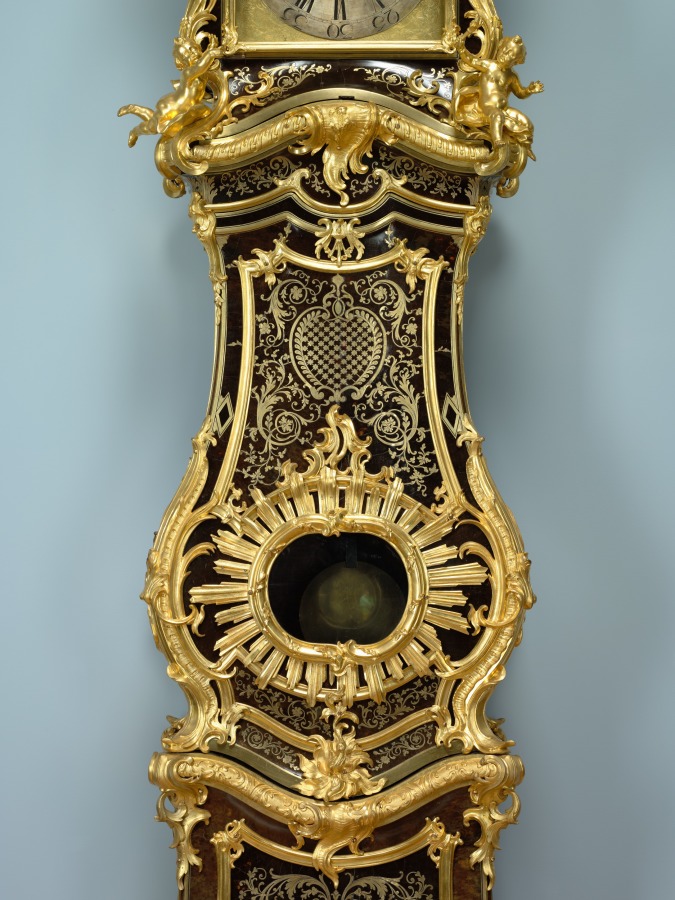
Tall- case Clock (Regulateur) (Cleveland Museum of Art 1949.200)

Cleveland Museum of Art, John L. Severance Fund · Public domain (CC0, Cleveland Museum of Art Open Access) · Museum source

Tall- case Clock (Regulateur) (Cleveland Museum of Art 1949.200)

1744

Documented

Cleveland Museum of Art object 1949.200: Tall- case Clock (Regulateur), 1744. Jean-Pierre Latz (French, 1691–1754), Stollewerck (French). Boulle marquetry with gilt bronze mounts; overall: 261.6 x 69.9 x 41.9 cm (103 x 27 1/2 x 16 1/2 in.). Inscribed: incised on the back of the lowest front panel: .LATZ . A . PARISIIS . FECIT ./. MDCCXLIV; engraved on the clock face: Stollewerck/Paris.. Details are those of this museum object; how far it represents a wider type has not been independently verified.

date recorded
1744
culture period
France, Paris
maker recorded
Jean-Pierre Latz (French, 1691–1754), Stollewerck (French)
museum attribution
Jean-Pierre Latz (French, 1691–1754); Stollewerck (French)
holding institution
Cleveland Museum of Art
museum object number
1949.200
published references
["The Cleveland Museum of Art. The Cleveland Museum of Art Handbook. Cleveland, OH: The Cleveland Museum of Art, 1958. Mentioned and Reproduced: cat. no. 285","The Cleveland Museum of Art. Handbook of the Cleveland Museum of Art/1966 . Cleveland, OH: The Cleveland Museum of Art, 1966. Reproduced: p. 137","The Cleveland Museum of Art. Handbook of the Cleveland Museum of Art/1969 . Cleveland, OH: The Cleveland Museum of Art, 1969. Reproduced: p. 137","Hawley, Henry H. “Jean-Pierre Latz, Cabinetmaker.” The Bulletin of the Cleveland Museum of Art 57, no. 7 (September/October 1970): 203–259. Mntioned and reproduced: p. 215-217, figs. 1, 1a, Cover","The Cleveland Museum of Art. Handbook of the Cleveland Museum of Art/1978 . Cleveland, OH: The Cleveland Museum of Art, 1978. Reproduced: p. 180","May, Sally Ruth. Knockouts: a pocket guide. Cleveland: Cleveland Museum of Art, 2001. Reproduced: no. 41, p. 42 - 43"]
museum classification
["Furniture and woodwork"]
Read the full record
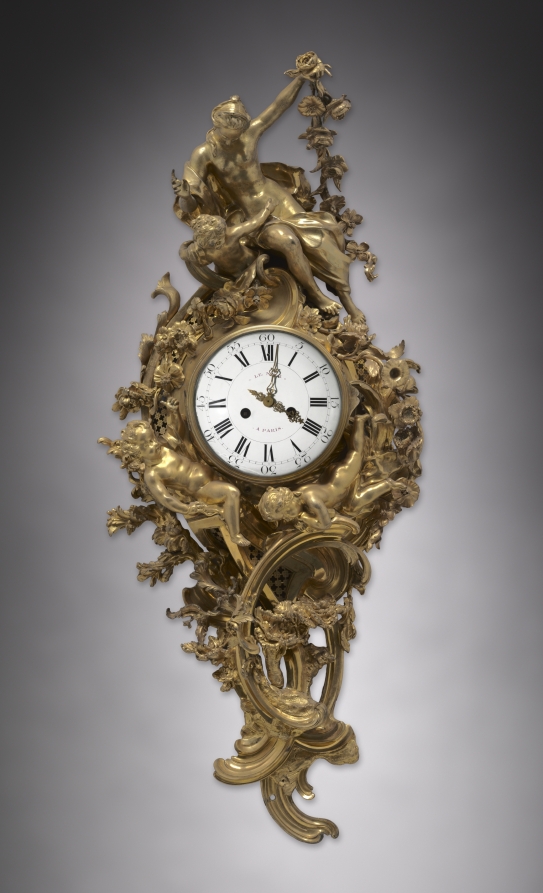
Wall Clock (Cleveland Museum of Art 1950.376)

Cleveland Museum of Art · CC0 1.0 (public domain dedication) · Museum source

Wall Clock (Cleveland Museum of Art 1950.376)

c. 1750–1760

Documented

Wall Clock in the Cleveland Museum of Art (accession 1950.376), dated c. 1750–1760; museum culture/place: France. Museum object record; the wider type is not yet verified.

museum object number
1950.376
museum classification
["Furniture and woodwork"]
Read the full record

Common mistakes

  • Identifying a clock from the dial name, which is often a retailer.
  • Assuming the case and movement are original to each other.
  • Dating a clock from its style alone when the case may be a later replacement.
  • Running an old movement without inspection, which can cause lasting damage.
  • Moving a pendulum or weight-driven clock without securing the pendulum and weights.

Identifying the form and period does not confirm originality, working condition or authorship. Many museum examples here are recorded as objects; their broader type may still require research.

Practise on these records

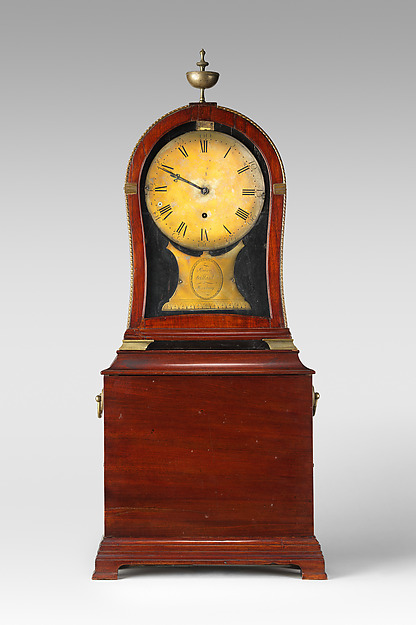
"Balloon" Shelf Clock, Simon Willard, 1780–90

clocks

"Balloon" Shelf Clock, Simon Willard, 1780–90

1780–90

"Balloon" Shelf Clock made by Simon Willard (1753–1848), dated 1780–90, from American. The museum records its materials as: Mahogany, pine; brass, iron, steel, lead, synthetic cord (modern). Recorded dimensions: 29 3/4 × 12 3/4 × 4 1/2 in. (75.6 × 32.4 × 11.4 cm). The Metropolitan Museum of Art holds this object as 2023.304a–c; details are those of this museum object, and how far it represents a wider type has not been independently verified.

Documented

Research required

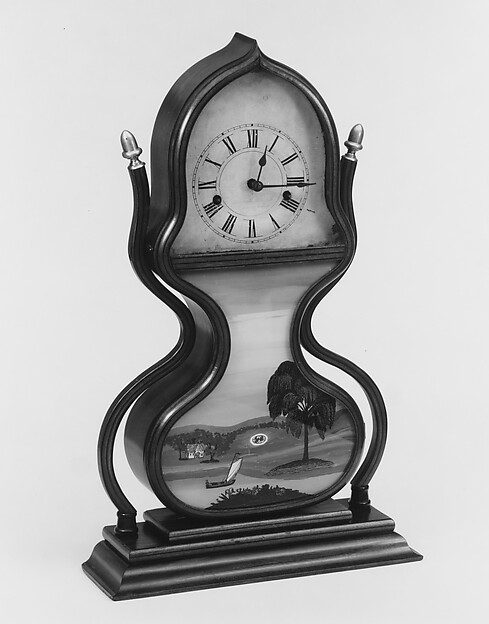
Acorn Clock

clocks

Acorn Clock

1847–50

Acorn Clock made by Forestville Manufacturing Company (1835–1853), dated 1847–50, from American. The museum records its materials as: Mahogany, laminated. Recorded dimensions: 24 3/8 x 14 5/8 x 5 1/8 in. (61.9 x 37.1 x 13 cm). The Metropolitan Museum of Art holds this object as 1970.289.6; details are those of this museum object, and how far it represents a wider type has not been independently verified.

Documented

Research required

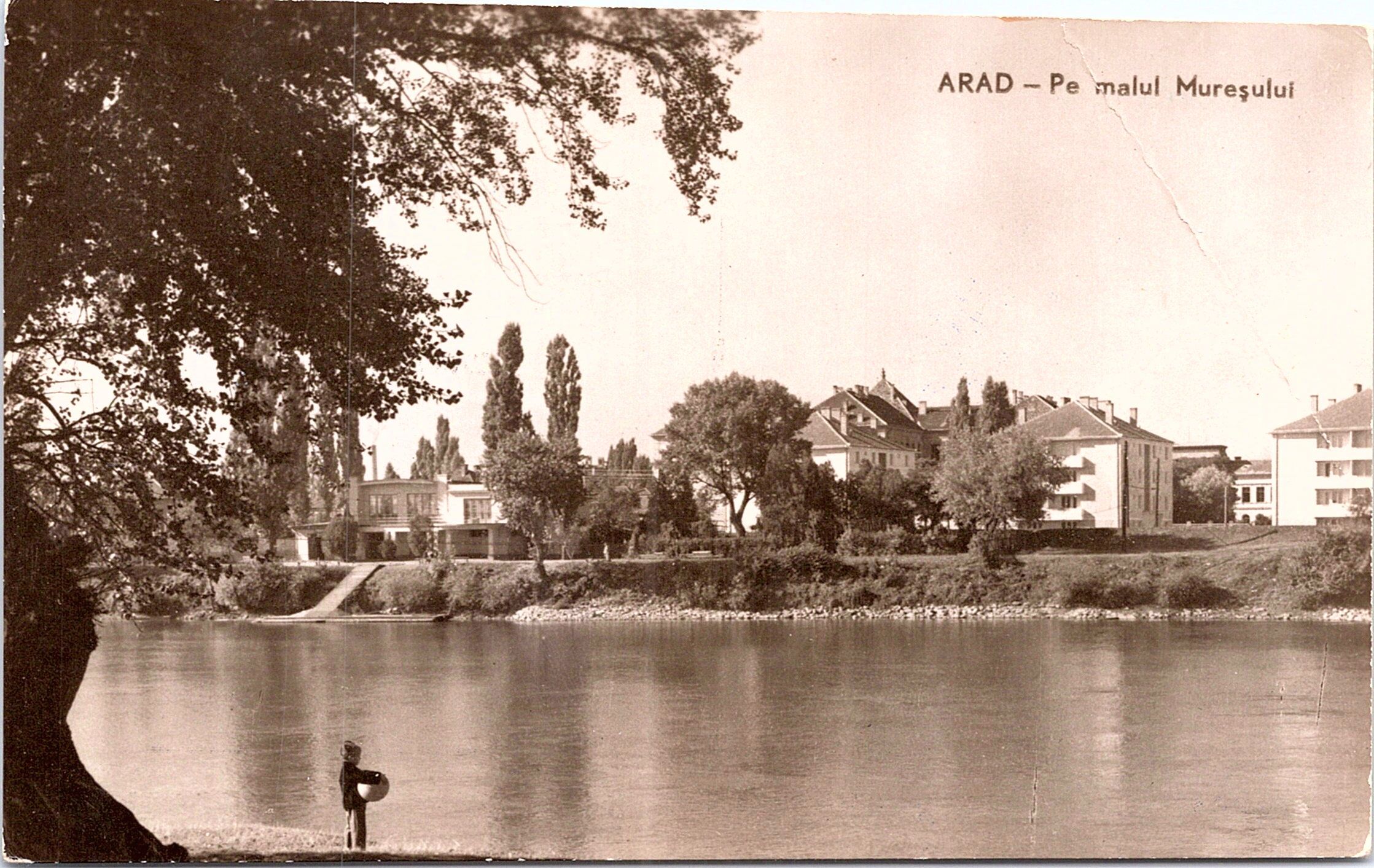
Arad - On the banks of the Mureș, CPCS (photographer)

clocks

Arad - On the banks of the Mureș, CPCS (photographer)

Arad - On the banks of the Mureș, CPCS (photographer) is held by National Heritage Institute, Bucharest. Museum description: View of a stretch of the bank of the Mureș River. Multi-story residential buildings, trees, and rich vegetation along the water's edge can be seen, as well as a child holding a large ball in their arms. The museum record gives maker recorded: CPCS (photographer). These details come from the holding museum's own record; how far this object represents a wider collectible type has not yet been independently verified.

Documented

Research required

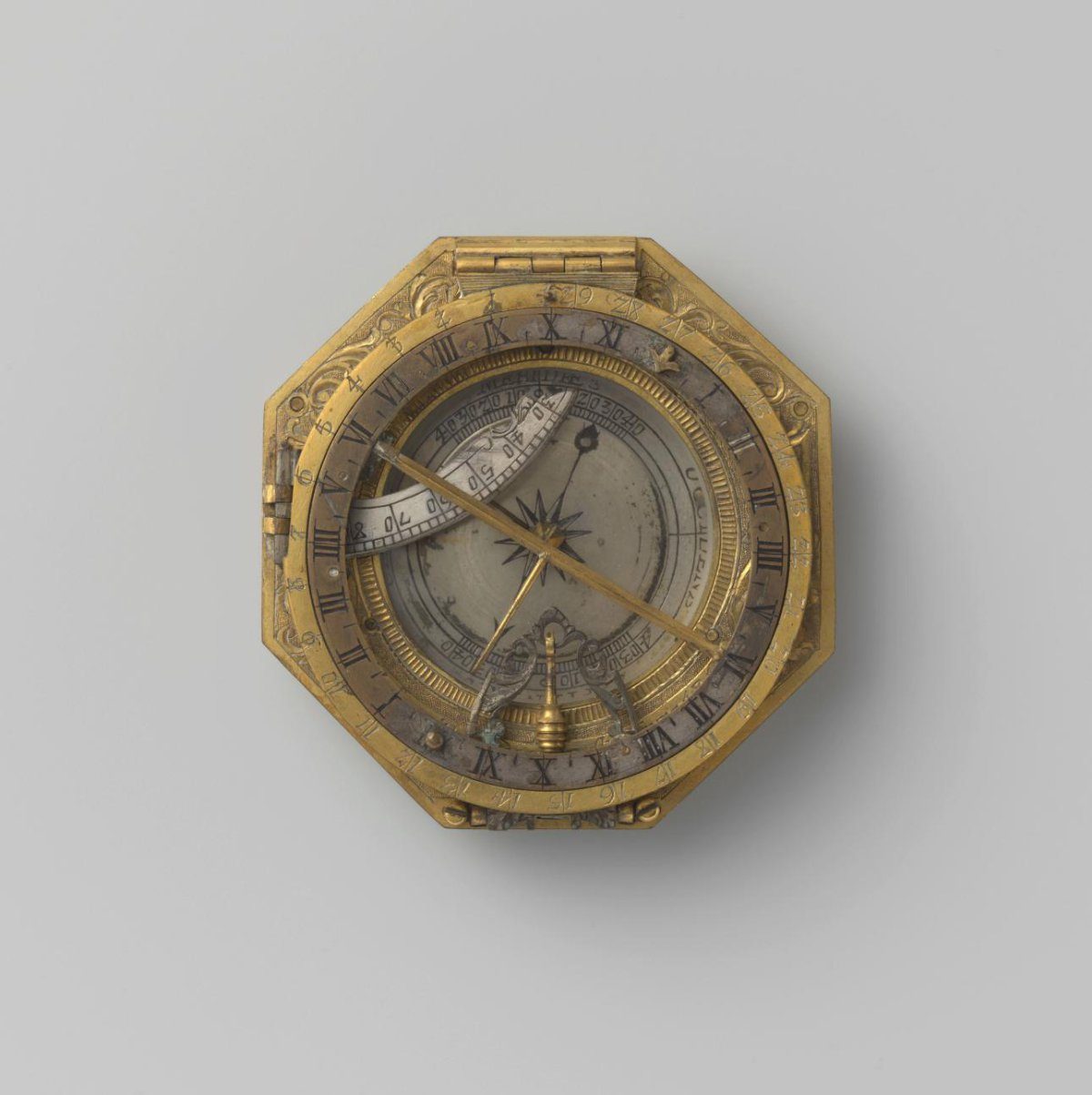
Astrolabe

clocks

Astrolabe

1700 - 1750

Compass sundial of brass and iron, eight-sided on 3 feet. Decorated and with a circular glass cover in the center. The Rijksmuseum, Amsterdam, holds this object as BK-1969-179; its record gives material recorded as brass (alloy); measurements height 7.5 cm x diameter 7.2 cm. Description translated from the museum's Dutch catalogue text; details are those of this museum object, and how far it represents a wider type has not been independently verified.

Documented

Research required

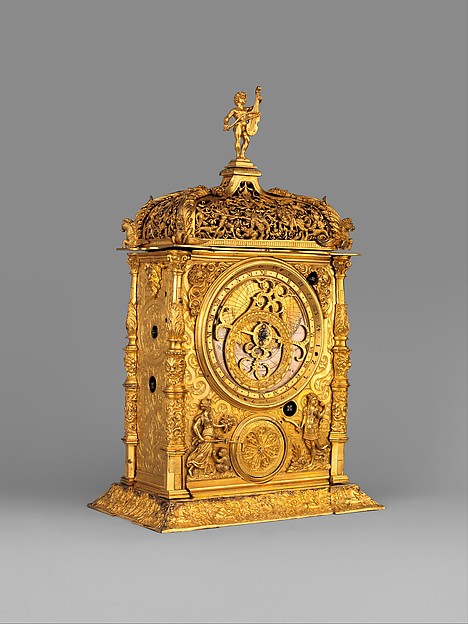
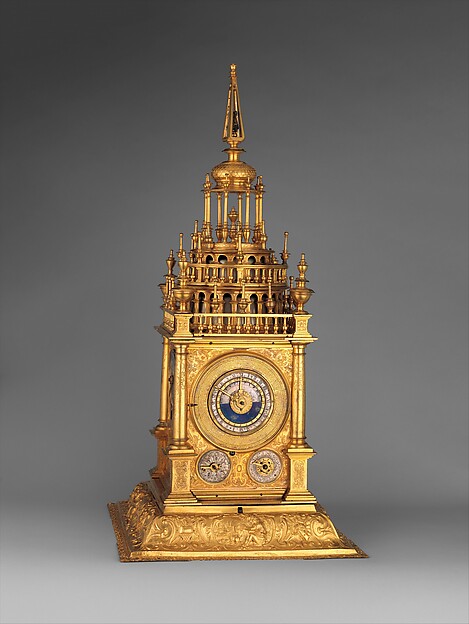
Astronomical table clock, 1568

clocks

Astronomical table clock, 1568

1568

Astronomical table clock in The Metropolitan Museum of Art, New York (accession 17.190.634a–d), catalogued by the museum's European Sculpture and Decorative Arts department. The museum dates it 1568. It is attributed to Jeremias Metzger (German, ca. 1525–ca. 1597). The museum records the medium as Case and dials: gilded brass; Movement: iron and the dimensions as Overall: 14 1/4 × 8 1/2 × 5 3/4 in. (36.2 × 21.6 × 14.6 cm). Subject tags assigned by the museum: Male Nudes, Pegasus, Zodiac. These details are transcribed from the museum's open-access record; how far this object represents a wider collectible type has not yet been independently verified.

Documented

Research required

Astronomical table clock, second quarter 17th century

clocks

Astronomical table clock, second quarter 17th century

second quarter 17th century

Astronomical table clock in The Metropolitan Museum of Art, New York (accession 17.190.747), catalogued by the museum's European Sculpture and Decorative Arts department. The museum dates it second quarter 17th century. The museum records the medium as Case: gilded brass and gilded copper; Dials: gilded brass and silver; Movement: brass, gilded brass, and steel and the dimensions as Overall: 25 × 10 × 10 in. (63.5 × 25.4 × 25.4 cm). Subject tags assigned by the museum: Astronomy, Zodiac. These details are transcribed from the museum's open-access record; how far this object represents a wider collectible type has not yet been independently verified.

Documented

Research required

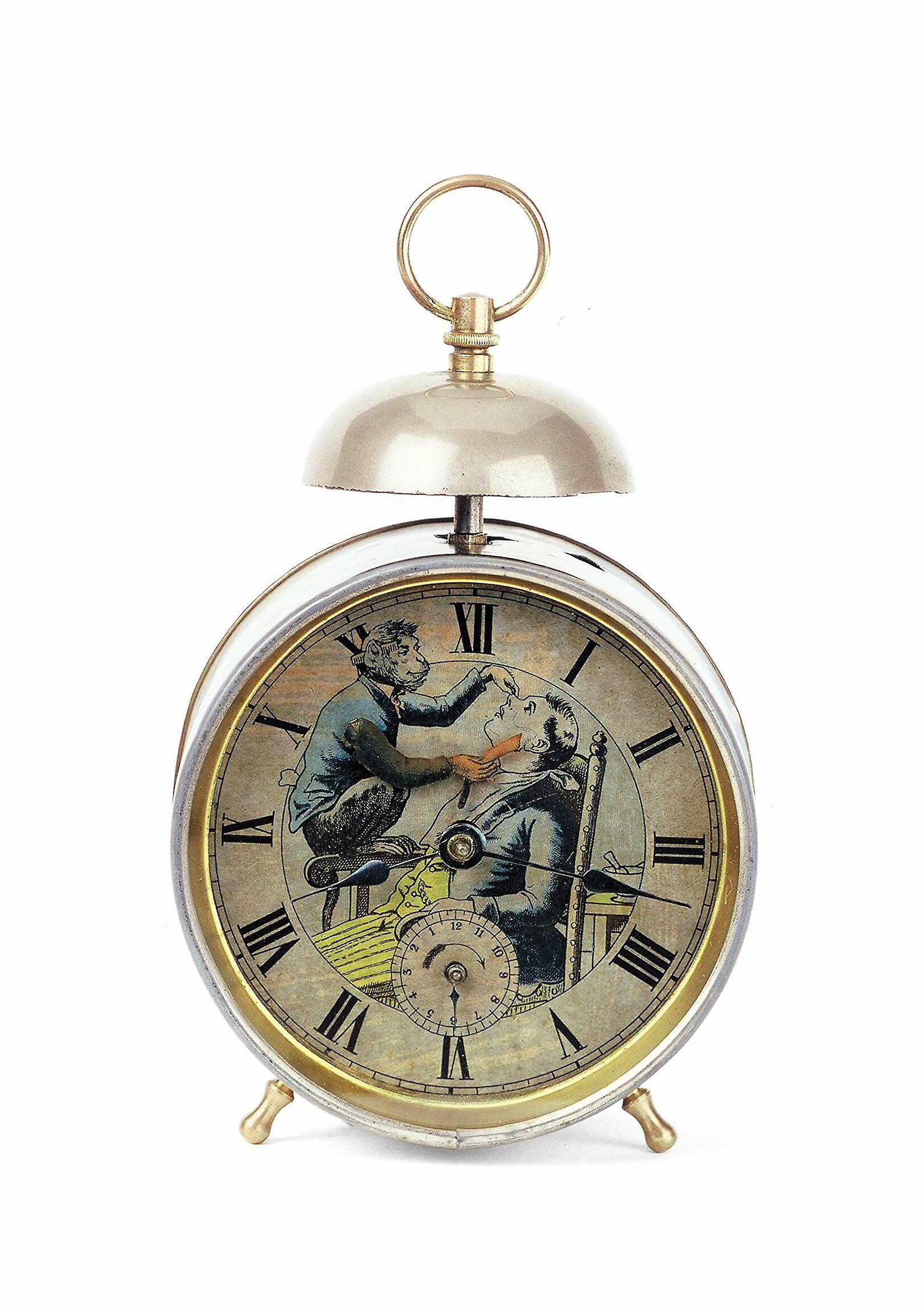
Baby alarm clock with monkey barber, Union Clock Company, Furtwangen, c. 1900, Union Clock Company, 1900

clocks

Baby alarm clock with monkey barber, Union Clock Company, Furtwangen, c. 1900, Union Clock Company, 1900

1900

Baby alarm clock with monkey barber, Union Clock Company, Furtwangen, c. 1900, Union Clock Company, 1900 is held by German Clock Museum, dated 1900. Museum description: Baby alarm clock with moving figure "monkey barber", Union Clock Company, Furtwangen, c. 1900. The paper dial shows a man being shaved by a "monkey barber". The back-and-forth swinging of the arm is linked to the movement of the anchor. (Deutsches Uhrenmuseum Furtwangen) The museum record gives measurements height: 17.00 cm, width: 10.50 cm, depth: 6.50 cm; maker recorded: Union Clock Company. These details come from the holding museum's own record; how far this object represents a wider collectible type has not yet been independently verified.

Documented

Research required

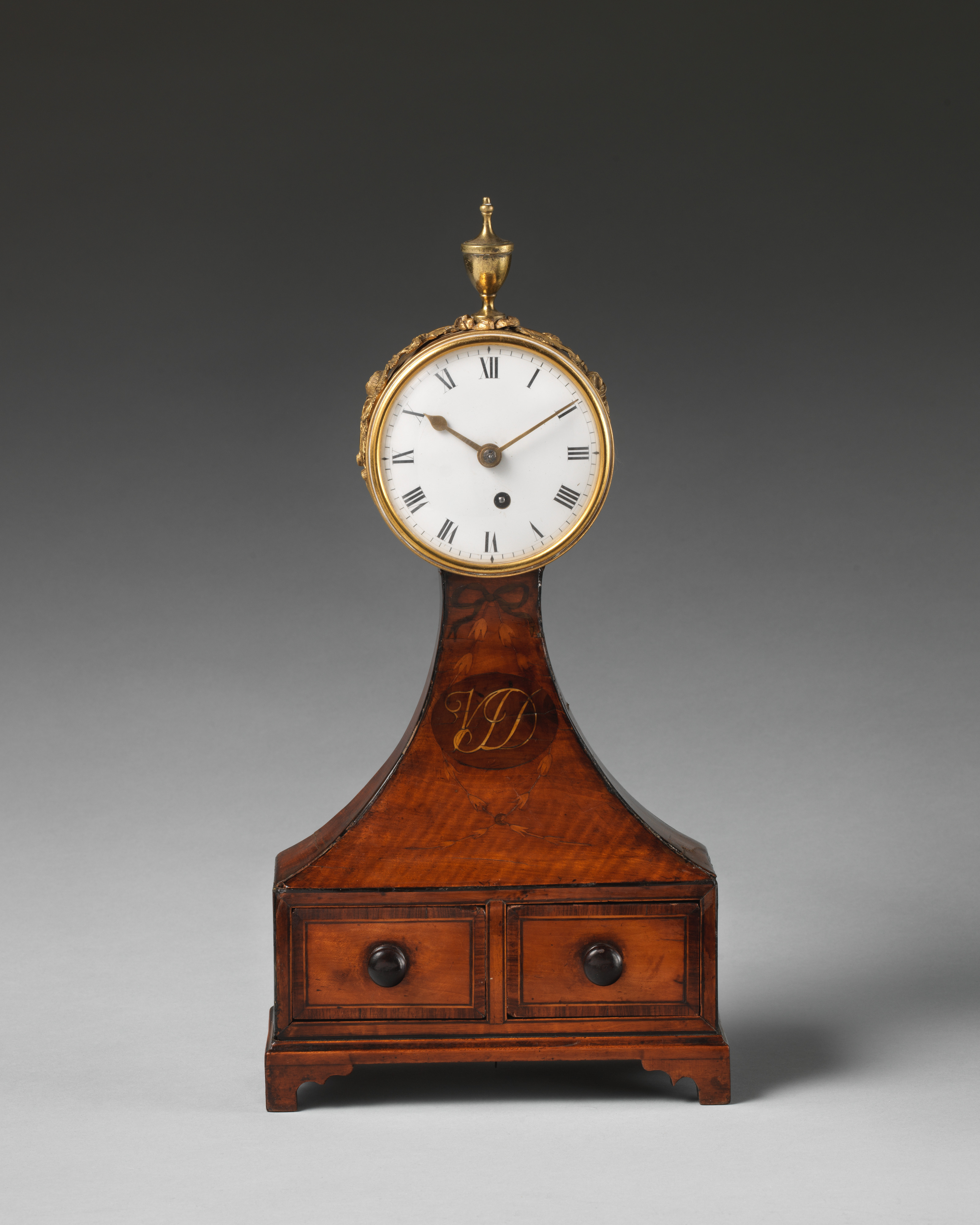
Balloon bracket clock, Savory, ca. 1790

clocks

Balloon bracket clock, Savory, ca. 1790

ca. 1790

Balloon bracket clock made by Savory, dated ca. 1790, from British, London. The museum records its materials as: Satinwood, mahogany. Recorded dimensions: Overall: 14 1/2 × 7 1/2 × 3 1/4 in. (36.8 × 19.1 × 8.3 cm). The Metropolitan Museum of Art holds this object as 64.101.876; details are those of this museum object, and how far it represents a wider type has not been independently verified.

Documented

Research required

This guide helps you identify a type. It does not estimate value, grade, or authenticate an individual object. How records are made.