Issuing authority
Catuvellauni
- Kind
- kingdom
- Region
- Celtic Britain, Europe
Objects are filed under the historical authority that actually issued or made them. A recorded period comes from the issuer's own reference description and is left blank where no source states it.
Published entries
5
Individual types and documented families
With photographs
100%
5 with a credited real-object photo
Dated span
65 BC – AD 5
5 entries with their own date
Verified or well documented
0
Highest two confidence levels
Catalogue entries (5)
Filter these entries by era, material or confidenceSorted by date, earliest first.
Cleveland Museum of Art
ancient coins
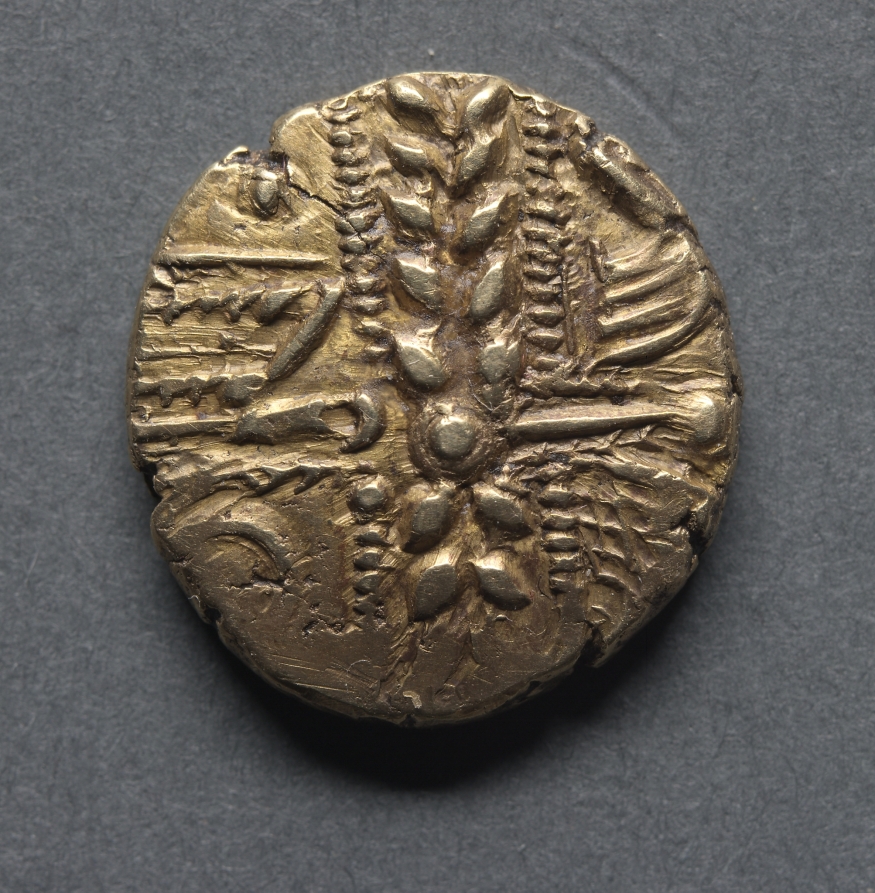
Stater: Wreath, Cloak, and Crescents (obverse); Horse and Wing Motif (Cleveland Museum of Art 1969.149)
c. 60–20 BCE
This particular type of stater received its type name, Whaddon Chase, from a hoard of over 320 such pieces which were turned up by a plow in a field called Narbury on the Whaddon Hall estate, Buckinghamshire, on February 14, 1849. The surrounding countryside is known as Whaddon Chase, the name still in use today. Th…
Partial type record
Cleveland Museum of Art
ancient coins
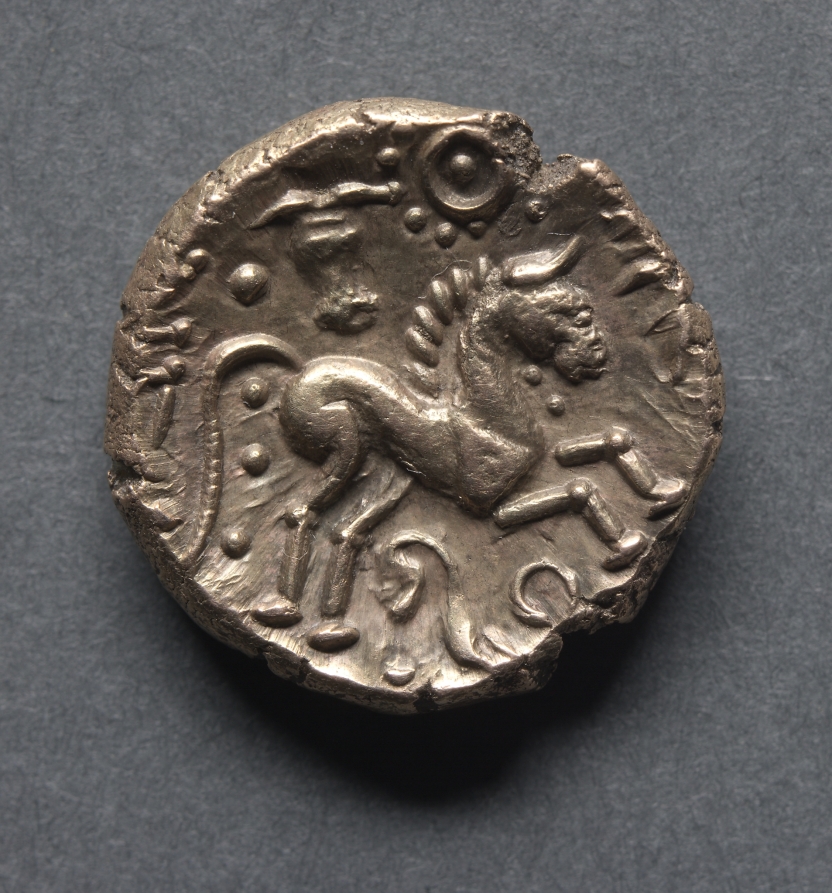
Tasciovanus Stater: Crossed Wreaths (obverse); Horse and Bucranium (Head of Ox) (Cleveland Museum of Art 1969.150)
20 BCE–10 CE
Tasciovanus was the first king of the Catuvellauni to put his name on his coins; otherwise he is completely unknown to history. It is based on earlier coin designs with the addition of a legend containing an abbreviation of his name and a bucranium (head of an ox) above the horse. Often earlier coins are badly execu…
Partial type record
Cleveland Museum of Art
ancient coins
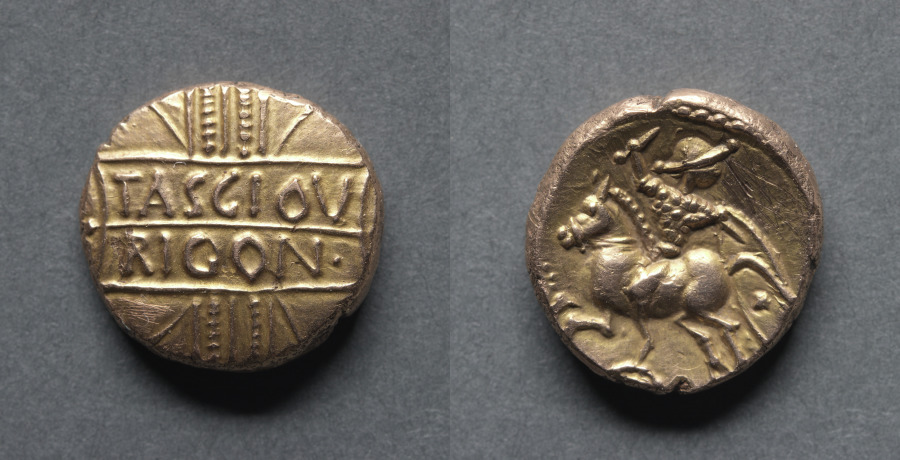
Tasciovanus Stater: Wreath (obverse); Horse and Armed Rider (Cleveland Museum of Art 1969.151)
c. 20 BCE–10 CE
The clarity of the obverse legend sets this piece beyond all doubt. The meaning of RICON, which on some other specimens occurs as RICONI or RIGON, is uncertain. Some authorities believe it to be the Celtic form of REX or king. A high quality or workmanship, the horse has a clear, three-dimensional appearance. The wa…
Partial type record
Cleveland Museum of Art
ancient coins
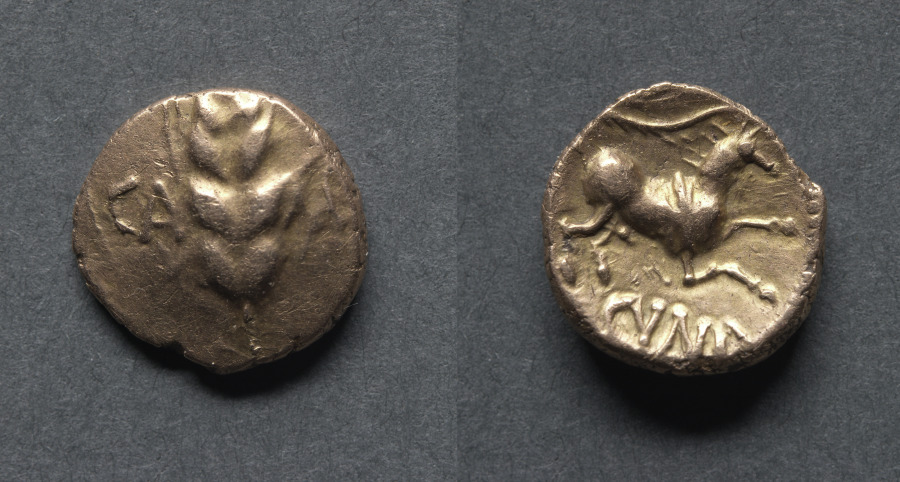
Cunobeline Quarter Stater: Corn (obverse); Horse and Branch (Cleveland Museum of Art 1969.153)
c. 10–40 CE
The ear of corn or wheat is frequently found on coins of Cunobeline. The workmanship on the horse is not as good as another in the collection, 1969.152. The relative proportions of the head and neck are poor and the animal has acquired an additional joint in its right foreleg, though this does not appear on all spec…
Partial type record
Cleveland Museum of Art
ancient coins
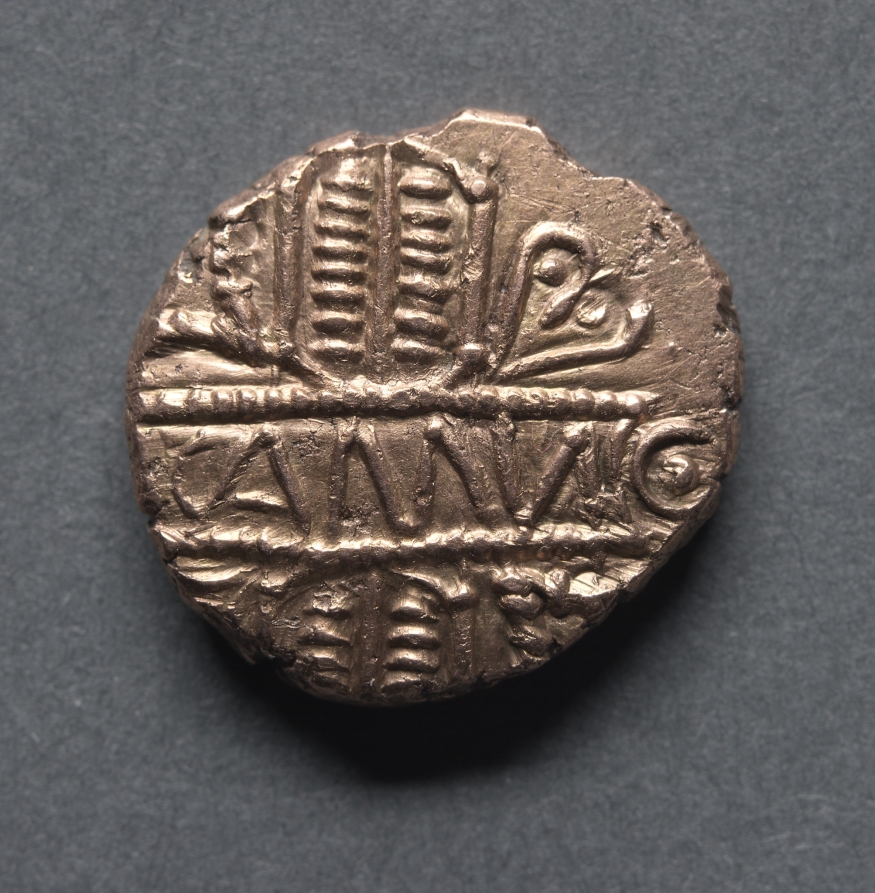
Cunobeline Stater: Tablet on Wreath (reverse); Two Horses and Wheel (Cleveland Museum of Art 1969.152)
c. 10–40 CE
Cunobeline is mentioned by various Roman historians. He was a powerful ruler, the son of Tasciovanus. He is known to have had one brother, Epaticcus, and possibly another, Sego, as well as two sons, Caratacus and Togodumnus. The history of this ancient time is very confused, particularly over family relationships; s…
Partial type record
Dated entries by century
- 1st century BC3
- 1st century2
Only the 5 entries carrying their own date to within about 150 years are counted, by the earliest year given. These are catalogue holdings, not production totals.
Browse other historical issuers and makers in the Atlas, or read how attributions are made in the editorial method.