Issuing authority
Syracuse
- Kind
- city-state
- Region
- Southern Europe, Europe
Objects are filed under the historical authority that actually issued or made them. A recorded period comes from the issuer's own reference description and is left blank where no source states it.
Published entries
5
Individual types and documented families
With photographs
100%
5 with a credited real-object photo
Dated span
485 BC – 344 BC
5 entries with their own date
Verified or well documented
0
Highest two confidence levels
Catalogue entries (5)
Filter these entries by era, material or confidenceSorted by date, earliest first.
Cleveland Museum of Art
ancient coins
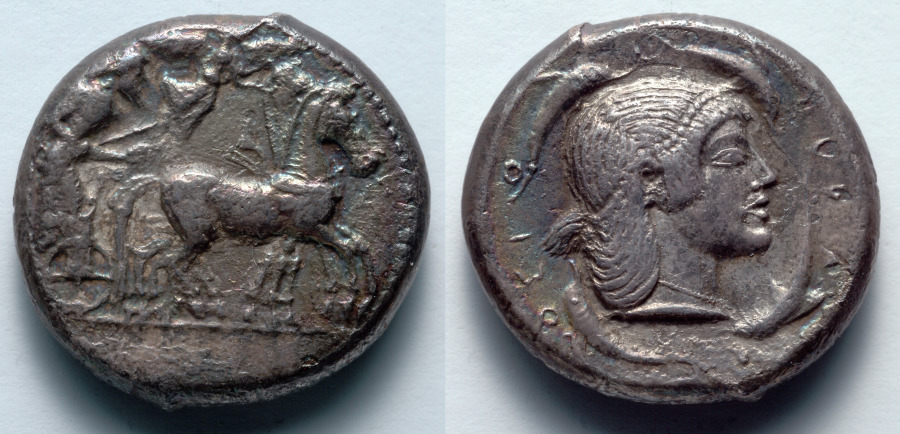
Tetradrachm: Quadriga (obverse); Head of Artemis/Arethousa (Cleveland Museum of Art 1917.987)
485–478 BCE
Cleveland Museum of Art object 1917.987: Tetradrachm: Quadriga (obverse); Head of Artemis/Arethousa (reverse), 485–478 BCE. Greek, minted at Syracuse (Sicily). Silver; diameter: 2.4 cm (15/16 in.). Inscribed: [ΣΥΡΑΚ] - ΟΣΙΟ[Ν] (Of the Syracusans). It is catalogued in the museum's Greek and Roman Art department unde…
Partial type record
Cleveland Museum of Art
ancient coins
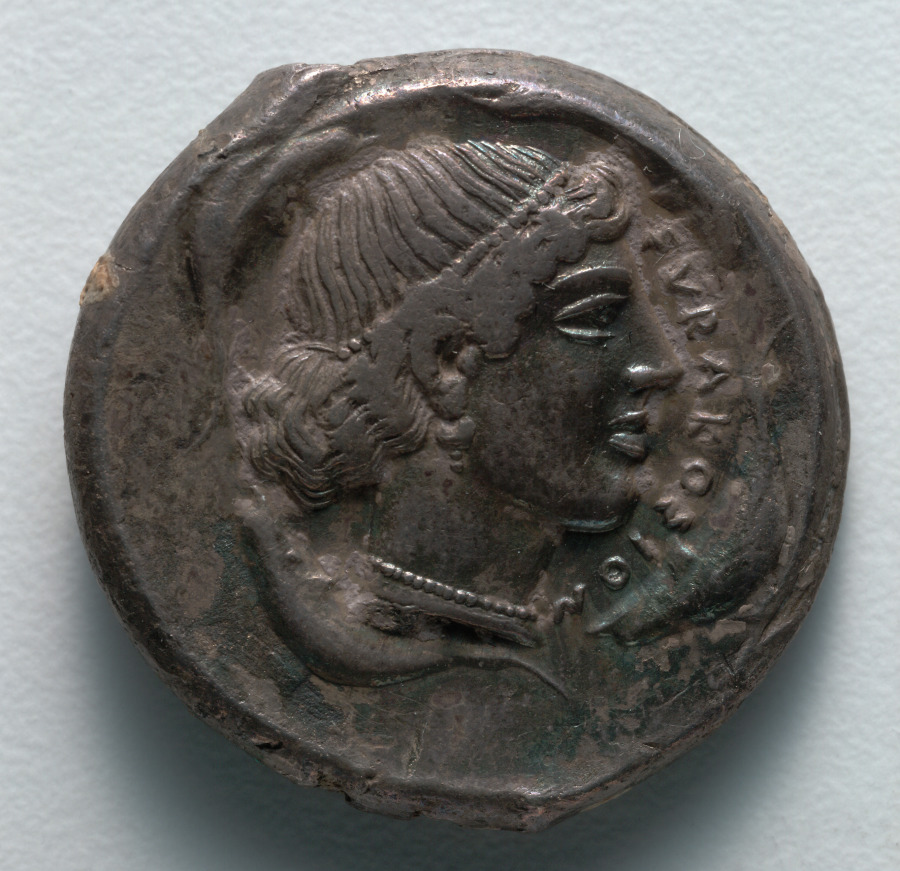
Tetradrachm: Quadriga (obverse); Head of Arethousa (Cleveland Museum of Art 1916.976)
c. 467–440 BCE
On the obverse of this highly symbolic coin is the head of Arethousa, a local goddess of Syracuse who fled from mainland Greece and arose on the site as a freshwater fountain. Four dolphins swim around her, suggesting Syracuse’s humble beginnings as a small island colony. On the reverse, a racing four-horse chariot…
Partial type record
Cleveland Museum of Art
ancient coins
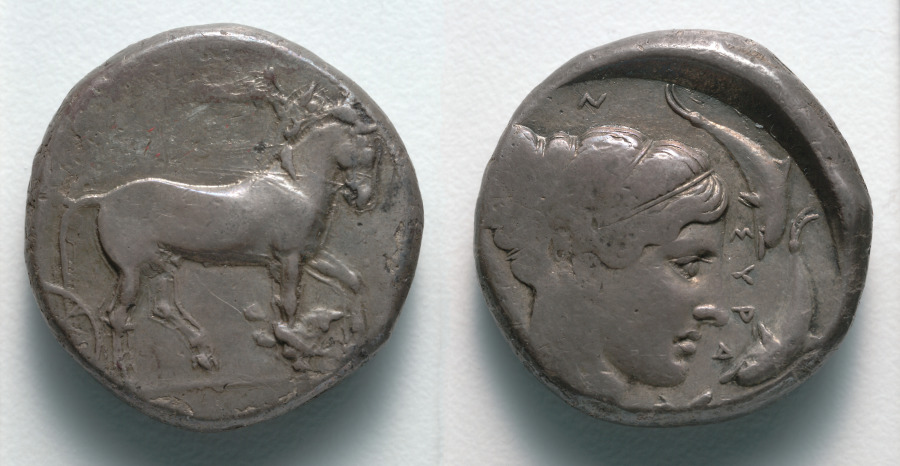
Tetradrachm: Quadriga (obverse); Head of Arethousa (Cleveland Museum of Art 1916.980)
c. 430–420 BCE
The rightmost horse of a chariot team dominates the obverse of this coin, while the other three are suggested only by contours. On the reverse, four dolphins should surround Arethousa, but poor positioning during the striking process has left off one and most of another. The lumps around the horses’ front legs sugge…
Partial type record
Rijksmuseum, Amsterdam
ancient coins
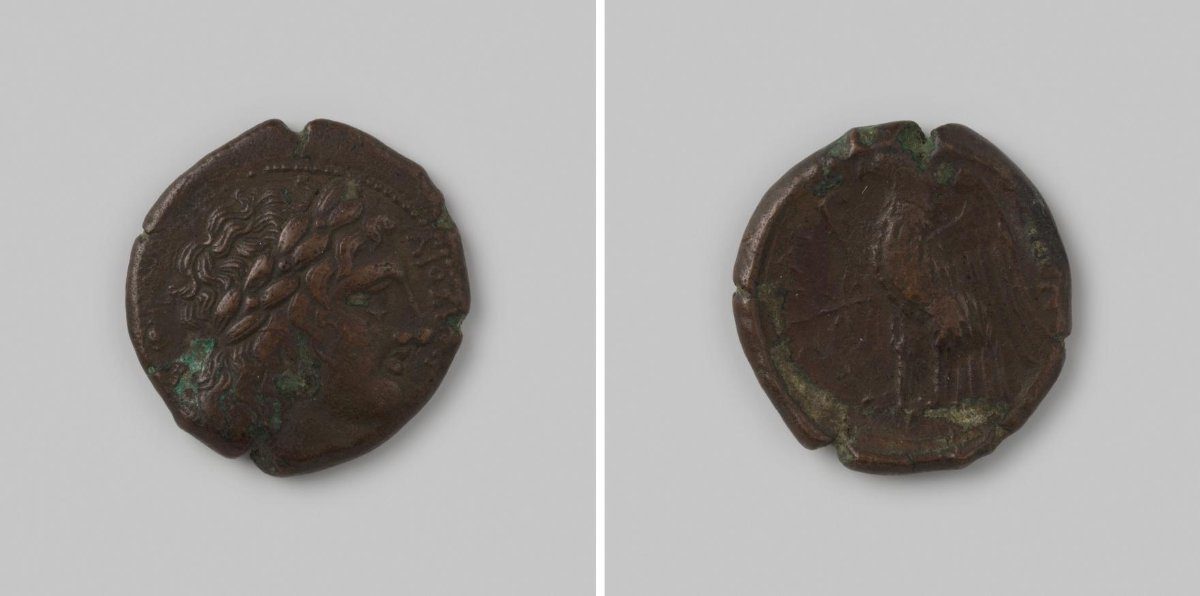
Obol (?) of Syracuse, 400–300 BC
400–300 BC
Bronze coin. Obverse: laureate head of Jupiter facing right. Reverse: eagle with spread wings on a thunderbolt facing left. In the field a star. The Rijksmuseum, Amsterdam, holds this object as KOG-MP-1-0008; its record gives material recorded as bronze (metal); technique striking (metalworking); measurements diamet…
Partial type record
Cleveland Museum of Art
ancient coins
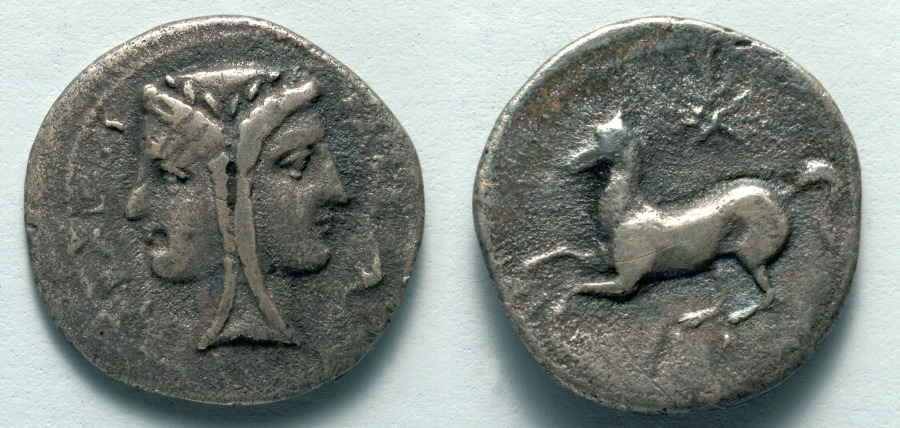
Two Litrae: Janiform Head (obverse); Horse (Cleveland Museum of Art 1917.986)
344–317 BCE
Cleveland Museum of Art object 1917.986: Two Litrae: Janiform Head (obverse); Horse (reverse), 344–317 BCE. Greek, minted at Syracuse (Sicily). Silver; diameter: 1.3 cm (1/2 in.). Inscribed: ΣΥΡ[ΑΚΟΣΙOΝ] (Of the Syracusans). It is catalogued in the museum's Greek and Roman Art department under Coins. Credit line: G…
Partial type record
Dated entries by century
- 5th century BC3
- 4th century BC2
Only the 5 entries carrying their own date to within about 150 years are counted, by the earliest year given. These are catalogue holdings, not production totals.
Materials recorded in the physical descriptions
- Silver4
- Bronze1
An entry made of several materials is counted once under each. Materials are counted only where the description states them.
Browse other historical issuers and makers in the Atlas, or read how attributions are made in the editorial method.