Catalogue
Clocks and Sundials
Table, bracket, longcase, tower and mantel clocks and sundials documented in institutional collections.
Individually identified types (347)
Filter by era, country, maker or material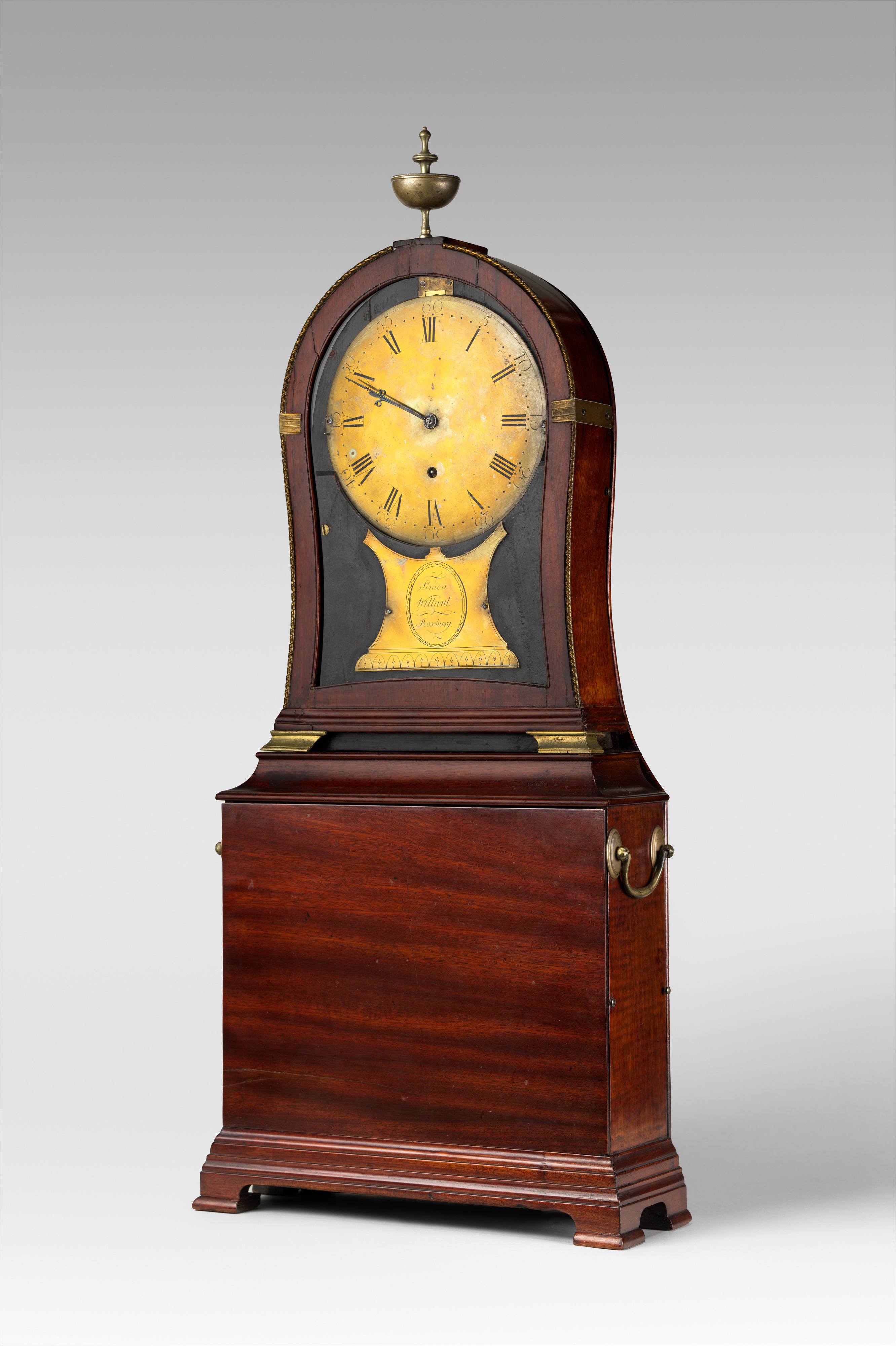
The Metropolitan Museum of Art — Sansbury-Mills and Richard Hampton Jenrette Americana Funds, 2023
clocks
"Balloon" Shelf Clock, Simon Willard, 1780–90
1780–90
"Balloon" Shelf Clock made by Simon Willard (1753–1848), dated 1780–90, from American. The museum records its materials as: Mahogany, pine; brass, iron, steel, lead, synthetic cord (modern). Recorded dimensions: 29 3/4 × 12 3/4 × 4 1/2 in. (75.6 × 32.4 × 11.4 cm). The Metropolitan Museum of Art holds this object as 2023.304a–c; details are those of this museum object, and how far it represents a wider type has not been independently verified.
Partial type record
The Metropolitan Museum of Art, New York
clocks
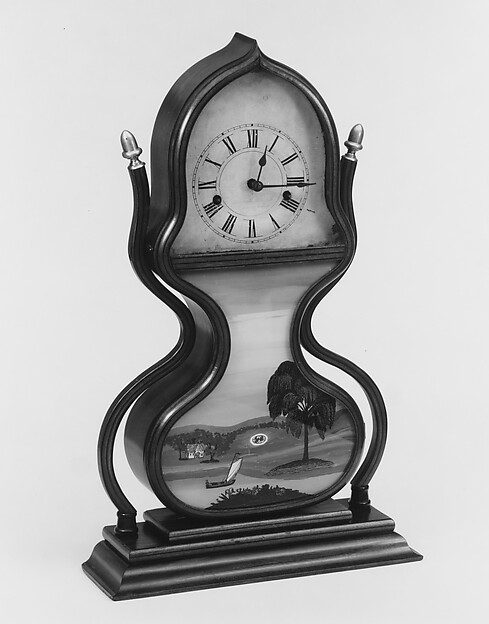
Acorn Clock
1847–50
Acorn Clock made by Forestville Manufacturing Company (1835–1853), dated 1847–50, from American. The museum records its materials as: Mahogany, laminated. Recorded dimensions: 24 3/8 x 14 5/8 x 5 1/8 in. (61.9 x 37.1 x 13 cm). The Metropolitan Museum of Art holds this object as 1970.289.6; details are those of this museum object, and how far it represents a wider type has not been independently verified.
Partial type record
National Heritage Institute, Bucharest via Europeana
clocks
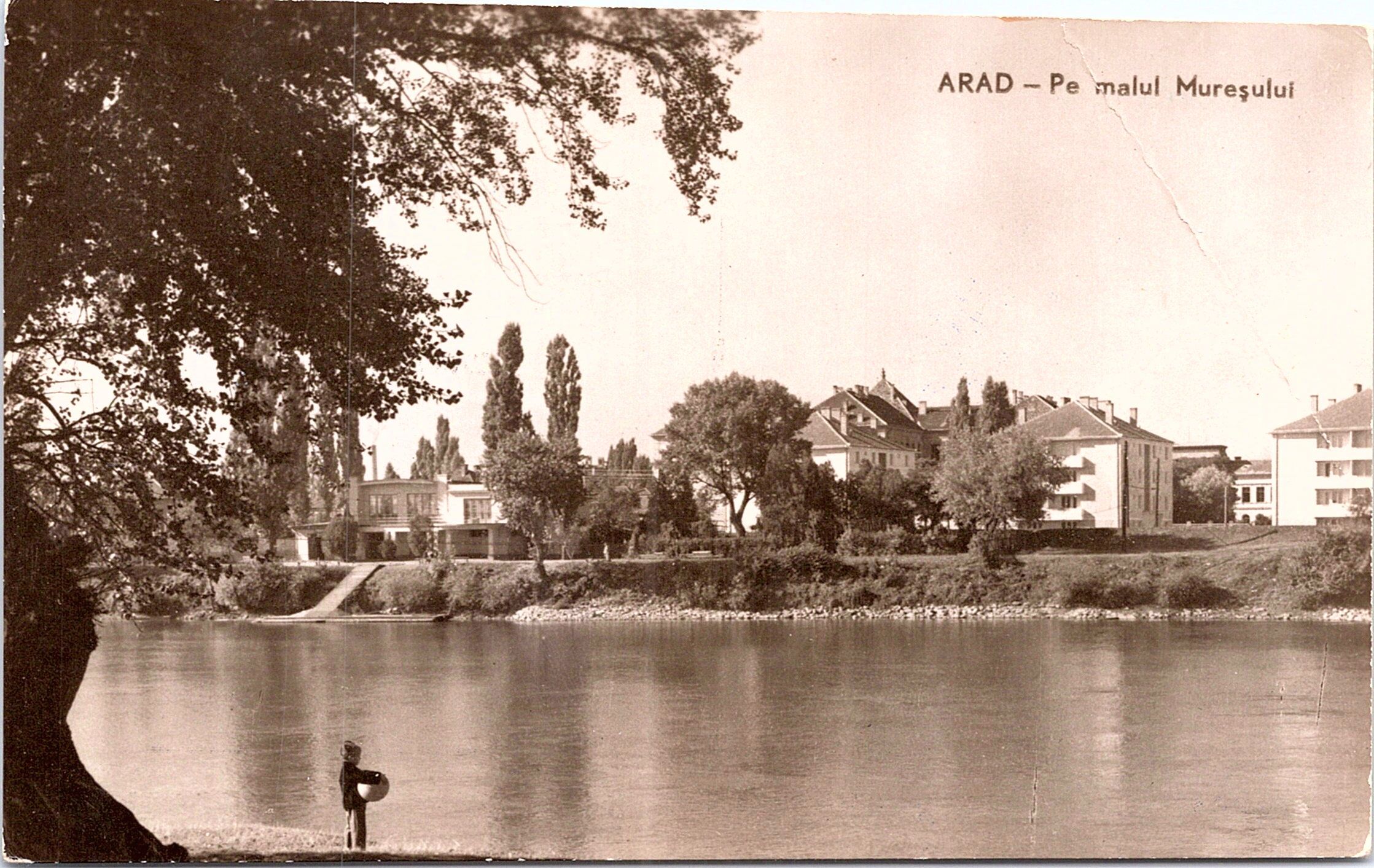
Arad - On the banks of the Mureș, CPCS (photographer)
Arad - On the banks of the Mureș, CPCS (photographer) is held by National Heritage Institute, Bucharest. Museum description: View of a stretch of the bank of the Mureș River. Multi-story residential buildings, trees, and rich vegetation along the water's edge can be seen, as well as a child holding a large ball in their arms. The museum record gives maker recorded: CPCS (photographer). These details come from the holding museum's own record; how far this object represents a wider collectible type has not yet been independently verified.
Partial type record
Rijksmuseum, Amsterdam
clocks
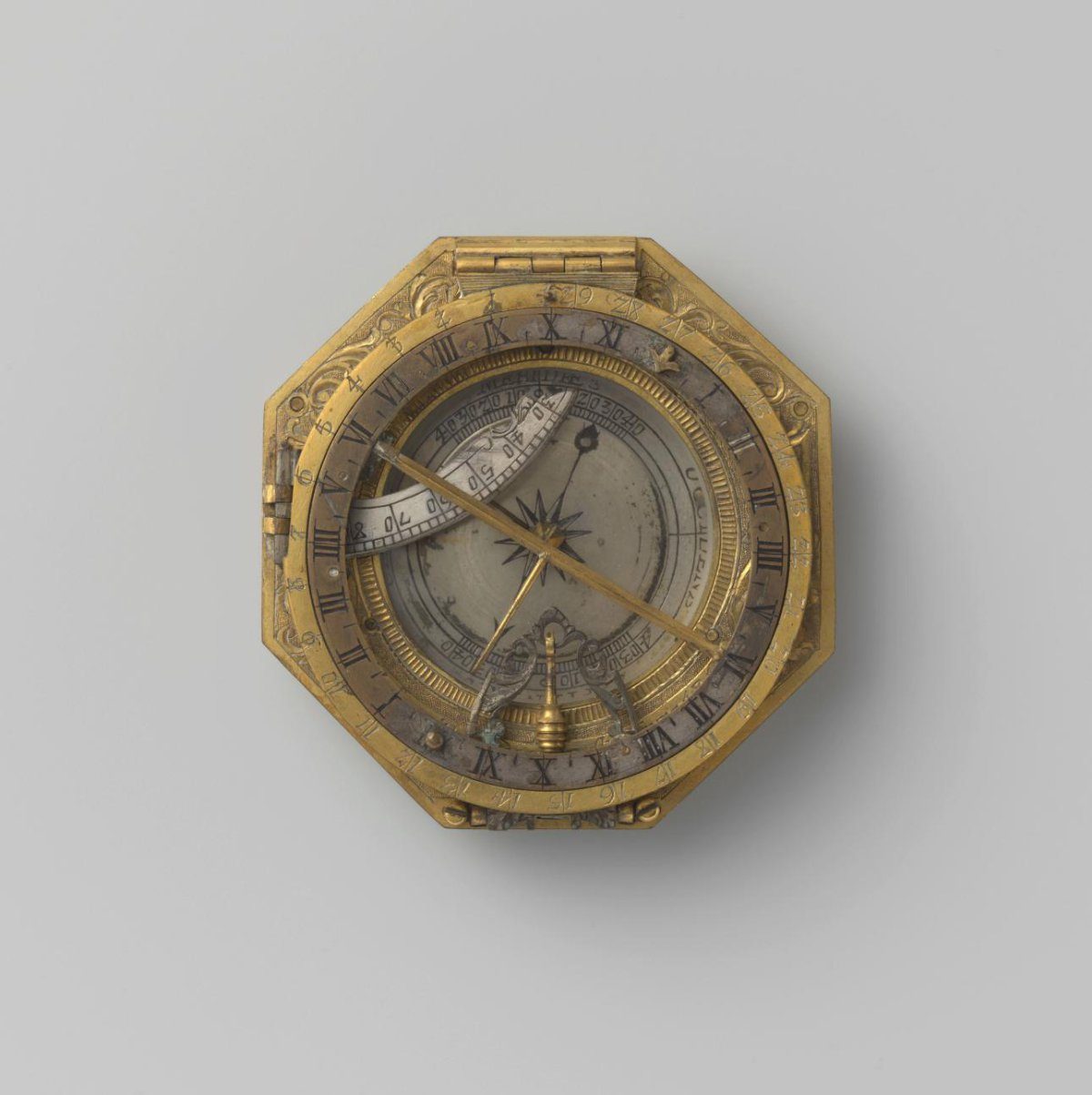
Astrolabe
1700 - 1750
Compass sundial of brass and iron, eight-sided on 3 feet. Decorated and with a circular glass cover in the center. The Rijksmuseum, Amsterdam, holds this object as BK-1969-179; its record gives material recorded as brass (alloy); measurements height 7.5 cm x diameter 7.2 cm. Description translated from the museum's Dutch catalogue text; details are those of this museum object, and how far it represents a wider type has not been independently verified.
Partial type record
The Metropolitan Museum of Art, New York
clocks
Astronomical table clock, 1568
1568
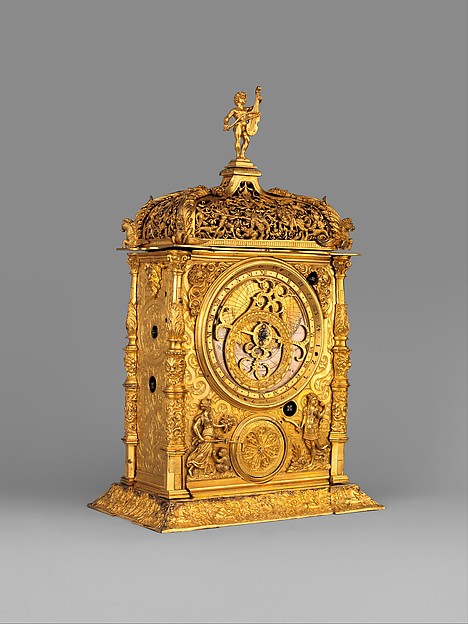
Astronomical table clock in The Metropolitan Museum of Art, New York (accession 17.190.634a–d), catalogued by the museum's European Sculpture and Decorative Arts department. The museum dates it 1568. It is attributed to Jeremias Metzger (German, ca. 1525–ca. 1597). The museum records the medium as Case and dials: gilded brass; Movement: iron and the dimensions as Overall: 14 1/4 × 8 1/2 × 5 3/4 in. (36.2 × 21.6 × 14.6 cm). Subject tags assigned by the museum: Male Nudes, Pegasus, Zodiac. These details are transcribed from the museum's open-access record; how far this object represents a wider collectible type has not yet been independently verified.
Partial type record
The Metropolitan Museum of Art, New York
clocks
Astronomical table clock, second quarter 17th century
second quarter 17th century
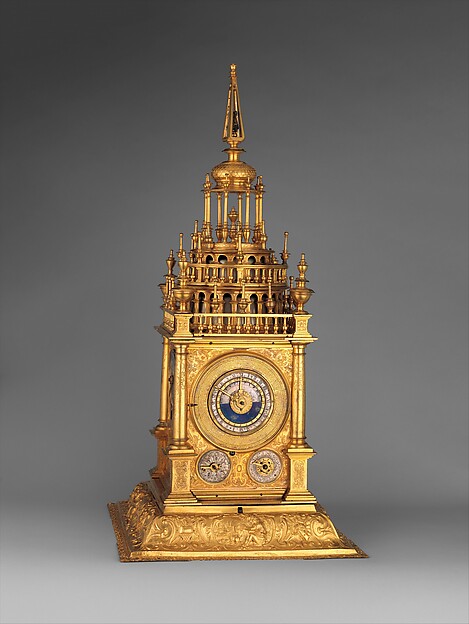
Astronomical table clock in The Metropolitan Museum of Art, New York (accession 17.190.747), catalogued by the museum's European Sculpture and Decorative Arts department. The museum dates it second quarter 17th century. The museum records the medium as Case: gilded brass and gilded copper; Dials: gilded brass and silver; Movement: brass, gilded brass, and steel and the dimensions as Overall: 25 × 10 × 10 in. (63.5 × 25.4 × 25.4 cm). Subject tags assigned by the museum: Astronomy, Zodiac. These details are transcribed from the museum's open-access record; how far this object represents a wider collectible type has not yet been independently verified.
Partial type record
German Clock Museum via Europeana
clocks
Baby alarm clock with monkey barber, Union Clock Company, Furtwangen, c. 1900, Union Clock Company, 1900
1900
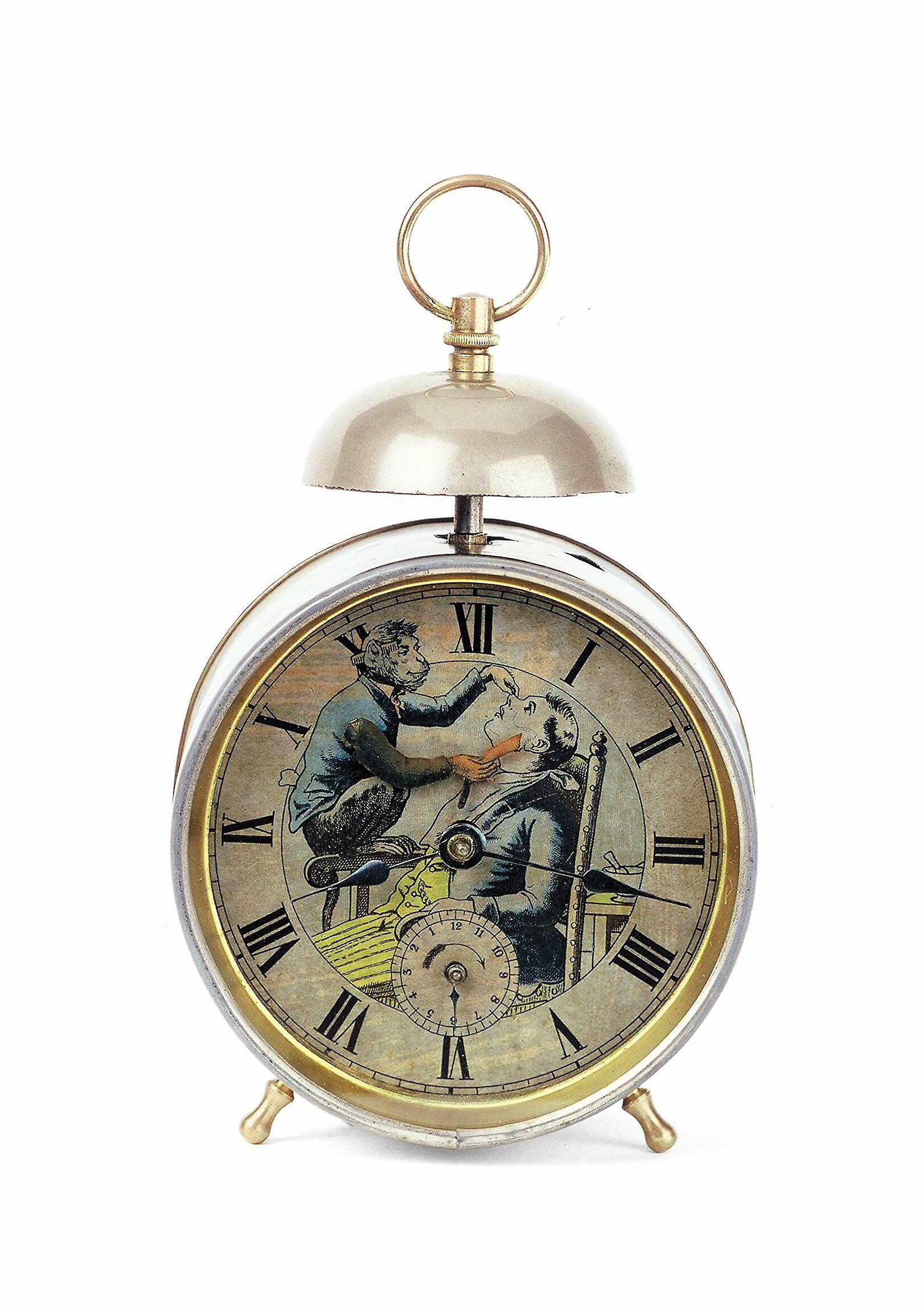
Baby alarm clock with monkey barber, Union Clock Company, Furtwangen, c. 1900, Union Clock Company, 1900 is held by German Clock Museum, dated 1900. Museum description: Baby alarm clock with moving figure "monkey barber", Union Clock Company, Furtwangen, c. 1900. The paper dial shows a man being shaved by a "monkey barber". The back-and-forth swinging of the arm is linked to the movement of the anchor. (Deutsches Uhrenmuseum Furtwangen) The museum record gives measurements height: 17.00 cm, width: 10.50 cm, depth: 6.50 cm; maker recorded: Union Clock Company. These details come from the holding museum's own record; how far this object represents a wider collectible type has not yet been independently verified.
Partial type record
The Metropolitan Museum of Art — Gift of Irwin Untermyer, 1964
clocks
Balloon bracket clock, Savory, ca. 1790
ca. 1790
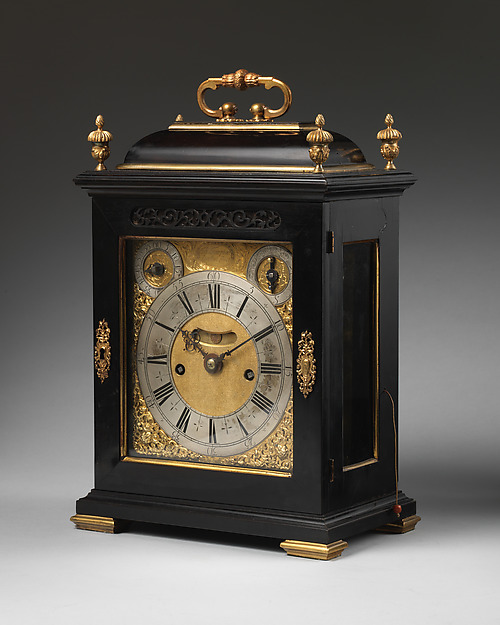
Balloon bracket clock made by Savory, dated ca. 1790, from British, London. The museum records its materials as: Satinwood, mahogany. Recorded dimensions: Overall: 14 1/2 × 7 1/2 × 3 1/4 in. (36.8 × 19.1 × 8.3 cm). The Metropolitan Museum of Art holds this object as 64.101.876; details are those of this museum object, and how far it represents a wider type has not been independently verified.
Partial type record
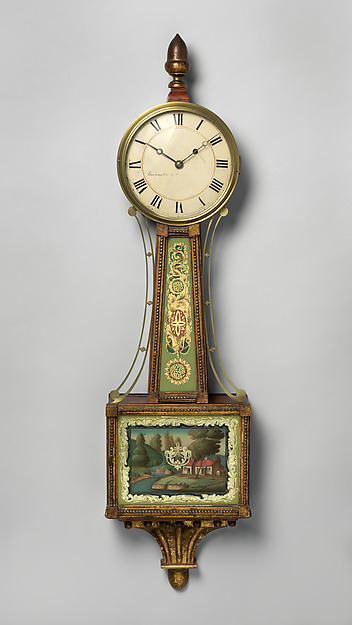
The Metropolitan Museum of Art, Bequest of Flora E. Whiting, 1971
clocks
Banjo clock
1813–16
Banjo clock made by Curtis and Dunning (1816–ca. 1833), dated 1813–16, from American. The museum records its materials as: Mahogany, gilded gesso, verre églomisé tablets. Recorded dimensions: 40 1/2 x 10 in. (102.9 x 25.4 cm). The Metropolitan Museum of Art holds this object as 1971.180.36; details are those of this museum object, and how far it represents a wider type has not been independently verified.
Partial type record
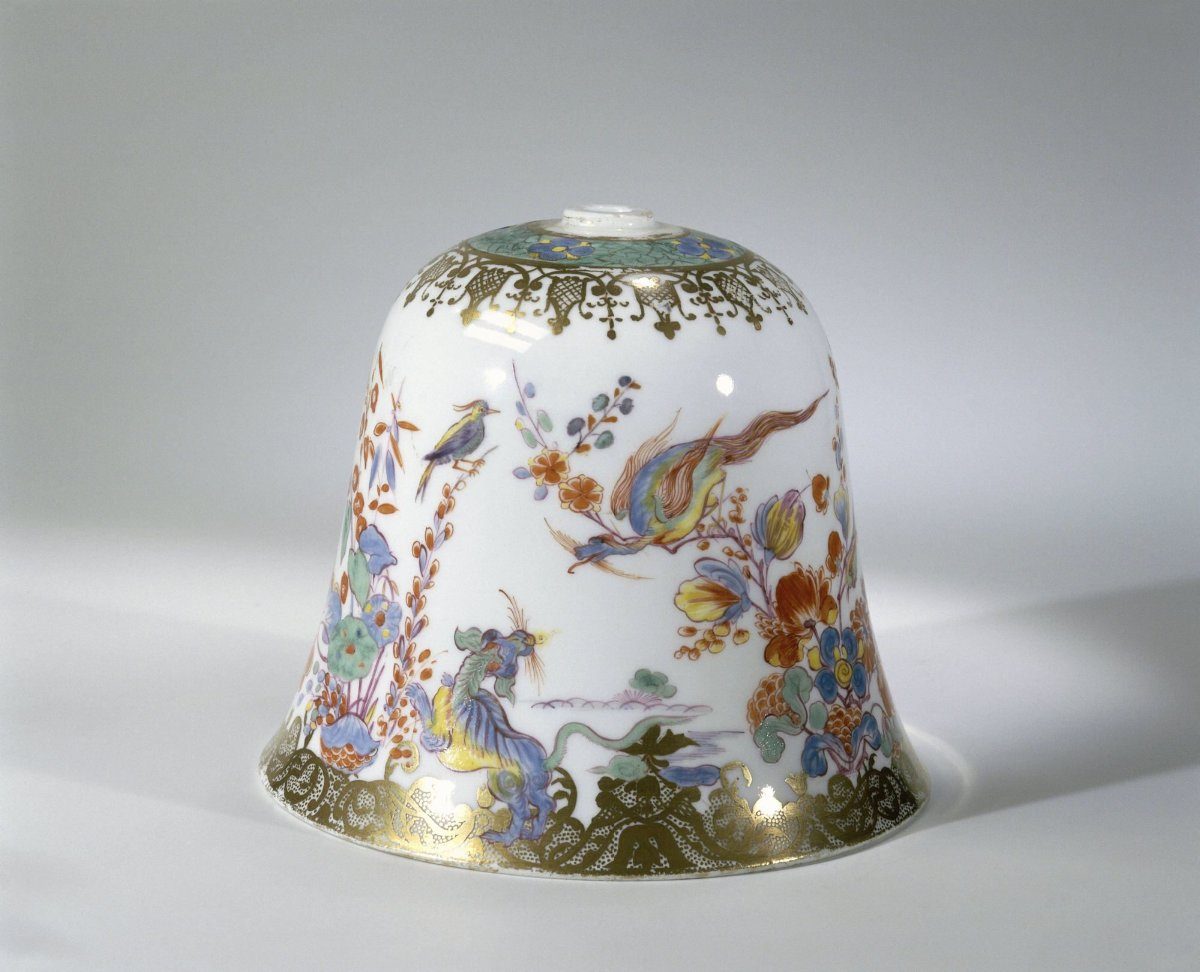
Rijksmuseum, Amsterdam
clocks
Bell from a carillon, polychrome painted with a Kakiemon pattern
c. 1732 - c. 1737
Bell from a carillon, made of polychrome painted porcelain. The bell is painted with a lion, a flying dragon and branches with Indianische Blumen. Painted on top are flowers in blue and yellow on a green ground, and along the rim and on the shoulder is an ornamental border in gold. The bell is marked. The Rijksmuseum, Amsterdam, holds this object as BK-17341; its record gives material recorded as porcelain; technique painting technique; measurements height 13 cm x diameter 15 cm. Description translated from the museum's Dutch catalogue text; details are those of this museum object, and how far it represents a wider type has not been independently verified.
Partial type record
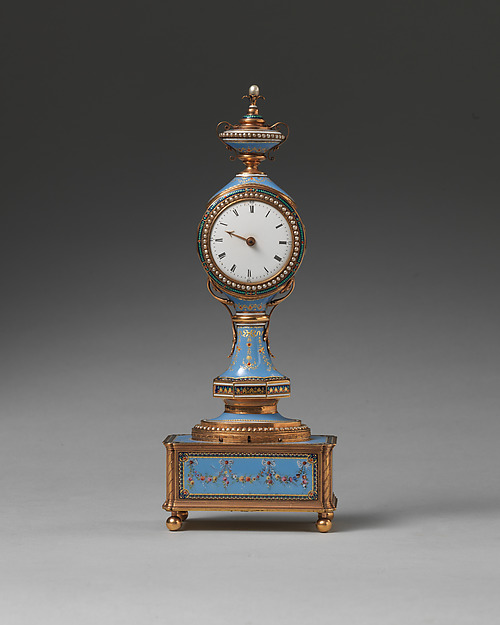
The Metropolitan Museum of Art, New York
clocks
Boudoir clock, ca. 1784–91
ca. 1784–91
Clock in The Metropolitan Museum of Art, New York (accession 52.206.9), catalogued by the museum's European Sculpture and Decorative Arts department under the title “Boudoir clock”. The museum dates it ca. 1784–91. It is attributed to Firm of Jaquet-Droz & Leschot, London and Geneva (1752–1791). The museum records the medium as Gold, enamel and the dimensions as 8 7/16 × 5 1/4 in. (21.4 × 13.3 cm). These details are transcribed from the museum's open-access record; how far this object represents a wider collectible type has not yet been independently verified.
Partial type record
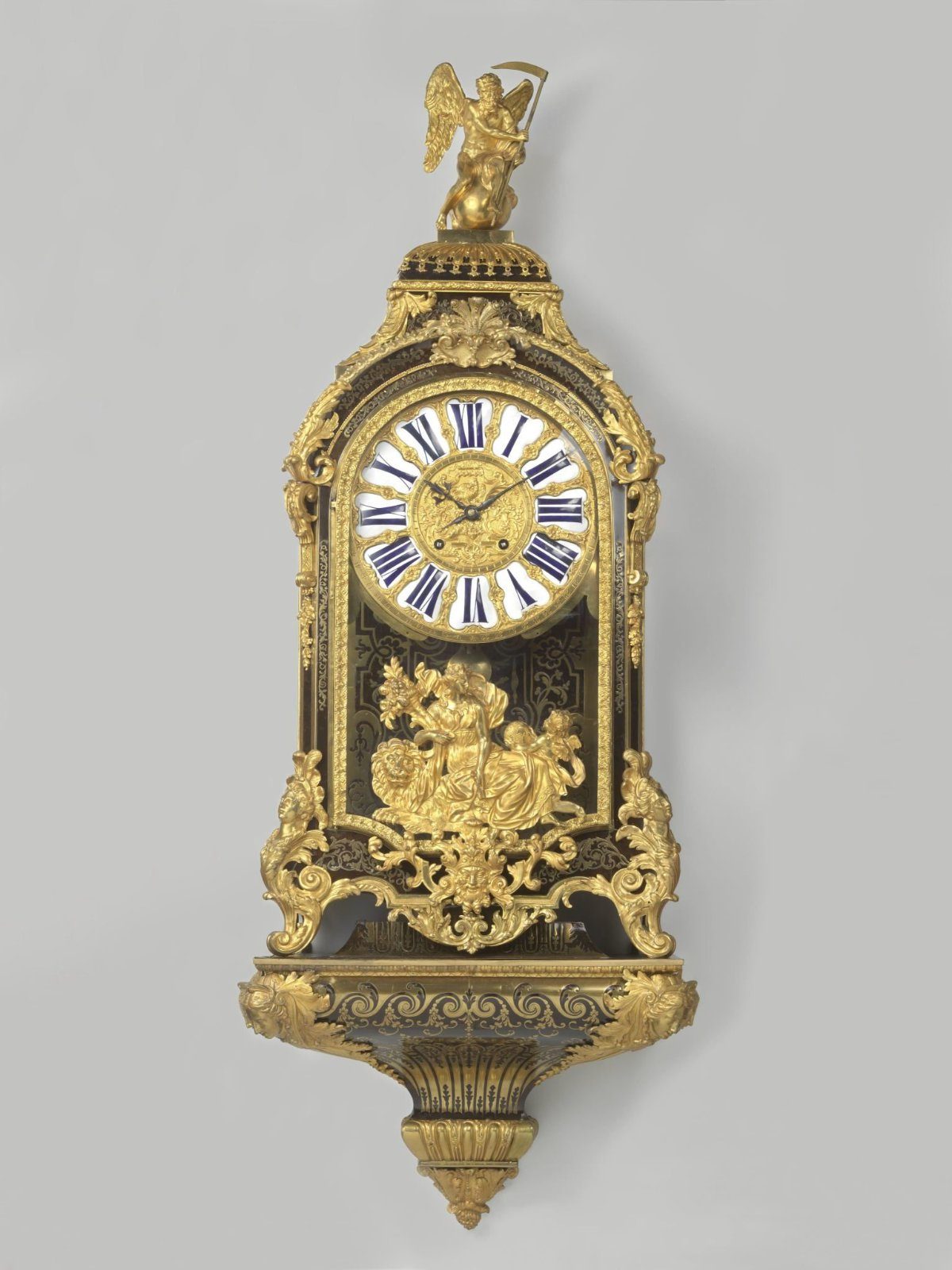
Rijksmuseum, Amsterdam
clocks
Bracket clock
c. 1715 - c. 1730
Bracket clock, decorated with marquetry of brass and tortoiseshell on a pine core, and with gilt bronze. The diagonally placed corner posts carry mounts with acanthus leaf, below with feathered female heads and above with brackets: below the gilt bronze dial decorated with grotesques and with numerals in enamel, a figurative representation in gilt bronze. The brackets also carry decorative mounts. The semicircular lintel is fitted with a crest, above which sits a figure of Father Time. Movement signed on the back: G.J. Campion à Paris. The Rijksmuseum, Amsterdam, holds this object as BK-NM-13187; its record gives material recorded as tortoise shell, bronze (metal), pine (wood), wood (plant material), brass (alloy); technique gild; measurements height 77 cm x width 50 cm x depth 26 cm. Description translated from the museum's Dutch catalogue text; details are those of this museum object, and how far it represents a wider type has not been independently verified.
Partial type record
Rijksmuseum, Amsterdam
clocks
Bracket Clock Decorated with Marquetry in Tortoiseshell and Brass and with Gilt-Bronze Mounts, on an Oak Core
c. 1745 - c. 1749
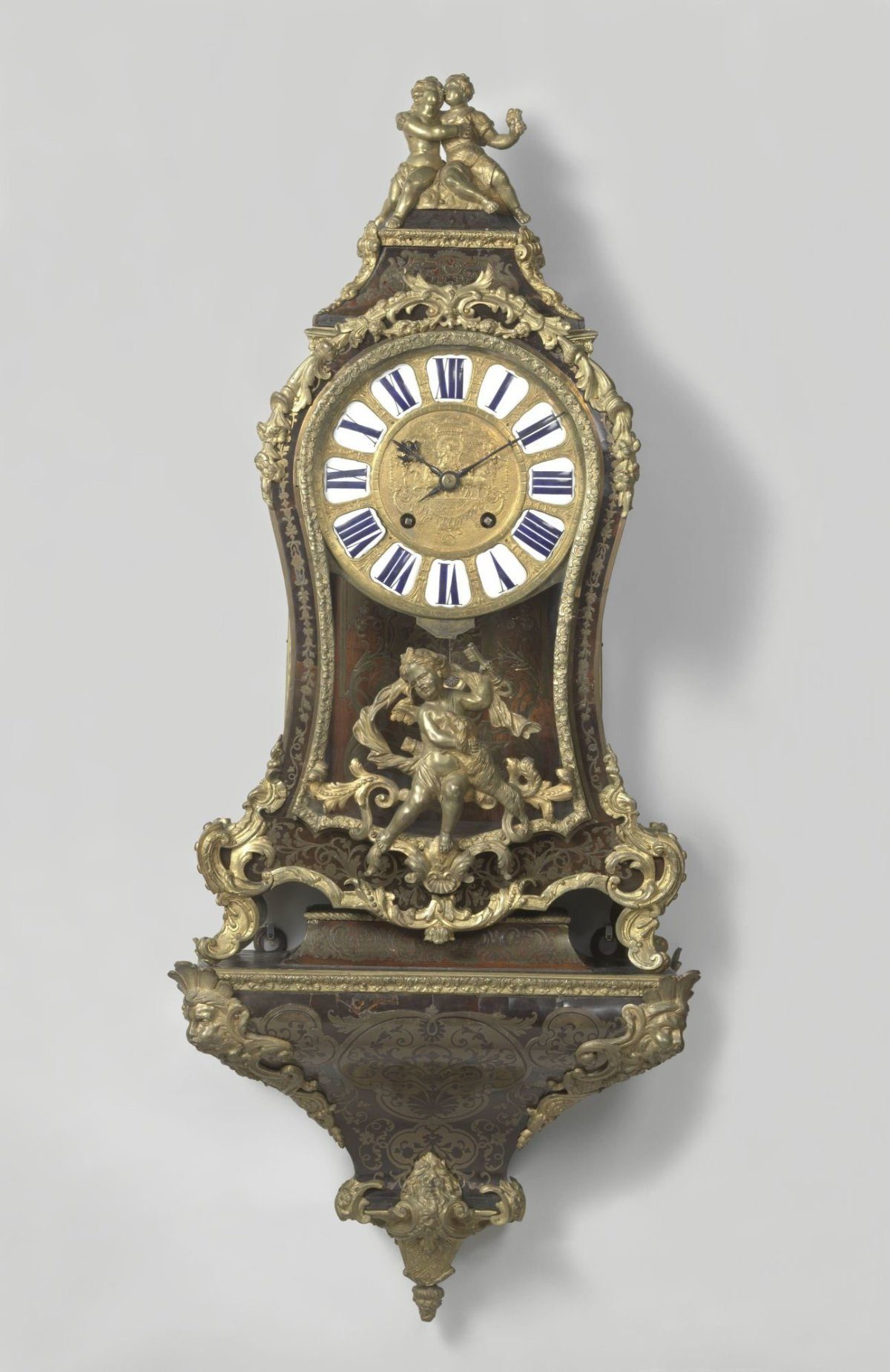
Bracket clock, decorated with marquetry in tortoiseshell and brass, with gilt-bronze mounts on an oak core. The incurved corner posts merge into the semicircular top rail. The mounts consist of volutes with flower and leaf branches. Below the gilt-copper dial, decorated with grotesques and with enamel numerals, mounts in the form of a cupid with dog and key. The top rail carries an upward-sloping cresting surmounted by an amorous couple. Bracket with mounts featuring masks on the corners. Movement signed on the back: "C.D.G: MESNIL à PARIS". The Rijksmuseum, Amsterdam, holds this object as BK-KOG-1456; its record gives material recorded as tortoise shell, bronze (metal), softwood, rosewood (wood), brass (alloy), oak (wood); technique gild; measurements height 121.4 cm x width 50.2 cm x depth 23.1 cm. Description translated from the museum's Dutch catalogue text; details are those of this museum object, and how far it represents a wider type has not been independently verified.
Partial type record
Rijksmuseum, Amsterdam
clocks
Bracket clock of gilded and chased bronze
c. 1745 - c. 1749
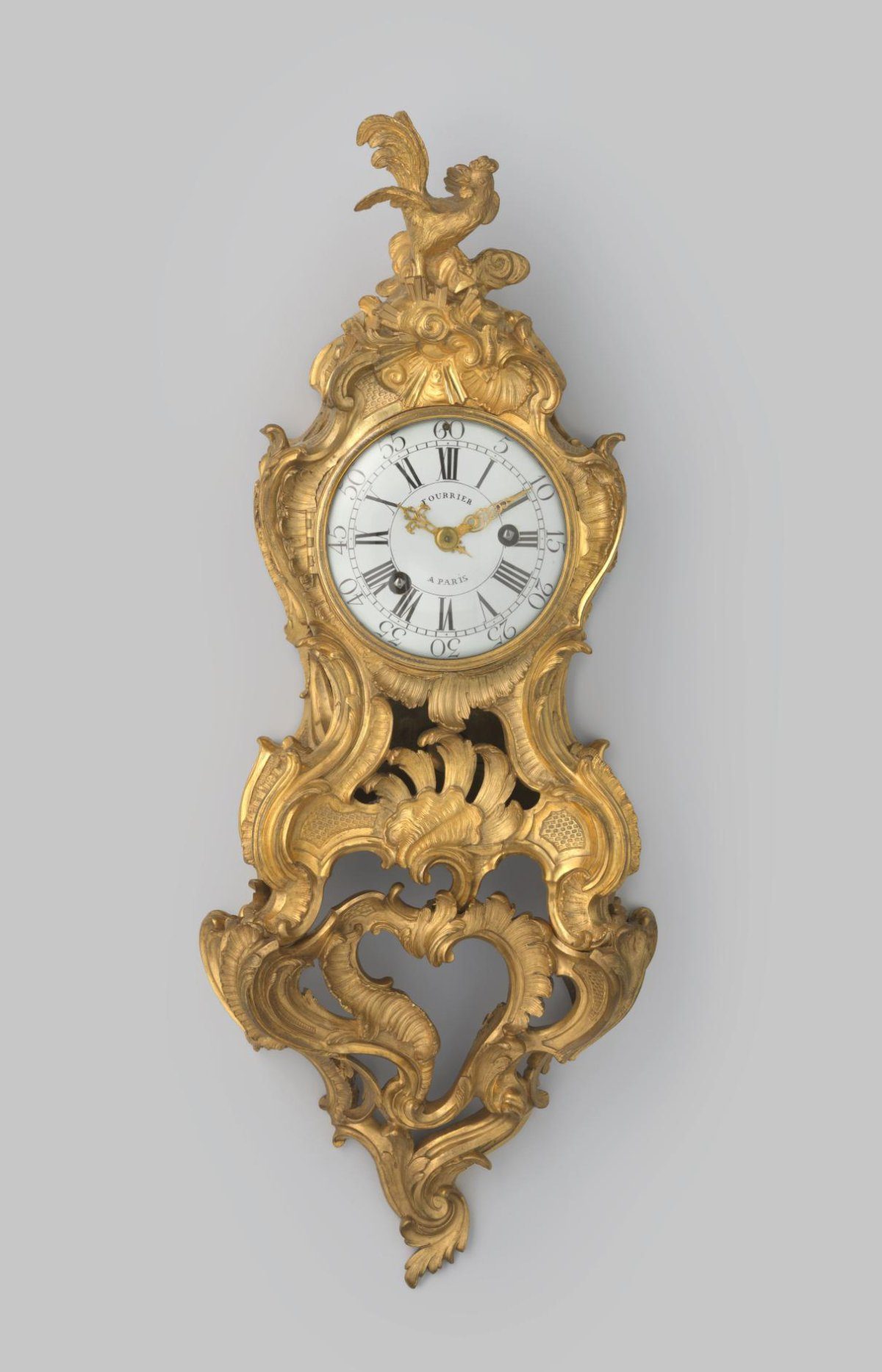
Bracket clock of gilded and chased bronze. The bracket in the shape of an equilateral triangle exhibits openwork, asymmetrical rocaille motifs. The clock is decorated in a similar manner and rests on diagonally placed C-shaped feet, which bear S-shaped foliate scrolls on the front supporting the circular dial. Surmounting the clock are a crowing cock and a sun shining through the clouds. The sides have openwork lozenge-shaped infills. On the bracket is the crowned C control mark. The Rijksmuseum, Amsterdam, holds this object as BK-NM-12289-1; its record gives material recorded as bronze (metal), gilding (material), brass (alloy); technique gild; measurements height 69 cm x width 27.5 cm x depth 15 cm. Description translated from the museum's Dutch catalogue text; details are those of this museum object, and how far it represents a wider type has not been independently verified.
Partial type record
Rijksmuseum, Amsterdam
clocks
Bracket clock of gilded and chased bronze
c. 1745 - c. 1749
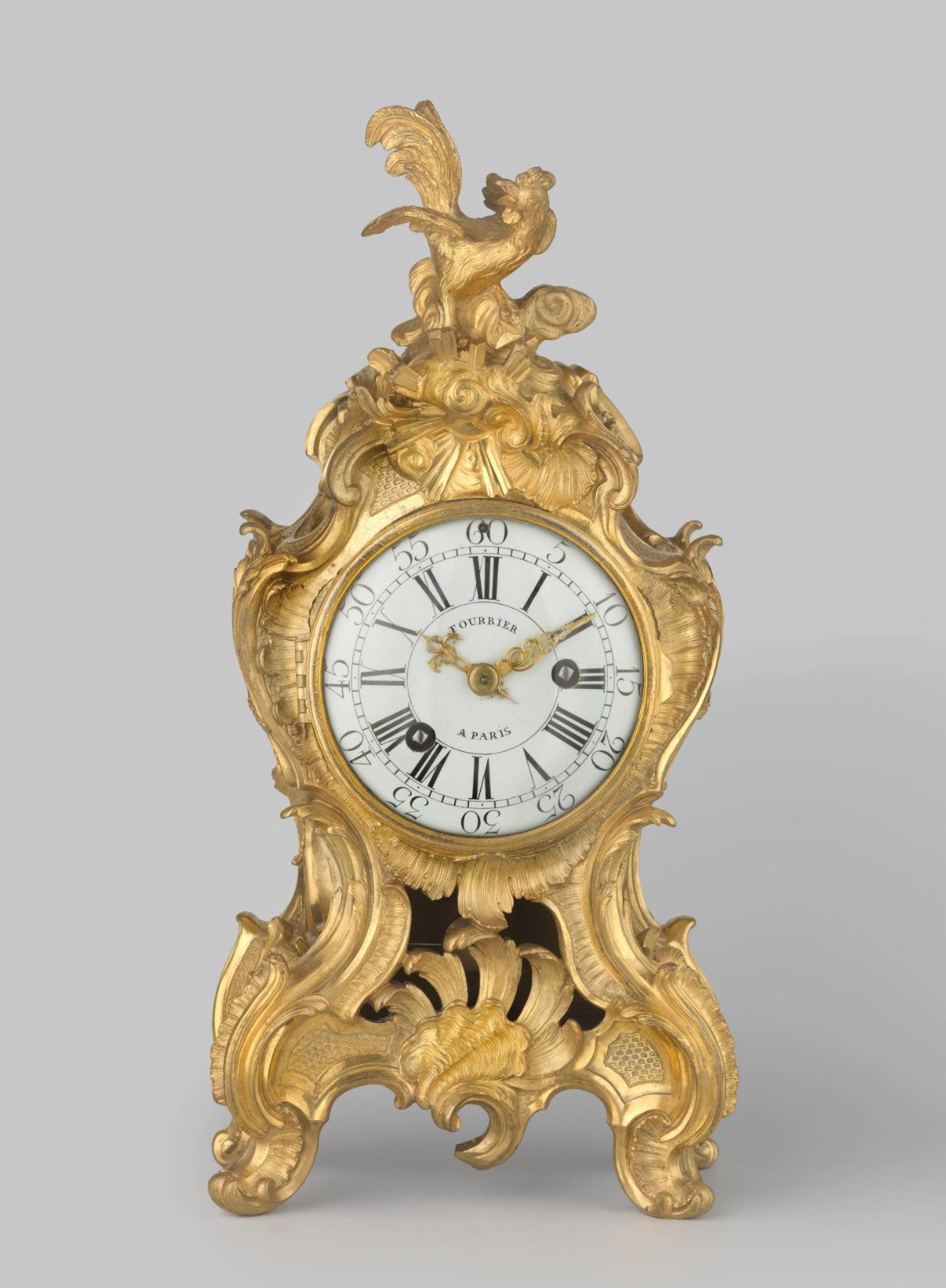
Pendulum of the bracket clock of gilded and chased bronze. The bracket in the shape of an equilateral triangle displays openwork, asymmetrical rocaille motifs. The clock is decorated in a similar manner and rests on diagonally placed C-shaped feet, which bear S-shaped leaf volutes on the front supporting the circular dial. Serving as surmount is a crowing rooster and a sun shining through clouds. The sides have openwork diamond-shaped fillings. On the bracket is the tax mark of the crowned C. The Rijksmuseum, Amsterdam, holds this object as BK-NM-12289-3; its record gives material recorded as gilding (material), brass (alloy), bronze (metal); technique gild; measurements height 69 cm x width 27.5 cm x depth 15 cm. Description translated from the museum's Dutch catalogue text; details are those of this museum object, and how far it represents a wider type has not been independently verified.
Partial type record
Rijksmuseum, Amsterdam
clocks
Bracket clock of gilded and chased bronze
c. 1745 - c. 1749
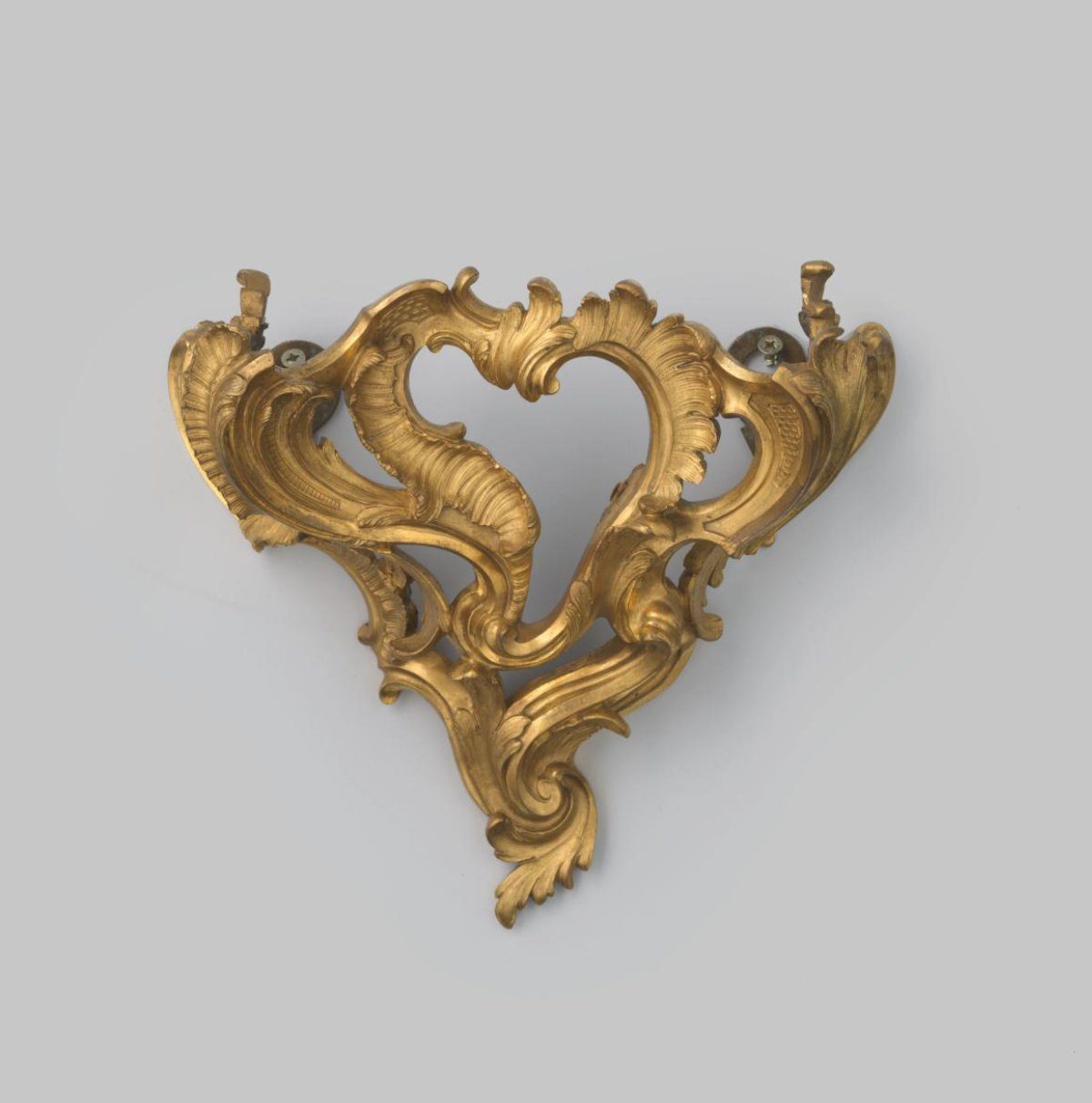
Lower part of the bracket clock of gilded and chased bronze. The bracket, in the shape of an equilateral triangle, displays openwork, asymmetrical rocaille motifs. The clock is decorated in a similar fashion and rests on diagonally placed C-shaped legs, which carry S-shaped foliate volutes on the front supporting the circular dial. The crowning element is a crowing cock and a sun shining through clouds. The sides have openwork diamond-shaped fillings. On the bracket, the crowned C control mark. The Rijksmuseum, Amsterdam, holds this object as BK-NM-12289-2; its record gives material recorded as gilding (material), bronze (metal), brass (alloy); technique gild; measurements height 69 cm x width 27.5 cm x depth 15 cm. Description translated from the museum's Dutch catalogue text; details are those of this museum object, and how far it represents a wider type has not been independently verified.
Partial type record
© Victoria and Albert Museum, London
clocks
Bracket clock, Alfred Thomas West, London, 1760-1765
1760-1765
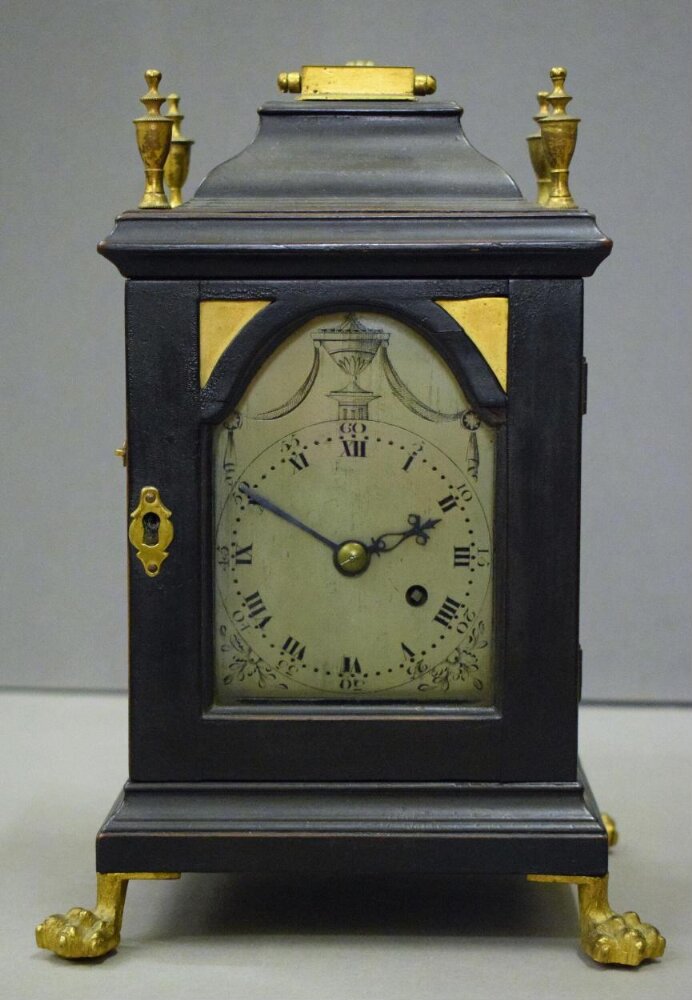
Bracket clock, Alfred Thomas West, London, 1760-1765 is an object recorded by Victoria and Albert Museum, dated 1760-1765. The museum's brief description reads: Bracket Clock, English, 1760-1665, Thomas West. Museum description: Bracket clock, signed at the back "Tho: West, London", and engraved on the face with a vase and festoons. Case of ebonized wood with gilt brass mounts consisting of a drop-handle on the top, four vase shaped finials, four claw feet, and a panel of scale ornament at each side. The museum record gives material recorded as wood, ormolu; measurements Height 25.4 cm; Width 14 cm; Depth 10.2 cm; place associated: London; maker recorded: Alfred Thomas West. These details come from the holding museum's own record; how far this object represents a wider collectible type has not yet been independently verified.
Partial type record
© Victoria and Albert Museum, London
clocks
Bracket clock, Cleghorn, Samuel, London, 1790
1790
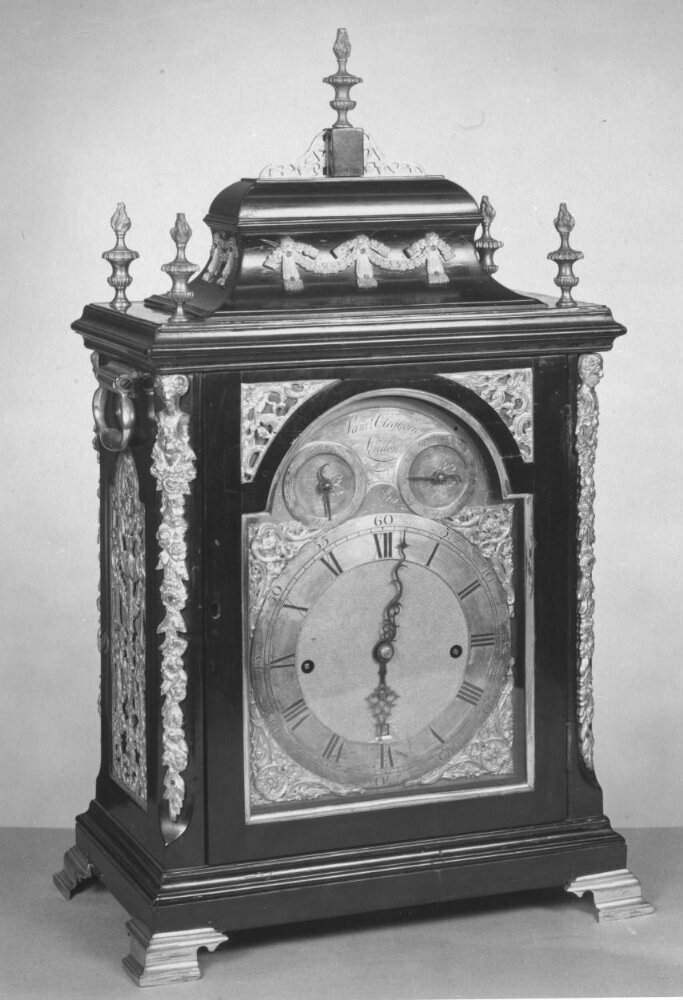
Bracket clock, Cleghorn, Samuel, London, 1790 is an object recorded by Victoria and Albert Museum, dated 1790. The museum's brief description reads: Musical bracket clock, ebonised wood with gilt brass mounts, Samuel Cleghorn, London, England, 1790. Museum description: Ebonised wood with gilt-brass mounts. The case rests on four brass bracket feet of irregular shape. At each corner there is a mount in the form of a female head from which hangs a trail of flowers and foliage. Above each is a brass flaming urn, with a fifth one, supported by a brass fretted decoration, surmounting the moulded oblong dome. This has a flattened swag-like mount on each side. A round-headed panel of fretted brass over crimson silk at each side with a brass loop handle above. A round-headed pane of glass at back and front. Brass face, silvered chapter ring and brass arabesques in the spandrels. Going and striking winding holes and a date aperture. Within the arched top a small Strike/Silent dial on the left and on the right a similar one marked 'Hornpipe, Lass Patty's Mill, Highland Laddie, March'. The museum record gives material recorded as ebony, brass, glass; measurements Height 62.8 cm; Width 37.1 cm; Depth 22.8 cm; place associated: London; maker recorded: Cleghorn, Samuel. These details come from the holding museum's own record; how far this object represents a wider collectible type has not yet been independently verified.
Partial type record
© Victoria and Albert Museum, London
clocks
Bracket clock, England, 1760-1770
1760-1770
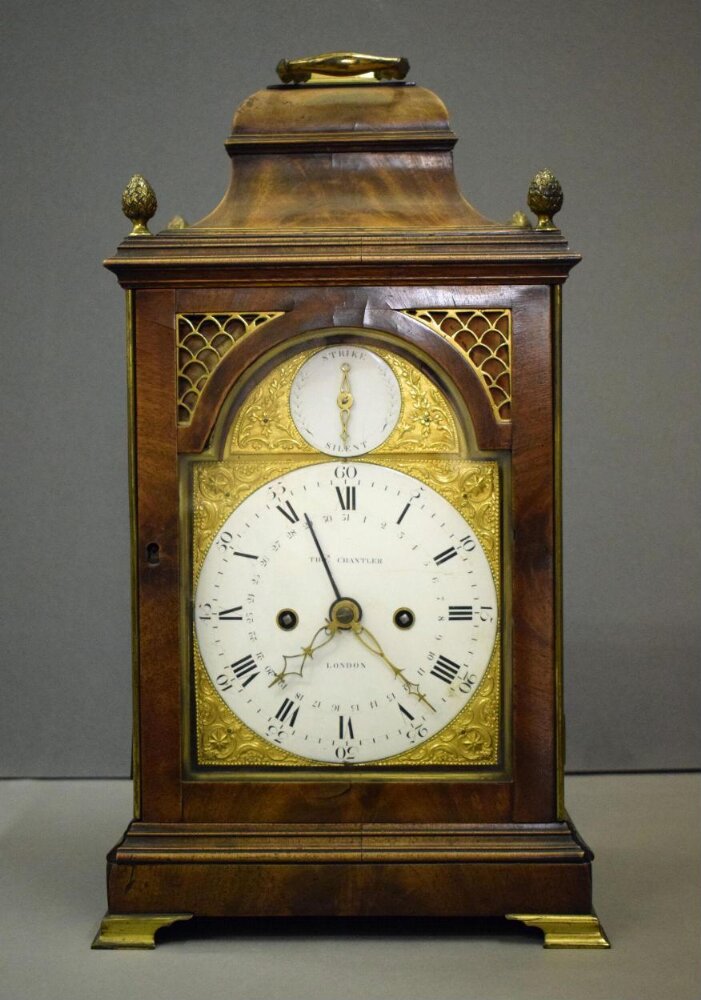
Bracket clock, England, 1760-1770 is an object recorded by Victoria and Albert Museum, dated 1760-1770. The museum's brief description reads: Bracket clock, English, 1760-1770, mahogany case, movement by Thomas Chantler. Museum description: The following description is transcribed from the original resiter of 1959: Mahogany case. Spring movement with anchor escapement. Striking on one bell. White enamel dial with indicator for days of the week. Arched top with white enamel roundel and indicator for striking or silence. Stamped gilt-brass spandrels. The backplate engraved in the centre with the Prince of Wales's feathers within neoclassical scrolls. Domed case veneered with mahogany with giltbrass frets at sides, glass back. Pineapple finials at corners, gilt-brass lifting handles and bracket feet. The museum record gives material recorded as mahogany, brass (alloy), enamel; measurements Height 40.6 cm; Width 25.4 cm; Depth 17.8 cm; place associated: England. These details come from the holding museum's own record; how far this object represents a wider collectible type has not yet been independently verified.
Partial type record
© Victoria and Albert Museum, London
clocks
Bracket clock, George McCulloch, England, ca.1880
ca.1880
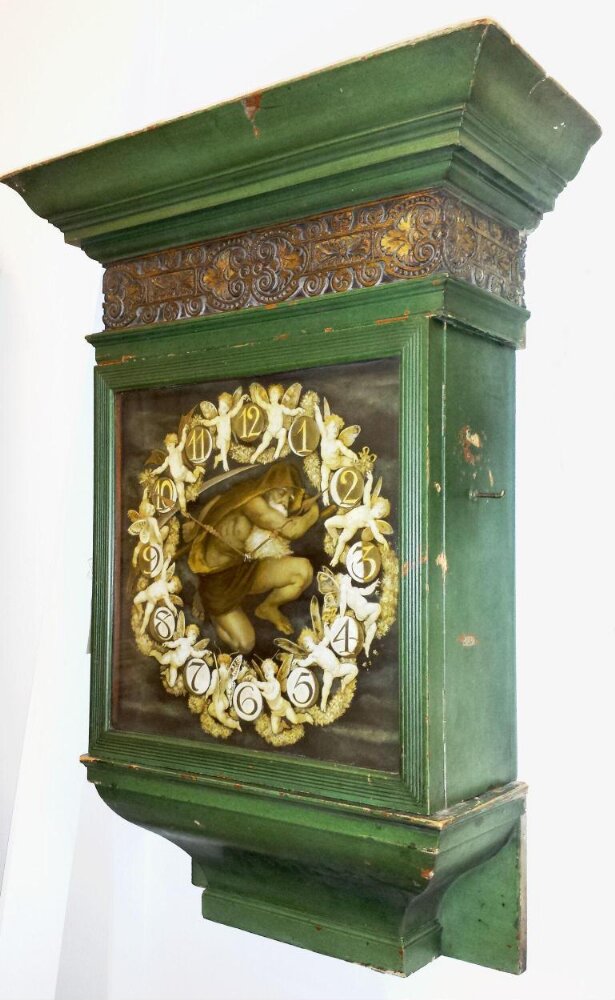
Bracket clock, George McCulloch, England, ca.1880 is an object recorded by Victoria and Albert Museum, dated ca.1880. The museum's brief description reads: Bracket clock made in England, ca. 1880, the dial painted in grisaille, possibly by George McCulloch.. Museum description: Bracket clock with carved and gilt decoration. The square clock face, with a glazed door with reeded decoration, is of brass with painted decoration en grisaille depicting fairies and garlands, with figures depicted as phases of the moon with a crouching hooded Father Time. Brass hands The museum record gives material recorded as brass (alloy), wood, glass; measurements Height 92 cm; Width 66.5 cm; Depth 30 cm; place associated: England; maker recorded: George McCulloch. These details come from the holding museum's own record; how far this object represents a wider collectible type has not yet been independently verified.
Partial type record
© Victoria and Albert Museum, London
clocks
Bracket clock, Gray, Thomas, London, ca. 1750
ca. 1750
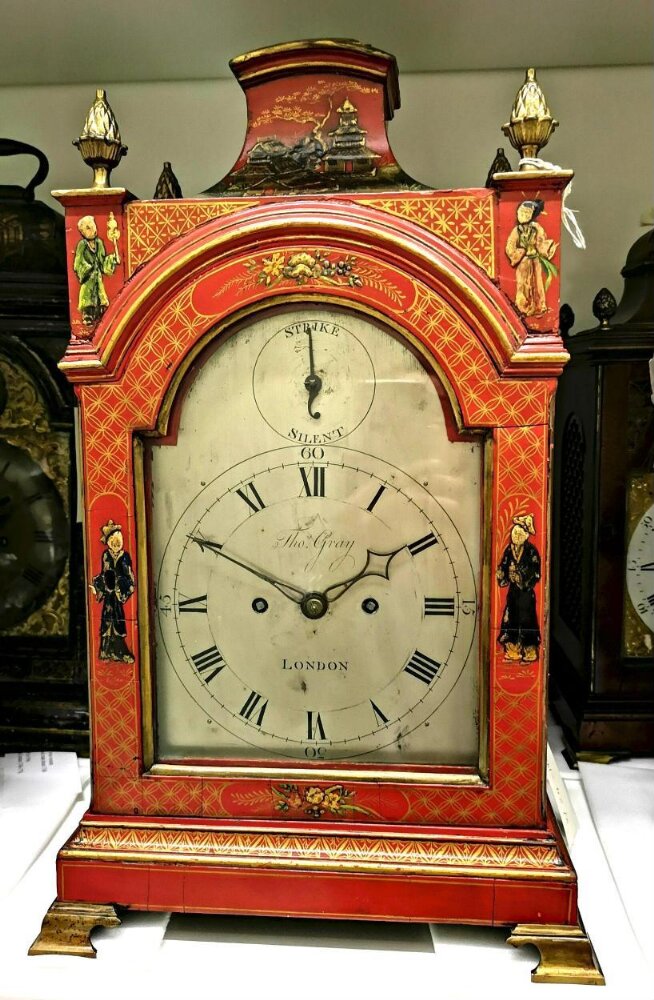
Bracket clock, Gray, Thomas, London, ca. 1750 is an object recorded by Victoria and Albert Museum, dated ca. 1750. The museum's brief description reads: Bracket clock, English, ca. 1750, inscribed "Thos. Gray London", lacquered red and decorated with landscapes and figures. Museum description: Bracket clock in wooden case lacquered red and decorated with landscapes and figures. The incurving top is fitted with a brass ring and at the four corners of the hood are brass acorn finials. Arched door with mouldings above, and a silvered dial with hand inscribed 'Thos. Gray London'. Side panels are filled with a reticulated pattern in brass work; moulded base is supported on brass bracket feet. Movement at back engraved with floral patterns and 'T.G.' in a circle. The museum record gives material recorded as wood, brass (alloy); measurements Height 48.3 cm; Width 24.1 cm; Depth 15.2 cm; place associated: London; maker recorded: Gray, Thomas. These details come from the holding museum's own record; how far this object represents a wider collectible type has not yet been independently verified.
Partial type record
© Victoria and Albert Museum, London
clocks
Bracket clock, Gretton, Charles, London, ca. 1700
ca. 1700
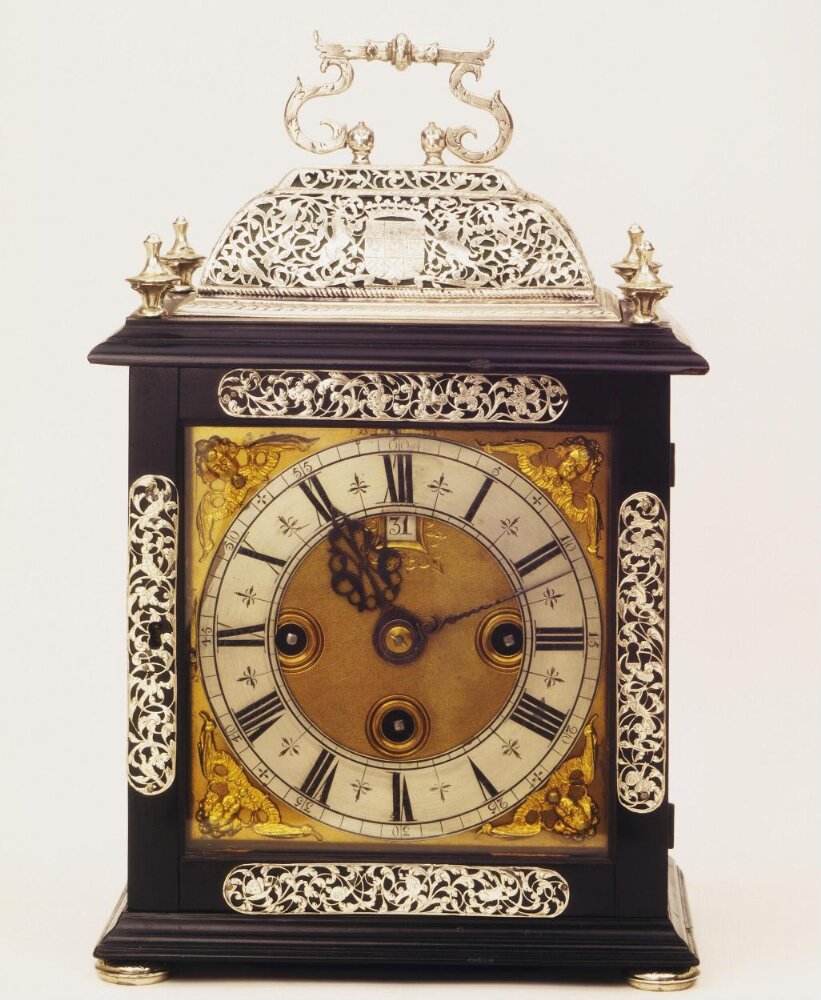
Bracket clock, Gretton, Charles, London, ca. 1700 is an object recorded by Victoria and Albert Museum, dated ca. 1700. The museum's brief description reads: Bracket Clock - Gretton. Museum description: Object TypeThis bracket clock with its ebonised case and silver mounts is a fine representative of a high-quality London-made time piece of the early 18th century. The complex mechanism is very characteristic of its maker, Charles Gretton. There is also a calendar mechanism, with a date aperture in the dial. The prominent silver mount on the top of the clock is pierced with scrolling foliage and bears the crest and cipher of Charles Bodville Robartes, 2nd Earl of Radnor (1685-1723). The clock has undergone some restoration.PeopleCharles Gretton was one of the best London clockmakers of the early 18th century. He was apprenticed in 1662, became a member of the Clockmakers Company in 1672 and was Master of the Clockmakers' Company from 1700 to 1733. He made watches, long-case clocks and bracket clocks, many like this example with complex repeating movements. The museum record gives measurements Height 35.5 cm; Width 22.5 cm; Depth 15.5 cm; place associated: London; maker recorded: Gretton, Charles. These details come from the holding museum's own record; how far this object represents a wider collectible type has not yet been independently verified.
Partial type record
© Victoria and Albert Museum, London
clocks
Bracket clock, Harris (Christopher), London, ca. 1740
ca. 1740
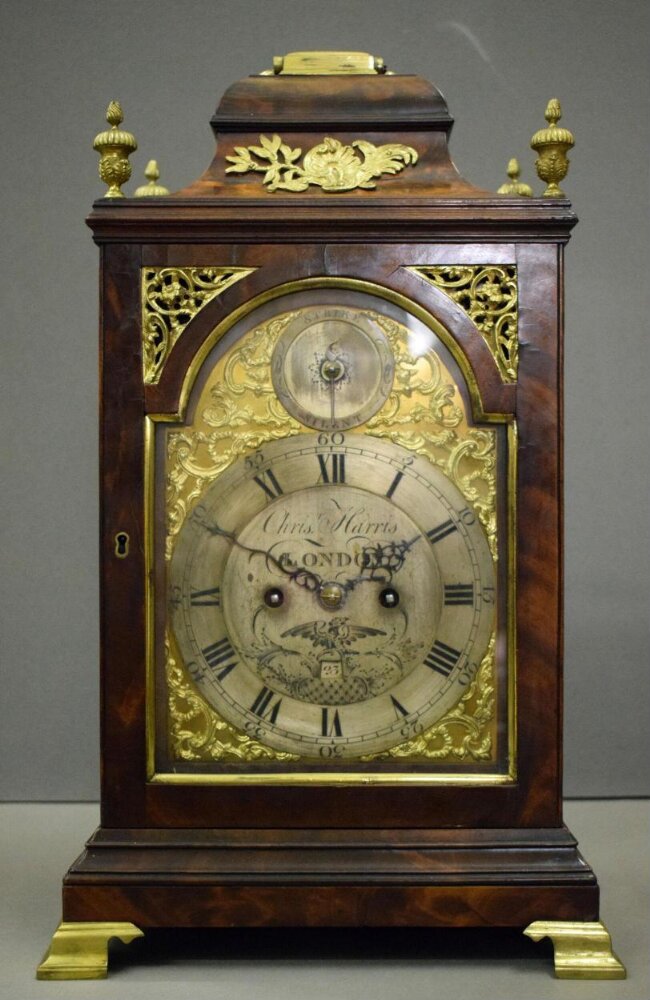
Bracket clock, Harris (Christopher), London, ca. 1740 is an object recorded by Victoria and Albert Museum, dated ca. 1740. The museum's brief description reads: Bracket clock in mahogany case, inscribed "Chrisr, Harris LONDON", made about 1740. Museum description: Bracket clock in a mahogany case with a moulded base resting on four brass feet. The bell-top has a mount at the front, with four flaming urn finials at the corners. The museum record gives material recorded as mahogany, brass (alloy); measurements Height 48.1 cm; Width 28.5 cm; Depth 20.3 cm; place associated: London; maker recorded: Harris (Christopher). These details come from the holding museum's own record; how far this object represents a wider collectible type has not yet been independently verified.
Partial type record
The Metropolitan Museum of Art — Gift of Irwin Untermyer, 1964
clocks
Bracket clock, John Fordham, 1755
1755
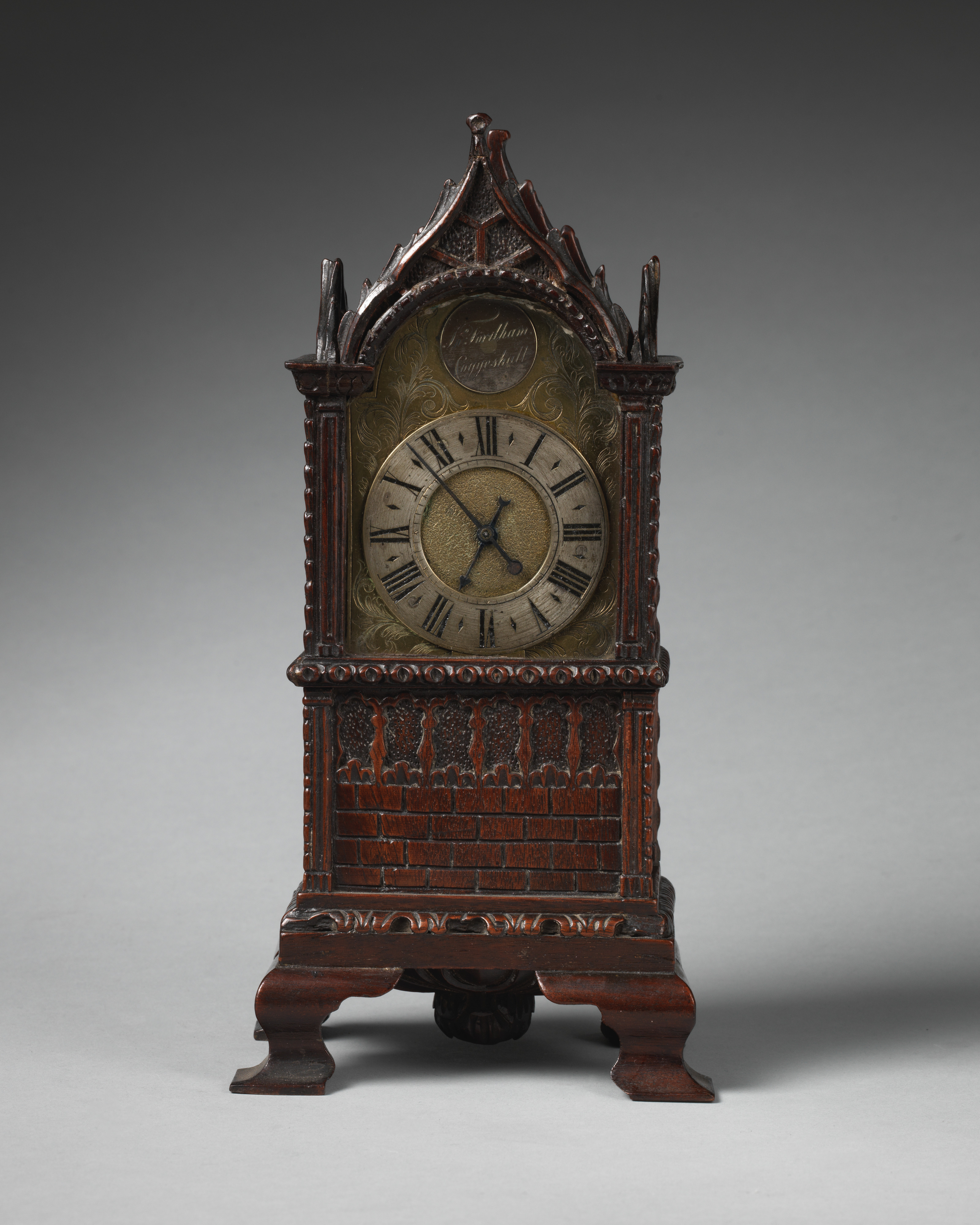
Bracket clock made by John Fordham (British, active Coggeshall), dated 1755, from British, Coggeshall. The museum records its materials as: Mahogany. Recorded dimensions: Overall: 10 × 5 × 3 3/4 in. (25.4 × 12.7 × 9.5 cm). The Metropolitan Museum of Art holds this object as 64.101.869; details are those of this museum object, and how far it represents a wider type has not been independently verified.
Partial type record
© Victoria and Albert Museum, London
clocks
Bracket clock, Markwick, James (the younger), London, ca. 1730
ca. 1730
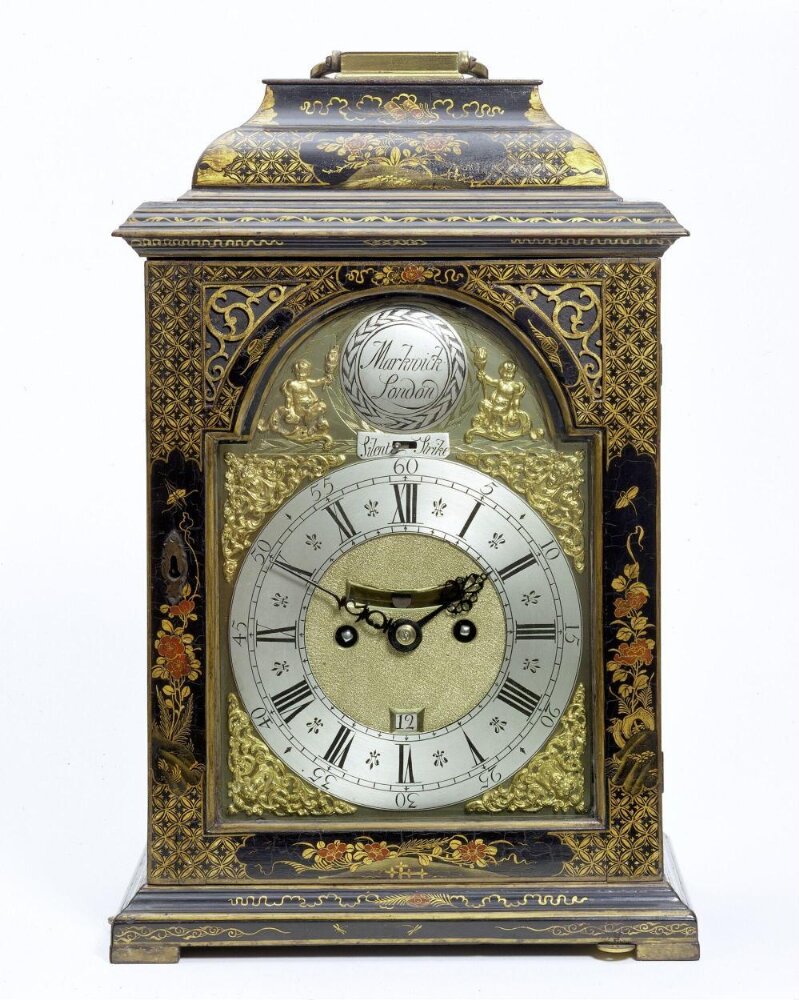
Bracket clock, Markwick, James (the younger), London, ca. 1730 is an object recorded by Victoria and Albert Museum, dated ca. 1730. The museum's brief description reads: Bracket clock, English, ca. 1730, made by James Markwick the Younger. Museum description: Bracket clock in a wooden case with chinoiserie decoration. The arched dial has a silvered hour-circle, hands of pierced steel and a day-of-the-month aperture; the spandrel ornament of brass in a design of masks surrounded by scrollwork. The back-plate is engraved with scrollwork, and the pendulum is engraved with a floral design. On a convex silvered disc is engraved 'Tarkwick London' and on either side are cherubs holding torches of brass. In the spandrels of the arched door and at the side below the top are panels of pierced fretwork decoration. The case is decorated with diaper patterns and floral ornament in red and gold on a black ground. The museum record gives material recorded as wood, steel, brass; measurements Height 45.6 cm; Width 26.6 cm; Depth 17.2 cm; place associated: London; maker recorded: Markwick, James (the younger). These details come from the holding museum's own record; how far this object represents a wider collectible type has not yet been independently verified.
Partial type record
© Victoria and Albert Museum, London
clocks
Bracket clock, Martin, John, London, ca. 1695
ca. 1695
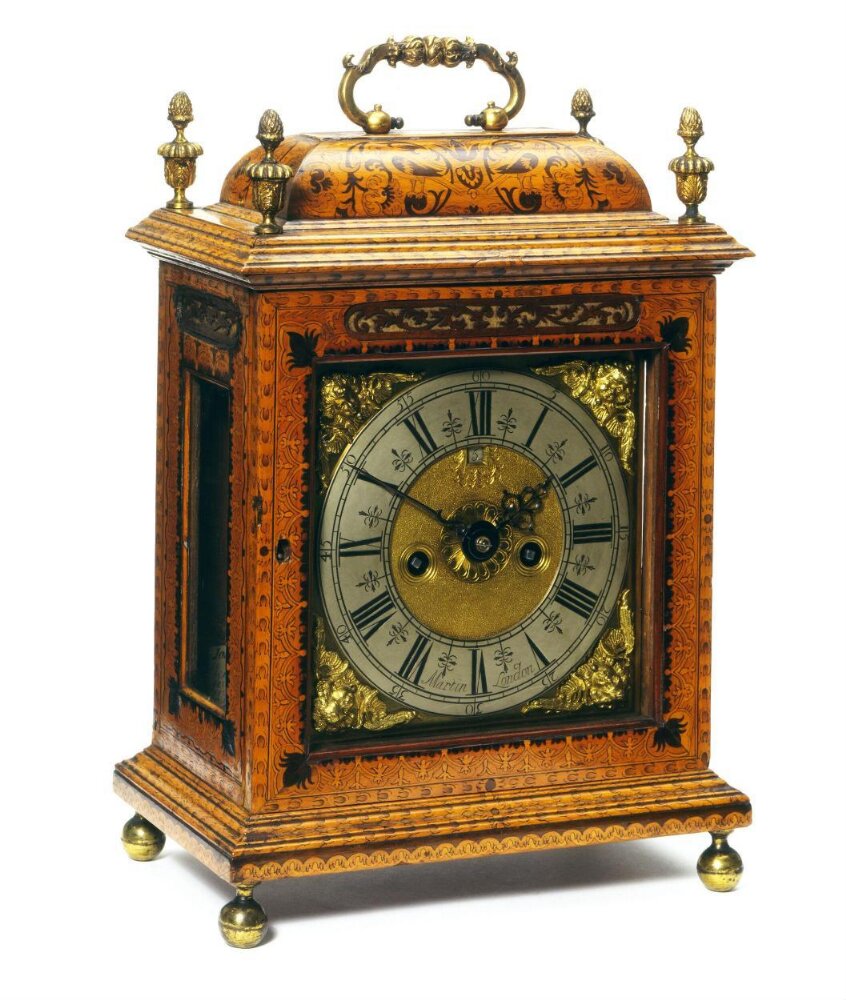
Bracket clock, Martin, John, London, ca. 1695 is an object recorded by Victoria and Albert Museum, dated ca. 1695. The museum's brief description reads: Bracket clock, English; London, 1690-1700, by John Martin. Museum description: Bracket clock in case decorated with repeating patterns of birds and flowers in marquetry of various woods on a sycamore ground, with ormolu mounts. It has a finely chased, brass fold-down handle and four vase-shaped pineapple finials. The museum record gives material recorded as sycamore, walnut, holly, boxwood, purpleheart, ormolu, oak, pine, brass (alloy); measurements Height 40 cm; Width 27 cm; Depth 17 cm; Height 35.5 cm; place associated: London; maker recorded: Martin, John. These details come from the holding museum's own record; how far this object represents a wider collectible type has not yet been independently verified.
Partial type record
© Victoria and Albert Museum, London
clocks
Bracket clock, Paulet, London, ca. 1710
ca. 1710
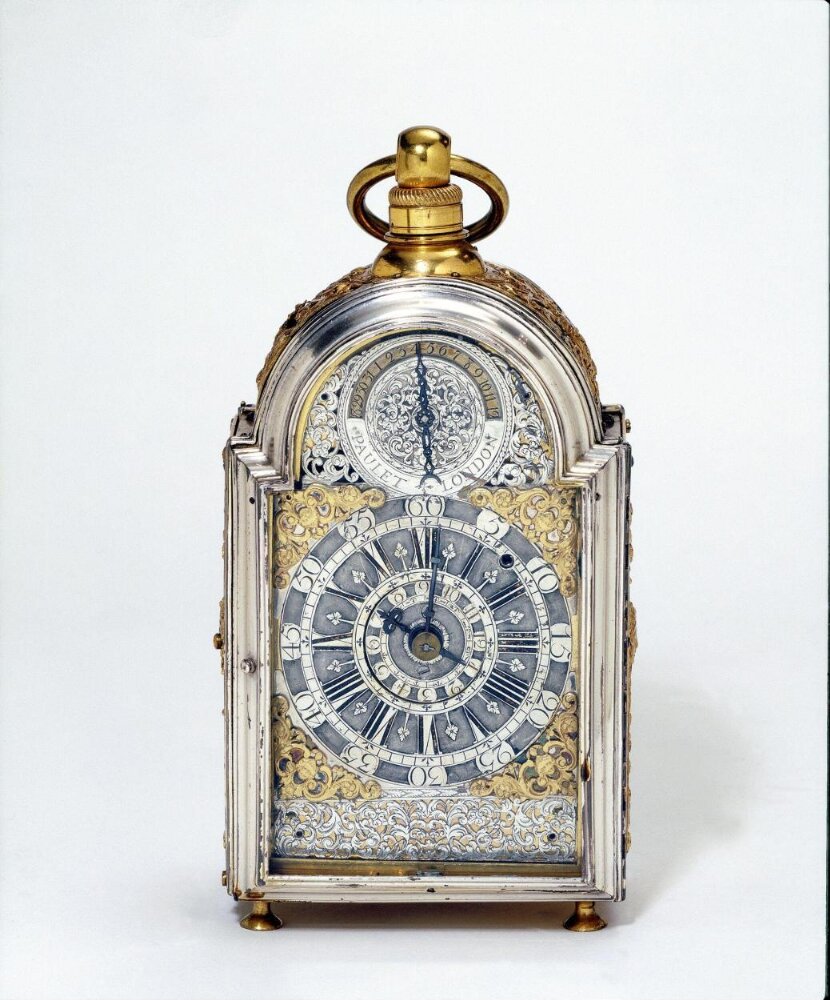
Bracket clock, Paulet, London, ca. 1710 is an object recorded by Victoria and Albert Museum, dated ca. 1710. The museum's brief description reads: Bracket Clock - Paulet. Museum description: Object TypeSmall clocks such as this example are thought to have been used when travelling. Too large to be used in a carriage, they were designed to be carried from place to place. It has been suggested that they might well have been used on board ship, fitted into a case fixed to the wall of a cabin.PeopleLittle is known about the maker who signed himself 'Paulet'. A number of clocks with his signature are recorded and he seems to have had wealthy clients. A clock by him in the Metropolitan Museum, New York bears the royal monogram of Queen Anne (ruled 1702-1714). The distinctly Continental style of his clocks and his French name suggest that he was a Huguenot (French Protestant emigré).DesignThe clock strikes hours in passing and repeats the hours and quarters. The central dial at the front is used to set the alarm, and the pointer on the top dial is for the calendar. The clock was… The museum record gives measurements Height 19.5 cm; Width 10 cm; Depth 7.5 cm; place associated: London; maker recorded: Paulet. These details come from the holding museum's own record; how far this object represents a wider collectible type has not yet been independently verified.
Partial type record
© Victoria and Albert Museum, London
clocks
Bracket clock, Perigal and Browne, London, 1790-1800
1790-1800
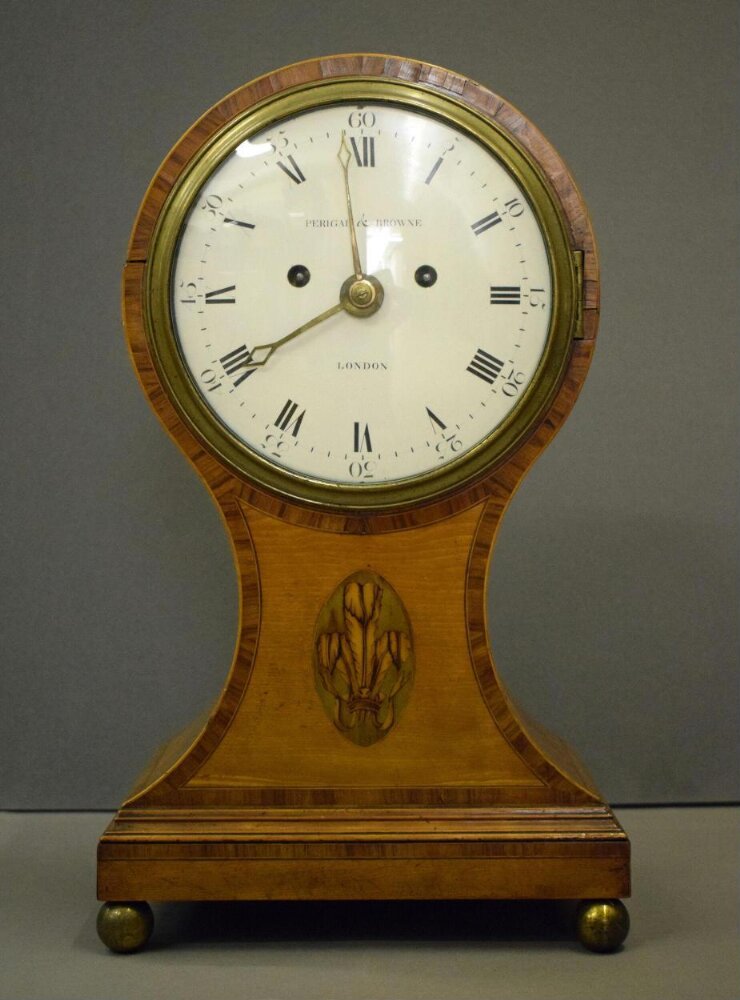
Bracket clock, Perigal and Browne, London, 1790-1800 is an object recorded by Victoria and Albert Museum, dated 1790-1800. The museum's brief description reads: Bracket clock in a balloon-shaped case veneered in satinwood with cross-banding of tulipwood, inlaid with a vesica-shaped panel with the Prince of Wales' feathers. 1790-1800, Perigal and Browne, London. Museum description: Bracket clock in a balloon-shaped case veneered in satinwood with cross-banding of tulipwood, inlaid with a vesica-shaped panel with the Prince of Wales' feathers. The clock is raised on four globular brass feet. The white enamel dial, with Roman hour numerals and arabic numerals for the five-minute intervals, is painted with the name of the makers, 'Perigal and Browne, London'. The museum record gives material recorded as satinwood, tulipwood, enamel; measurements Height 41.9 cm; place associated: London. These details come from the holding museum's own record; how far this object represents a wider collectible type has not yet been independently verified.
Partial type record
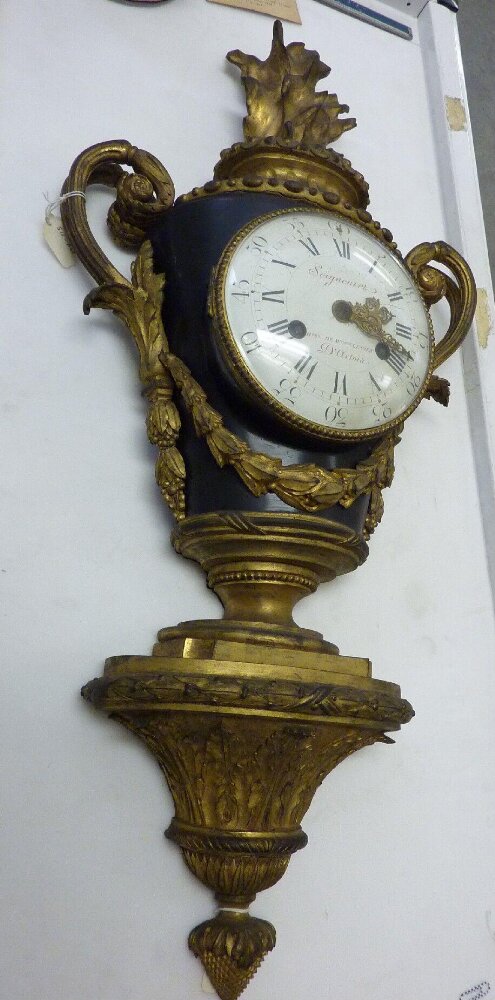
© Victoria and Albert Museum, London
clocks
Bracket clock, Pierre Seigneuret, France, 1750-1800
1750-1800
Bracket clock, Pierre Seigneuret, France, 1750-1800 is an object recorded by Victoria and Albert Museum, dated 1750-1800. The museum's brief description reads: Bracket clock in metal case with scroll handles and flamed-shaped top signed by Pierre Seignoret, Clockmaket to the the Comte d'Artois. Museum description: Case: Clock set in urn-shaped enamelled copper case. The main body of the clock of iron, painted black, surmounted by a flame-shaped top of cast and chased ormolu. The body flanked by pairs of cast scrolled handles. Dial: Hinged and domed glazed dial cover; domed white-enamel dial with outer ring of 5 minutes; set of Roman hours within. Winding holes inside and slightly breaking into IIII and VIIII; regulating hole piercing 60. Signed on the dial: SEIGNEURET HGER DE MGNEUR LE COMTE D'Artois. Elaborately pierced and gilt hands without tails. Movement: Circular movement plates 12.7 cm diameter, slightly flattened at the bottom. Two going barrels. Going train at right, with anchor escapement, escape wheel of 30T, pallets spanning 4T. Pendulum of overall length 5.2 cm, with steel rod and lens-shaped brass-covered bob 3.2 cm diameter, 0.6 cm thick. Regulation by wound-up cord. Striking train… The museum record gives material recorded as ormolu, copper; measurements Height 80 cm; Width 34 cm; Depth 13.5 cm; place associated: France; maker recorded: Pierre Seigneuret. These details come from the holding museum's own record; how far this object represents a wider collectible type has not yet been independently verified.
Partial type record
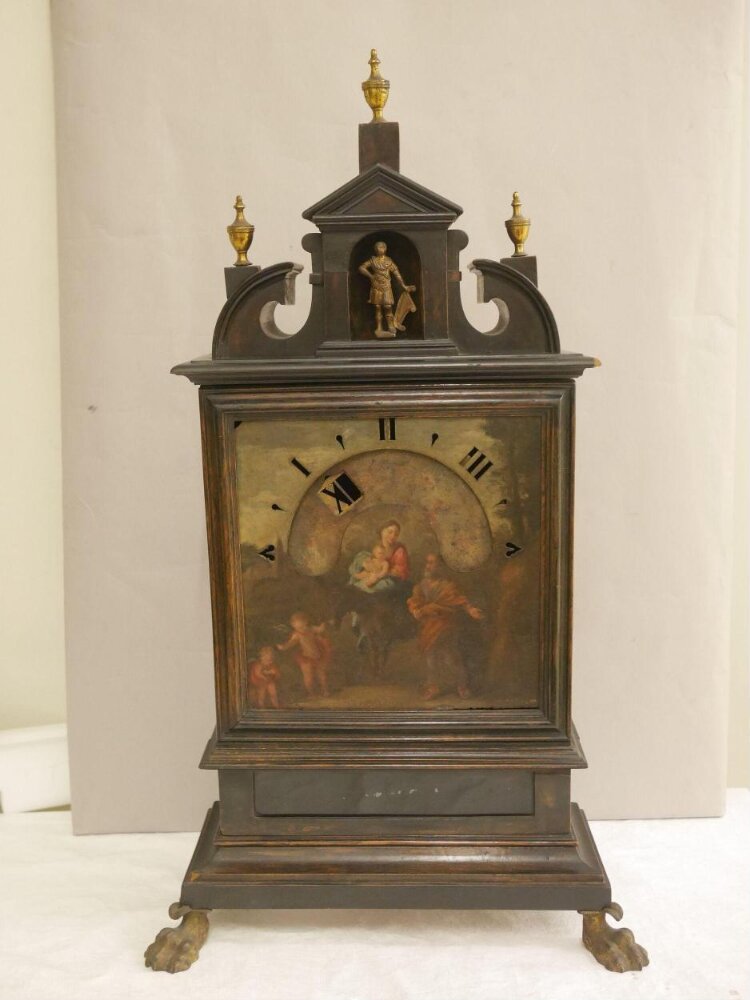
© Victoria and Albert Museum, London
clocks
Bracket clock, Pietro Tommaso Campani, Rome, 1680-1690
1680-1690
Bracket clock, Pietro Tommaso Campani, Rome, 1680-1690 is an object recorded by Victoria and Albert Museum, dated 1680-1690. The museum's brief description reads: Bracket clock, Italian, 1680-1690,"Petrus Thomas Campanus Romae".. Museum description: Bracket night clock. Ebonised wood veneered on oak, surmounted by a scrolled classic pediment of solid wood carved in sections, on which are mounted three gilt metal vase finials and a gilt metal standing figure in Roman armour with a harp (Orpheus?) in the niche. The unglazed and pierced metal dial is painted with a representation of the Flight into Egypt; behind is a two-part circular metal plate, to which the circular clock mechanism is attached, and supported on a horizontal bracket screwed at each end to the case. The moulded plinth is supported on carved and gilded wood paw feet with gilt metal leaf ornament and turned and ebonised back feet. The softwood backing is nailed in place (with hand made nails). A deep door (held on a single, metal sprung clip at the right) occupies the front third of the clock body and contains the dial, window and clock mechanism. Below the painted… The museum record gives material recorded as wood; measurements Height 76 cm; Width 43 cm; Depth 18.5 cm; place associated: Rome; maker recorded: Pietro Tommaso Campani. These details come from the holding museum's own record; how far this object represents a wider collectible type has not yet been independently verified.
Partial type record
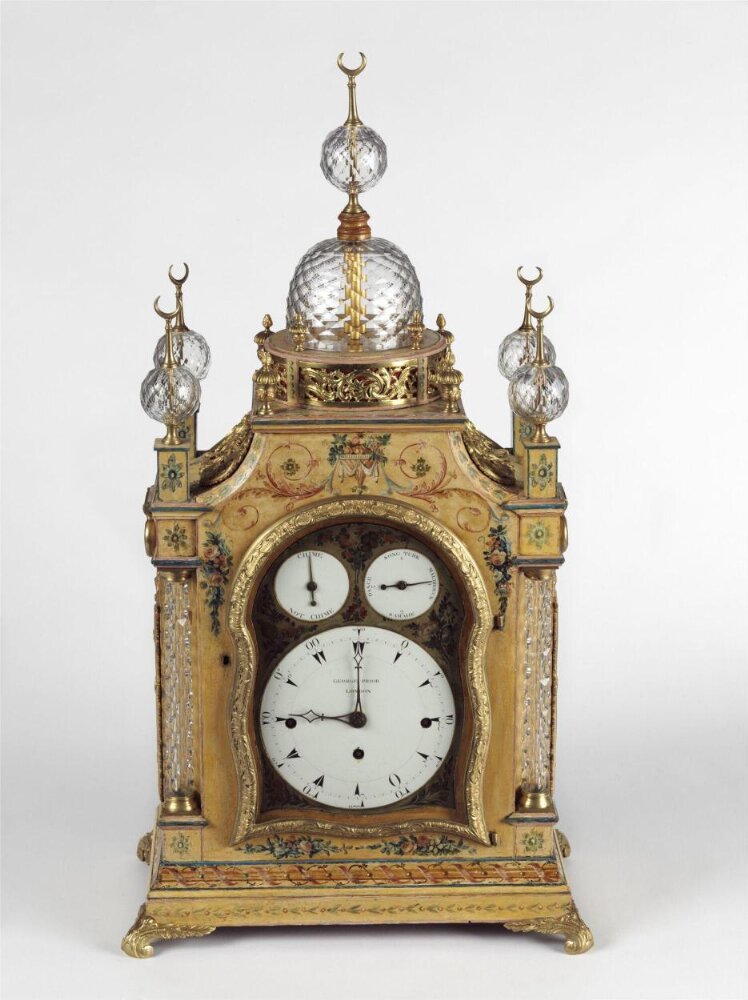
© Victoria and Albert Museum, London
clocks
Bracket clock, Prior, George, London, ca. 1790
ca. 1790
Bracket clock, Prior, George, London, ca. 1790 is an object recorded by Victoria and Albert Museum, dated ca. 1790. The museum's brief description reads: BRACKET CLOCK Painted deal with glass and ormolu Inscribed "George Prior, London" and made about 1790-1810 Bracket clock with painted floral decoration, glass dome and spheres with crescent-moon finials, supplied by George Prior for the Turkish market in about 1790.. Museum description: Summary description A large table clock with a cream and floral painted case, cut-glass columns, glass dome and spheres, with gilt-brass fittings including crescent moon finials. The clock face has Arabic numerals. Decorative scheme The clock case has a complex decorative scheme evoking fantasy architecture, the top decorated to suggest minarets with fixed, facetted glass spheres which sparkle in the light. The reflective gilt-brass fittings and the pastel painted decorative scheme also give a light and airy impression. In the centre a cut-glass sphere rises above a facetted and textured cut-glass dome, both held in place by a vertical gilded wood rod. Above this is a tall brass finial surmounted by an upturned crescent moon. There are four matching glass spheres with tall crescent finials, one at each corner of the case, supported on small painted pedestals. The dome is raised on a… The museum record gives material recorded as wood, glass, brass, brass, paint; measurements Height 74 cm; Width 40 cm; Depth 23.5 cm; place associated: London; maker recorded: Prior, George, Thwaites, John. These details come from the holding museum's own record; how far this object represents a wider collectible type has not yet been independently verified.
Partial type record
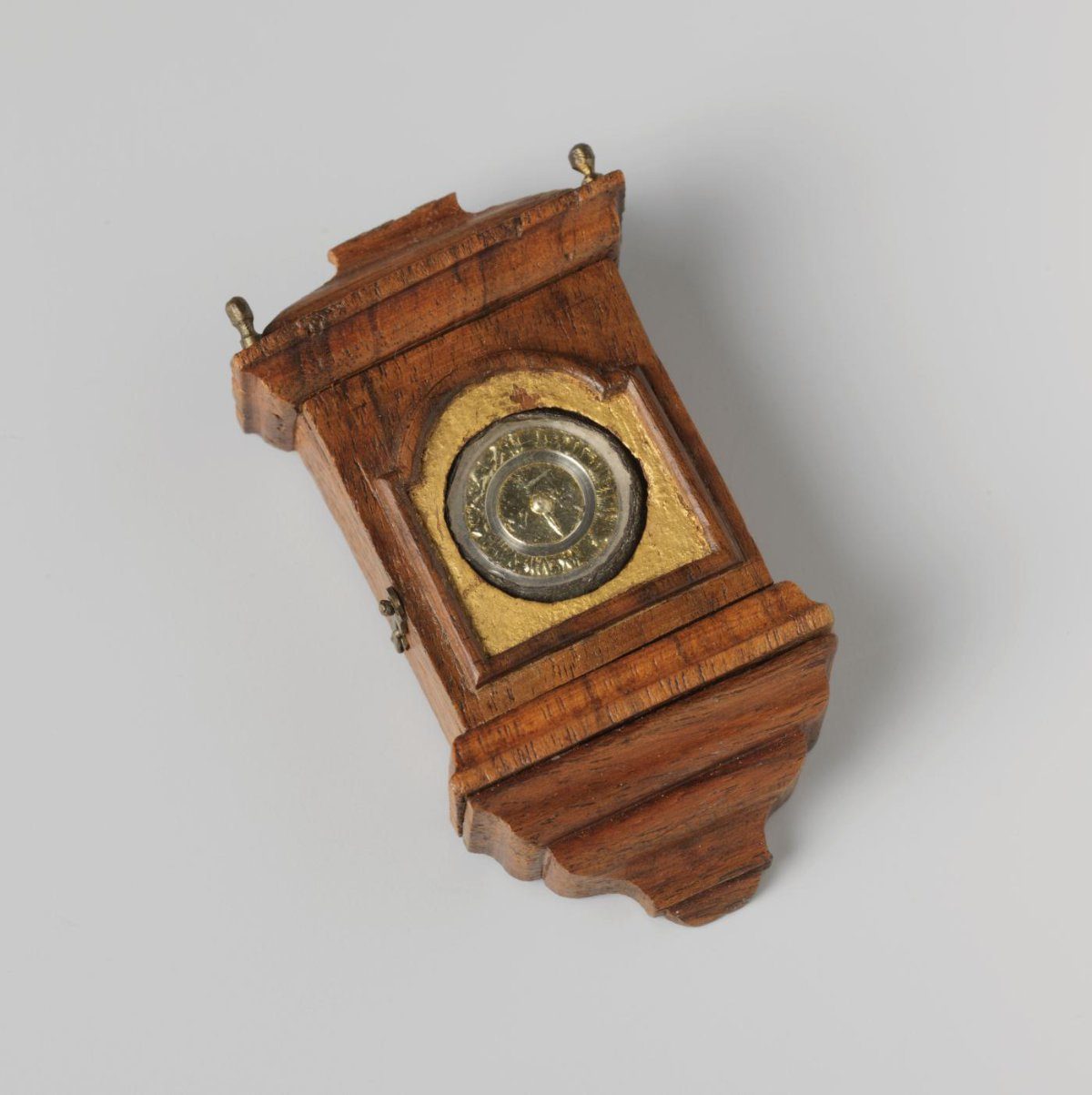
Rijksmuseum, Amsterdam
clocks
Bracket clock, rectangular, with molded plinth and pediment
c. 1740 - c. 1760
Bracket clock, made of walnut. The clock has a rectangular shape with a molded plinth and pediment surmounted by four brass finials. The movement is a watch mounted in gilded lead with a glass lens. The Rijksmuseum, Amsterdam, holds this object as BK-NM-5783-20; its record gives material recorded as lead (metal), copper (metal), walnut (hardwood), gilding (material), glass; technique gild; measurements height 7.5 cm x width 4.2 cm x depth 1.9 cm. Description translated from the museum's Dutch catalogue text; details are those of this museum object, and how far it represents a wider type has not been independently verified.
Partial type record
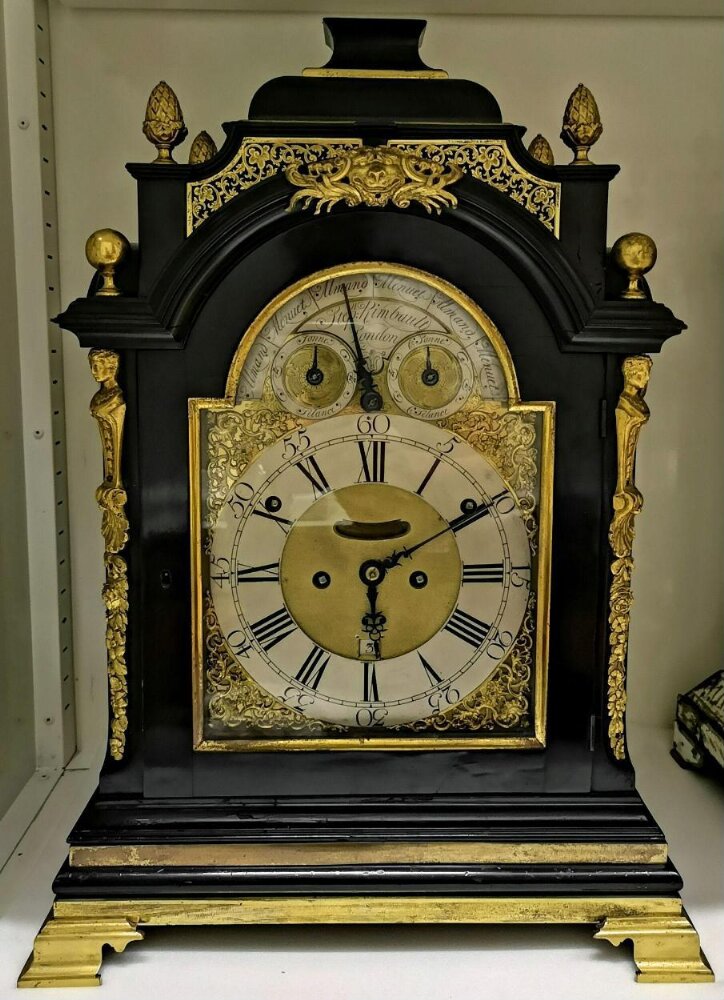
© Victoria and Albert Museum, London
clocks
Bracket clock, Rimbault, Stephen, London, c.1770
c.1770
Bracket clock, Rimbault, Stephen, London, c.1770 is an object recorded by Victoria and Albert Museum, dated c.1770. The museum's brief description reads: Musical bracket clock, inscribed ‘Stephen Rimbault, London’, made in about 1770. Oak case veneered with ebony, gilt brass mounts. Museum description: Musical bracket clock in an oak case veneered with ebony, with gilt brass mounts The museum record gives material recorded as oak, ebony, brass (alloy); measurements Height 55 cm; Width 39 cm; Depth 26.5 cm; place associated: London; maker recorded: Rimbault, Stephen. These details come from the holding museum's own record; how far this object represents a wider collectible type has not yet been independently verified.
Partial type record
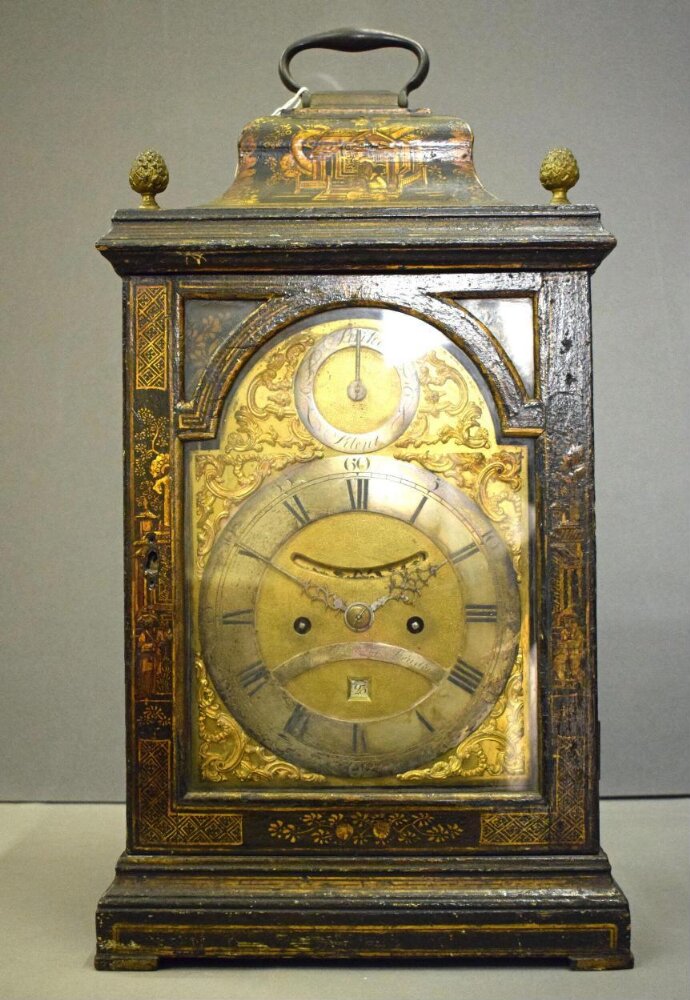
© Victoria and Albert Museum, London
clocks
Bracket clock, Rogers, Isaac, London, ca. 1760
ca. 1760
Bracket clock, Rogers, Isaac, London, ca. 1760 is an object recorded by Victoria and Albert Museum, dated ca. 1760. The museum's brief description reads: Bracket clock, blue japanned case with gilt brass mounts, inscribed "Isaac Rogers", and made about 1760. Museum description: Bracket clock with blue japanned case with ormolu mounts and floral decoration The museum record gives material recorded as ormolu; measurements Height 52 cm; Width 27 cm; Depth 17.5 cm; place associated: London; maker recorded: Rogers, Isaac. These details come from the holding museum's own record; how far this object represents a wider collectible type has not yet been independently verified.
Partial type record
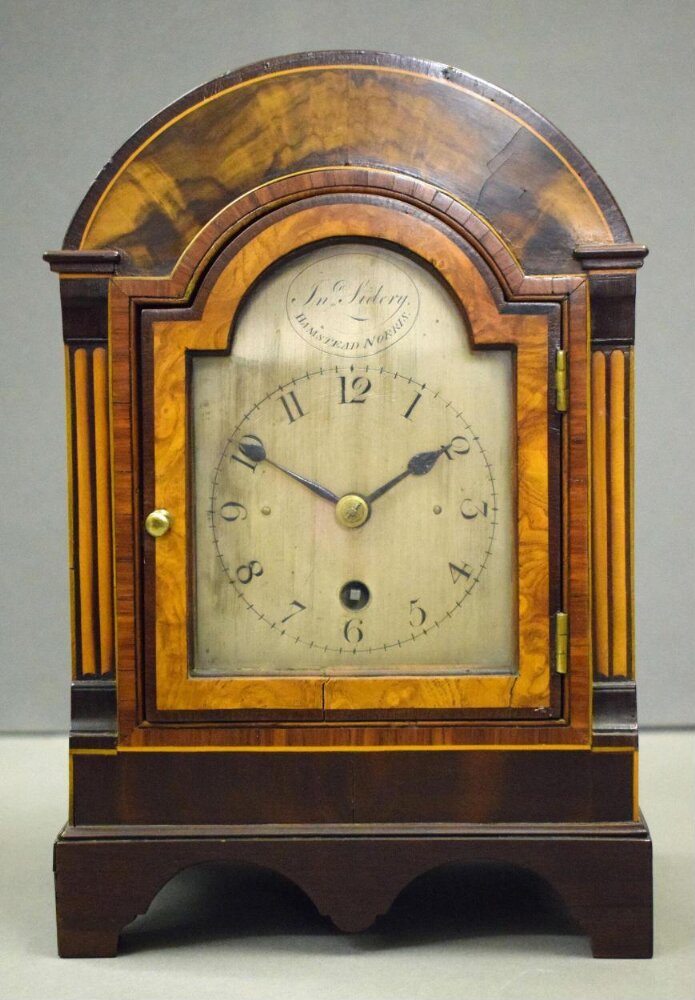
© Victoria and Albert Museum, London
clocks
Bracket clock, Sidery, John, England, 1780-1785
1780-1785
Bracket clock, Sidery, John, England, 1780-1785 is an object recorded by Victoria and Albert Museum, dated 1780-1785. The museum's brief description reads: Bracket clock, English, 1780-1785, inscribed Jno Sidery. Museum description: Bracket clock in a mahogany case inlaid with olive and other woods. The case has a round-arched top and corresponding door in front flanked by fluted pilasters. The lower part is shaped to form a base. The dial is of white metal, the hours marked with Arabic numberals. The museum record gives material recorded as olive, metal; measurements Height 26.7 cm; Width 17.5 cm; Depth 12.4 cm; place associated: England; maker recorded: Sidery, John. These details come from the holding museum's own record; how far this object represents a wider collectible type has not yet been independently verified.
Partial type record
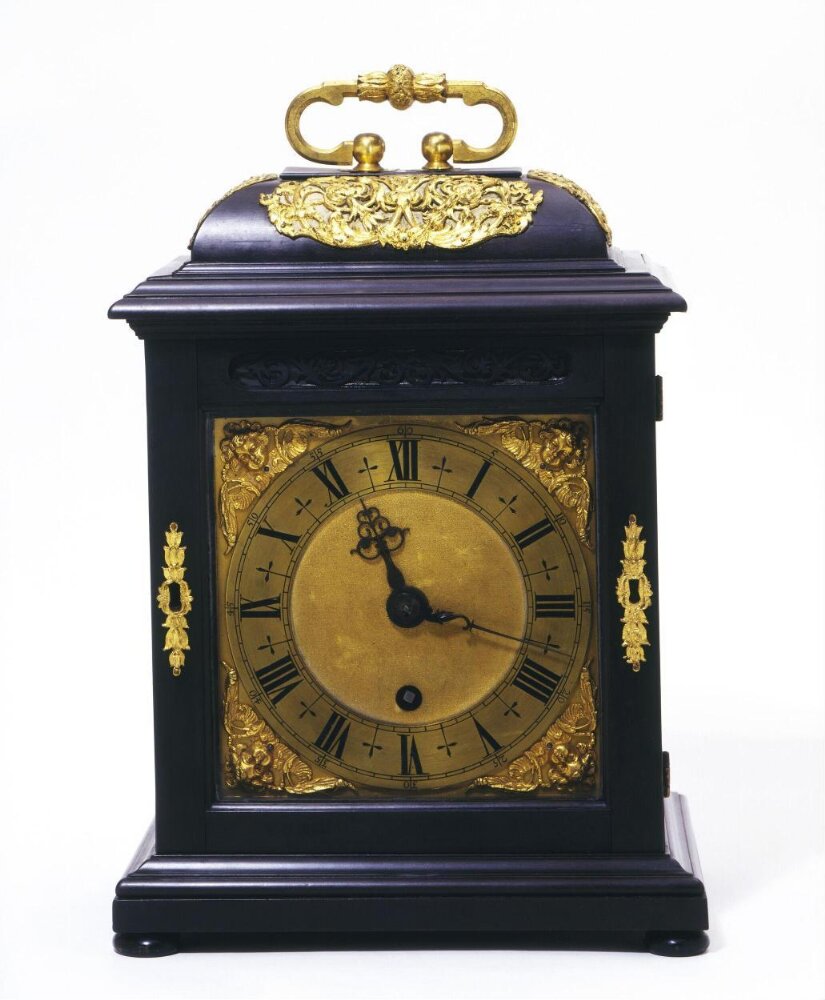
© Victoria and Albert Museum, London
clocks
Bracket clock, Tompion, Thomas, London, ca. 1690
ca. 1690
Bracket clock, Tompion, Thomas, London, ca. 1690 is an object recorded by Victoria and Albert Museum, dated ca. 1690. Museum description: Object TypeThis bracket clock is signed by Thomas Tompion on the back plate and numbered '35' at the top left inside a scroll. Tompion numbered most of his clocks and a date sequence has been worked out by specialists using these numbers. This number is consistent with a date of manufacture around 1690.The movement has a gong train with a large spring, barrel fusee and pendulum. It is also fitted with a complex repeating mechanism. If the cords attached to two short arms at the back of the clock are pulled, the hour and quarter hour are struck on two bells of different pitch. The case is of oak and a measure of the quality of Tompion's workmanship is the use of an ebony veneer of unusual thickness.MakerThomas Tompion (1639-1713) was the leading English clockmaker of the period. He introduced some important innovations, including some of the first watches with balance springs and also… The museum record gives measurements Height 35.5 cm; Width 23.5 cm; Depth 16.2 cm; place associated: London; maker recorded: Tompion, Thomas. These details come from the holding museum's own record; how far this object represents a wider collectible type has not yet been independently verified.
Partial type record
© Victoria and Albert Museum, London
clocks
Bracket clock, Tregent, James, London, ca. 1780
ca. 1780
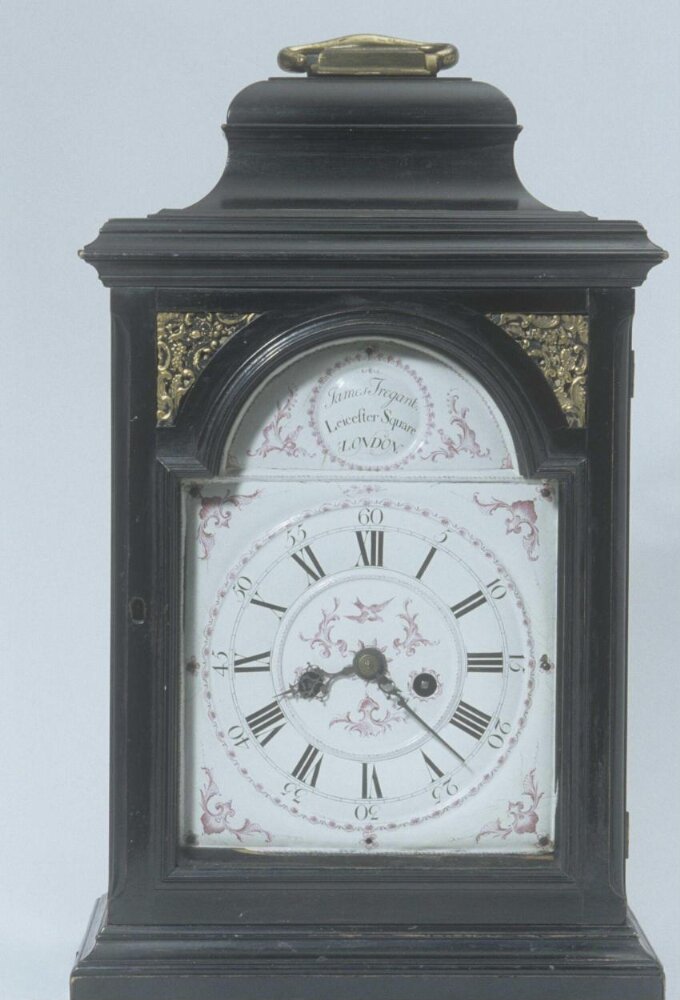
Bracket clock, Tregent, James, London, ca. 1780 is an object recorded by Victoria and Albert Museum, dated ca. 1780. The museum's brief description reads: Bracket clock of ebony, with face of West Midlands enamel painted in black and crimson, made by James Tregent, London, England, about 1780. Museum description: Bracket clock of ebony, with face of Staffordshire enamel painted in black and crimson, bearing the name of the maker, "James Tregant, Leicester Square, LONDON". Rectangular, with "bell" top, on which is a brass handle. At the front and back are glazed doors, the openings of which are in the form of a square with semicircular projection at the top, the spandrels being filled in with rococo scrollwork in chased and pierced brass. The face is of the same form as the doors. The numerals on the dial, and the inscription, which occupies a sunk circular medallion at the top, are painted in black. The inter-spaces are filled in with rococo scrollwork and a bird in crimson. The movement is screened at the back by a brass plate engraved with symmetrical leafy strapwork. The museum record gives material recorded as enamel; measurements Height 46 cm; Width 28 cm; Depth 19 cm; place associated: London; maker recorded: Tregent, James. These details come from the holding museum's own record; how far this object represents a wider collectible type has not yet been independently verified.
Partial type record
© Victoria and Albert Museum, London
clocks
Bracket clock, Weeks, Thomas, England, 1780-1790
1780-1790
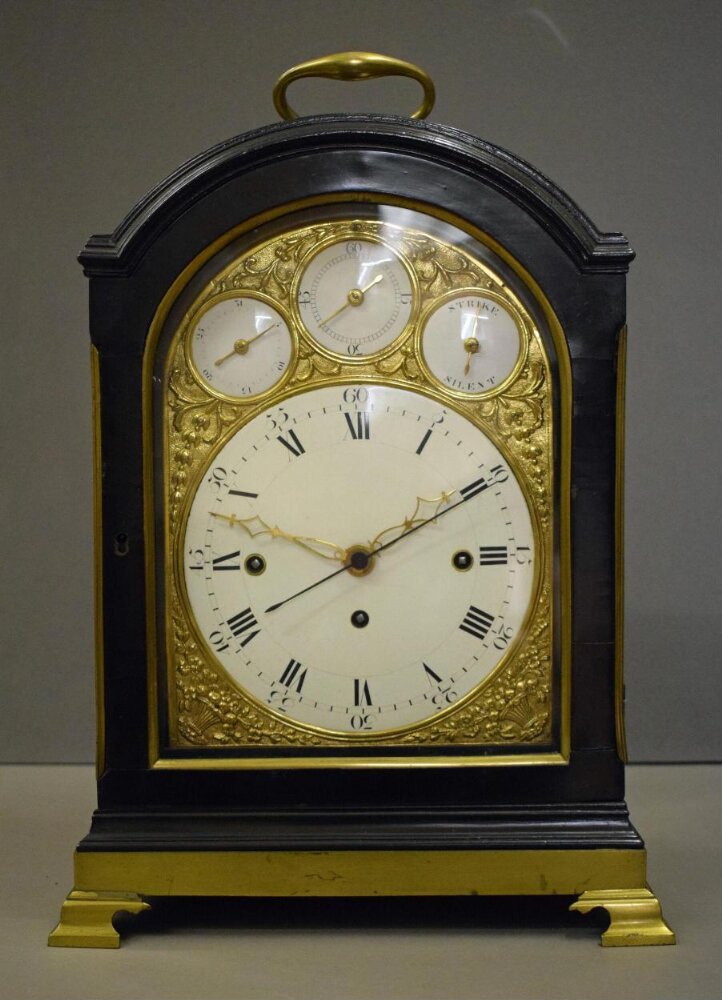
Bracket clock, Weeks, Thomas, England, 1780-1790 is an object recorded by Victoria and Albert Museum, dated 1780-1790. The museum's brief description reads: Ebonised bracket clock, English, 1780-1790, movement made by Weeks. Museum description: Bracket clock. The ebonised oak case is inset with brass fillets and stands on a brass base with brass bracket feet, the whole surrmounted by a brass loop handle. An arched panel of brass scaly fret at each side and an arched pane of glass at the back. The enamelled hour dial is overset by three subsidiary dials, all incorporated into a brass field, the lower spandrels of which are decorated with baskets of flowers and the upper section consisting of honeysuckle ornament. The chime is of eight bells and the movement is by Weekes. The museum record gives material recorded as brass (alloy), glass; measurements Height 44 cm; Width 30.5 cm; Depth 22 cm; place associated: England; maker recorded: Weeks, Thomas. These details come from the holding museum's own record; how far this object represents a wider collectible type has not yet been independently verified.
Partial type record
Rijksmuseum, Amsterdam
clocks
Brass mantel clock
c. 1905
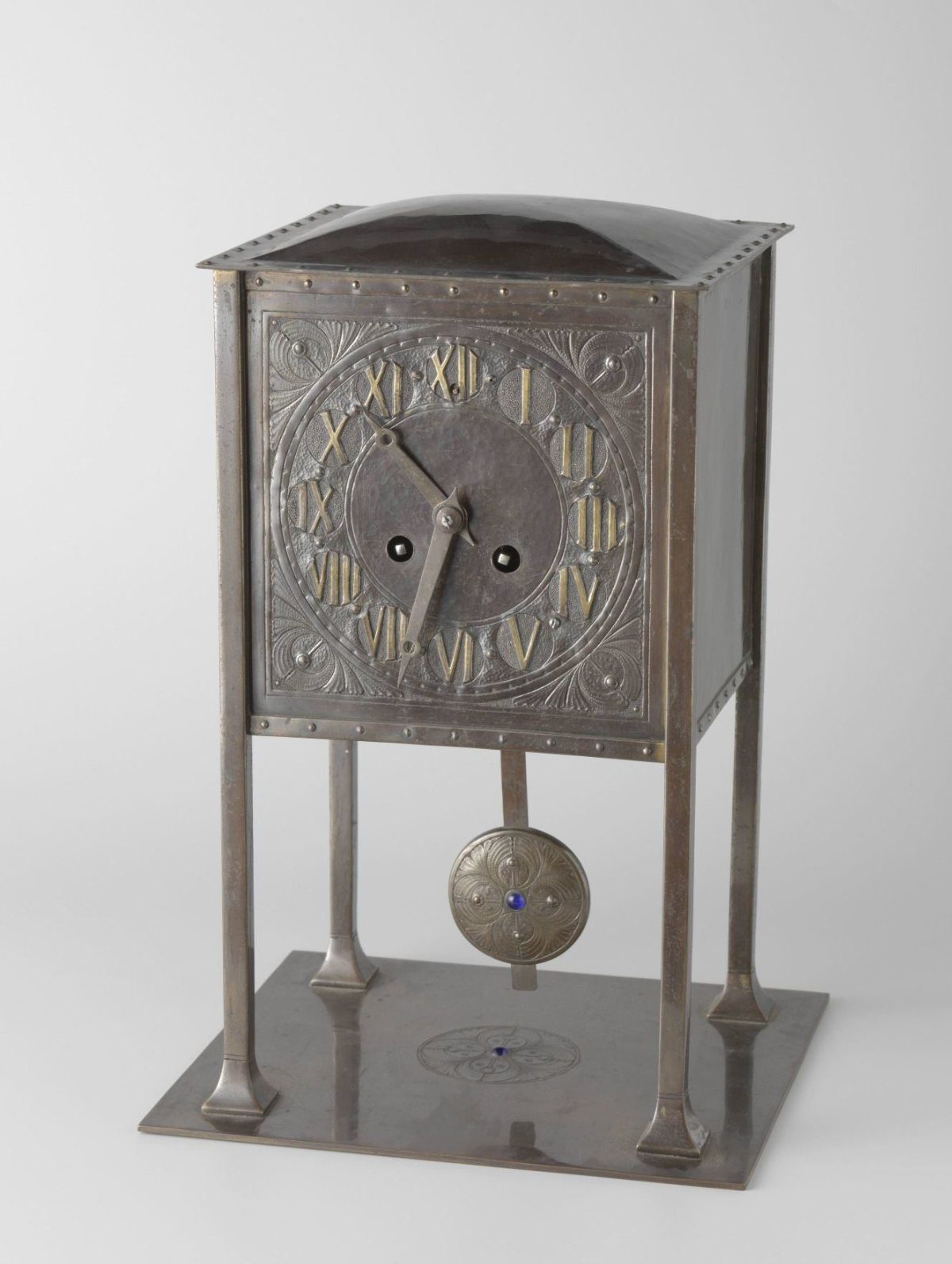
Brass mantel clock, square with arched roof, on four feet that rest on a square plate. Decorated dial. Round pendulum plate, and decorated with a blue stone in the center of the baseplate. The Rijksmuseum, Amsterdam, holds this object as BK-1977-108; its record gives material recorded as brass (alloy); measurements depth 19.7 cm. Description translated from the museum's Dutch catalogue text; details are those of this museum object, and how far it represents a wider type has not been independently verified.
Partial type record
Cleveland Museum of Art, Gift of Henry W. Kent
clocks
Butterfield Sundial (Cleveland Museum of Art 1942.490)
1700s
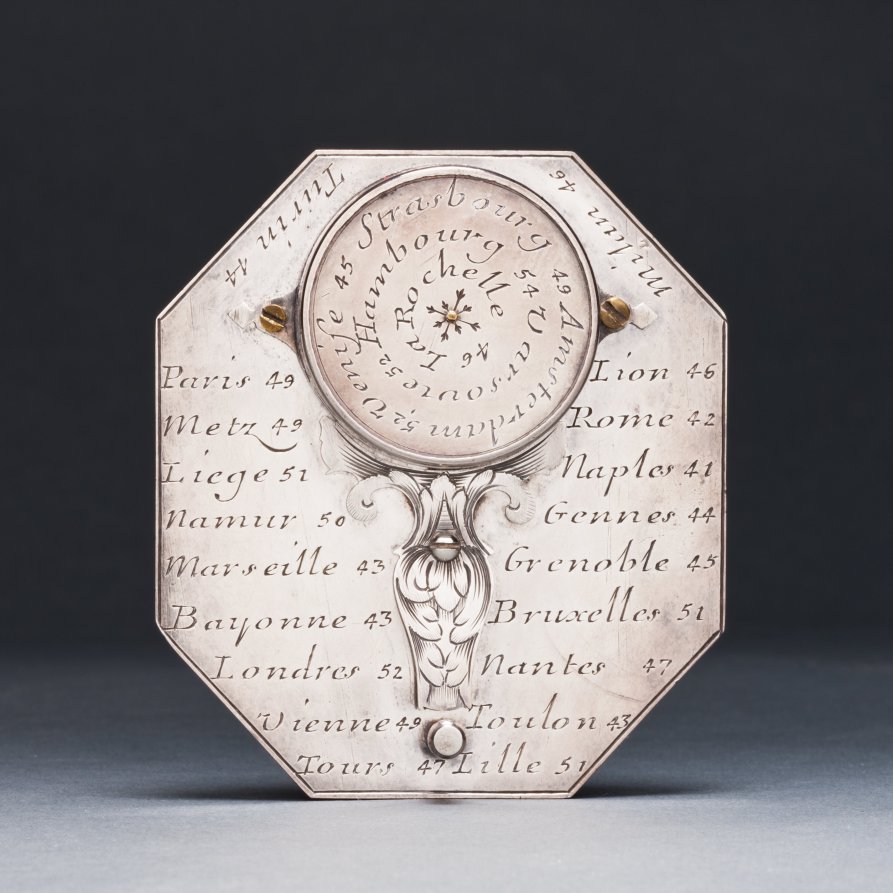
Butterfield-type sundials are characterized by their adjustable gnomons, metal flaps that cast a shadow on the dial’s face to indicate the hour, and geographical indices. This sundial has a scale adjustable between latitudes of 40° to 60° north. The latitudes of 26 European towns are engraved on its back for quick reference. With an intricately engraved silver face, it would have functioned as a fashionable traveler’s accessory. Cleveland Museum of Art object 1942.490: Butterfield Sundial, 1700s. France. Silver; overall: 7.7 x 7.4 cm (3 1/16 x 2 15/16 in.). Inscribed: [Engraved signature above the compass in ribbon band]: "N. BION A Paris"; [Engraved on the face of the sundial]: “Pour 55° 4-5-6-7-8-9-10-11 50° IIII-V-VI-VII-VIII-IX-X-XI 45° 5-6-7-8-9-10-11 40° -VI-VII-VIII-IX-X-XI'; [Engraved on the other side]: "Pour 55° -8-7-6-5-4-3-2-1-0 50°-VIII-VII-VI-V-IIII-III-II-I 45°-8-7-6-5-4-3-2-1 40°-VII-VI-V-IIII-III-II-I"; [Engraved around the compass]: “NORD-OUEST-SUD-EST”; [Engraved on the back of the sundial]: “Turin 44 Milan 46 Paris 49 Lion 46 Metz 49 Rome 42 Liege 51 Naples 44 Namur 50 Gennes 44 Marseille 43 Grenoble 45 Bayonne 43 Bruxelle 51 Londres 52 Nantes 47 Vienne 48 Toulon 43 Tours 47 Lille 51”; [Engraved around the back of the compass]: “Venise 45 Strasbourg 49 Amsterdam 52 Hambourg 54 Varsovie 52 La Rochelle 46”. Details are those of this museum object; how far it represents a wider type has not been independently verified.
Partial type record
© Victoria and Albert Museum, London
clocks
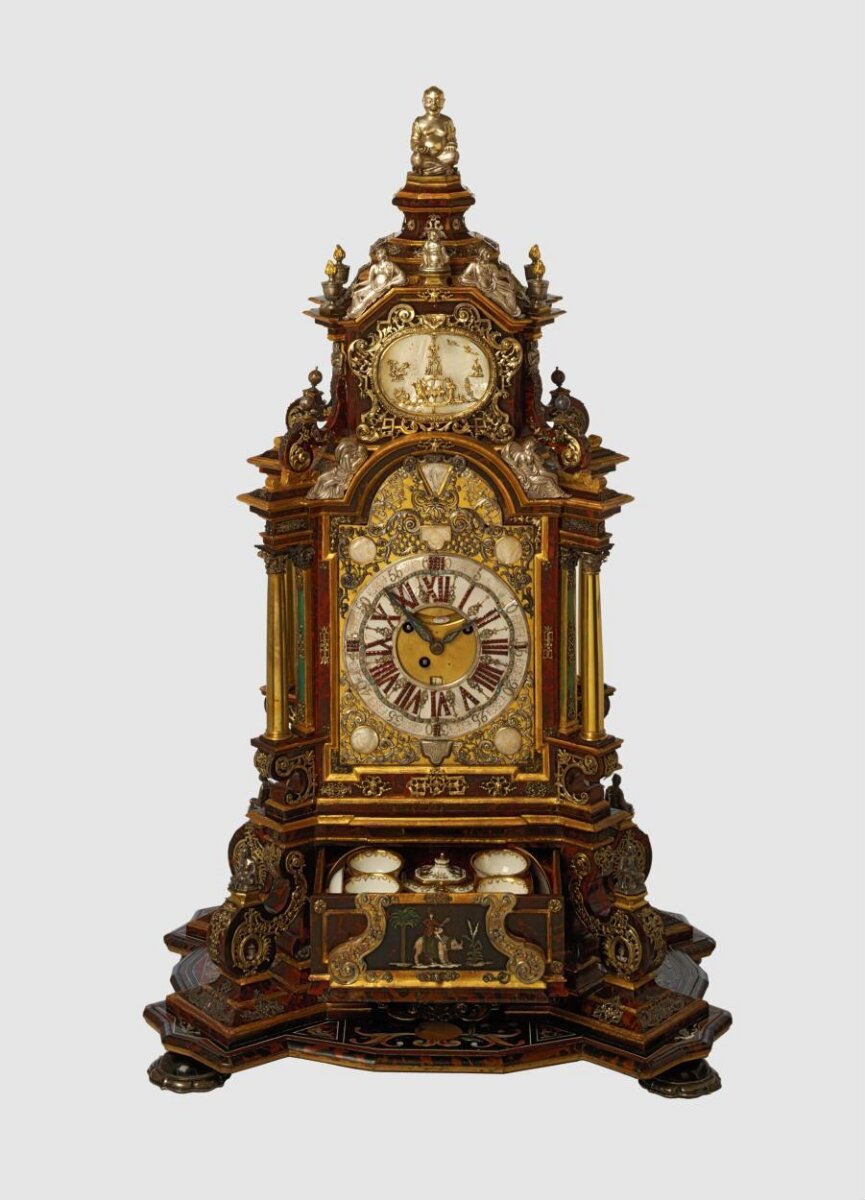
Cabinet clock — Augsburg Clock, Augsburg, 1700-1725
1700-1725
Cabinet clock in the Victoria and Albert Museum, London (museum number LOAN:GILBERT.3:1-2008), made in Augsburg, dated 1700-1725. The museum's brief description reads: Silver-gilt wood, tortoiseshell, silver, mother of pearl and other materials, Augsburg; 1700-1725 and later. Museum description: A cabinet clock of architectural form in three sections: a base with shaped borders and volutes at the corners; a central body; and a top storey with a lantern. The cabinet is faced in tortoiseshell, with borders and Corinthian columns at each corner of silver-gilt. Chinoiserie panels, inlaid mother-of-pearl, ivory, enamel and brass are set around the base and upper storey. The front of the upper storey bears a large mother-of-pearl plaque inlaid with Chinoiserie motifs and relief designs in silver-gilt. Small silver statuettes of Buddha adorn the volutes at the base, the centre of the upper storey, and the pediment of the lantern. Figures from classical mythology appear on the sides of the cabinet. On the front of the base is a red, velvet-lined drawer containing a Meissen tea service consisting of nine pieces. Below this is another drawer containing a removable square silver-gilt inkwell and pounce pot, and having two rectangular compartments, probably intended to hold pens and… The museum records it as Wood, boulle marquetry and tortoiseshell, silver and gilded silver (silver-gilt), inlaid mother-of-pearl, ivory, enamel and brass, pietre dure, cut garnets, turquoise, micromosaic, velvet, porcelain,…, measuring Height 110.9 cm; Width 69.5 cm; Depth 50.3 cm. These details come from the museum's own record; how far this object represents a wider collectible type has not yet been independently verified.
Partial type record
Cleveland Museum of Art, Gift of Howard F. Stirn
clocks
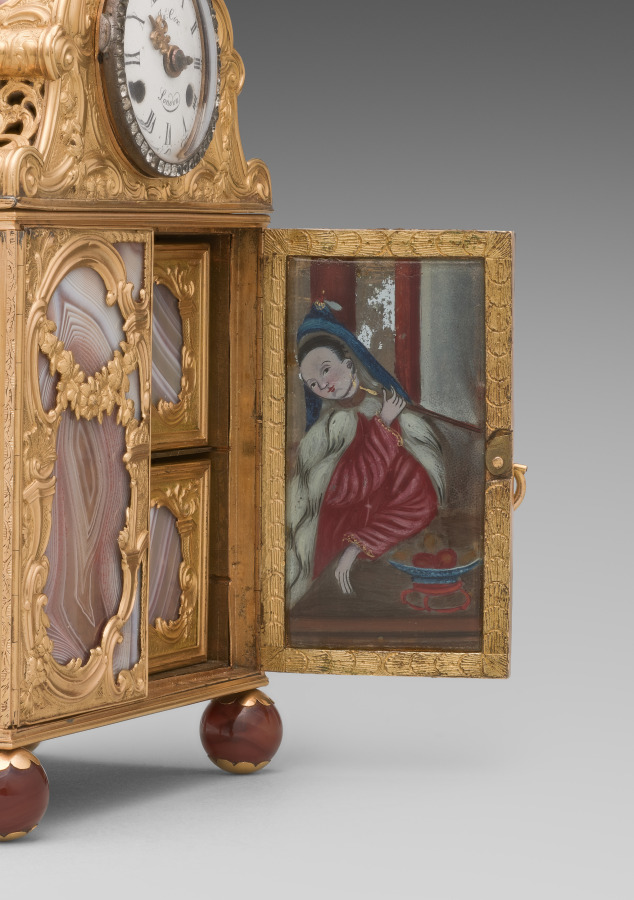
Cabinet Clock (Cleveland Museum of Art 2009.77)
c. 1770–75
In the 1700s and early 1800s, luxurious objects such as jewelry, miniatures, snuff boxes, and vanity cases emphasized their owner’s refinement and wealth. Especially popular were small cases with clocks and moving mechanical devices that played a handful of musical tunes. James Cox, the London goldsmith responsible for this clock and case, was known for creating such tuneful surprises, although this work no longer contains such a mechanism. Its glittering surface disguises a system based on the labor and suffering of enslaved people, whether in gold and stone mines or in shops where these goods were made by indentured apprentices. Many of these timepieces were designed for export and sold to the Chinese emperor Ch'ien Lung (1711–1799) and his court in attempt to balance out the substantial amount of tea that Britain was importing at the time. Cleveland Museum of Art object 2009.77: Cabinet Clock, c. 1770–75. Attributed to James Cox (British). Gold, agate, enamel dial, glass; overall: 16.5 x 8.9 cm (6 1/2 x 3 1/2 in.). Inscribed: signed "Jas Cox". Details are those of this museum object; how far it represents a wider type has not been independently verified.
Partial type record
The Metropolitan Museum of Art, New York
clocks
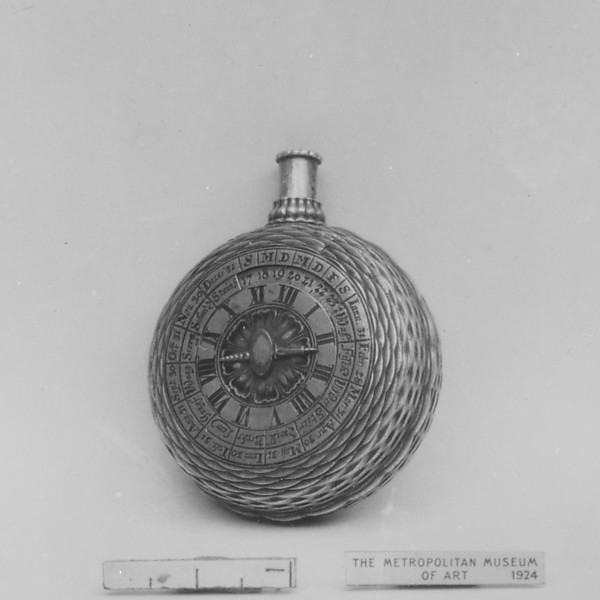
Calendar with sundial, 17th century
17th century
Calendar with sundial in The Metropolitan Museum of Art, New York (accession 24.104.2), catalogued by the museum's European Sculpture and Decorative Arts department. The museum dates it 17th century. The museum records the medium as Silver and the dimensions as Diameter: 1 3/4 in. (4.4 cm). These details are transcribed from the museum's open-access record; how far this object represents a wider collectible type has not yet been independently verified.
Partial type record
The Metropolitan Museum of Art, Gift of Mr. and Mrs. H. Ochs, 1981
clocks
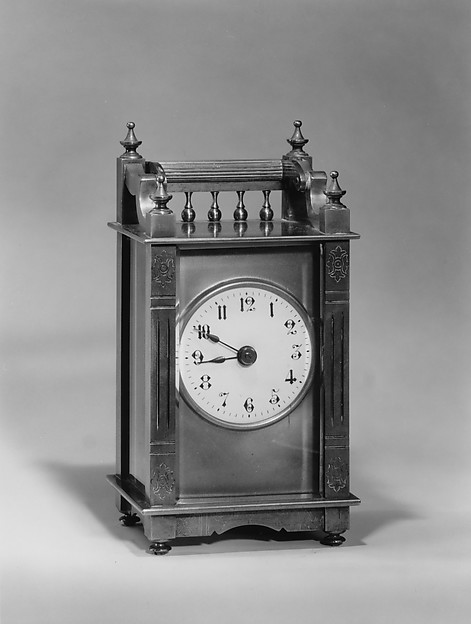
Carriage Clock
ca. 1890
Carriage Clock made by Boston Clock Company (1888–1897), dated ca. 1890, from American. The museum records its materials as: Brass, glass, enamel. Recorded dimensions: 6 1/8 x 3 1/4 x 2 5/8 in. (15.6 x 8.3 x 6.7 cm). The Metropolitan Museum of Art holds this object as 1981.434; details are those of this museum object, and how far it represents a wider type has not been independently verified.
Partial type record
Rijksmuseum, Amsterdam
clocks
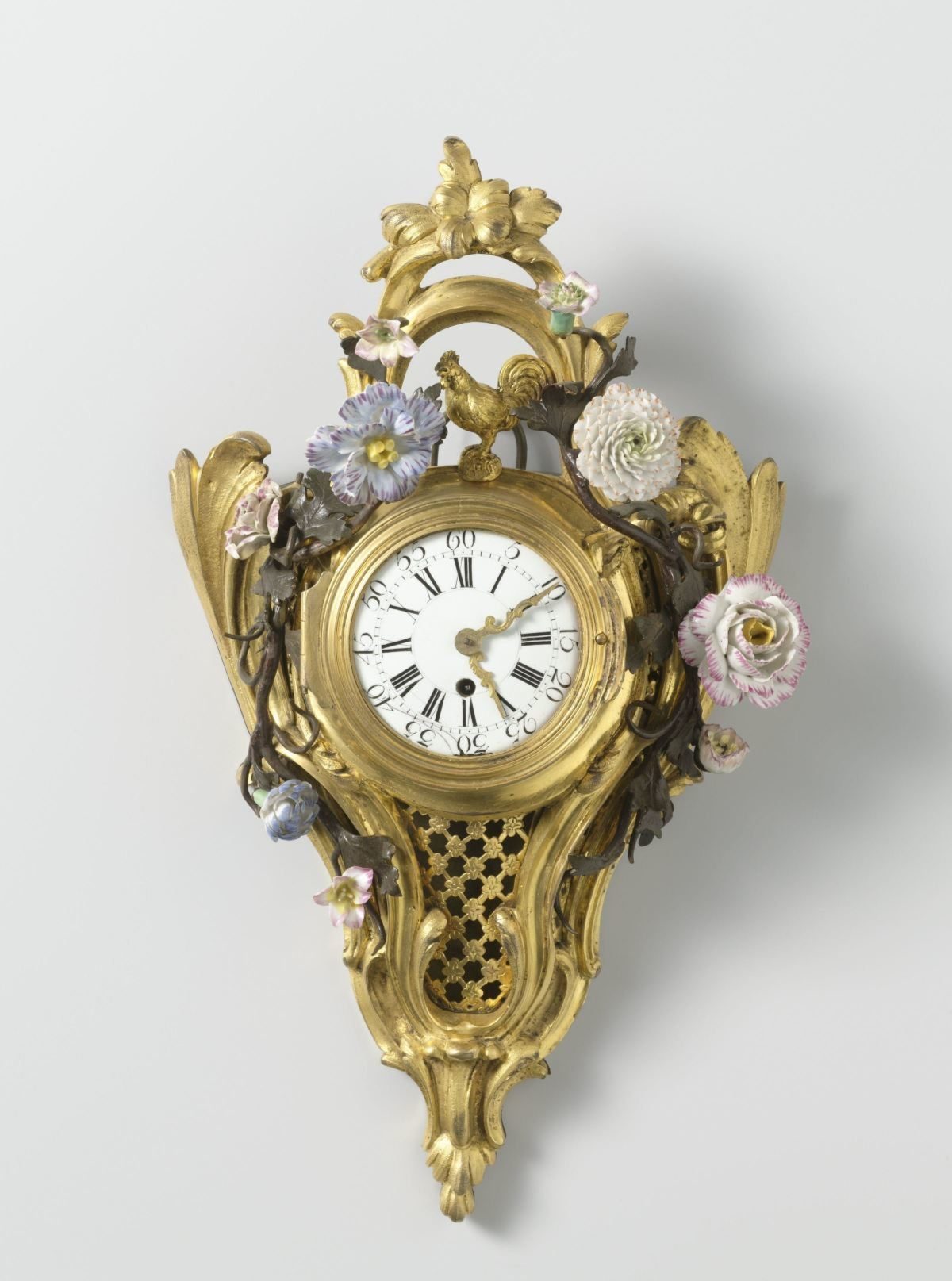
Cartel clock of gilt bronze with round dial decorated with rocailles and painted metal leafy branches with porcelain flowers.
c. 1750
Cartel clock of gilt bronze. The round dial is set in a gilt bronze mount, decorated with rocaille motifs and painted metal leafy branches with porcelain flowers. The Rijksmuseum, Amsterdam, holds this object as BK-16908; its record gives material recorded as bronze (metal), metal, porcelain; technique gild; measurements height 30 cm x width 18 cm x depth 8 cm. Description translated from the museum's Dutch catalogue text; details are those of this museum object, and how far it represents a wider type has not been independently verified.
Partial type record
Rijksmuseum, Amsterdam
clocks
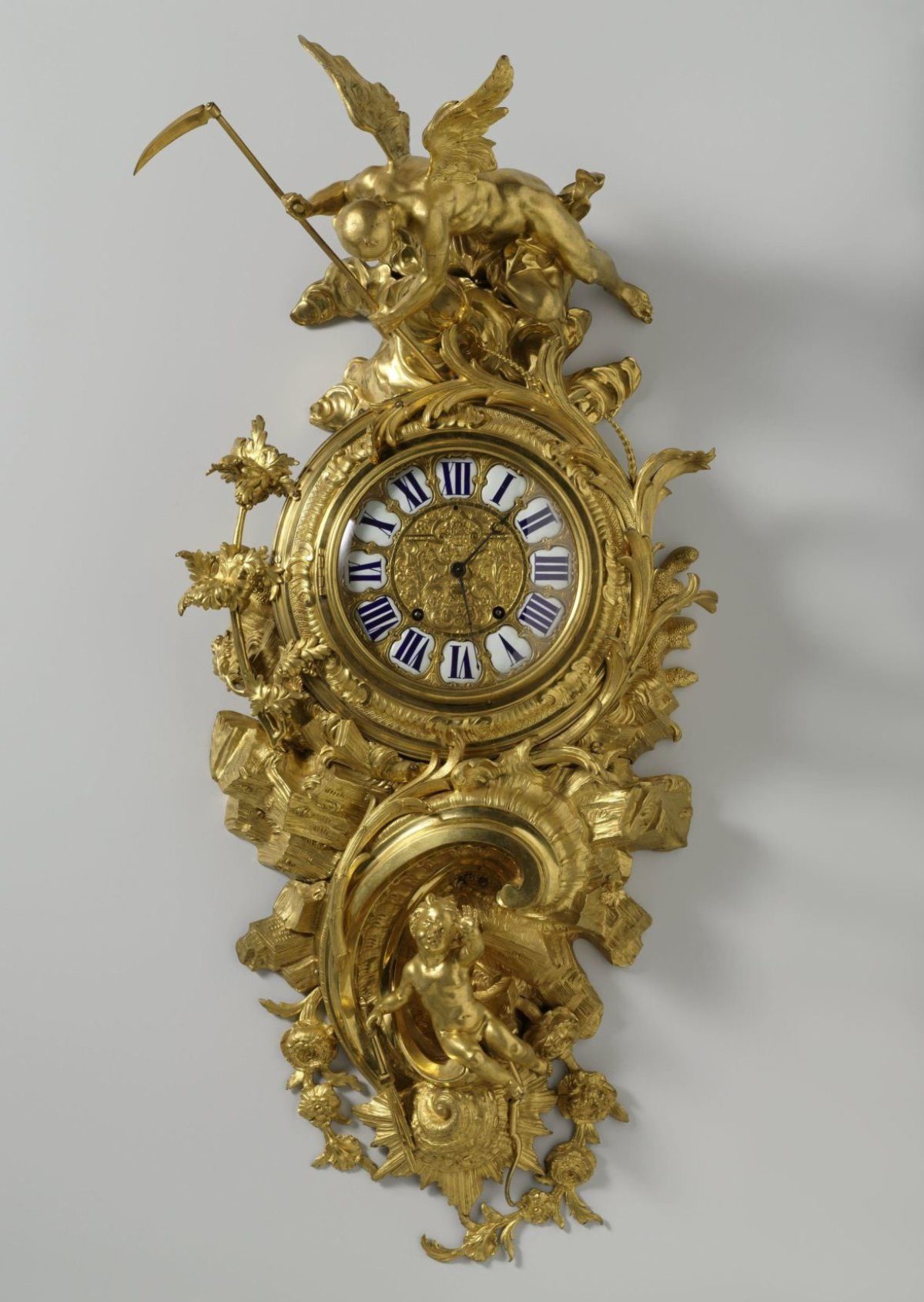
Cartel clock, c. 1740 - c. 1745
c. 1740 - c. 1745
Cartel clock of gilt bronze depicting: Time conquers Love. Above the round dial with low relief and enamelled numeral plaques, set on a bank of clouds, is the winged, forward-leaning figure of Time with a scythe; below it, Cupid sits on a large C-scroll, surrounded by boulders, with outstretched left hand. The quiver falls from his right hand; the bow lies behind his legs. At the bottom is a large shell surrounded by flowering branches; around the dial are a branch of flowers and a palm branch. The Rijksmuseum, Amsterdam, holds this object as BK-18018; its record gives material recorded as bronze (metal), kingwood (wood), brass (alloy), oak (wood); technique gild; measurements height 115 cm x width 52 cm x depth 38 cm. Description translated from the museum's Dutch catalogue text; details are those of this museum object, and how far it represents a wider type has not been independently verified.
Partial type record
Rijksmuseum, Amsterdam
clocks
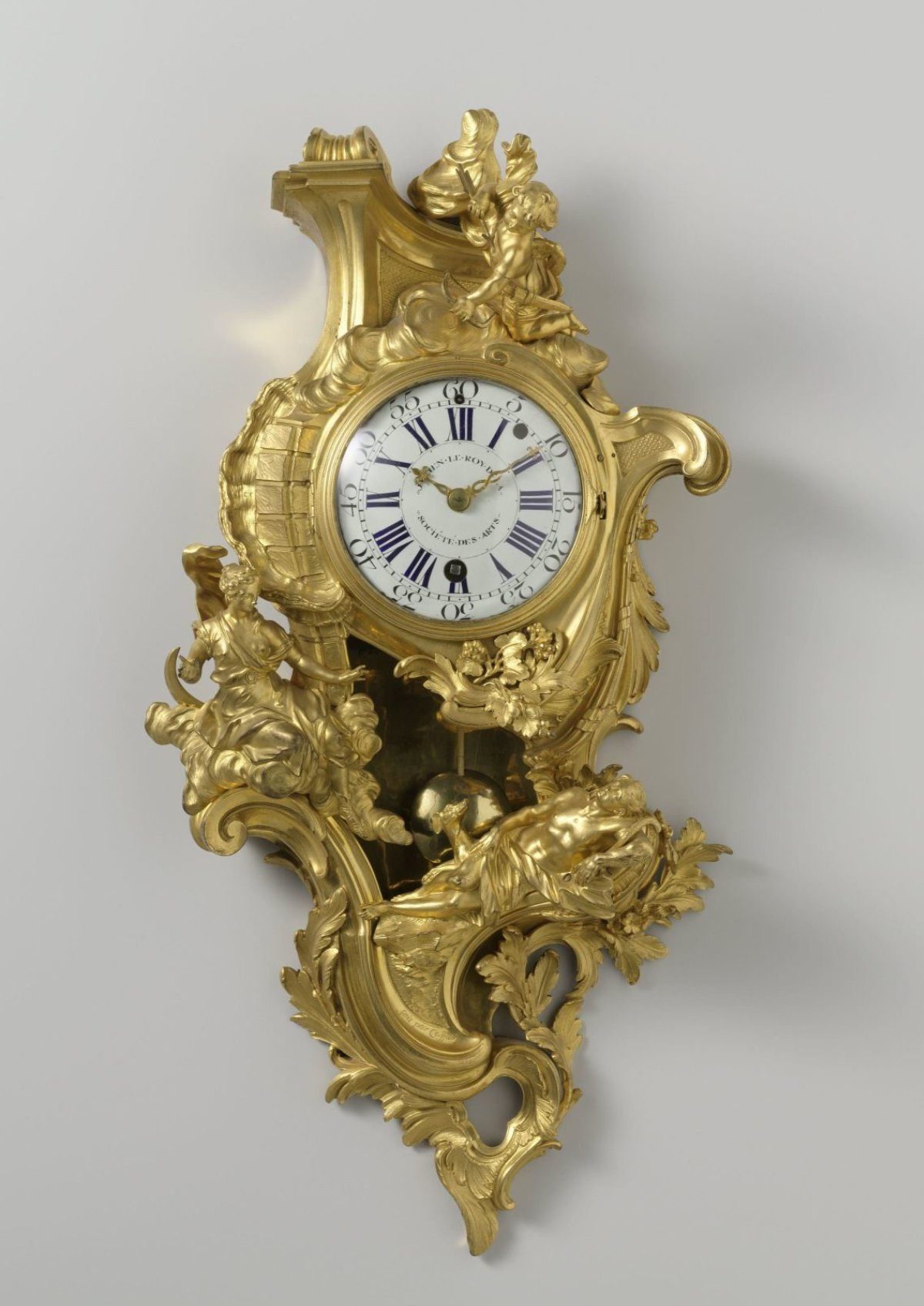
Cartel Clock, c. 1741
c. 1741
Cartel clock mounted in a gilt-bronze case. On a large S-shaped volute, below and to the left of the round dial, sits the goddess Diana on clouds, holding her arms spread towards the slumbering Endymion, who lies on a smaller volute below and to the right, holding a shepherd's crook and flanked by his dog. Above the dial, Cupid, holding a bow and arrow, looks on from the clouds. Above and to the left of the dial, a wall with shell motif and cornice; finished with flower, leaf, and volute motifs. The Rijksmuseum, Amsterdam, holds this object as BK-1959-88; its record gives material recorded as bronze (metal), gilding (material); technique gild; measurements height 64.5 cm x width 33 cm x depth 11 cm. Description translated from the museum's Dutch catalogue text; details are those of this museum object, and how far it represents a wider type has not been independently verified.
Partial type record
Rijksmuseum, Amsterdam
clocks
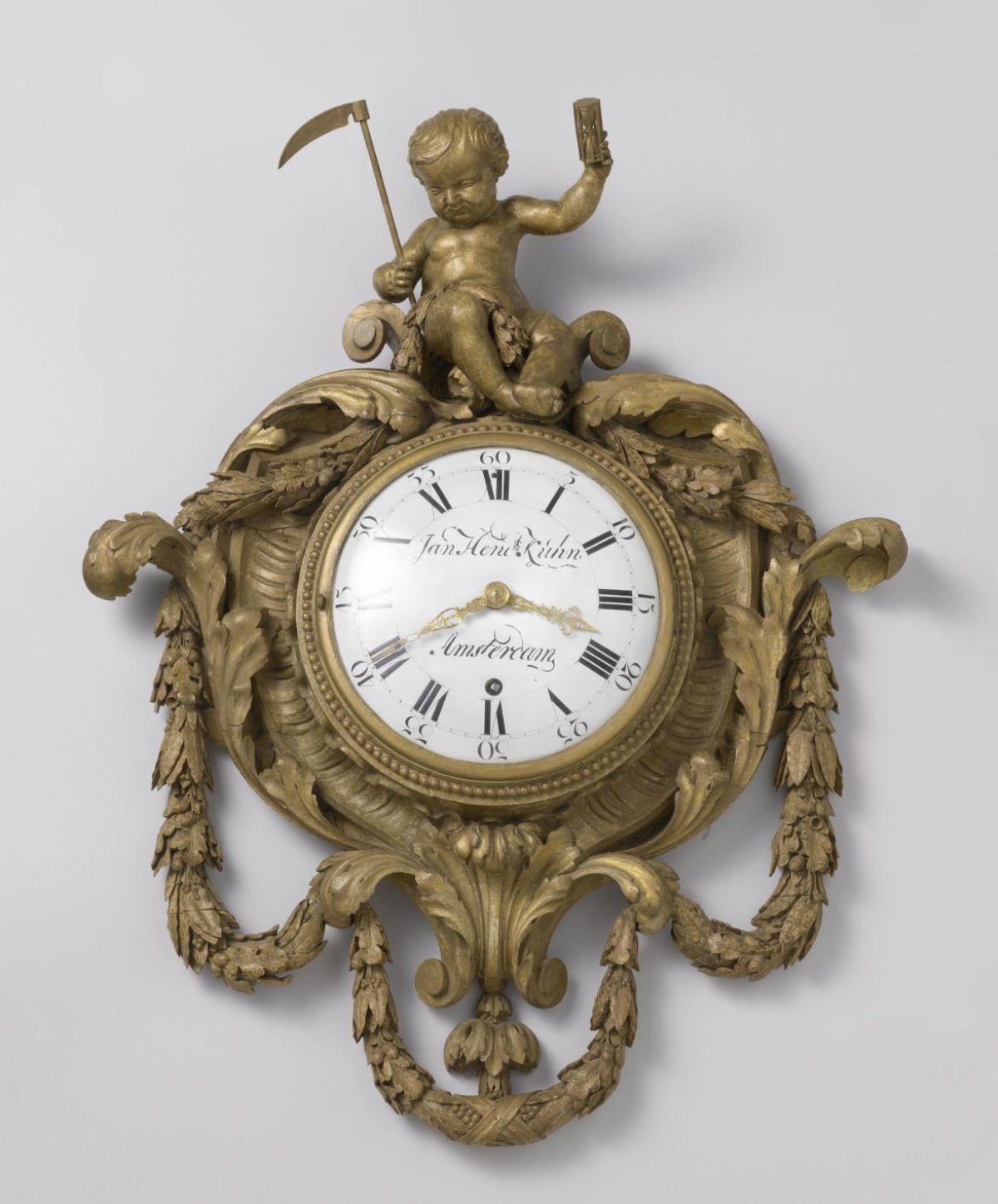
Cartel clock, c. 1792
c. 1792
Wall clock of linden wood, gilded and painted brown. The round dial is surrounded by a beaded border and is set in a lyre-shaped frame ending in volutes at the top and bottom, filled with wave or froth ornament. Acanthus leaves curl around the lyre shape, from which hangs a garland composed of oak and laurel leaves. The case is surmounted by a seated child figure holding a scythe and an hourglass in its hands. Dial is signed: "Jan Hendk Kuhn Amsterdam". The Rijksmuseum, Amsterdam, holds this object as BK-NM-8869; its record gives material recorded as gilding (material), wood (plant material), linden; technique gild; measurements height 102.5 cm x width 75.5 cm x depth 25 cm. Description translated from the museum's Dutch catalogue text; details are those of this museum object, and how far it represents a wider type has not been independently verified.
Partial type record