Catalogue
Tiles
Delftware and other decorated wall and floor tiles documented in institutional collections.
Individually identified types (320)
Filter by era, country, maker or material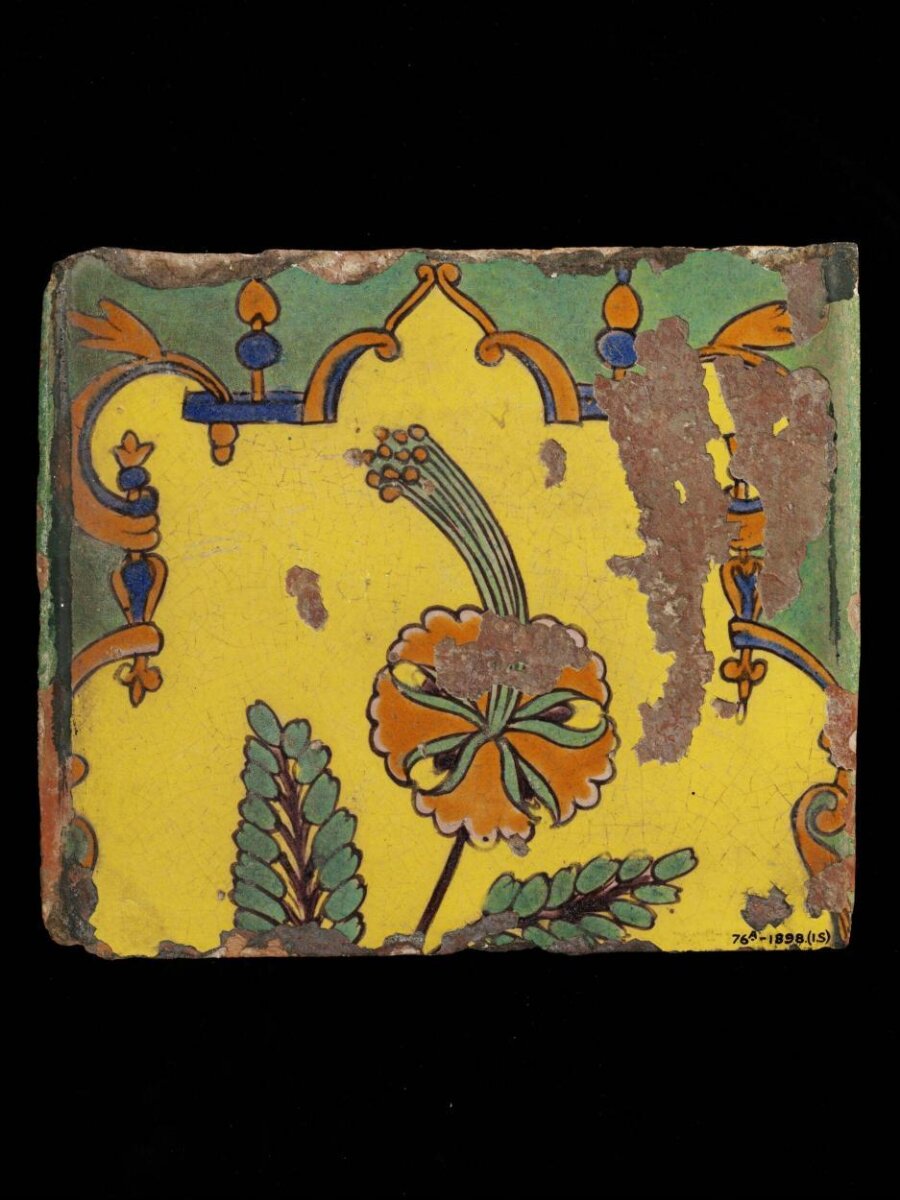
© Victoria and Albert Museum, London
tiles
Architectual tile — tile, Punjab (India), ca. 1650
ca. 1650
Architectual tile in the Victoria and Albert Museum, London (museum number IS.76&A-1898), made in Punjab (India), dated ca. 1650. The museum's brief description reads: TILE: Square tile with a floral motif of green, brown and yellow enamel within an ornate border of blue and brown surrounded by green. Lahore, 17th century.. Museum description: Square tile with a stylised floral motif of green, brown and yellow within an ornate shaped border of blue and brown surrounded by green. The museum records it as glazed earthenware with cuerda seca decoration, measuring Height 17.5 cm; Width 20.3 cm; Depth 2.8 cm. These details come from the museum's own record; how far this object represents a wider collectible type has not yet been independently verified.
Partial type record
Badisches Landesmuseum Karlsruhe via Europeana
tiles
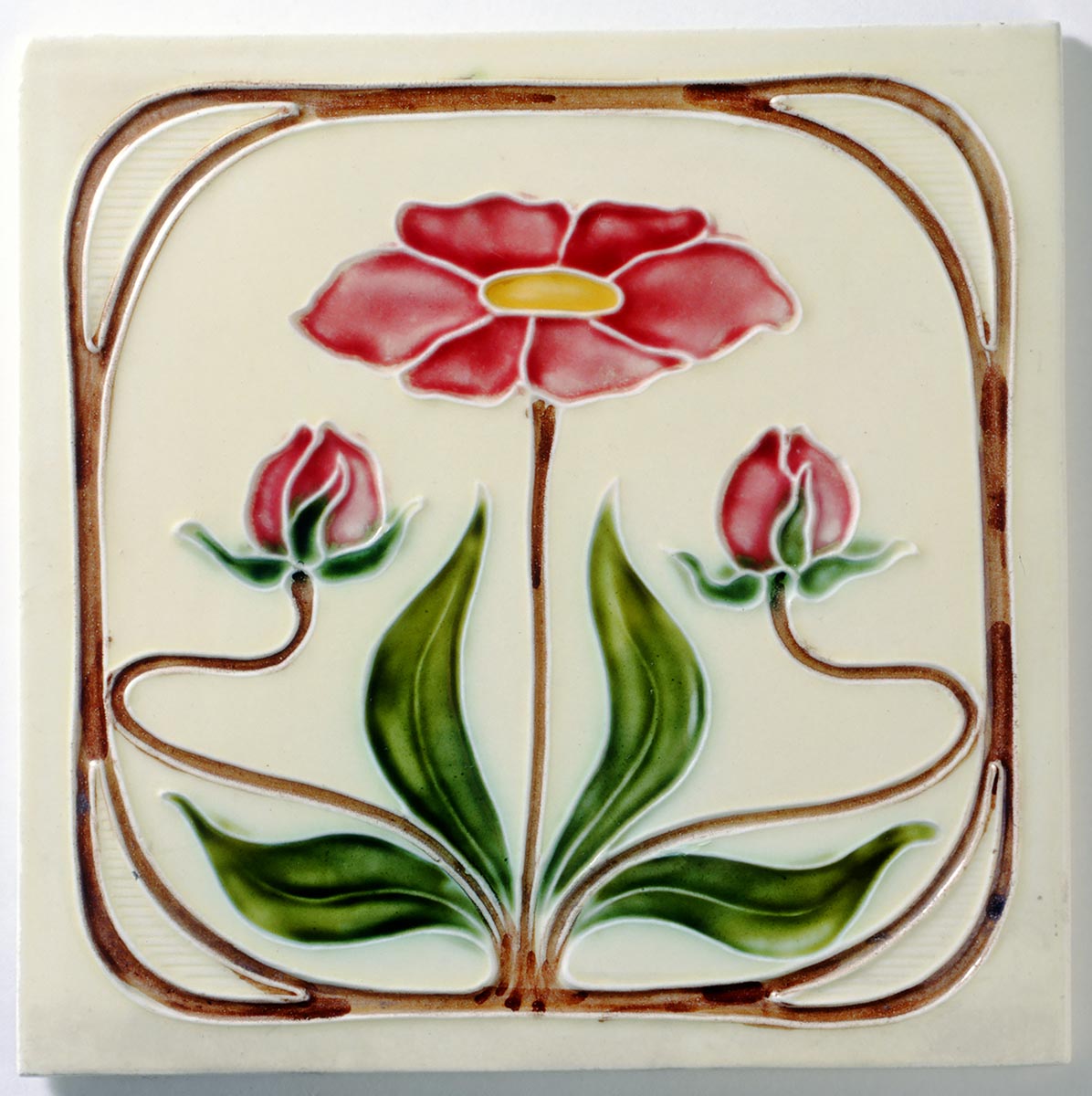
Art Nouveau tile with floral pattern, Georg Schmider - Vereinigte Zeller keramische Fabriken
Art Nouveau tile with floral pattern is held by Badisches Landesmuseum Karlsruhe (Germany), attributed to Georg Schmider - Vereinigte Zeller keramische Fabriken. Description supplied by the holding institution: Around 1900, the manufactory in Zell, Baden, specialized in the production of Art Nouveau tiles, which were sold throughout the German Empire. In contrast to other German tile manufacturers, who produced both geometric and floral motifs, Zell favored floral patterns influenced by French art. Literature: Simmermacher, René: Jugendstil-Fliesen, Bestandskatalog des Badischen Landesmuseum Karlsruhe, Karlsruhe 2000. The collection record gives measurements Height: 15.0 cm, Width: 15.0 cm. Published through Europeana; how far this object represents a wider collectible type has not yet been independently verified.
Partial type record
Rijksmuseum, Amsterdam
tiles
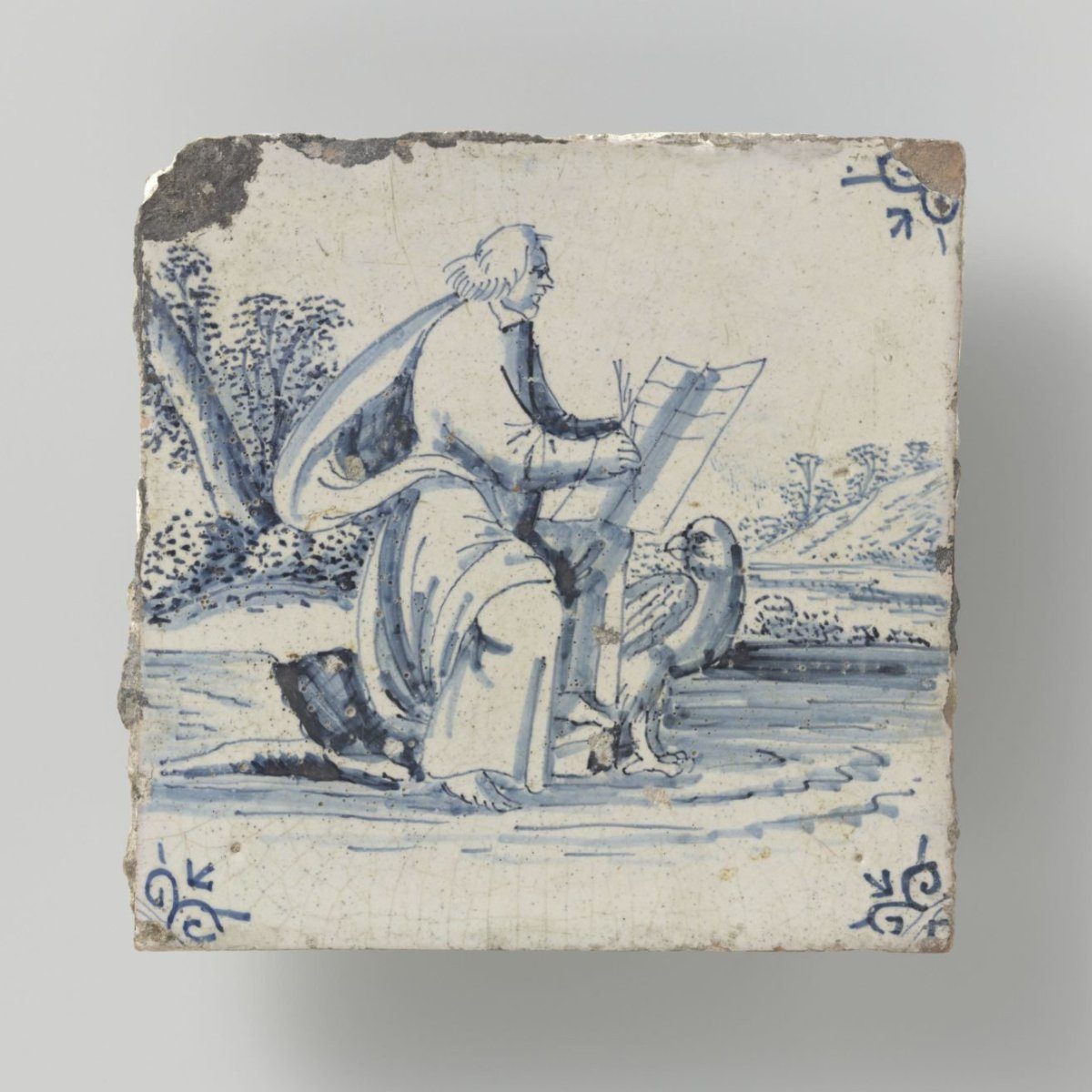
Biblical tile with John the Evangelist
c. 1620 - c. 1650
Tile with a blue-painted biblical depiction of John the Evangelist with a writing and next to an eagle. In the corners, an ox-head. The Rijksmuseum, Amsterdam, holds this object as BK-1955-303; its record gives material recorded as earthenware, tin glaze; technique maiolica; measurements height 12.5 cm x width 12.5 cm x thickness 0.9 cm. Description translated from the museum's Dutch catalogue text; details are those of this museum object, and how far it represents a wider type has not been independently verified.
Partial type record
© Victoria and Albert Museum, London
tiles
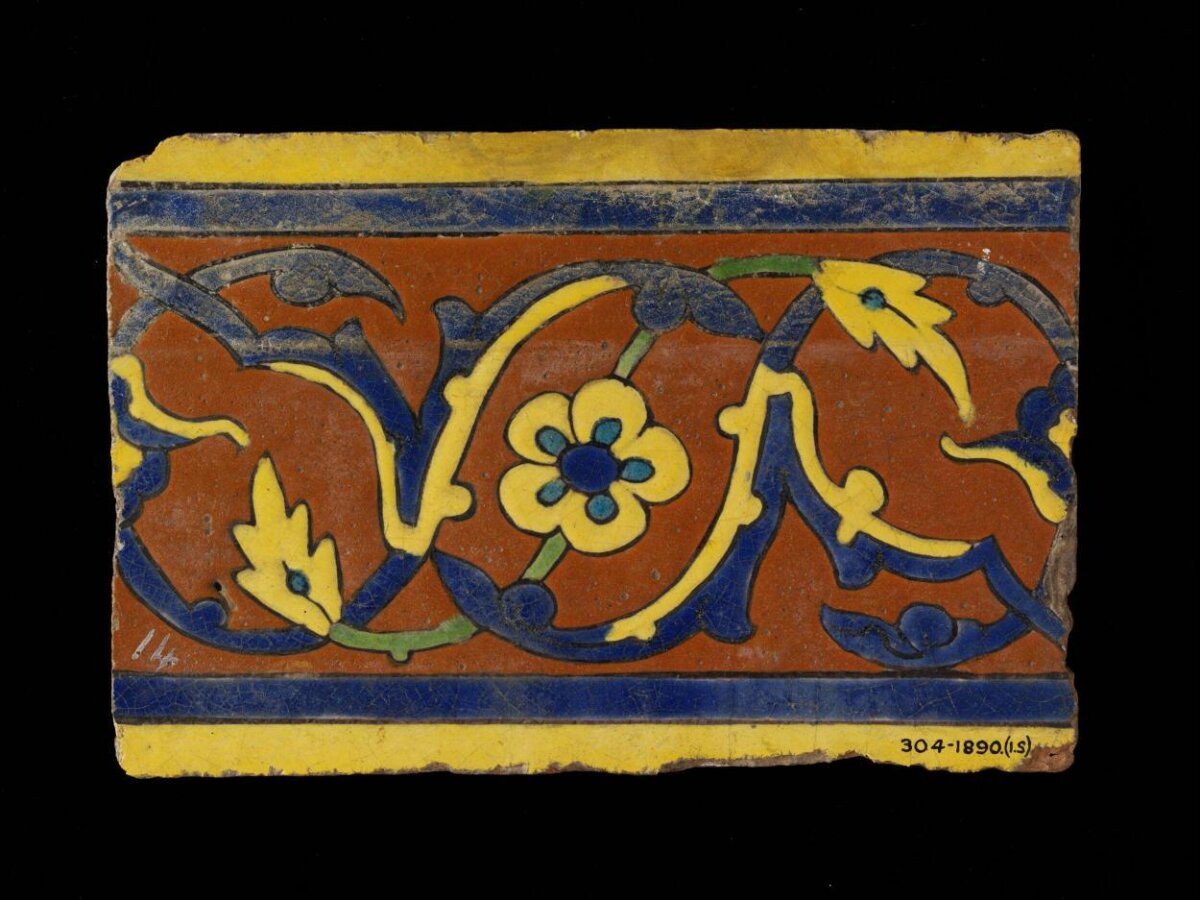
Border tile — tile, Lahore, second quarter of 17th century
second quarter of 17th century
Border tile in the Victoria and Albert Museum, London (museum number IS.304-1890), made in Lahore, dated second quarter of 17th century. The museum's brief description reads: Rectangular border tile with green, blue and yellow floral arabesques on a brown ground with blue and yellow borders.; Architecture, ceramic, glazed. Museum description: Border tile with an interlaced scrolling floral arabesque in yellow, green and blue against a reddish-brown ground between blue stripes and yellow margins. The museum records it as Earthenware decorated in cuerda seca, measuring Height 12.5 cm; Width 19 cm; Depth 2.4 cm. These details come from the museum's own record; how far this object represents a wider collectible type has not yet been independently verified.
Partial type record
© Victoria and Albert Museum, London
tiles
Border tile — tile, Punjab (India), ca. 1650
ca. 1650
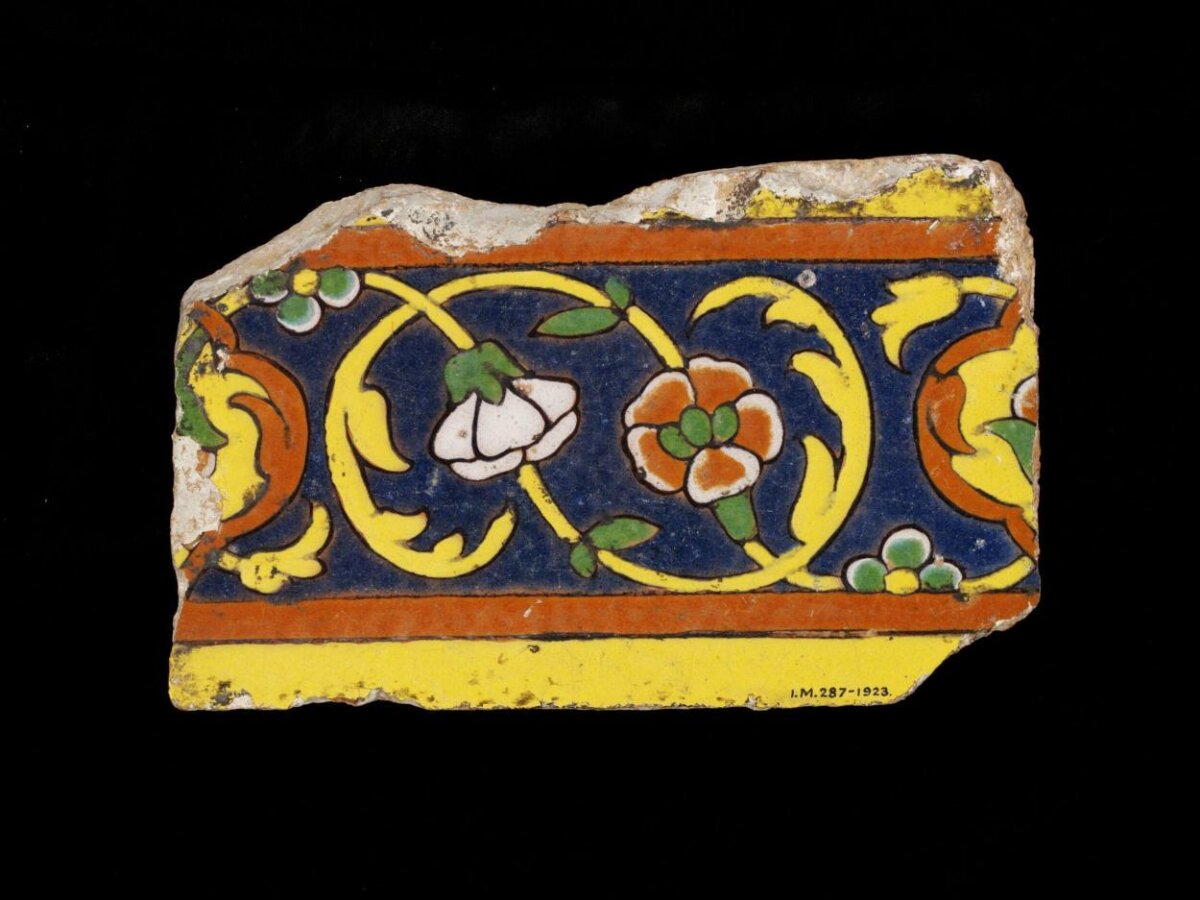
Border tile in the Victoria and Albert Museum, London (museum number IM.287-1923), made in Punjab (India), dated ca. 1650. The museum's brief description reads: Glazed earthenware, Mughal, ca. 1650. Museum description: Border tile of rectangular shape with a chipped lower edge. It has a design outlined in dry manganese and is painted with a horizontal band of interweaving scrolling stems, rosettes and halves of two arabesque panels in yellow. Indian-red, white and green on a cobalt-blue ground. The museum records it as Earthenware with cuerda seca decoration, measuring Height 20 cm. These details come from the museum's own record; how far this object represents a wider collectible type has not yet been independently verified.
Partial type record
© Victoria and Albert Museum, London
tiles
Border tile — tile, Punjab (India), ca. 1650 (CIRC.1306-1923)
ca. 1650
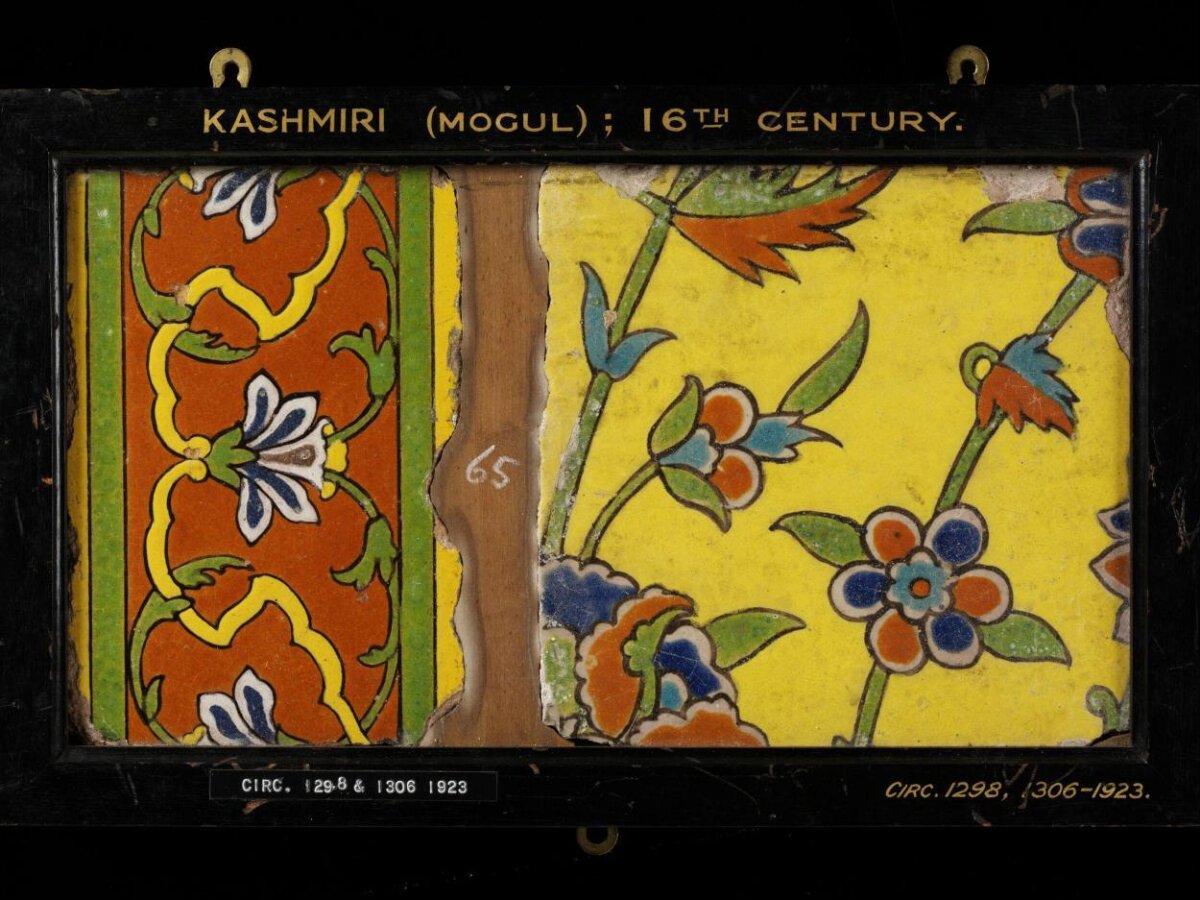
Border tile in the Victoria and Albert Museum, London (museum number CIRC.1306-1923), made in Punjab (India), dated ca. 1650. The museum's brief description reads: Architecture, ceramic, prob Lahore, ca. 1650. Museum description: Glazed earthenware rectangular border tile with a central orange band between two narrower green bands and yellow margins. The central band is decorated with a green foliated scroll and a yellow arabesque which are connected by alternate flower heads facing up and down with blue petals edged in white. The museum records it as Earthenware with cuerda seca decoration, measuring Height 24.2 cm; Width 40.1 cm; Depth 4.6 cm. These details come from the museum's own record; how far this object represents a wider collectible type has not yet been independently verified.
Partial type record
© Victoria and Albert Museum, London
tiles
Border tile — tile, Punjab (India), ca. 1650 (IS.66-1898)
ca. 1650
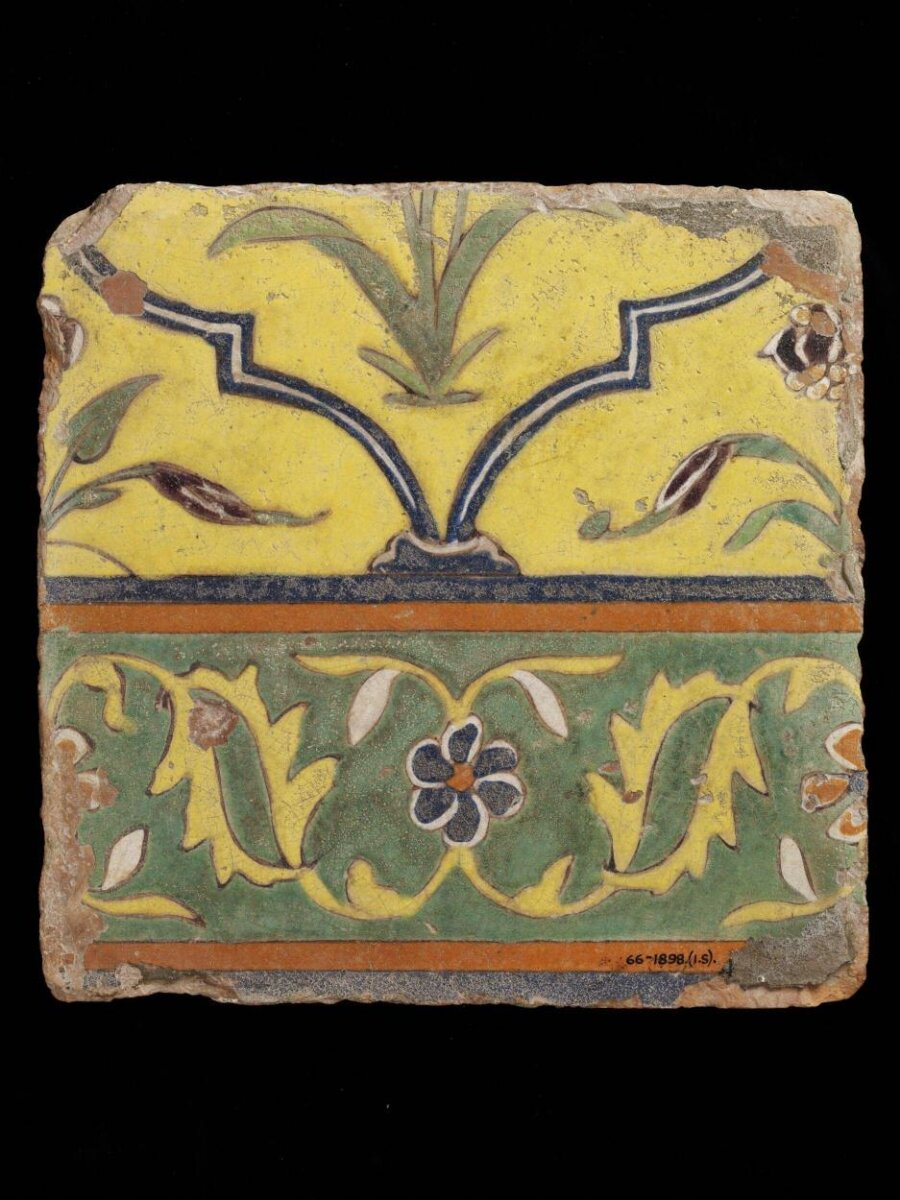
Border tile in the Victoria and Albert Museum, London (museum number IS.66-1898), made in Punjab (India), dated ca. 1650. The museum's brief description reads: Square border tile with floral motifs in green, white and brown enamel on yellow within a blue and white diaper with floral arabesque borders in blue and white on green separated by blue stripes.; Architecture, ceramic. Museum description: Part of a larger composition, this tile has a field of flowering plants in green, white and brown on a yellow ground within a blue and white shaped diaper pattern. Below this there is a border with floral and foliate arabesques design in blue, white and green between bands of blue and red stripes. The museum records it as Glazed earthenware with cuerda seca decoration, measuring Height 20.3 cm; Width 20.5 cm; Depth 2.5 cm. These details come from the museum's own record; how far this object represents a wider collectible type has not yet been independently verified.
Partial type record
The Metropolitan Museum of Art — Gift of Mrs. George F. Leonard, 1971
tiles
Border Tile, J. and J. G. Low Art Tile Works, 1881
1881
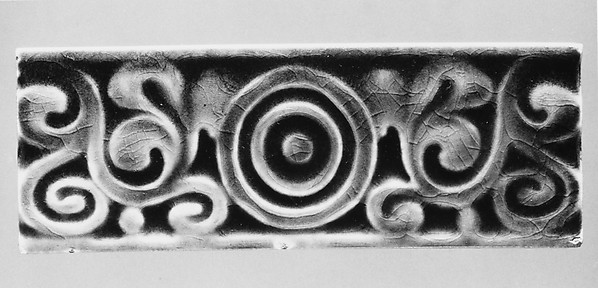
Border Tile made by J. and J. G. Low Art Tile Works (American, Chelsea, Massachusetts, 1877–1903), dated 1881, from American. The museum records its materials as: Earthenware. Recorded dimensions: 6 1/8 x 2 3/16 x 3/8 in. (15.6 x 5.6 x 1 cm). The Metropolitan Museum of Art holds this object as 1971.182.3; details are those of this museum object, and how far it represents a wider type has not been independently verified.
Partial type record
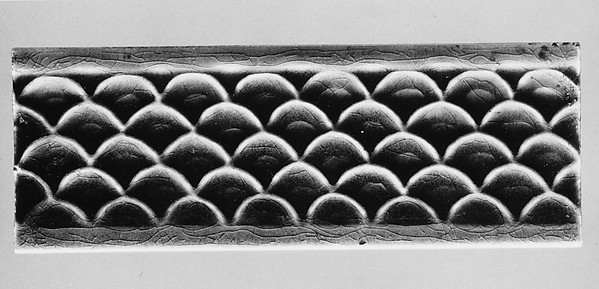
The Metropolitan Museum of Art — Gift of Mrs. George F. Leonard, 1971
tiles
Border Tile, J. and J. G. Low Art Tile Works, 1881
1881
Border Tile made by J. and J. G. Low Art Tile Works (American, Chelsea, Massachusetts, 1877–1903), dated 1881, from American. The museum records its materials as: Earthenware. Recorded dimensions: 6 1/8 x 2 1/8 x 3/8 in. (15.6 x 5.4 x 1 cm). The Metropolitan Museum of Art holds this object as 1971.182.7; details are those of this museum object, and how far it represents a wider type has not been independently verified.
Partial type record
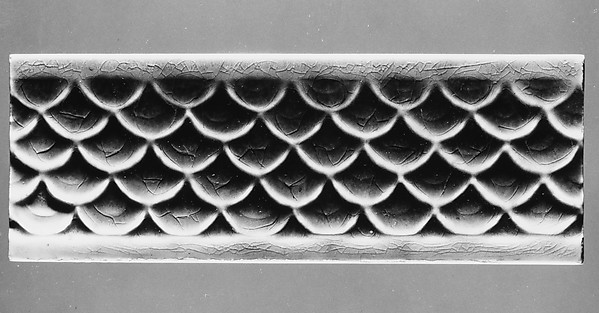
The Metropolitan Museum of Art — Funds from various donors, 1970
tiles
Border Tile, J. and J. G. Low Art Tile Works, 1881–84
1881–84
Border Tile made by J. and J. G. Low Art Tile Works (American, Chelsea, Massachusetts, 1877–1903), dated 1881–84, from American. The museum records its materials as: Earthenware. Recorded dimensions: 2 3/16 x 6 1/8 x 3/8 in. (5.6 x 15.6 x 1 cm). The Metropolitan Museum of Art holds this object as 1970.100.8; details are those of this museum object, and how far it represents a wider type has not been independently verified.
Partial type record
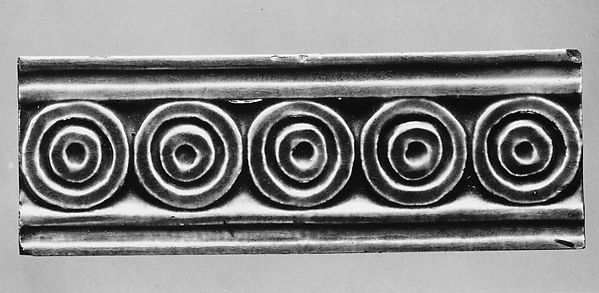
The Metropolitan Museum of Art — Gift of Mrs. George F. Leonard, 1971
tiles
Border Tile, J. and J. G. Low Art Tile Works, 1883
1883
Border Tile made by J. and J. G. Low Art Tile Works (American, Chelsea, Massachusetts, 1877–1903), dated 1883, from American. The museum records its materials as: Earthenware. Recorded dimensions: 6 1/8 x 2 1/8 x 3/8 in. (15.6 x 5.4 x 1 cm). The Metropolitan Museum of Art holds this object as 1971.182.4; details are those of this museum object, and how far it represents a wider type has not been independently verified.
Partial type record
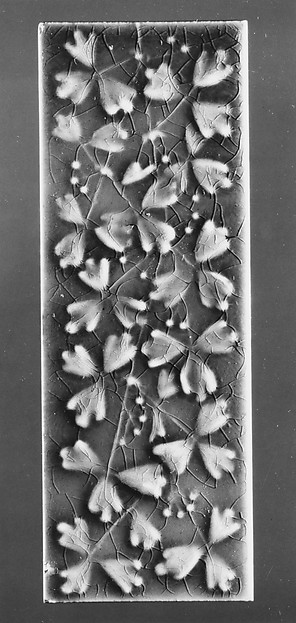
The Metropolitan Museum of Art — Funds from various donors, 1970
tiles
Border Tile, J. and J. G. Low Art Tile Works, ca. 1885
ca. 1885
Border Tile made by J. and J. G. Low Art Tile Works (American, Chelsea, Massachusetts, 1877–1903), dated ca. 1885, from American. The museum records its materials as: Earthenware. Recorded dimensions: 2 1/8 x 6 x 5/16 in. (5.4 x 15.2 x 0.8 cm). The Metropolitan Museum of Art holds this object as 1970.100.12; details are those of this museum object, and how far it represents a wider type has not been independently verified.
Partial type record
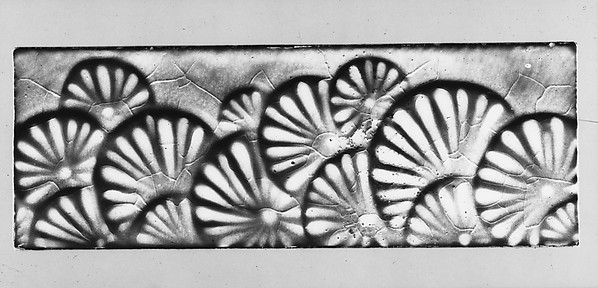
The Metropolitan Museum of Art — Funds from various donors, 1970
tiles
Border Tile, J. and J. G. Low Art Tile Works, ca. 1885
ca. 1885
Border Tile made by J. and J. G. Low Art Tile Works (American, Chelsea, Massachusetts, 1877–1903), dated ca. 1885, from American. The museum records its materials as: Earthenware. Recorded dimensions: 2 3/16 x 6 1/8 x 7/16 in. (5.6 x 15.6 x 1.1 cm). The Metropolitan Museum of Art holds this object as 1970.100.10; details are those of this museum object, and how far it represents a wider type has not been independently verified.
Partial type record
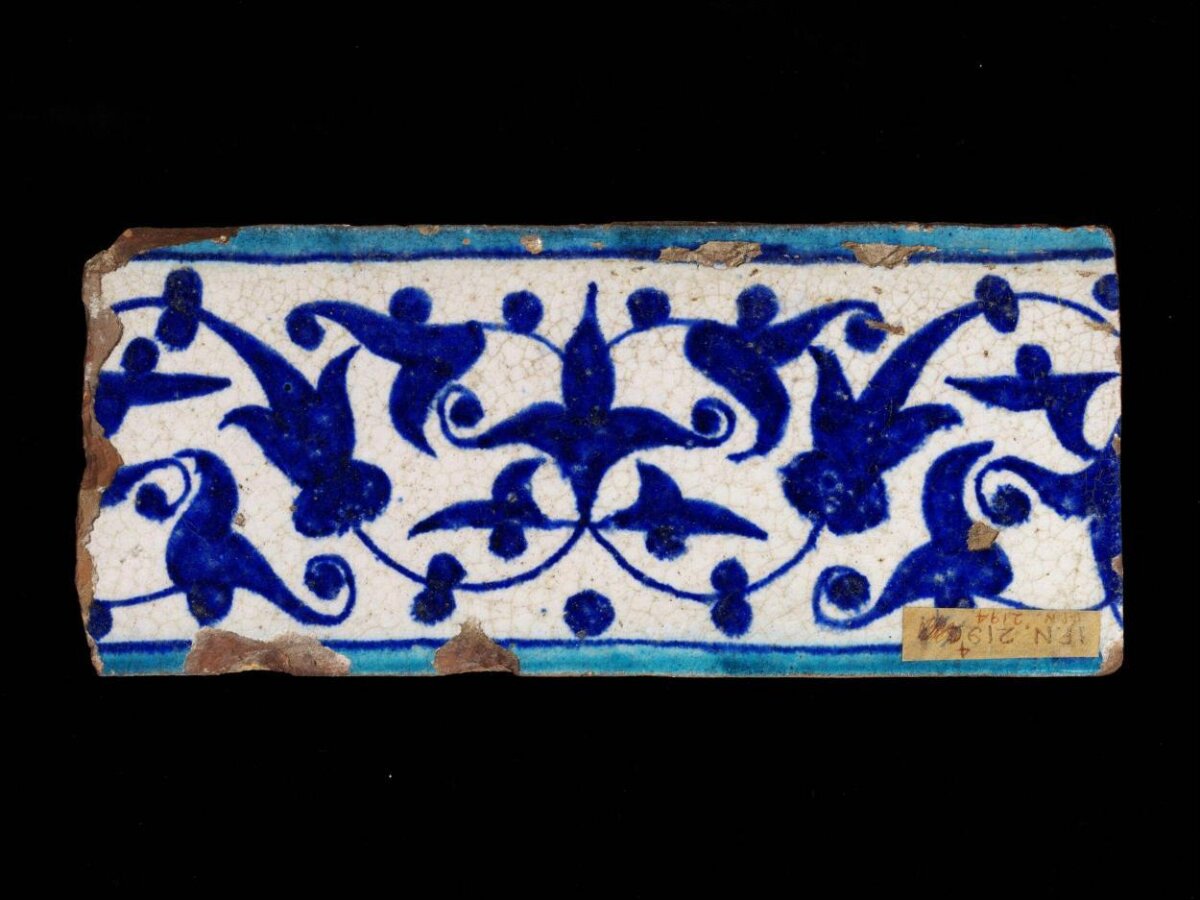
© Victoria and Albert Museum, London
tiles
Border tile, Multan, ca. 1880
ca. 1880
Border tile in the Victoria and Albert Museum, London (museum number IPN.2194), made in Multan, dated ca. 1880. The museum's brief description reads: Glazed earthenware, Multan, ca. 1880. Museum description: Rectangular glazed earthenware border tile, with multiple chips. Design in style of late 16th/early 17th century of cobalt blue scrolling lines bearing palmettes and half-palmettes, on a white ground with turquoise framing bands separated from the main panel of decoration by fine cobalt blue lines The museum records it as glazed earthenware, measuring Height 8.8 cm; Depth 2.5 cm; Width 20.4 cm. These details come from the museum's own record; how far this object represents a wider collectible type has not yet been independently verified.
Partial type record
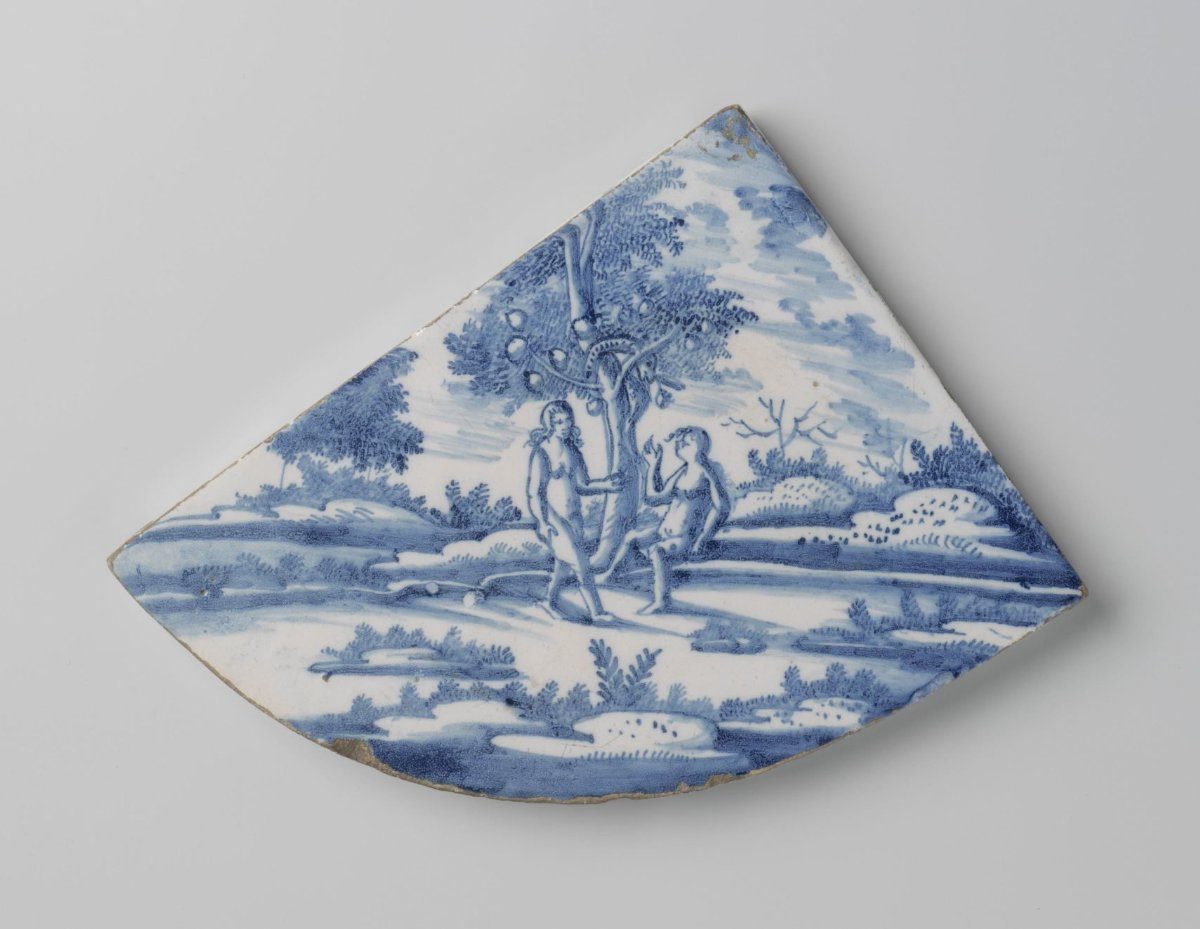
Rijksmuseum, Amsterdam
tiles
Bracket tile with depiction of Adam and Eve in Paradise
c. 1720 - c. 1770
Etagère tile of faience. Painted in blue with a depiction of Adam and Eve in Paradise. The Rijksmuseum, Amsterdam, holds this object as BK-NM-10460; its record gives measurements height 24 cm x width 18.5 cm x thickness 2 cm. Description translated from the museum's Dutch catalogue text; details are those of this museum object, and how far it represents a wider type has not been independently verified.
Partial type record
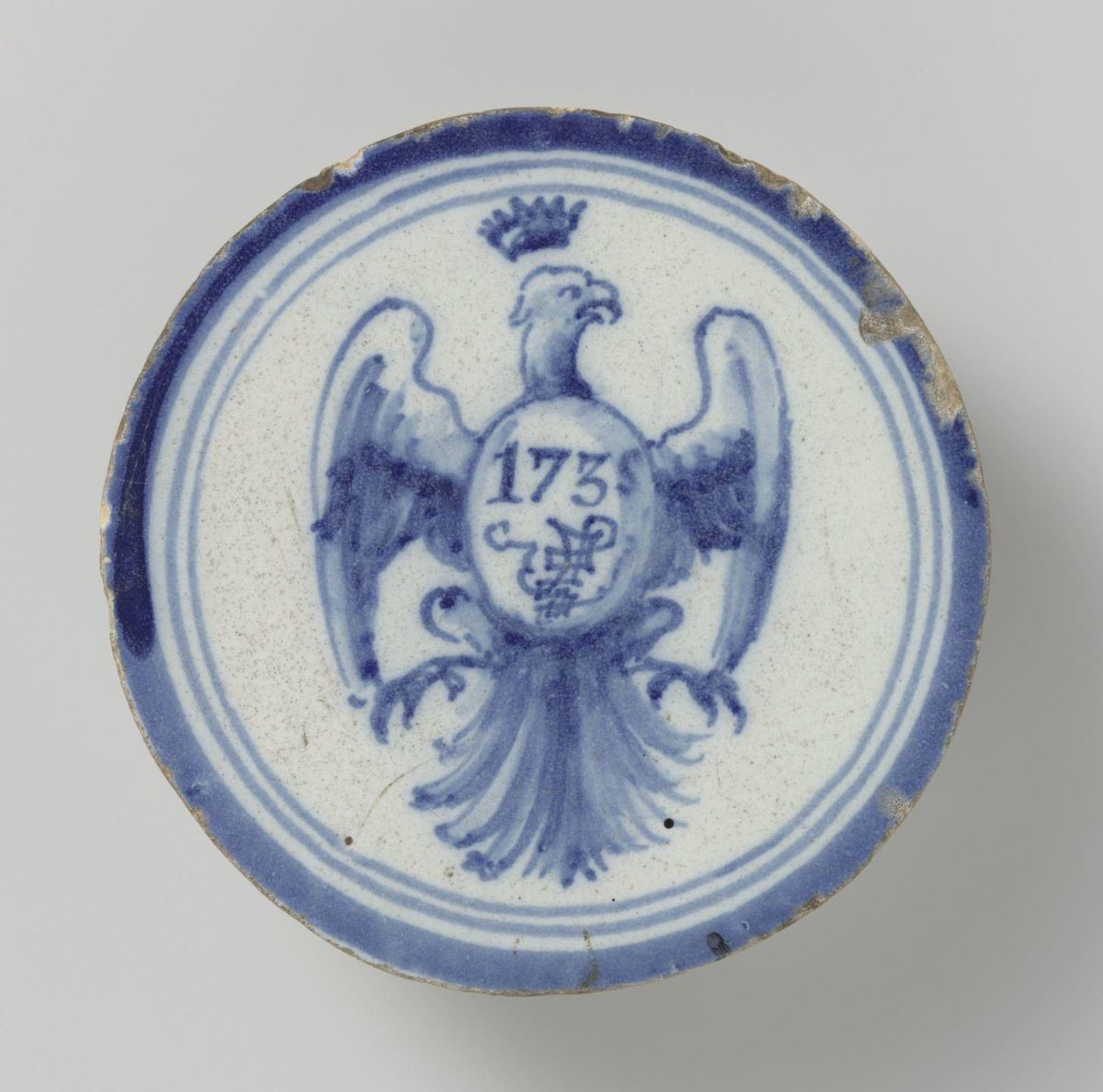
Rijksmuseum, Amsterdam
tiles
Circular tile with eagle
1735
Circular tile with a blue-painted crowned eagle, on its chest a shield with the year: 1735. The Rijksmuseum, Amsterdam, holds this object as BK-1955-331; its record gives material recorded as earthenware, tin glaze; technique maiolica; measurements diameter 12.3 cm x thickness 1.4 cm. Description translated from the museum's Dutch catalogue text; details are those of this museum object, and how far it represents a wider type has not been independently verified.
Partial type record
"Valer Literat" Făgăraş Country Museum via Europeana
tiles
Corner stove tile, 1784
1784
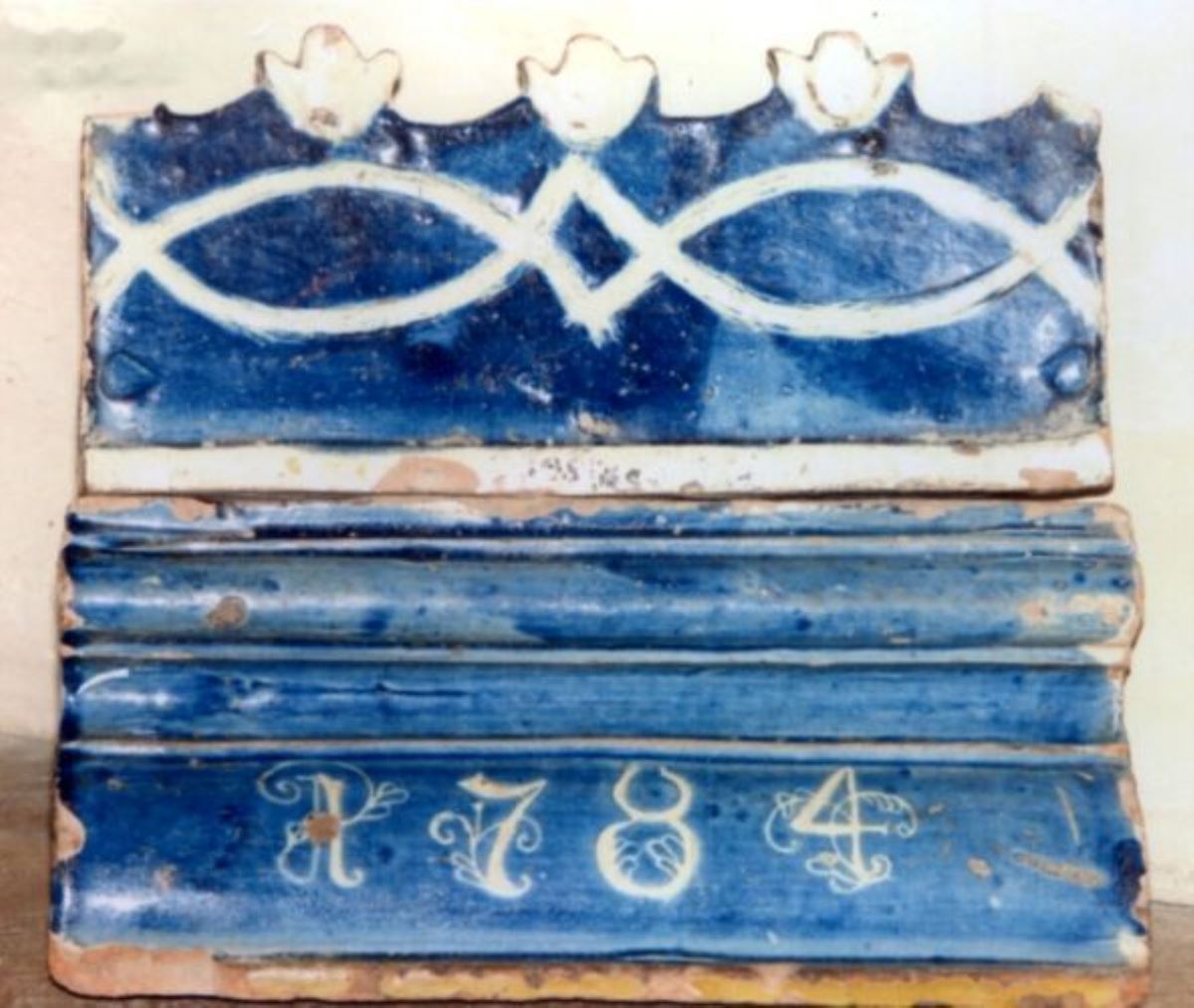
Corner stove tile, 1784 is held by "Valer Literat" Făgăraş Country Museum, dated 1784. Museum description: Rectangular stove cresting, engobed, glazed, decorated with geometric and floral motifs: tulip. Glaze chipped in places, small missing fragments; two pieces fastened with a screw. The year 1784 appears. The museum record gives measurements length: 20 cm; width: 22 cm. These details come from the holding museum's own record; how far this object represents a wider collectible type has not yet been independently verified.
Partial type record
Rijksmuseum, Amsterdam
tiles
Cross-shaped tile with Quranic texts and scrolls
c. 1262 - c. 1263
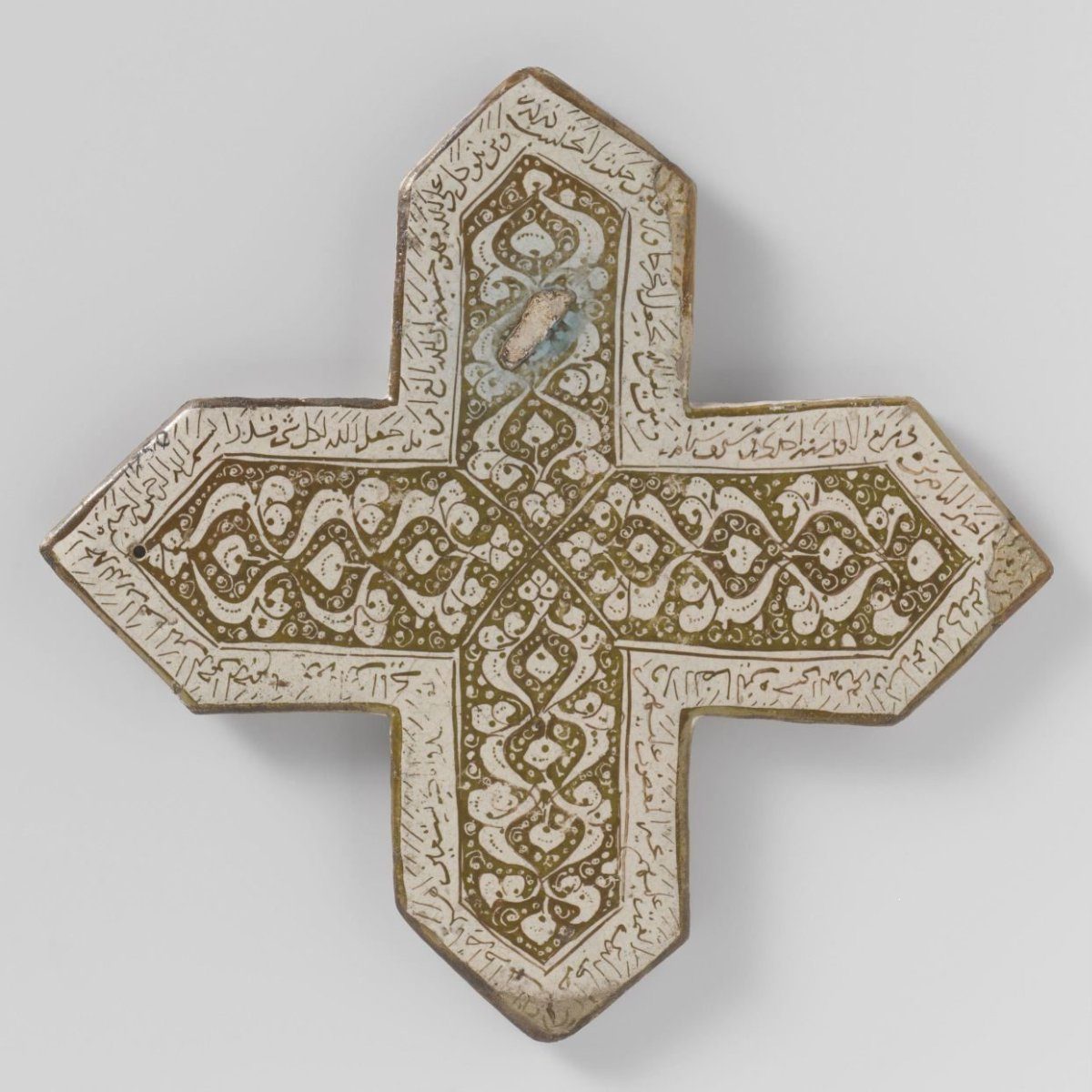
Cross tile of earthenware (quartz-fritware), painted over the tin glaze with a brown lustre decoration with reserved scrolls. Along the edge, Quranic texts: Surah 1 and Surah 65:3, together with an as yet undeciphered text. The Rijksmuseum, Amsterdam, holds this object as BK-NM-11750-A; its record gives material recorded as glaze, earthenware, luster (textile), quartz; technique vitrification, paint, fired, formed; measurements thickness 1.5 cm x diameter 30.5 cm. Description translated from the museum's Dutch catalogue text; details are those of this museum object, and how far it represents a wider type has not been independently verified.
Partial type record
Rijksmuseum, Amsterdam
tiles
Cuenca tile with medallion containing rosette; four adjoining corner compartments.
1500 - 1600
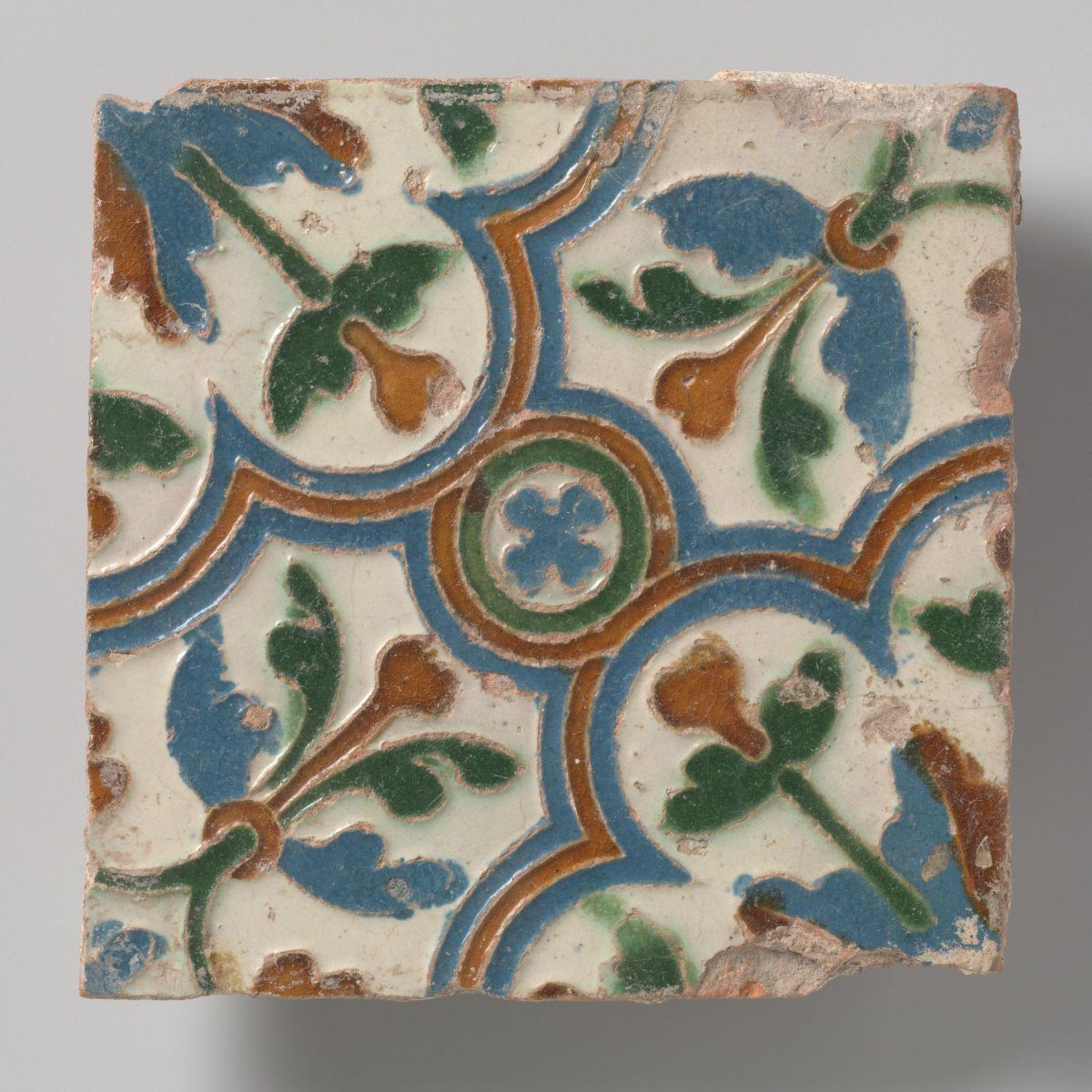
Cuenca tile, painted in white (ground), light blue, ochre yellow and dark green. An ochre-yellow band forms a pattern with a small medallion in the centre and four adjoining corner compartments. A rosette inside the medallion. Foliate and floral motifs in the corner compartments. The Rijksmuseum, Amsterdam, holds this object as BK-1964-27; its record gives material recorded as earthenware, tin glaze; technique cuenca; measurements height 14 cm x width 14 cm x thickness 1.8 cm. Description translated from the museum's Dutch catalogue text; details are those of this museum object, and how far it represents a wider type has not been independently verified.
Partial type record
Deutsche Fotothek via Europeana
tiles
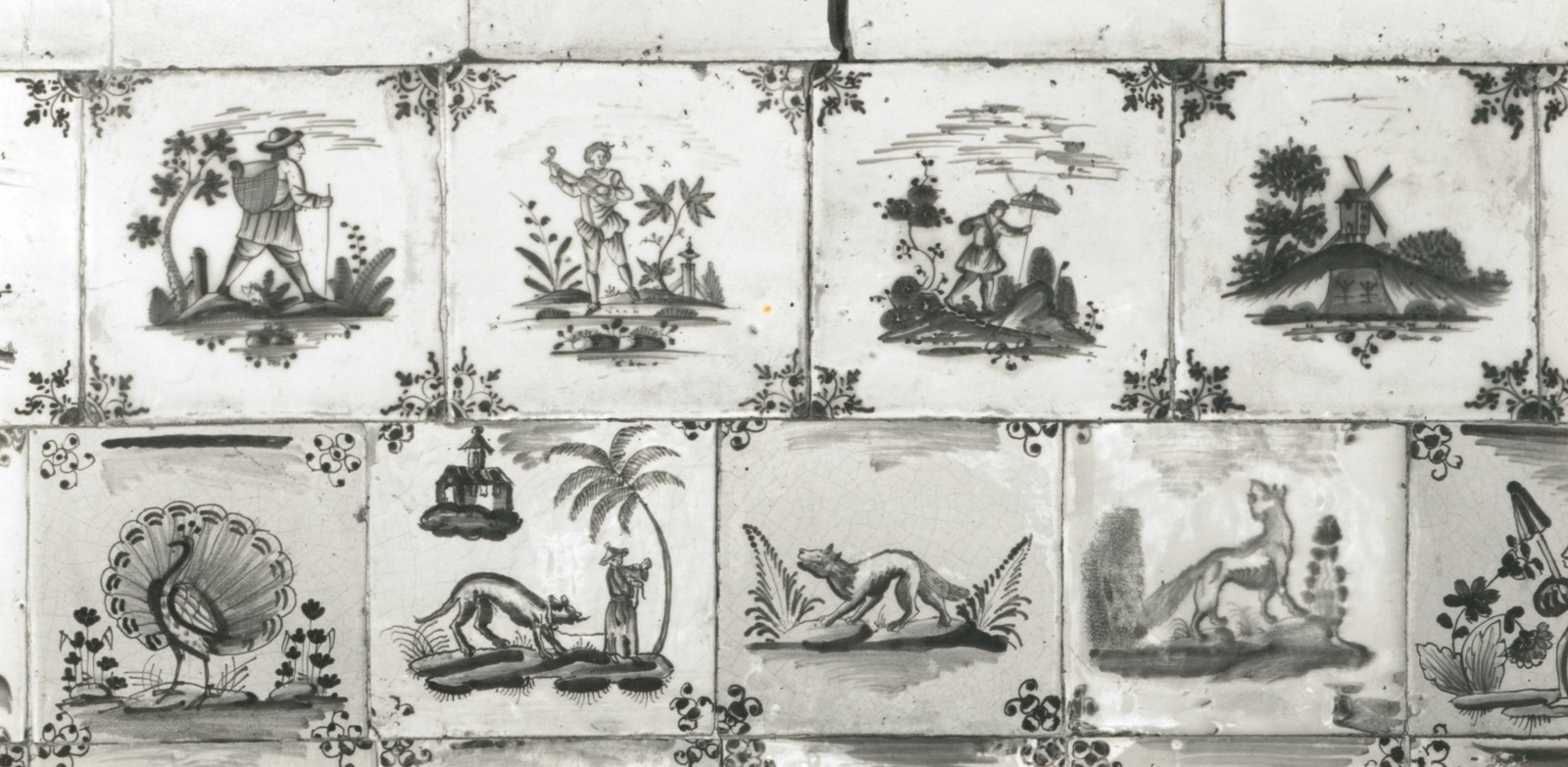
Delft tiles with animal, genre, and chinoiserie depictions. 1st half of the 18th century. Seußlitz, garden pavilion of the castle, Walther, Bernd (Production) (Photographer)
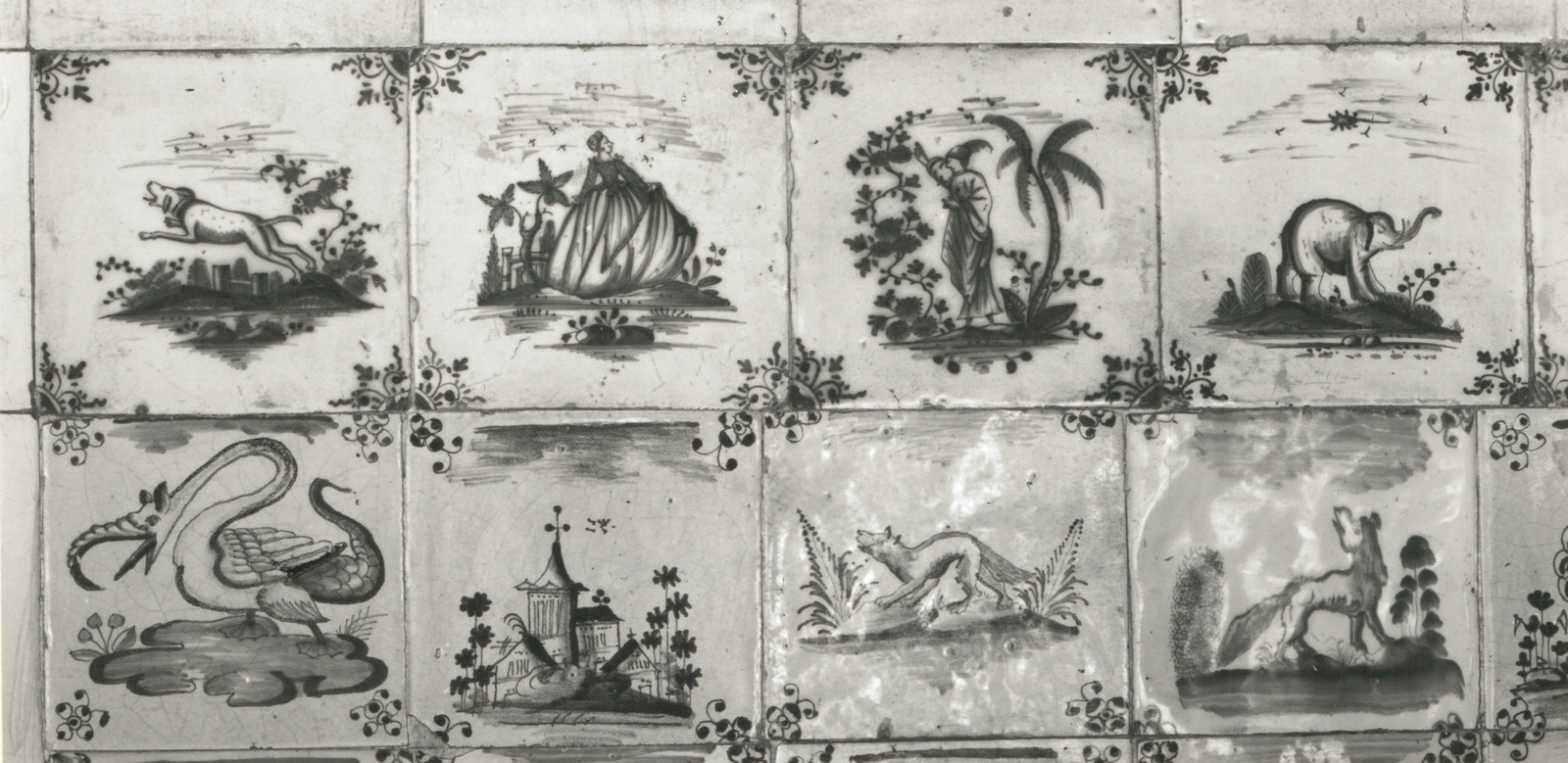
Delft tiles with animal, genre, and chinoiserie depictions. 1st half of the 18th century. Seußlitz, garden pavilion of the castle held by Deutsche Fotothek (Germany). Collection record published through Europeana; the wider type is not yet verified.
Partial type record
Deutsche Fotothek via Europeana
tiles
Delft tiles with animal, genre, and chinoiserie depictions. 1st half of the 18th century. Seußlitz, garden pavilion of the castle, Walther, Bernd (Production) (Photographer)
Delft tiles with animal, genre, and chinoiserie depictions. 1st half of the 18th century. Seußlitz, garden pavilion of the castle held by Deutsche Fotothek (Germany). Collection record published through Europeana; the wider type is not yet verified.
Partial type record
Rijksmuseum, Amsterdam
tiles
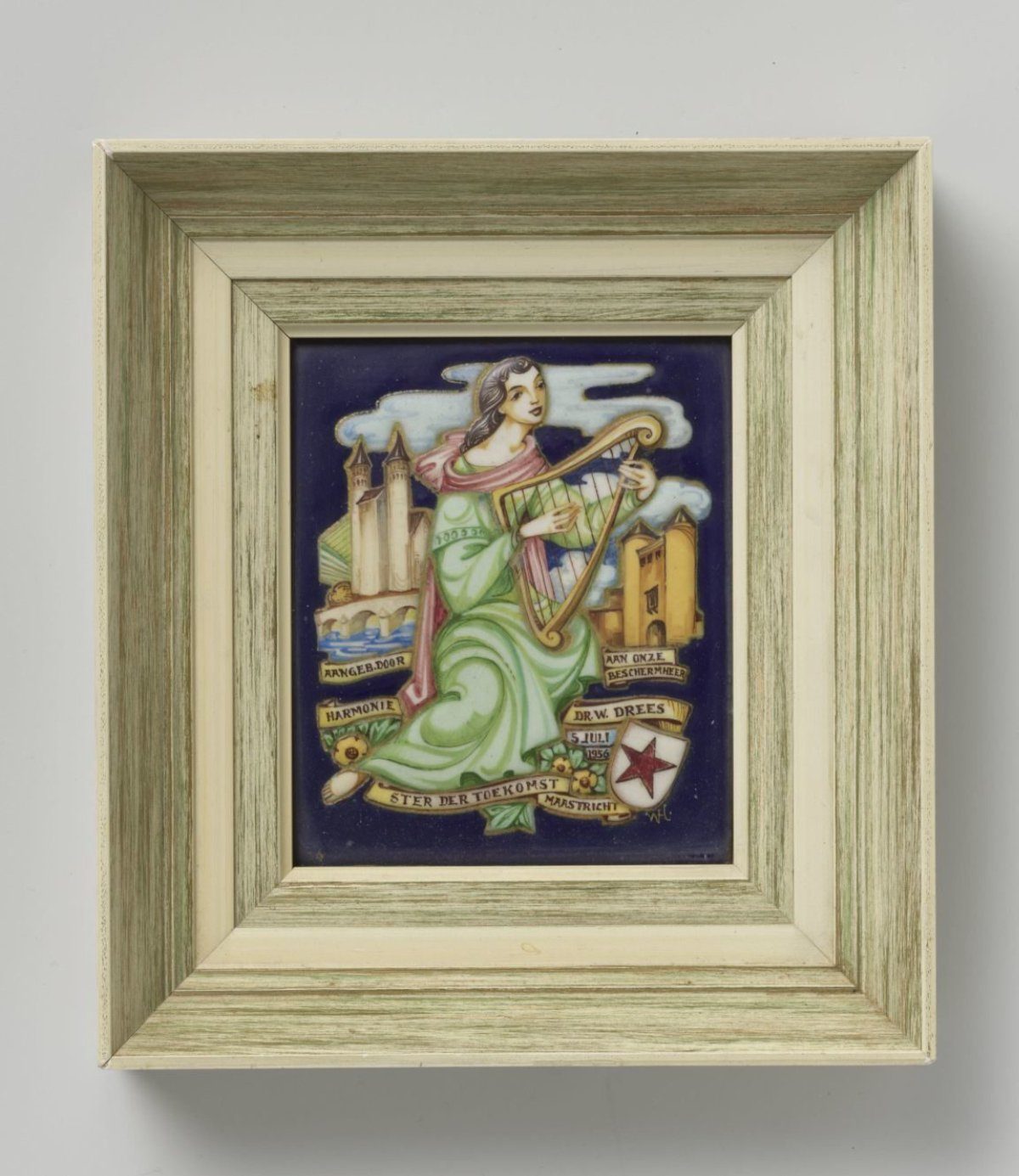
Enamelled tile presented to patron W. Drees by the 'Ster der Toekomst' wind band in Maastricht
1956-07-05
Enamelled tile in a plastic frame depicting a Madonna playing a harp. Around her green skirt runs the text 'aangeb. door harmonie ster der toekomst maastricht' and 'aan onze beschermheer Dr. W. Drees, 5 juli 1956'. Signed WH. The Rijksmuseum, Amsterdam, holds this object as NG-1991-4-27; its record gives material recorded as metal, plastic (organic material); measurements height 11.5 cm x width 10 cm x depth 3.5 cm. Description translated from the museum's Dutch catalogue text; details are those of this museum object, and how far it represents a wider type has not been independently verified.
Partial type record
The Metropolitan Museum of Art — Gift of Florence I. Balasny-Barnes, in memory of her sister, Yvette B. Gould, 1984
tiles
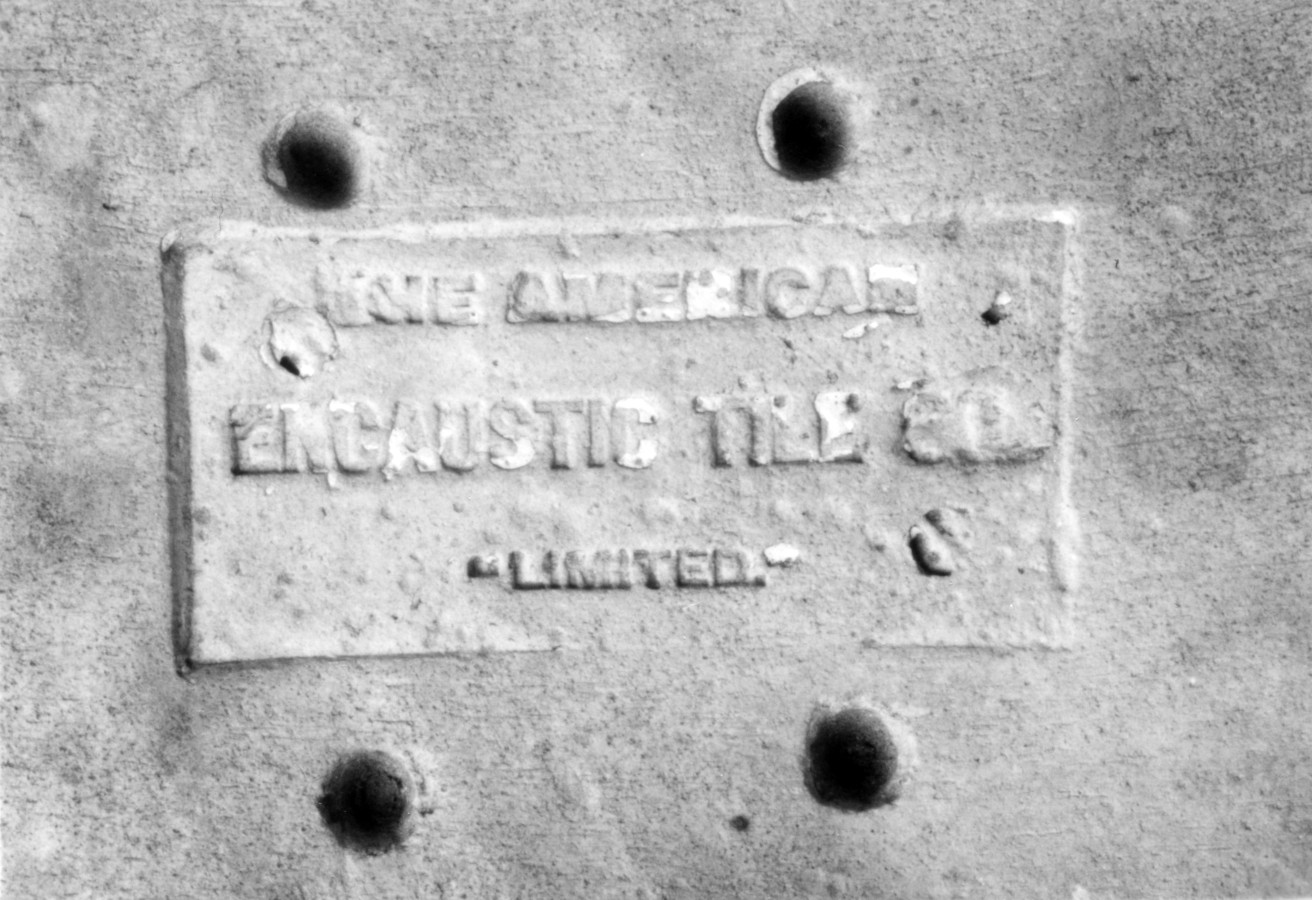
Encaustic Tile, American Encaustic Tile Company, 1870–75
1870–75
Encaustic Tile made by American Encaustic Tile Company (American, New York, 1875–1935), dated 1870–75, from American. The museum records its materials as: Earthenware. Recorded dimensions: 4 5/16 x 4 5/16 x 1/2 in. (11 x 11 x 1.3 cm). The Metropolitan Museum of Art holds this object as 1984.443.8; details are those of this museum object, and how far it represents a wider type has not been independently verified.
Partial type record
Székely National Museum via Europeana
tiles
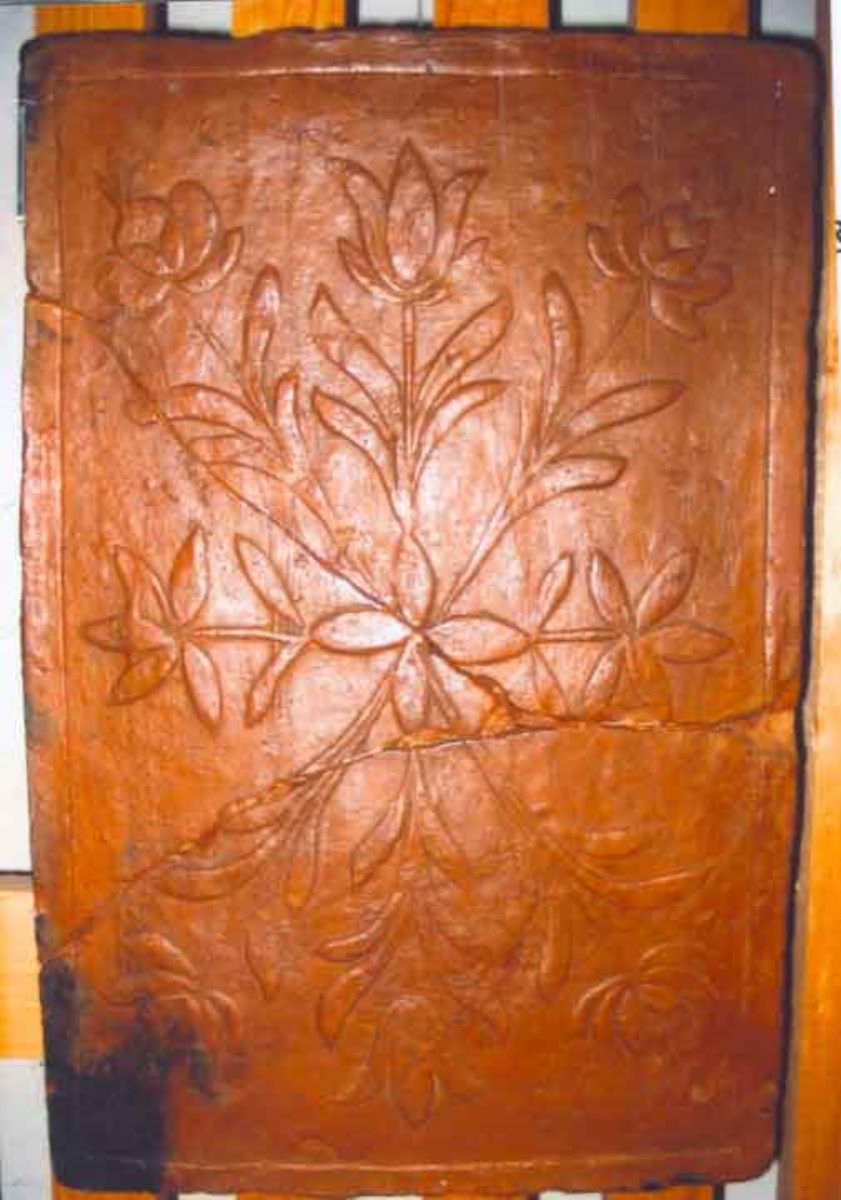
Flat stove tile
Flat stove tile is held by Székely National Museum. Museum description: Flat stove tile with floral motifs. The piece is crafted symmetrically along both the horizontal and vertical axes. In the centre is a flower from which eight floral stems emerge. Those at the edges are shorter, directed toward the edges. The six flowers are divided into groups of three: three are on the upper part of the tile, pointing upwards, and the other three are on the lower part of the tile, pointing downwards. Two flowers pointing up and down are tulips, while the four arranged diagonally are roses. The tile is brown, unglazed. The piece, broken into three fragments at some point, has been treated and glued together. The museum record gives measurements length: 38.5 cm; width: 25.5 cm. These details come from the holding museum's own record; how far this object represents a wider collectible type has not yet been independently verified.
Partial type record
National Museum of Romanian History via Europeana
tiles
Flat stove tile
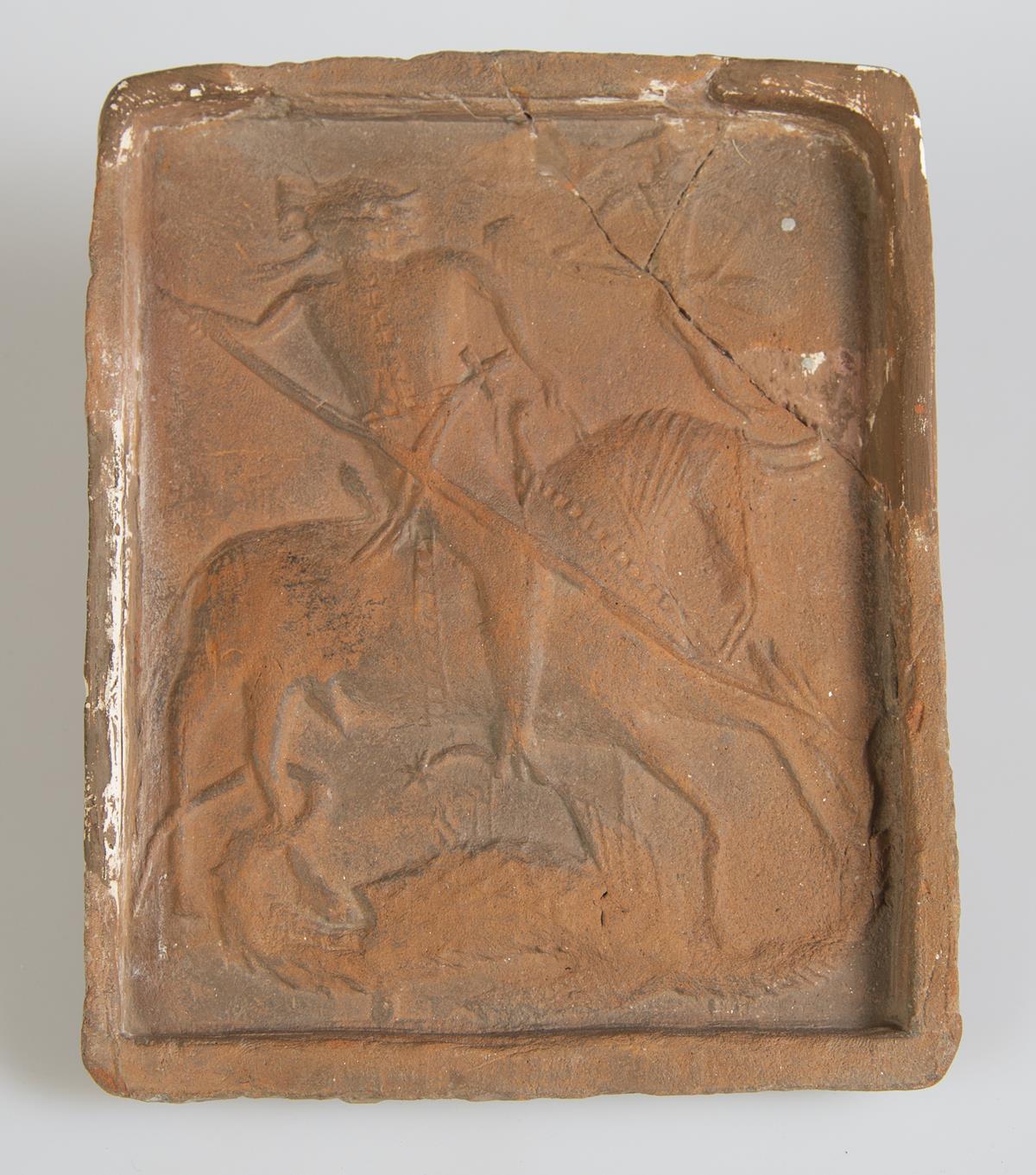
Flat stove tile is held by National Museum of Romanian History. Museum description: Flat stove tile of rectangular shape, the edge is raised, corners slightly rounded, reconstructed from three fragments. The upper corners, as well as the long side of the rim, have been filled in with plaster. The decoration is in relief and depicts St. George slaying the dragon. St. George on horseback, dressed in a tunic, helmet on his head, sword at his waist, spurs on his boots, kills the dragon with a spear. The dragon is fallen belly-up at the horse's feet. In the upper right corner there is another figure, depicted in smaller dimensions. The tile is unglazed, brick-red paste; on the back are traces of fingerprints from the craftsman's fingers. The museum record gives measurements length: 168 mm; width: 136 mm; thickness: 10 mm; height: 23 mm; place associated: discovery point: Cătina; discovery locality: Cătina; discovery commune: Cătina commune; county of…. These details come from the holding museum's own record; how far this object represents a wider collectible type has not yet been independently verified.
Partial type record
Székely National Museum via Europeana
tiles
Flat stove tile, 1823
1823
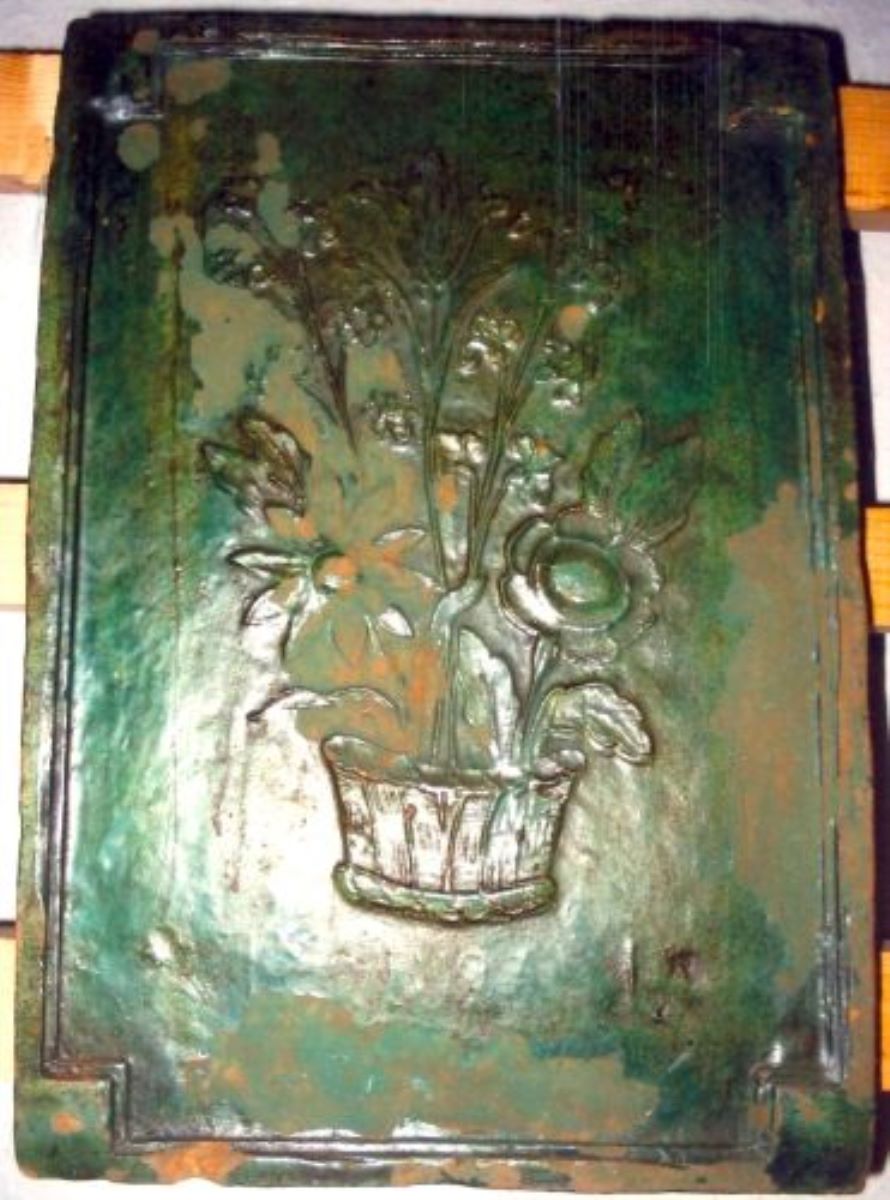
Flat stove tile, 1823 is held by Székely National Museum, dated 1823. Museum description: Flat stove tile with floral ornaments. On the lower part in the center is a large vase, in which a bouquet of flowers is placed. This bouquet consists of five flower stems with leaves. The two flowers at the edges are shorter, and the flowers in the middle rise to the upper edge of the tile. On the two sides of the piece are the initials of the master, T I (Turóczi István) from Târgu Secuiesc; under the vase is the year of manufacture 1823. The tile is glazed in green; inscription [Hungarian]: 1823; T I The museum record gives measurements length: 36 cm; width: 25 cm. These details come from the holding museum's own record; how far this object represents a wider collectible type has not yet been independently verified.
Partial type record
Museums Muttenz via Europeana
tiles
Floor slab, tile in terrazzo look
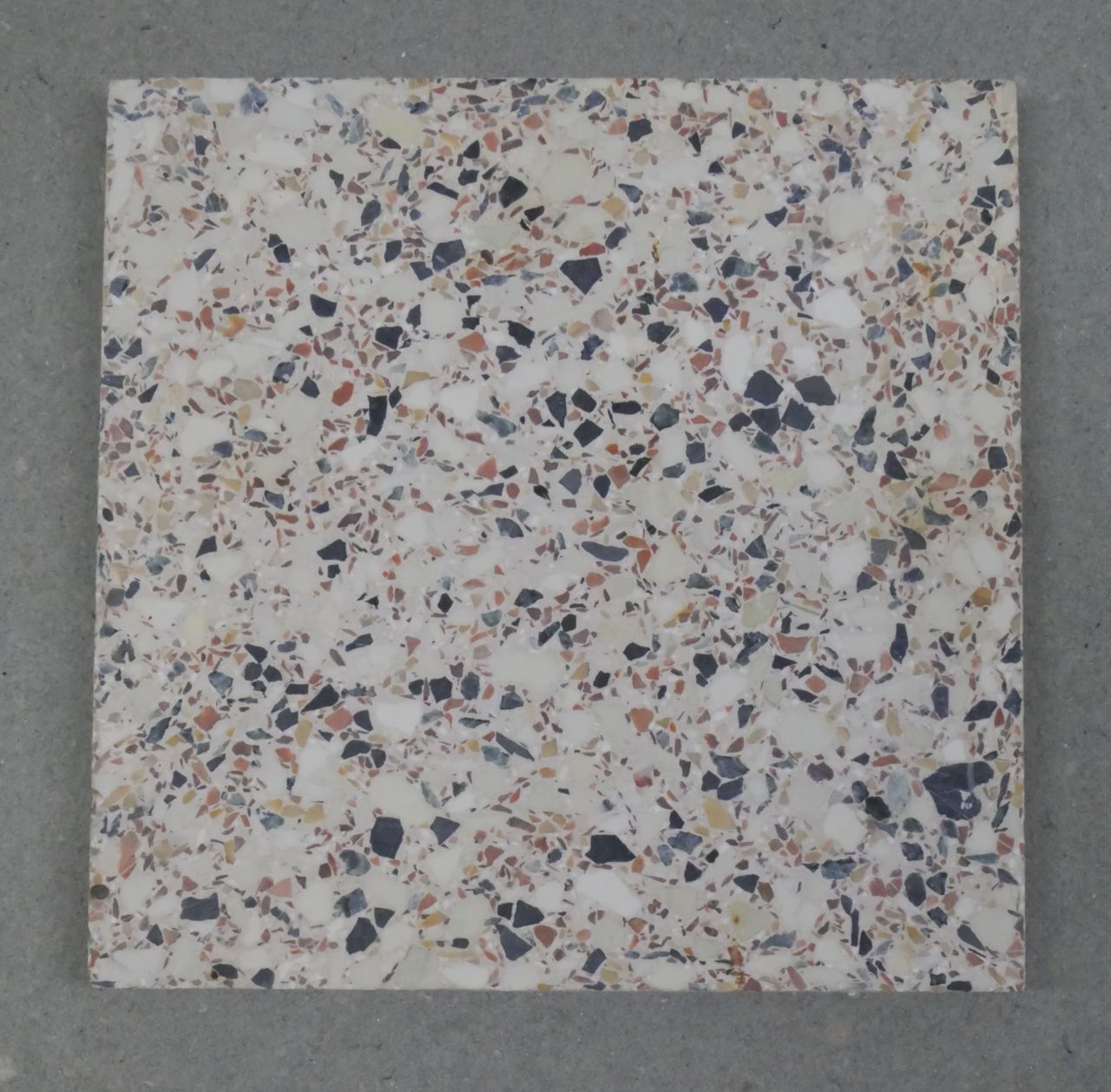
Floor slab, tile in terrazzo look is held by Museums Muttenz. Museum description: Instead of full-surface terrazzo floorings, cut tiles were available. They were mainly used in stairwells, entrance areas, and kitchens. Terrazzo is the name for a mineral floor covering known since antiquity. Aggregates selected for color are mixed with water, pigments, and binders such as lime and cement and applied to the subfloor like a screed. After hardening, the mortar is ground and, if necessary, polished after the application of waxes and other substances to achieve a glossy surface. The museum record gives material recorded as cement. These details come from the holding museum's own record; how far this object represents a wider collectible type has not yet been independently verified.
Partial type record
Rijksmuseum, Amsterdam
tiles
Framed tile with man and woman in 18th-century costume
c. 1765 - c. 1775
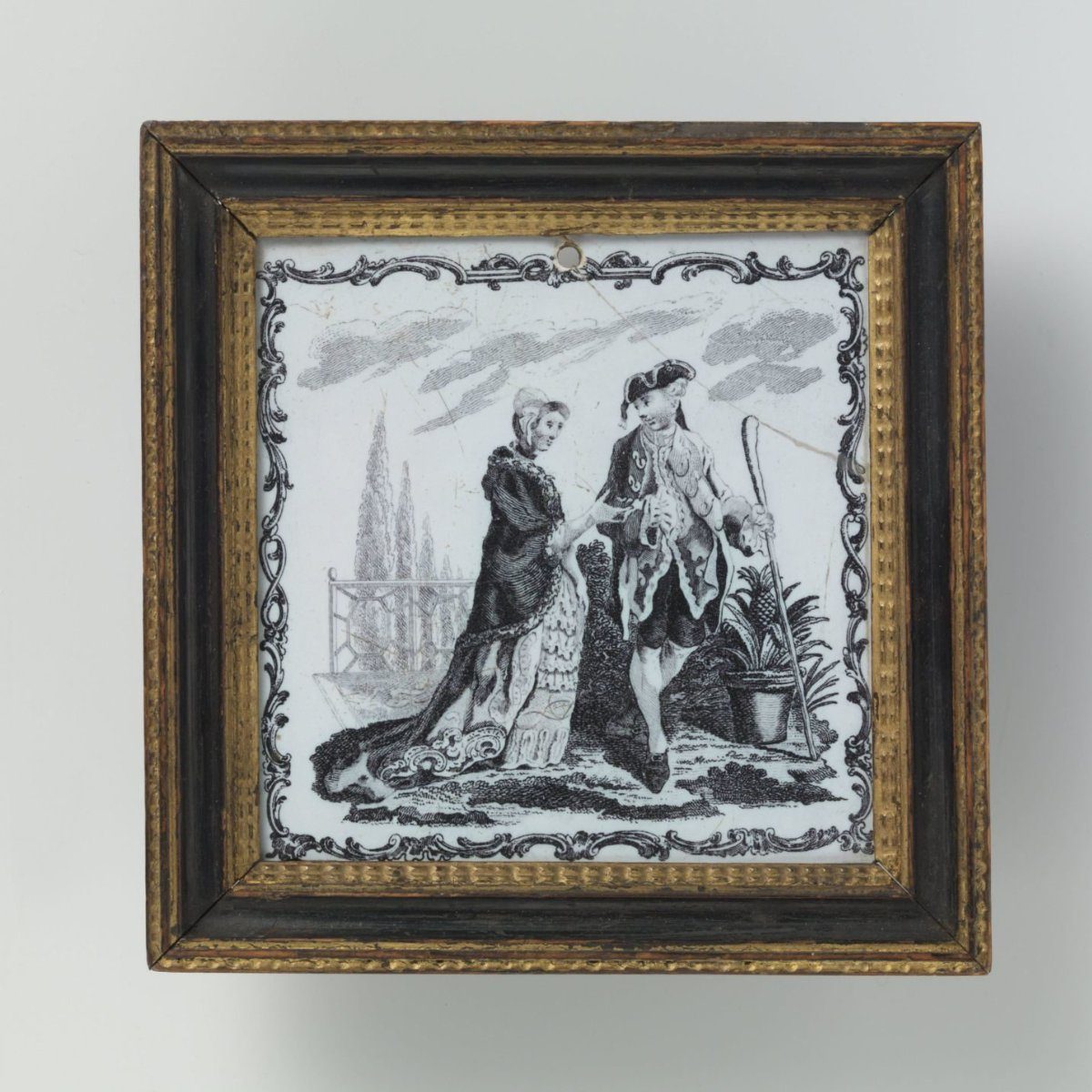
Tin-glazed earthenware tile with a black transfer-printed decoration of a woman and a man in 18th-century costume in a garden, framed by rococo ornament. The tile is set in a frame. The Rijksmuseum, Amsterdam, holds this object as BK-NM-14206; its record gives material recorded as earthenware, tin glaze; technique maiolica; measurements depth 2.8 cm. Description translated from the museum's Dutch catalogue text; details are those of this museum object, and how far it represents a wider type has not been independently verified.
Partial type record
Museum of City History Leipzig via Europeana
tiles
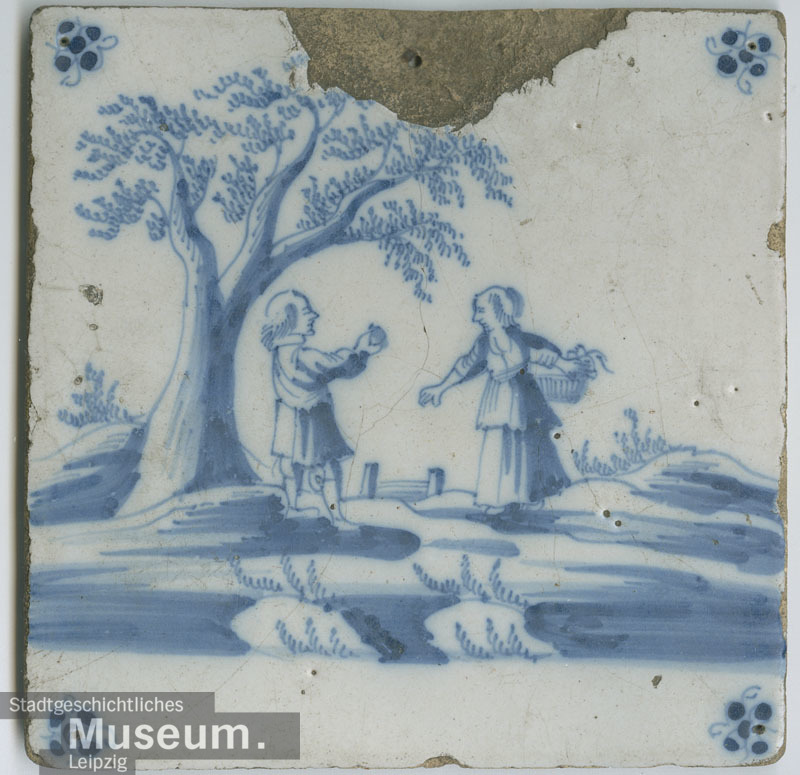
Frisian wall tile, Delft
Frisian wall tile is held by Museum of City History Leipzig (Germany), attributed to Delft. Description supplied by the holding institution: Enamelled Frisian wall tile. Spider heads as ornamentation are located on all four corners. In the center of the tile, as a central image, is a bucolic landscape with a peasant scene. In the scene, a man to the right of a tree hands an apple to a woman with a basket. Dutch tile in the Delft manner decorated in Delft blue The collection record gives material recorded as Ceramic; measurements height x width: 12.9 x 12.8 cm. Published through Europeana; how far this object represents a wider collectible type has not yet been independently verified.
Partial type record
District Archeology Rotenburg (Wümme) via Europeana
tiles
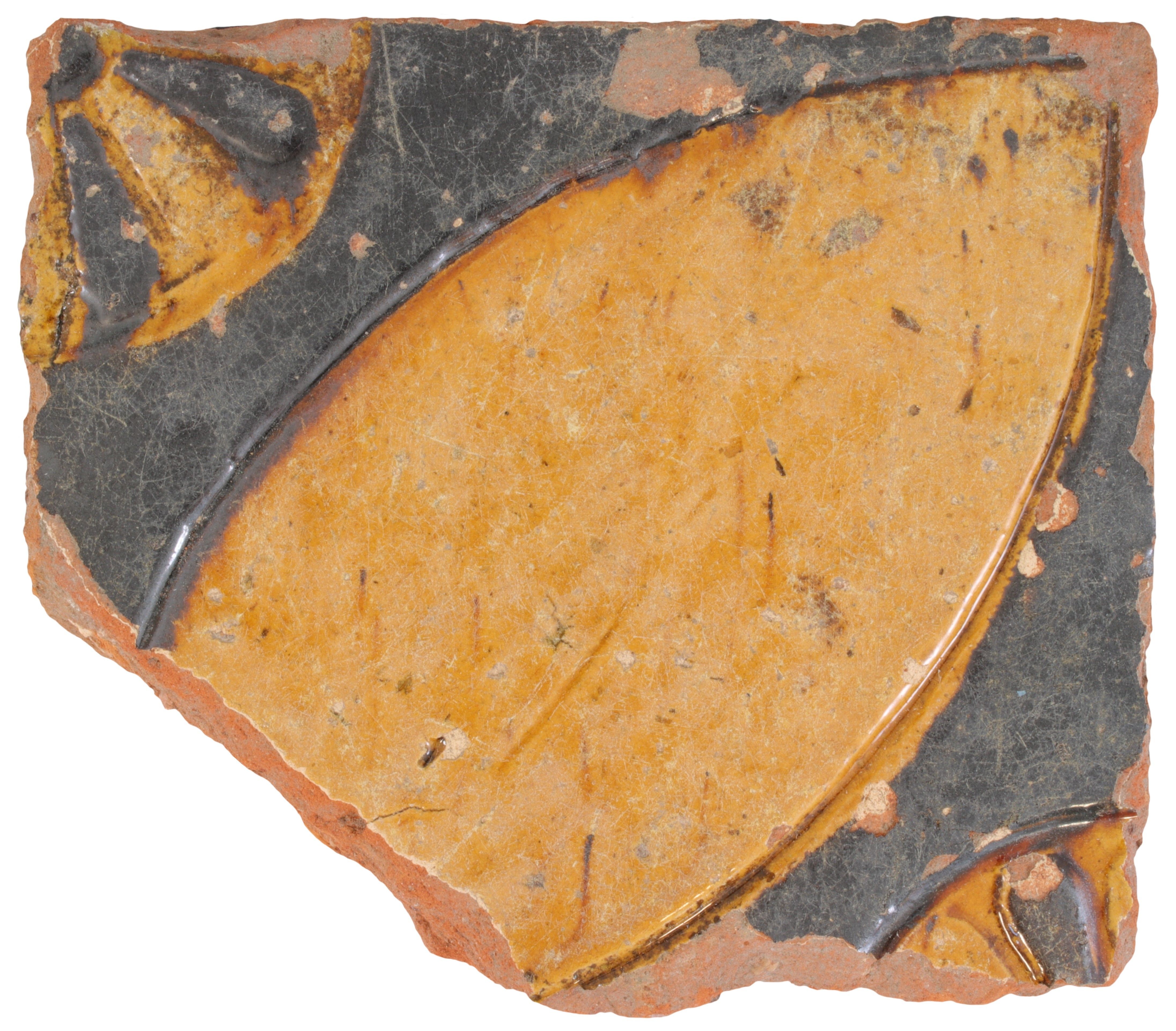
Glazed floor tile Bremervörde FStNr. 200
Glazed floor tile Bremervörde FStNr. 200 is held by District Archeology Rotenburg (Wümme). The museum record gives measurements thickness: 2.7 cm; width: 12.5 cm; length: 14.2 cm; place associated: Bremervörde (Rotenburg (Wümme), Lower Saxony) (find). These details come from the holding museum's own record; how far this object represents a wider collectible type has not yet been independently verified.
Partial type record
Rijksmuseum, Amsterdam
tiles
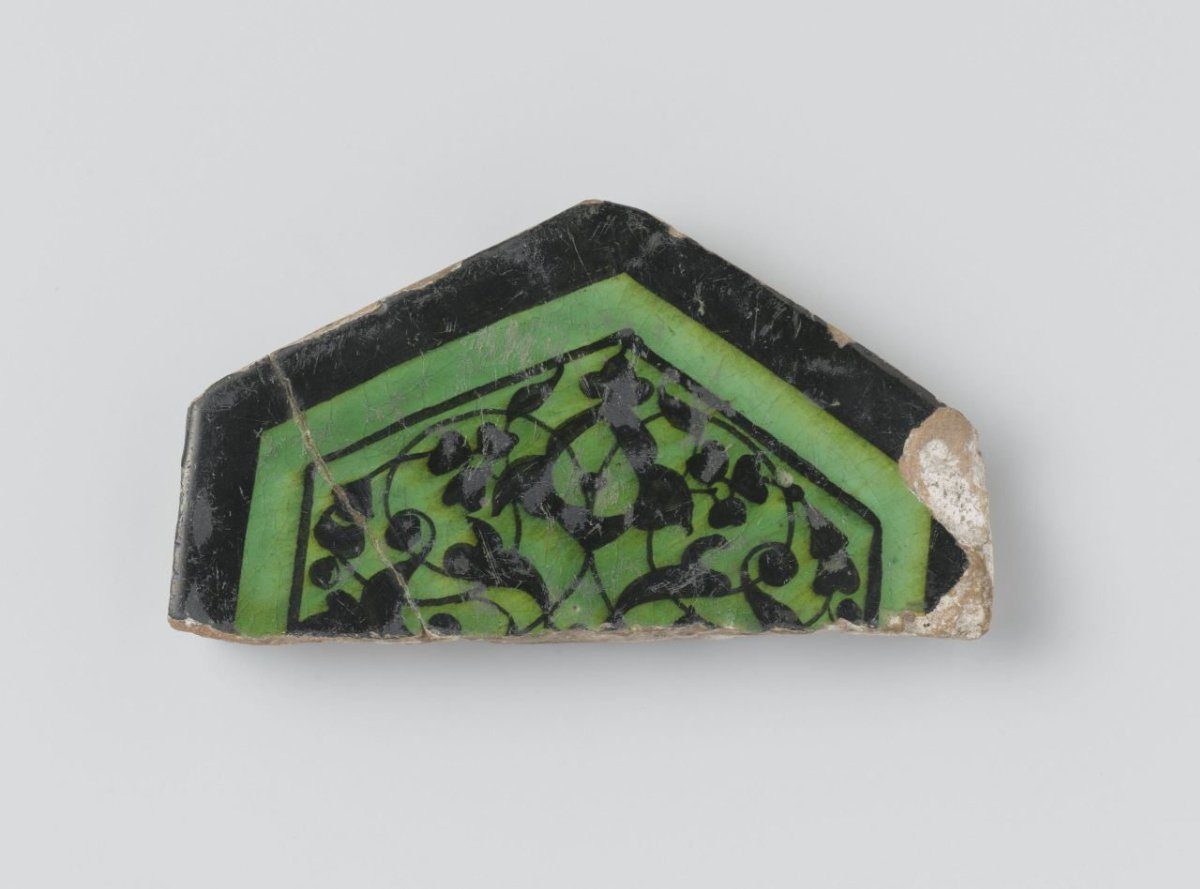
Half of a hexagonal tile with floral scrolls
c. 1450 - c. 1499
Half of a hexagonal tile of quartz fritware with a reddish-grey body, decorated under green glaze with a broad border and floral scrolls in black. From the Mosque of Yechel. From Broussa. The Rijksmuseum, Amsterdam, holds this object as BK-NM-11791; its record gives material recorded as glaze, earthenware, quartz; technique vitrification, paint, fired, formed; measurements height 1.6 cm x depth 7.4 cm x width 13.5 cm. Description translated from the museum's Dutch catalogue text; details are those of this museum object, and how far it represents a wider type has not been independently verified.
Partial type record
Rijksmuseum, Amsterdam
tiles
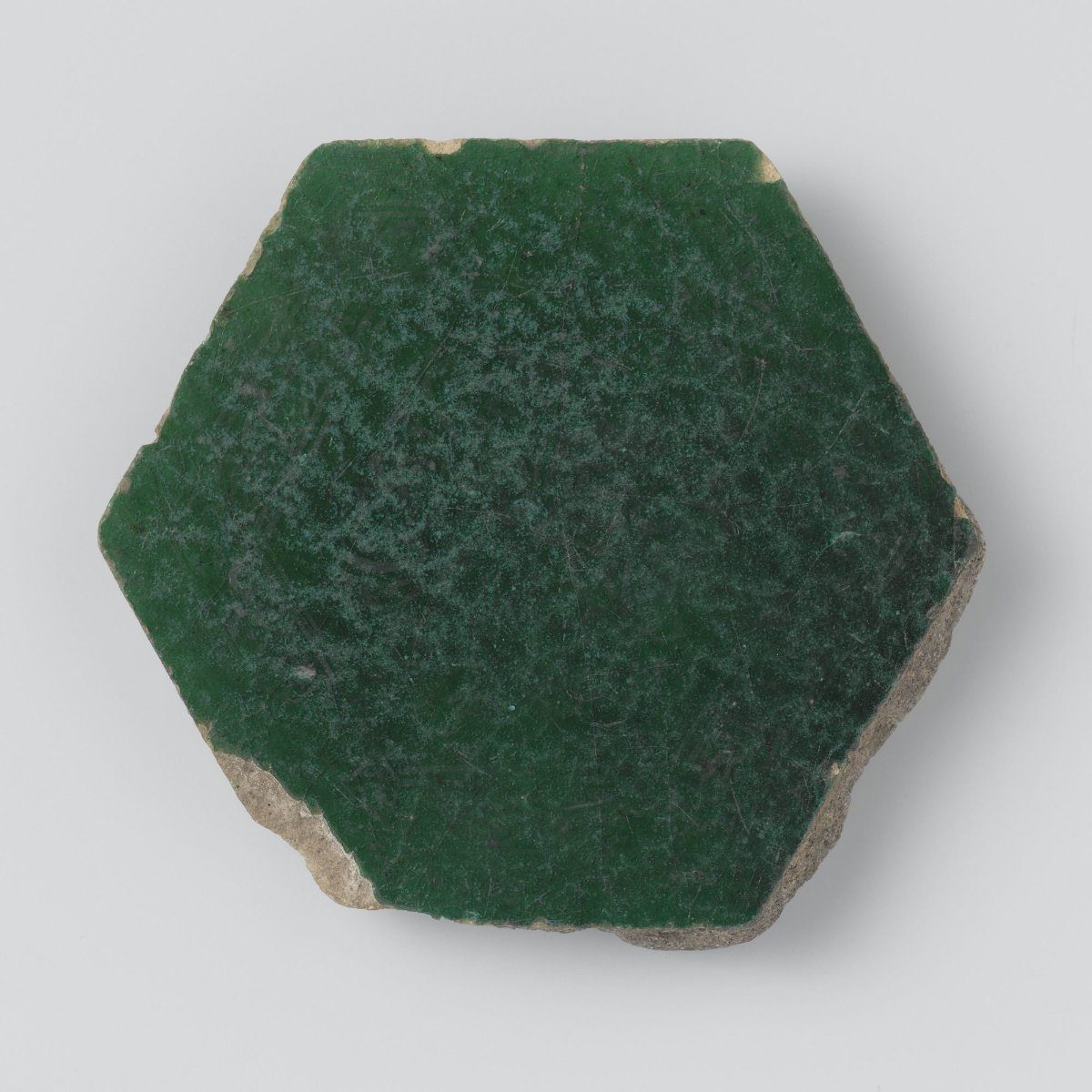
Hexagonal tile with a green glaze and inscription
c. 1400 - c. 1599
Hexagonal quartz-fritware tile. On a ground of thick green glaze, a border in lustre running parallel to the perimeter has been applied, containing an inscription in Arabic characters: 'In den naam van Allah, barmhartig en mededogend. Allah is één. Hij is de God tot wie alle wezens zich richten met hun noden. Hij heeft niet verwekt en is niet verwekt. Hij heeft geen gelijke in wie ook.' (Koran ch. 112). In the centre are the names of the Twelve Imams. Originating from the palace of Selim II at Anetrinopel. The metallic lustre has become almost entirely dull, so that the inscriptions are only visible under certain angles of light. Damaged at the corners. The Rijksmuseum, Amsterdam, holds this object as BK-NM-11792; its record gives material recorded as glaze, earthenware, luster (textile), quartz; technique vitrification, paint, fired, formed; measurements height 1.5 cm x diameter 13 cm. Description translated from the museum's Dutch catalogue text; details are those of this museum object, and how far it represents a wider type has not been independently verified.
Partial type record
Rijksmuseum, Amsterdam
tiles
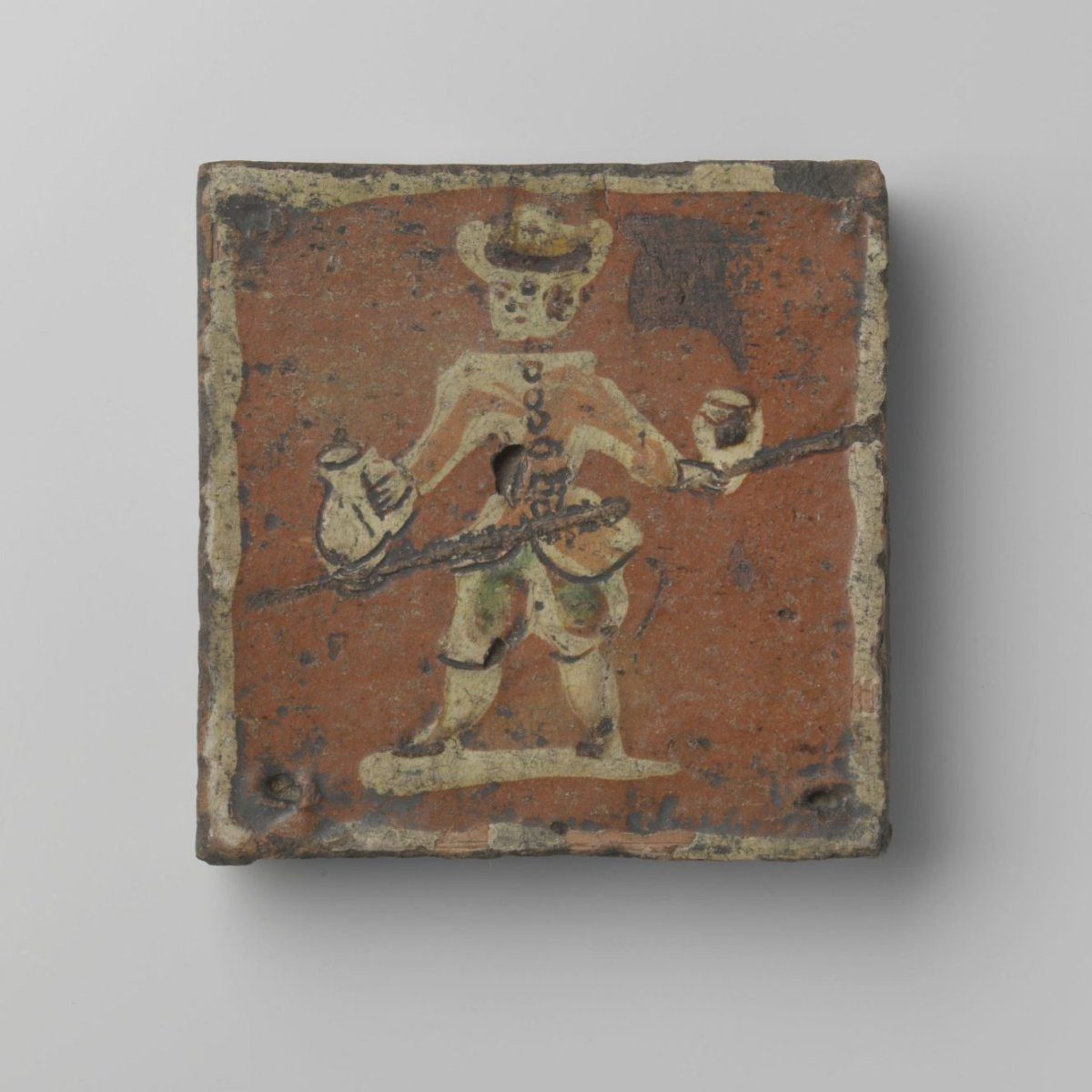
Lead-glazed earthenware tile
c. 1785 - c. 1790
Tile decorated with a standing figure wearing a hat and holding a glass and a jug in his hands. The Rijksmuseum, Amsterdam, holds this object as BK-NM-12495; its record gives material recorded as earthenware, lead glaze; technique scoring; measurements height 10.6 cm x width 10.7 cm x thickness 1.8 cm. Description translated from the museum's Dutch catalogue text; details are those of this museum object, and how far it represents a wider type has not been independently verified.
Partial type record
The Cleveland Museum of Art — Gift of the John Huntington Art and Polytechnic Trust by exchange
tiles
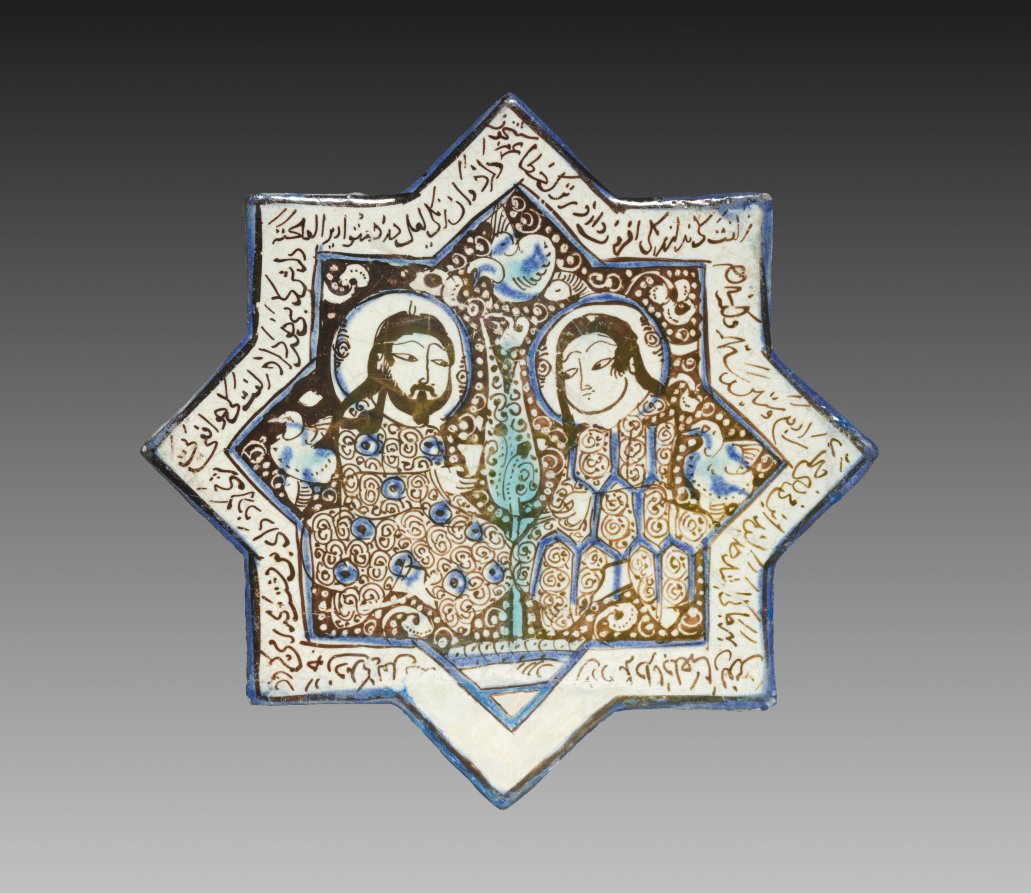
Luster Wall Tile with a Couple, Iran, Kashan, Ilkhanid period (1256-1353), 1266
1266
The design of this tile-a couple with a wine beaker surrounded by verses of Iranian love poetry-indicates that it was originally part of wall decoration and would have alternated with cross-shaped tiles. Cleveland Museum of Art object 1915.524: Luster Wall Tile with a Couple, 1266. Iran, Kashan, Ilkhanid period (1256-1353). Fritware with luster-painted design; overall: 19.5 x 16 cm (7 11/16 x 6 5/16 in.). Inscribed: Top reading R to L: (1) Rubāʿī: TEXT: zulfat ki hizār zangī afzūn dārad——————bar turk-i khitā ʿazm-i shabīkhūn dārad v'ān zangī laʿl duzd-i mutvāri-rā——————āvikht-i dār ki basi khūn dārad. TRANSLATION: Your tresses, which possess over a thousand Zangis (Zanjis, black slave-soldiers, i.e. more than a thousand strands of hair) Are bent on a surprise night time charge against the Cathay Turks (handsome slave-soldier boys redolent of musk) And (as for) that ruby stealing (disheveled) Zangi in hiding Have him hanged for he has plenty of blood on his hands. (2) Rubāʿī: these verses start immediately after the last verses, on the left hand side going down: TEXT: zulfat ki chu afʿī pay-i sharr mi-gardad———dāni pas-i pushtat bi-chi bar migardad chun dīd ki laʿl to [zumurrud bigrift————vahshī shud u bar kuh u kamar migardad.] TRANSLATION: Your hair (tresses), which viper-like is bent on mischief, do you know why it returns behind your back? When it saw that your ruby (lips) has (now) an emerald (down appearing above the lips), it became wild (lost all senses) and wanders on the mountain side.. Details are those of this museum object; how far it represents a wider type has not been independently verified.
Partial type record
Museum of Architecture at Berlin Institute of Technology via Europeana
tiles
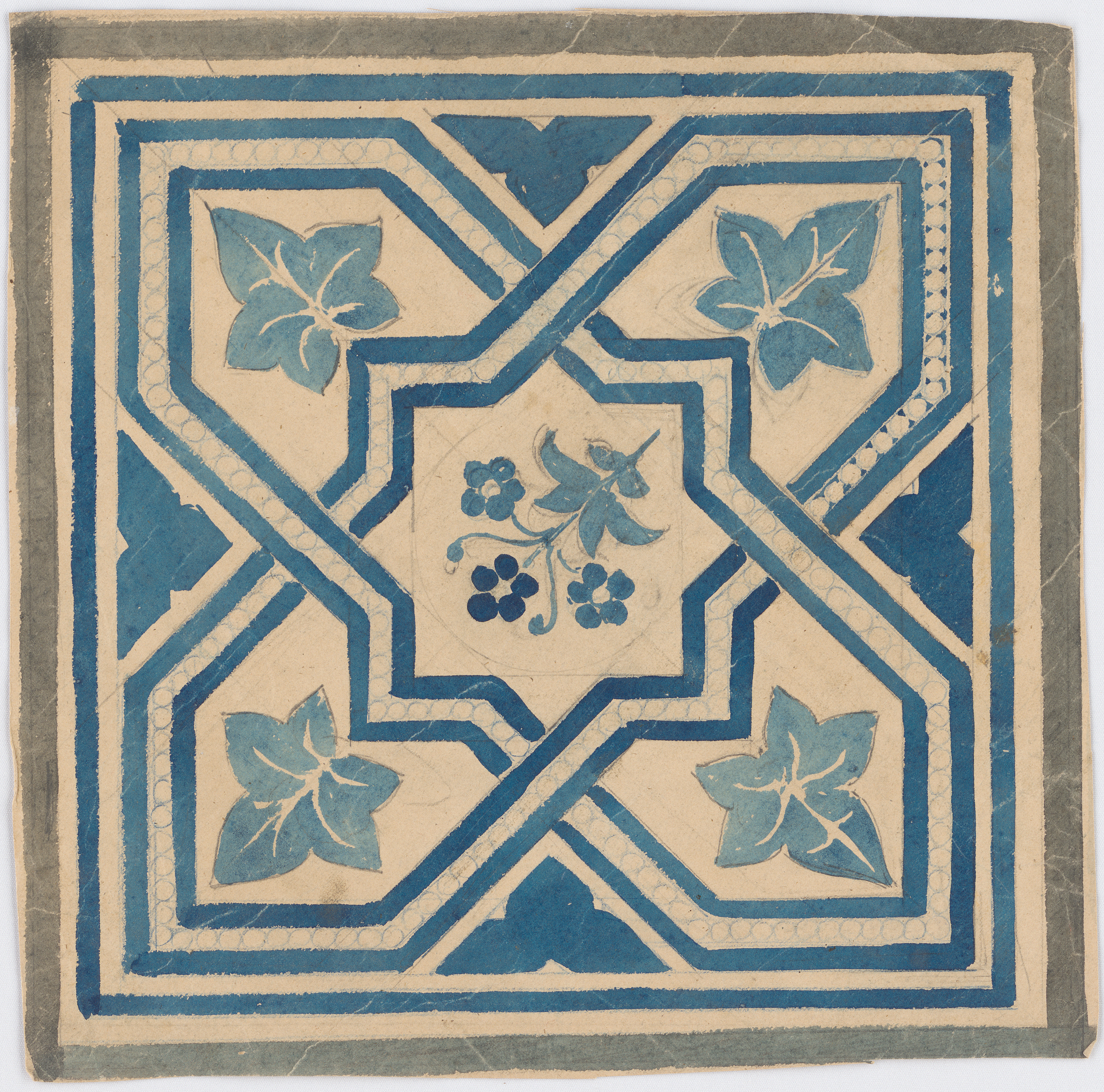
Ornamentation: Detail, possibly tile with floral decoration
Ornamentation: Detail, possibly tile with floral decoration is held by Museum of Architecture at Berlin Institute of Technology. Museum description: Architecture Museum of the TU Berlin, Inv. No. 41819. Work and digital image are in the public domain, but we appreciate a picture credit. (Note) The museum record gives measurements sheet dimensions: 31.9 x 32.2 cm. These details come from the holding museum's own record; how far this object represents a wider collectible type has not yet been independently verified.
Partial type record
Badisches Landesmuseum Karlsruhe via Europeana
tiles
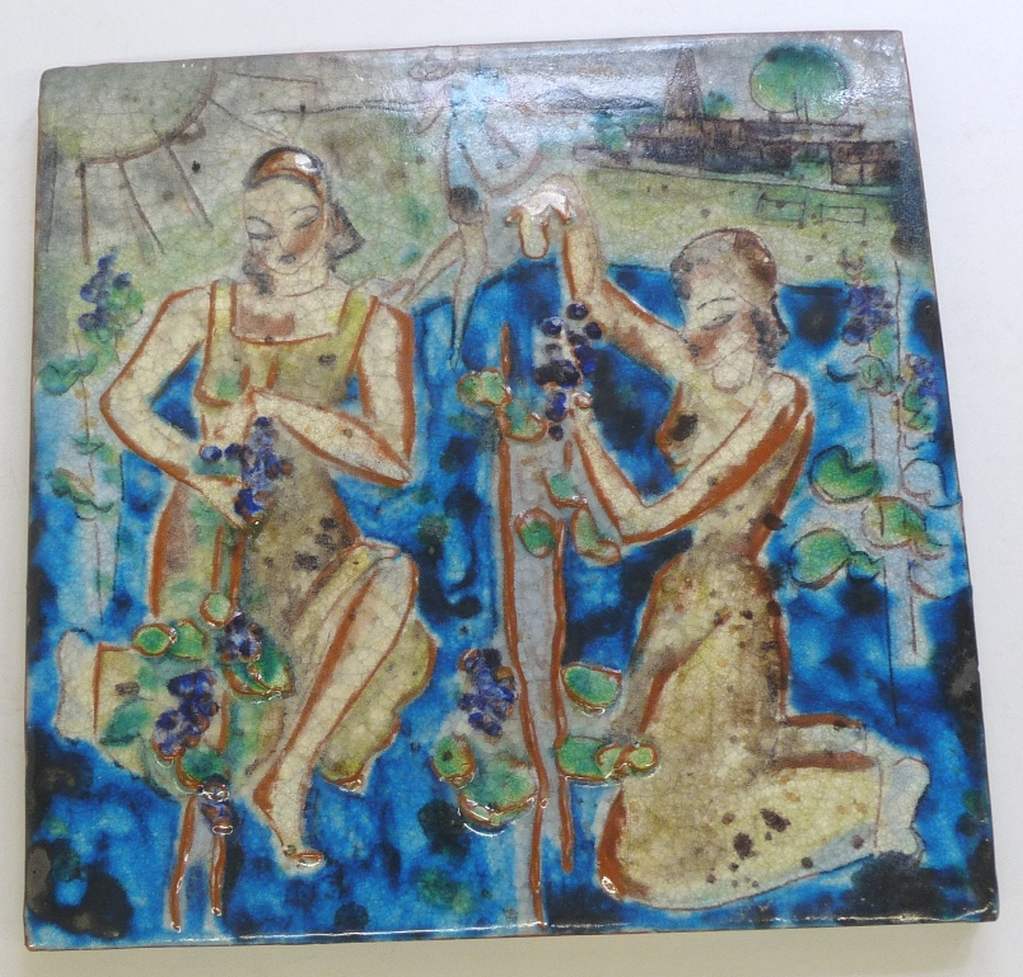
Picture tile: Two women at the grape harvest, Ilse Hohenreuther
Picture tile: Two women at the grape harvest, Ilse Hohenreuther is held by Badisches Landesmuseum Karlsruhe. Museum description: Square tile with two women at the grape harvest. In bas-relief, two kneeling women at the grape harvest. Blue, beige, green. Unmarked. Ilse Hohenreuther (13.03.1911 Karlsruhe – 31.05.1952 Karlsruhe) is among the female artists who have not been taken into account in previous research on women and whose work remained undiscovered in public perception. While the work of Bauhaus women or Jewish female artists has long been brought to light, especially on the occasion of the Bauhaus jubilee in 2019, a large host of unknown female designers who await discovery and the recognition due to them was still left behind. This circumstance applies to most of the women working at the Staatliche Majolika-Manufaktur. At the age of 15, Ilse Hohenreuther began a three-year apprenticeship in 1926 in the painters' studio of the Karlsruhe Majolika Manufaktur. After completion The museum record gives measurements Height: 29.7 cm, Width: 29.7 cm, Depth: 3.4 cm; maker recorded: Ilse Hohenreuther; Staatliche Majolika-Manufaktur Karlsruhe. These details come from the holding museum's own record; how far this object represents a wider collectible type has not yet been independently verified.
Partial type record
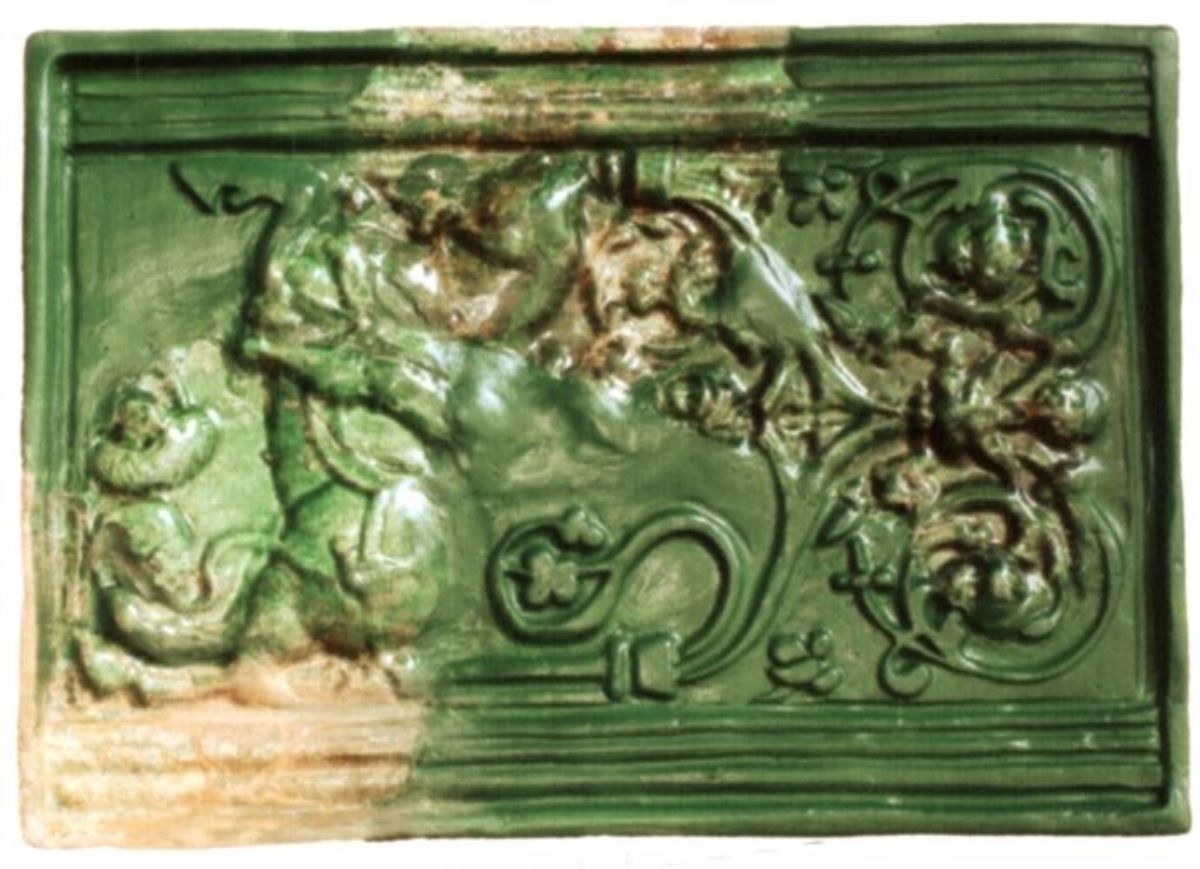
Alba Iulia Roman Catholic Archdiocese via Europeana
tiles
Placque stove tile
Placque stove tile is held by Alba Iulia Roman Catholic Archdiocese. Museum description: Rectangular plaque stove tile, made of fine paste with a high mica content, fired completely to a brick red. The clay was pressed into the mold by hand and with the aid of a wooden spatula. Green glaze over slip, on some fragments well preserved, on others completely iridized into silver. On the back traces of soot. Decoration: armored knight, equestrian, framed by a Gothic portal. Beneath the horse's belly two human heads, one with a turban and the other with a fez. The ogee portal is decorated with rich foliage, both on the intrados and on the extrados. On the extrados between tendrils two other turbaned heads are suspended. The museum record gives measurements length: 36 cm; width: 26 cm; thickness: 0.7 cm. These details come from the holding museum's own record; how far this object represents a wider collectible type has not yet been independently verified.
Partial type record
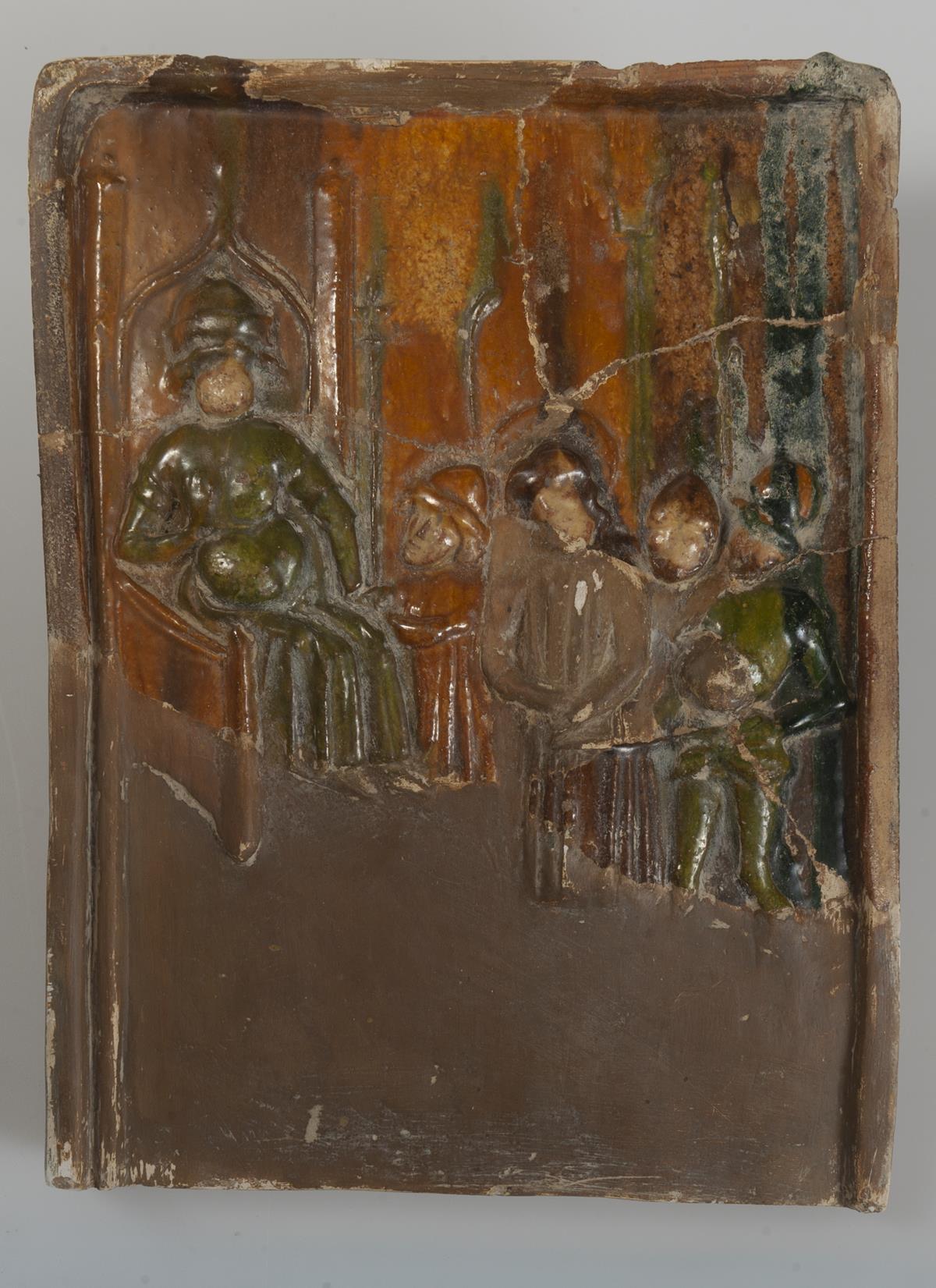
National Museum of Romanian History via Europeana
tiles
Plaque stove tile with semi-cylindrical foot
Plaque stove tile with semi-cylindrical foot is held by National Museum of Romanian History. Museum description: Rectangular stove tile, with raised edge, continuing on the reverse with the semi-cylindrical foot. The decoration is in relief, depicting the scene of the judgment of Pilate. The decoration is covered with polychrome ochre and green glaze. The fabric is brick-red. The museum record gives measurements length: 320 mm; width: 245 mm. These details come from the holding museum's own record; how far this object represents a wider collectible type has not yet been independently verified.
Partial type record
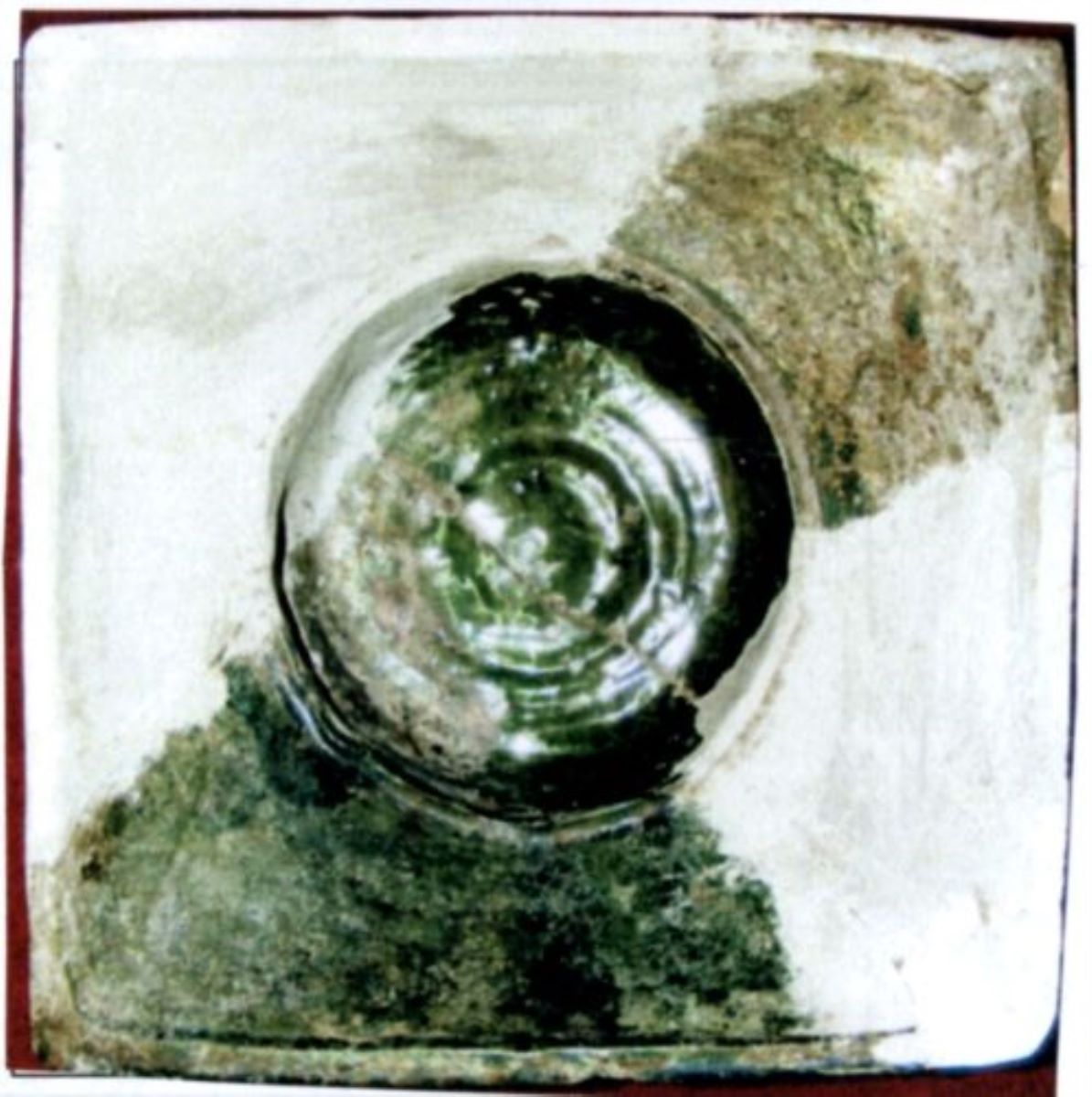
National Museum of Bukovina via Europeana
tiles
Pot tile
Pot tile is held by National Museum of Bukovina. Museum description: Pot-shaped stove tile, with a square opening; cylindrical mounting base. The transition zone from the base to the opening is marked by a prominent rib. The museum record gives measurements length: 228 mm; height: 98 mm; mouth diameter: 160mm; base diameter: 224mm. These details come from the holding museum's own record; how far this object represents a wider collectible type has not yet been independently verified.
Partial type record
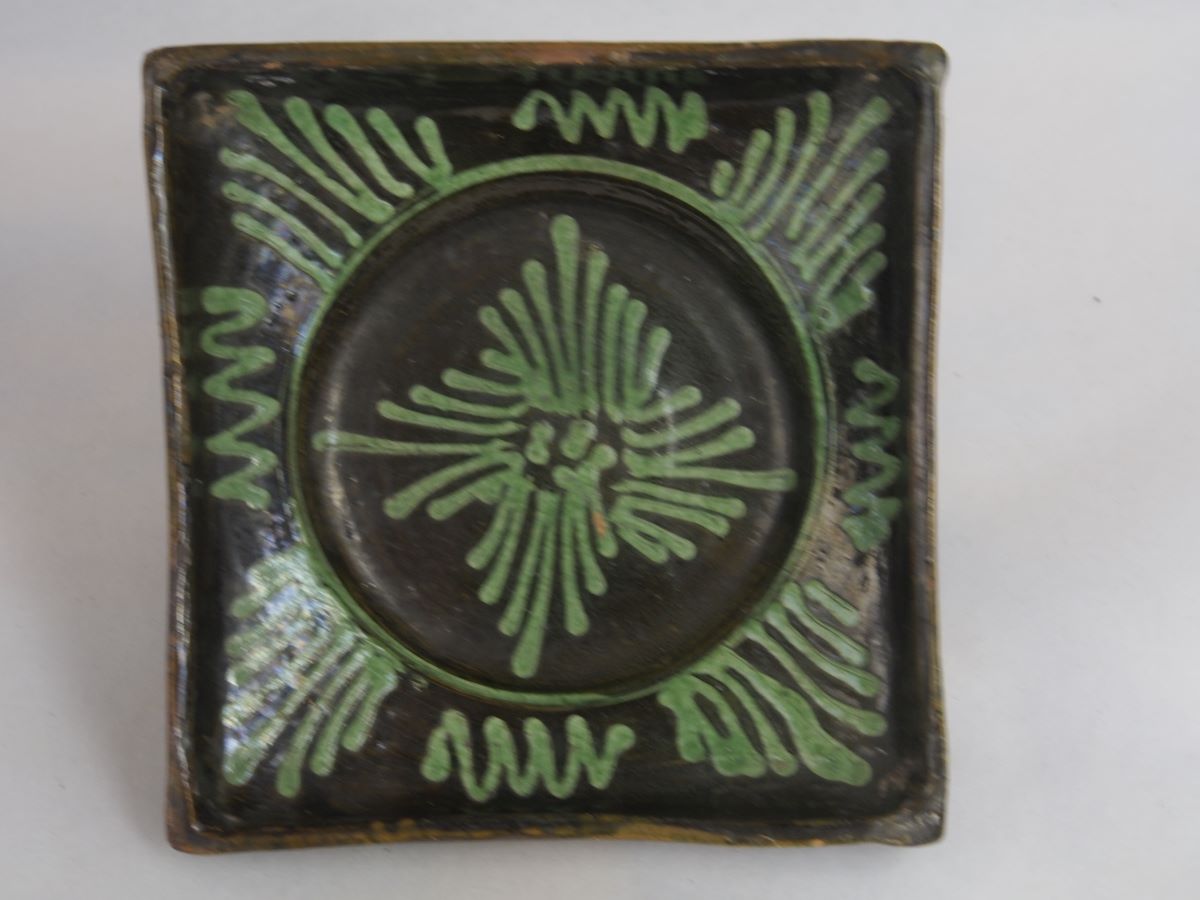
"Dimitrie Gusti" National Village Museum via Europeana
tiles
Pot-shaped stove tile
Pot-shaped stove tile is held by "Dimitrie Gusti" National Village Museum. Museum description: Square shape, with a deep bottom. Geometric decoration arranged centrally and along the edges all around, following a radial scheme. Chromatics: brown, green; use: used to face the brick or stone chimney with clay, above the hearth The museum record gives measurements H. - 17 cm; width: 17 cm. These details come from the holding museum's own record; how far this object represents a wider collectible type has not yet been independently verified.
Partial type record
Rijksmuseum, Amsterdam
tiles
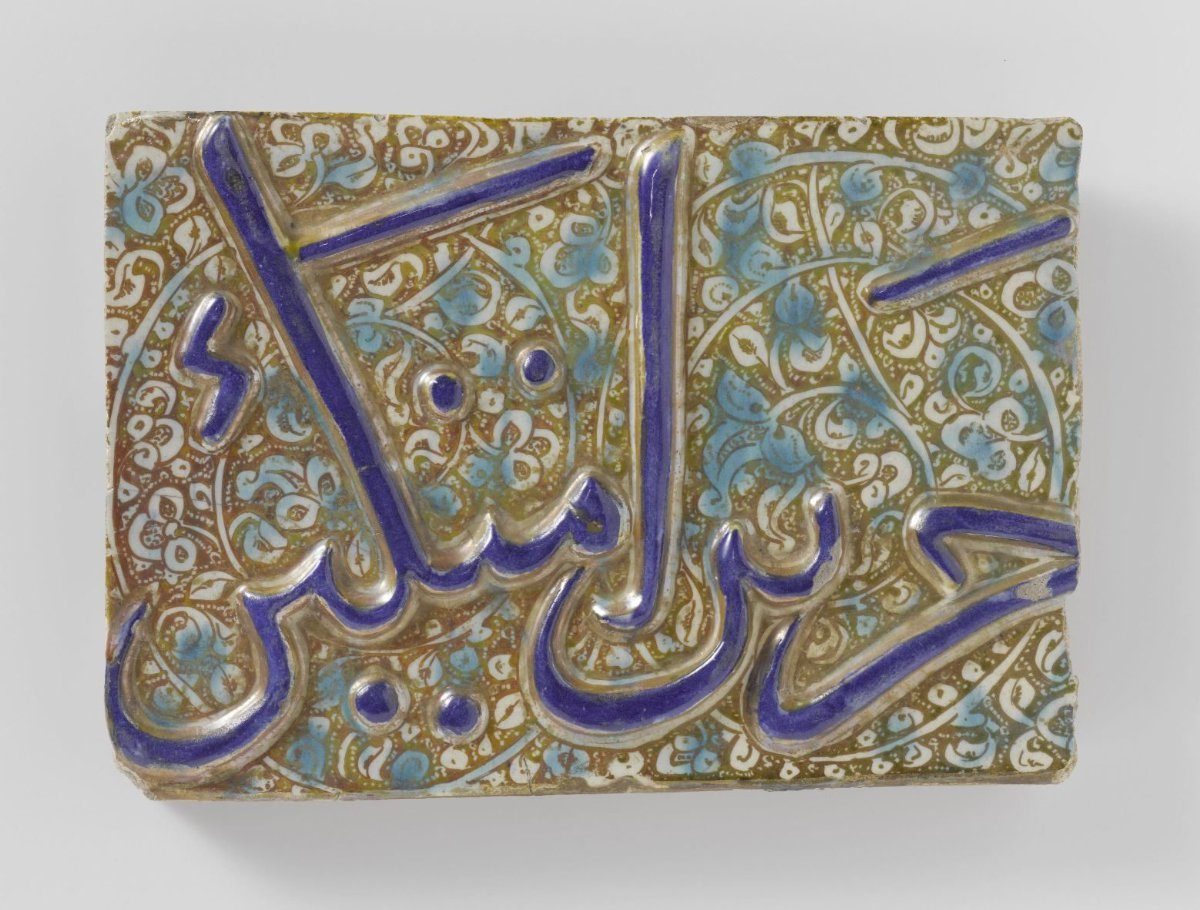
Rectangular tile with an inscription and foliate scrolls
c. 1250 - c. 1324
Quartz-fritware tile with an inscription applied in relief, heightened in blue, further painted in blue, greenish-blue, and lustre with reserved foliate scrolls. The Rijksmuseum, Amsterdam, holds this object as BK-1992-34; its record gives material recorded as glaze, earthenware, cobalt (mineral), luster (textile), quartz; technique vitrification, paint, fired, formed; measurements length 28 cm x depth 20 cm. Description translated from the museum's Dutch catalogue text; details are those of this museum object, and how far it represents a wider type has not been independently verified.
Partial type record
© Victoria and Albert Museum, London
tiles
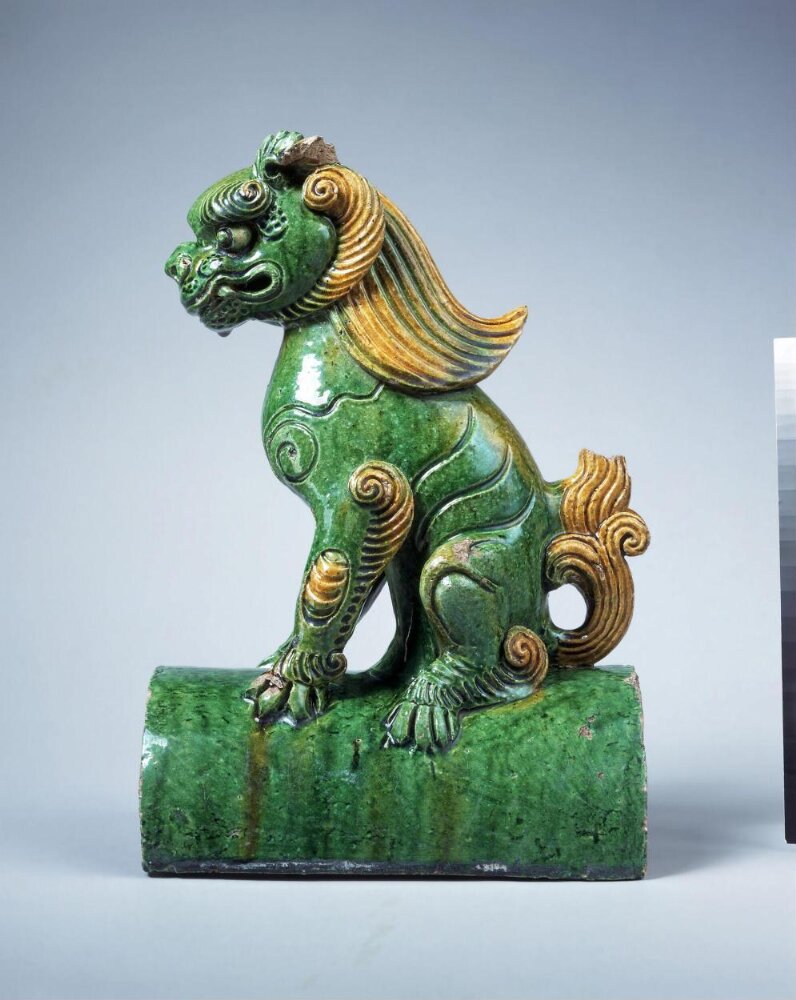
Roof tile — Seated Lion, 1500-1644
1500-1644
Roof tile — Seated Lion, 1500-1644 is an object recorded by Victoria and Albert Museum, dated 1500-1644. The museum's brief description reads: Roof tile, 'Seated lion', earthenware with lead glaze, China, Ming Dynasty (1368-1644), 1500-1644. Museum description: Roof tile of earthenware in the form of a lion. Covered in a green lead glaze. The museum record gives material recorded as earthenware, lead glaze; place associated: China. These details come from the holding museum's own record; how far this object represents a wider collectible type has not yet been independently verified.
Partial type record
© Victoria and Albert Museum, London
tiles
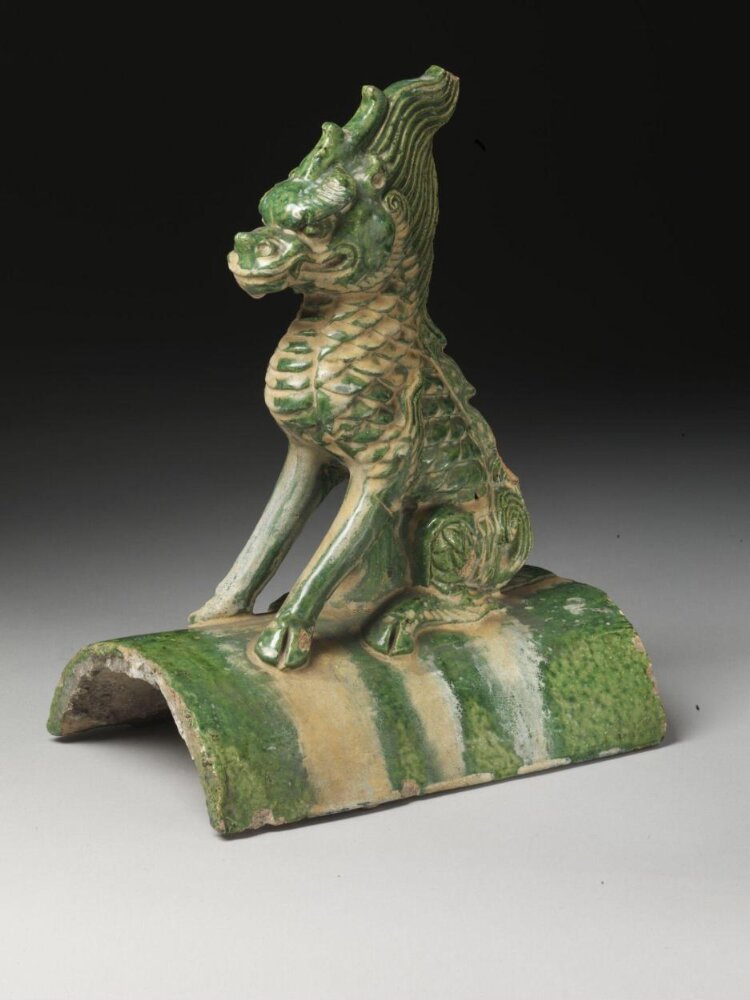
Roof tile — Seated Xiezhi, 1500-1644
1500-1644
Roof tile — Seated Xiezhi, 1500-1644 is an object recorded by Victoria and Albert Museum, dated 1500-1644. The museum's brief description reads: Roof tile, 'Seated Xiezhi', earthenware with lead glaze, China, Ming Dynasty (1368-1644), 1500-1644. Museum description: Roof tile of earthenware in the shape of a seated horned figure. Covered in green glaze. The museum record gives material recorded as earthenware, lead glaze; place associated: China. These details come from the holding museum's own record; how far this object represents a wider collectible type has not yet been independently verified.
Partial type record
© Victoria and Albert Museum, London
tiles
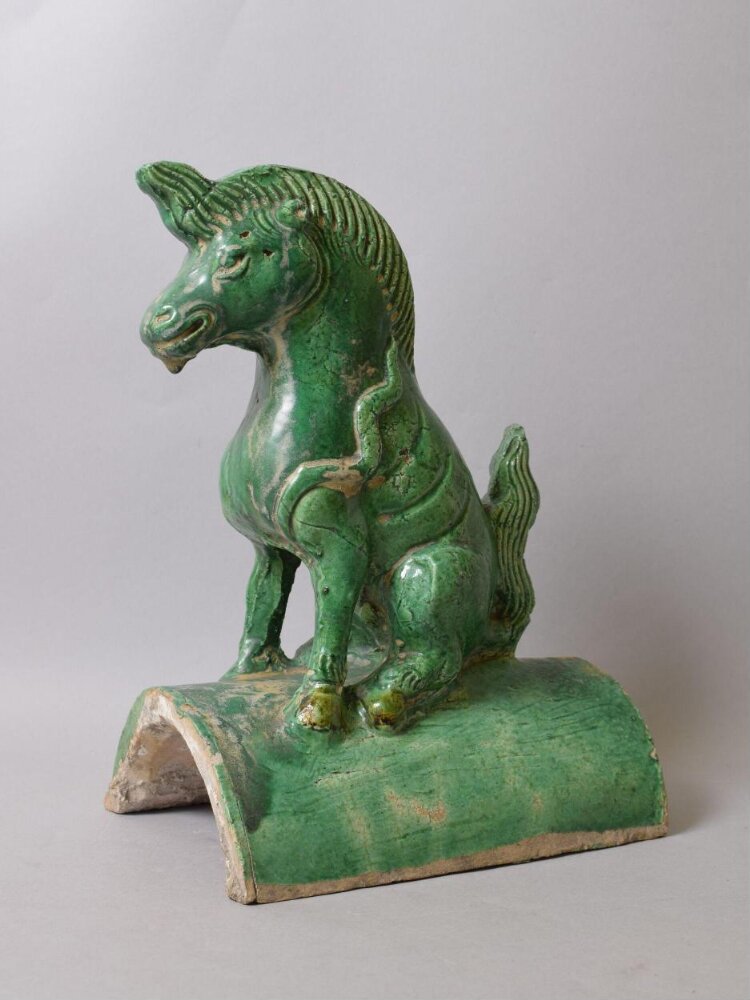
Roof tile, 1368-1644
1368-1644
Roof tile, 1368-1644 is an object recorded by Victoria and Albert Museum, dated 1368-1644. The museum's brief description reads: Roof tile, glazed earthenware, China, Ming dynasty, 1368-1644. Museum description: Roof tile of red earthenware covered with a green glaze surmounted by a figure of a seated horse. The museum record gives material recorded as earthenware; measurements Height 29.2 cm; Width 14 cm; Length 19.7 cm; place associated: China, Beijing. These details come from the holding museum's own record; how far this object represents a wider collectible type has not yet been independently verified.
Partial type record
© Victoria and Albert Museum, London
tiles
Roof tile, 1368-1644
1368-1644
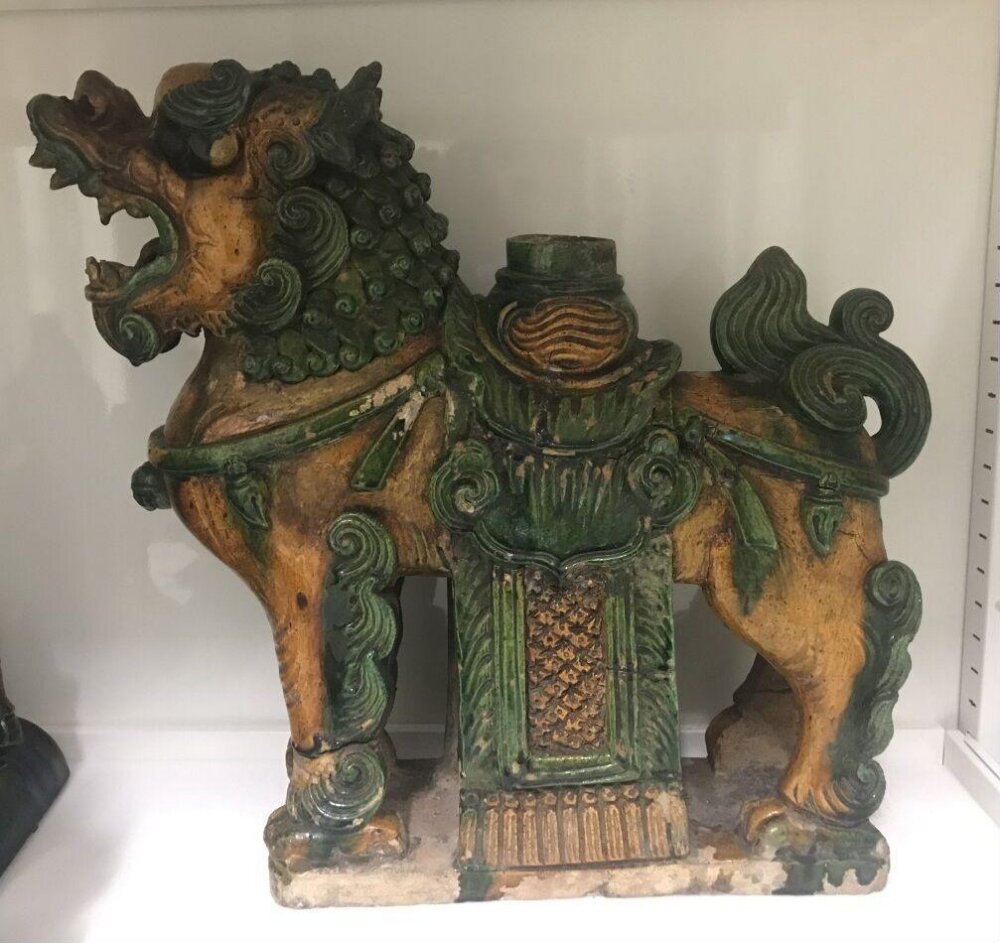
Roof tile, 1368-1644 is an object recorded by Victoria and Albert Museum, dated 1368-1644. The museum's brief description reads: Roof tile, glazed earthenware, China, Ming dynasty, 1368-1644. Museum description: Roof tile of red earthenware in the form of a lion-like monster covered with green lead and yellow glazes. The creature stands open-mouthed supporting a small vase which rests on a saddle with long diapered and fringed saddle-cloth. The museum record gives material recorded as earthenware; measurements Height 49.5 cm; Length 51.4 cm; place associated: China. These details come from the holding museum's own record; how far this object represents a wider collectible type has not yet been independently verified.
Partial type record
© Victoria and Albert Museum, London
tiles
Roof tile, 1368-1644
1368-1644
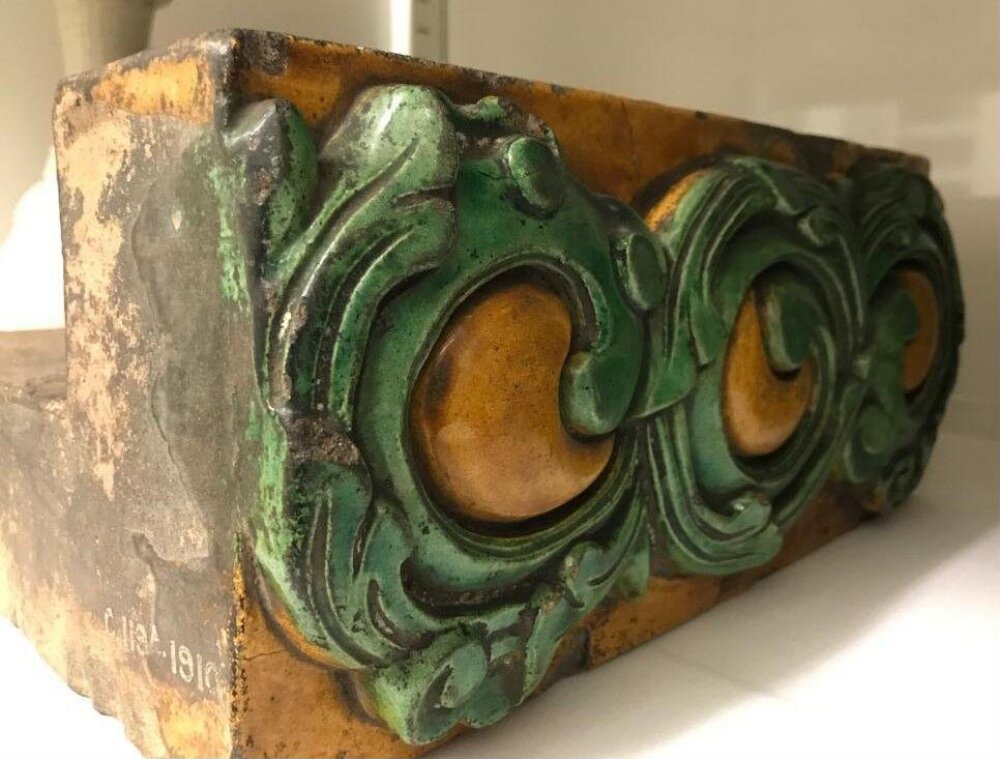
Roof tile, 1368-1644 is an object recorded by Victoria and Albert Museum, dated 1368-1644. The museum's brief description reads: Roof tile, glazed earthenware, China, Ming dynasty, 1368-1644. Museum description: Roof tile of earthenware, moulded in relief and covered with green lead and yellow glazes. The front of the tile is moulded with three volutes of foliage. The tile has unglazed horizontal and vertical projection at the back, the latter with a groove for keying into an adjoining tile. The museum record gives material recorded as earthenware; measurements Height 14.2 cm; Width 31.4 cm; place associated: China. These details come from the holding museum's own record; how far this object represents a wider collectible type has not yet been independently verified.
Partial type record
© Victoria and Albert Museum, London
tiles
Roof tile, 1500 - 1644
1500 - 1644
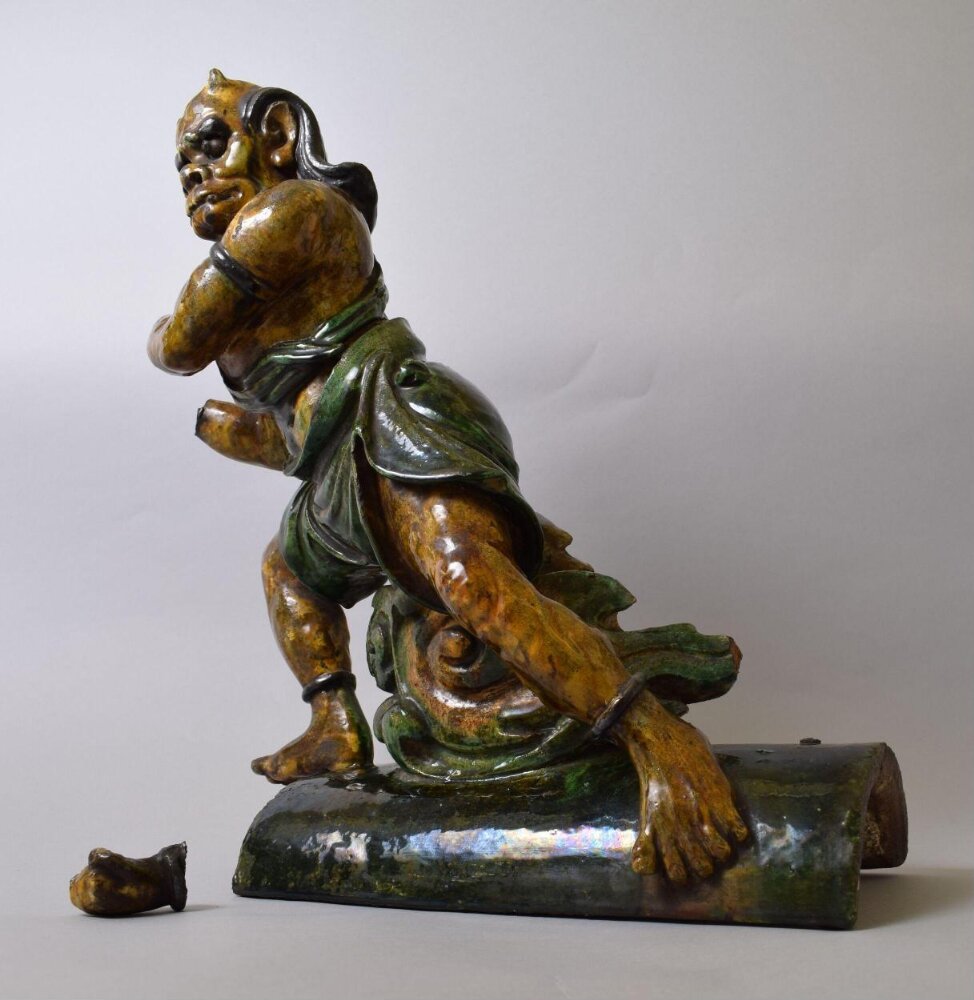
Roof tile, 1500 - 1644 is an object recorded by Victoria and Albert Museum, dated 1500 - 1644. The museum's brief description reads: Roof tile, glazed earthenware, China, Ming dynasty, 1500-1644. Museum description: Roof tile, in two pieces, in the form of a demon with a monster head. It is made of earthenware and covered in green, brown and manganese-purple glazes. The museum record gives material recorded as earthenware; measurements Height 41.5 cm; place associated: China. These details come from the holding museum's own record; how far this object represents a wider collectible type has not yet been independently verified.
Partial type record
© Victoria and Albert Museum, London
tiles
Roof tile, 15th century
15th century
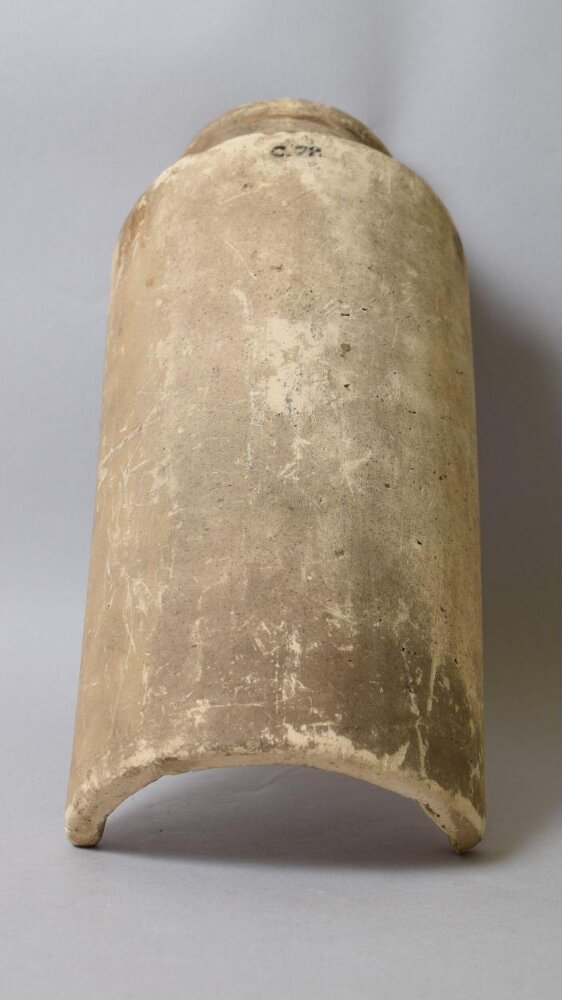
Roof tile, 15th century is an object recorded by Victoria and Albert Museum, dated 15th century. The museum's brief description reads: Roof tile, earthenware, China, 15th century. Museum description: Cream-coloured earthenware roof tile of semi-circular section The museum record gives material recorded as earthenware; measurements Length 12.375 in; Width 5.5 in; place associated: China. These details come from the holding museum's own record; how far this object represents a wider collectible type has not yet been independently verified.
Partial type record