Catalogue
Hand Fans
Folding, brisé and fixed hand fans documented in institutional collections.
Individually identified types (153)
Filter by era, country, maker or material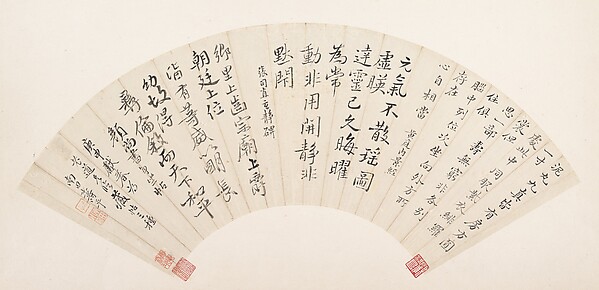
The Metropolitan Museum of Art, New York
fans
After Three Rubbings, China, dated 1680
dated 1680
Folding fan mounted as an album leaf in The Metropolitan Museum of Art, New York (accession 1989.363.147), catalogued by the museum's Asian Art department under the title “After Three Rubbings”. The museum dates it dated 1680 and records its origin as China; Qing dynasty (1644–1911). It is attributed to Yun Shouping (Chinese, 1633–1690). The museum records the medium as Folding fan mounted as an album leaf; ink on paper and the dimensions as 6 11/16 x 20 in. (17 x 50.8 cm). These details are transcribed from the museum's open-access record; how far this object represents a wider collectible type has not yet been independently verified.
Partial type record
Palais Galliera - Musée de la Mode de la Ville de Paris via Europeana
fans
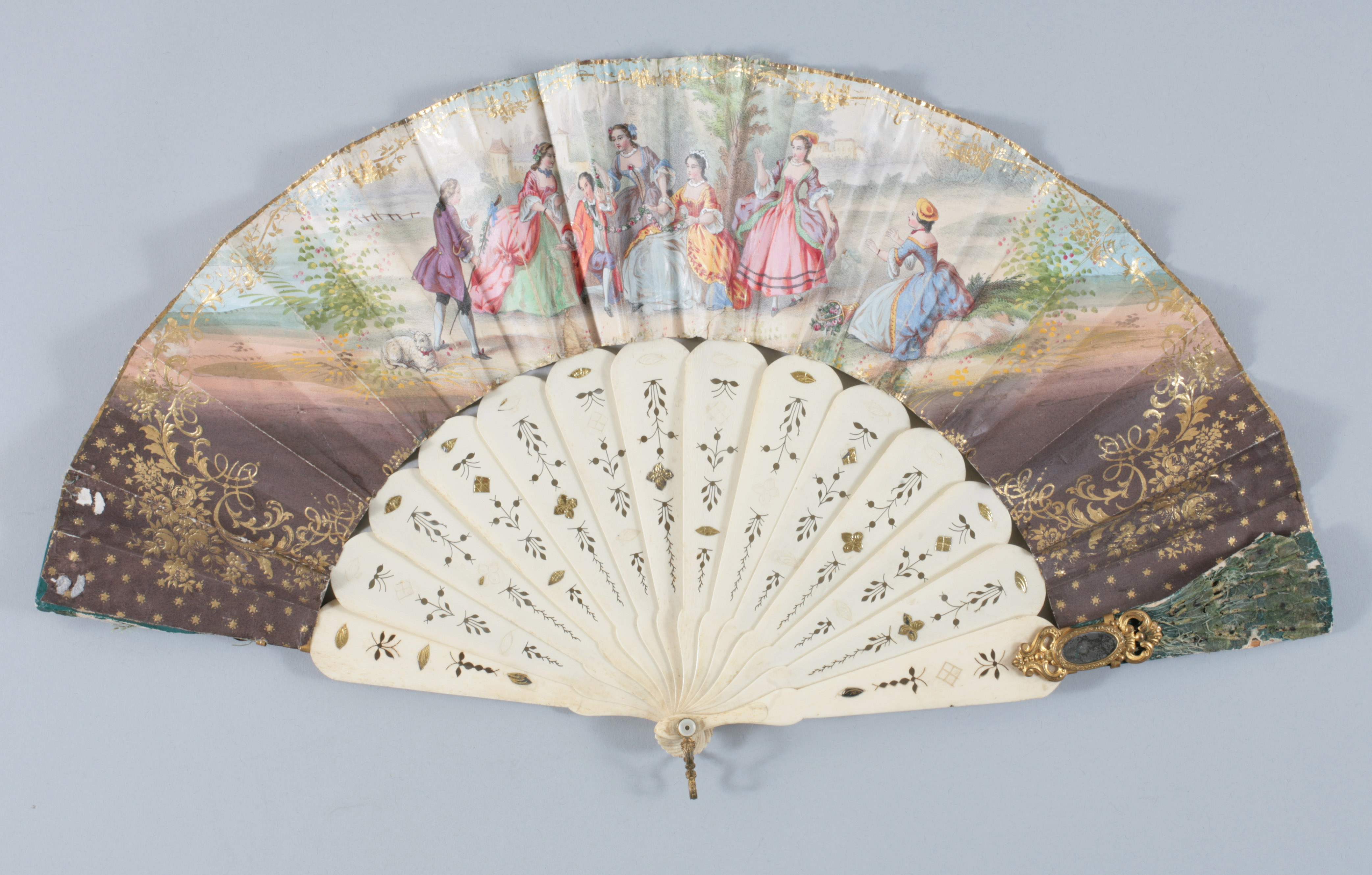
Bouquet-holder fan, 1860
1860
Bouquet-holder fan is held by Palais Galliera - Musée de la Mode de la Ville de Paris (France), dated 1860. Description supplied by the holding institution: Bouquet-holder fan, composed of 12 sticks + 2 guards. Coloured chromolithographed leaf, bone sticks pierced, engraved, and gilded, on the 2 guards a bouquet-holder of green cardboard and mirror in an embossed gilded brass frame, gilded metal suspension loop. Published through Europeana; how far this object represents a wider collectible type has not yet been independently verified.
Partial type record
Rijksmuseum, Amsterdam
fans
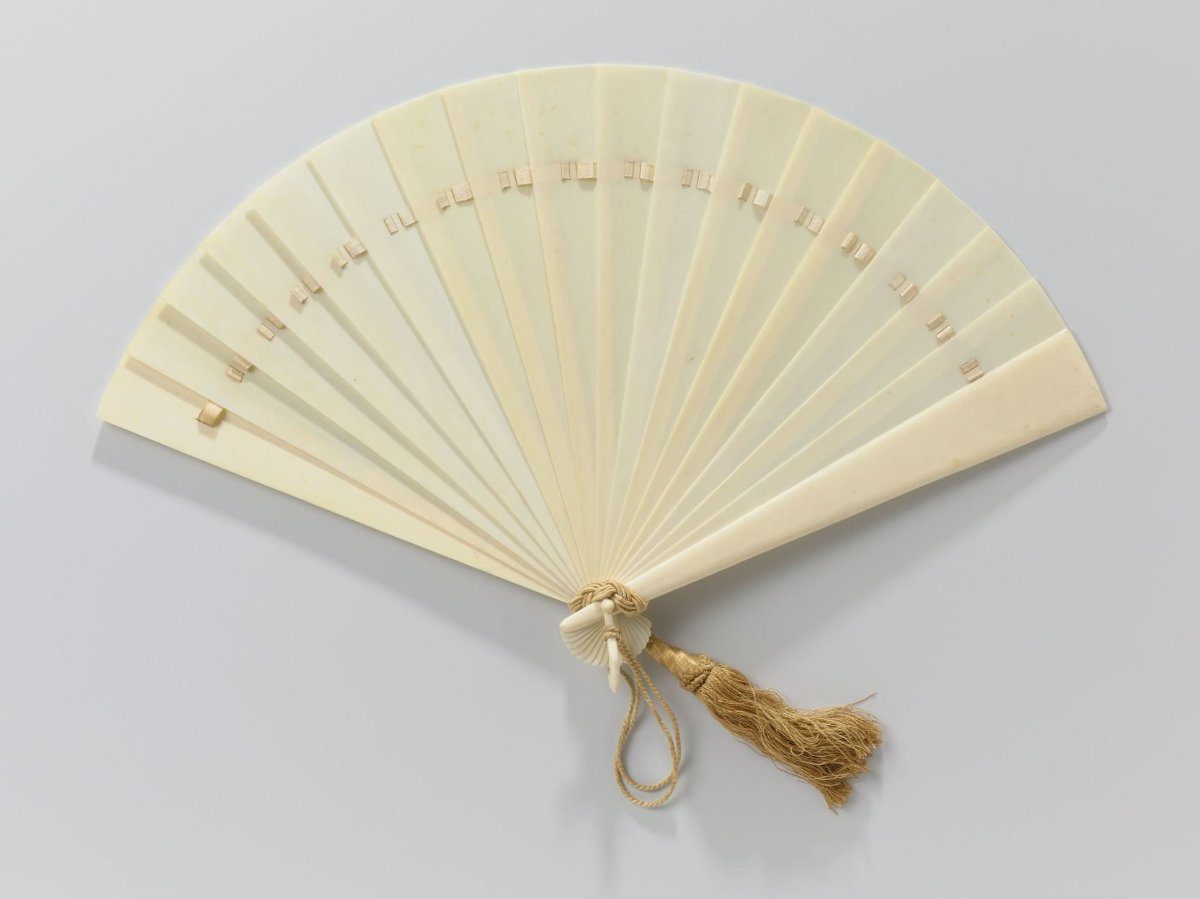
Brisé fan entirely of ivory
c. 1890 - c. 1900
Brisé fan entirely of ivory. The 19 joined sticks are undecorated and connected to each other by a silk ribbon. Fan loop of ivory, tassel and loop of silk. The Rijksmuseum, Amsterdam, holds this object as BK-1973-762; its record gives material recorded as ivory, silk; technique cutting, weaving. Description translated from the museum's Dutch catalogue text; details are those of this museum object, and how far it represents a wider type has not been independently verified.
Partial type record
Rijksmuseum, Amsterdam
fans
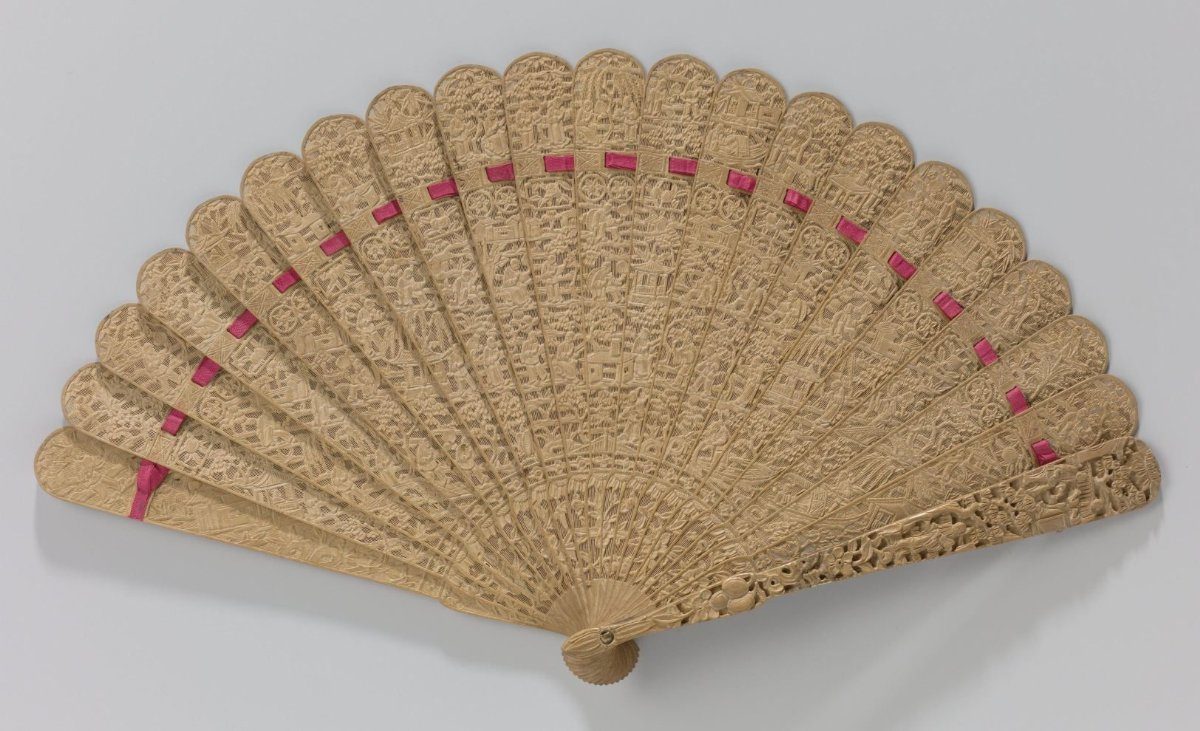
Brisé fan made of cedar wood, pierced and carved in relief on both sides, with Chinese scenes
c. 1830 - c. 1840
Brisé fan made of cedar wood, pierced and carved in relief on both sides, depicting Chinese scenes. The scenes consist of various people, houses, tables, boats, and floral motifs. The 21 contiguous sticks are connected by a red-pink ribbon. Copper rivet. The Rijksmuseum, Amsterdam, holds this object as BK-TN-3348; its record gives material recorded as cedar (wood), copper (metal), satin; technique cutting, weaving. Description translated from the museum's Dutch catalogue text; details are those of this museum object, and how far it represents a wider type has not been independently verified.
Partial type record
Rijksmuseum, Amsterdam
fans
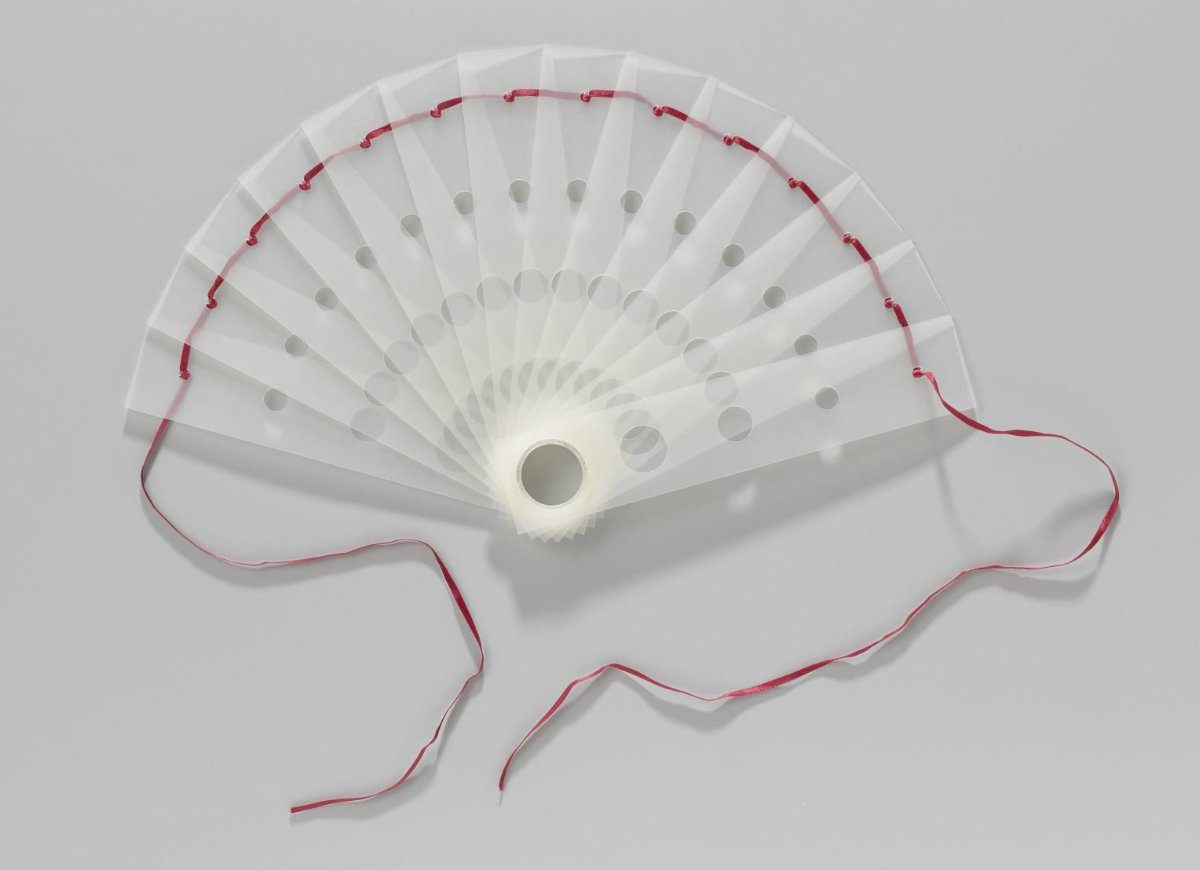
Brisé fan made of polypropylene with pierced circles, with red satin ribbon
1992
Brisé fan made of polypropylene in which circles have been cut out, joined by a red satin ribbon. The Rijksmuseum, Amsterdam, holds this object as BK-1993-11; its record gives material recorded as polypropylene, satin; technique cutting. Description translated from the museum's Dutch catalogue text; details are those of this museum object, and how far it represents a wider type has not been independently verified.
Partial type record
Rijksmuseum, Amsterdam
fans
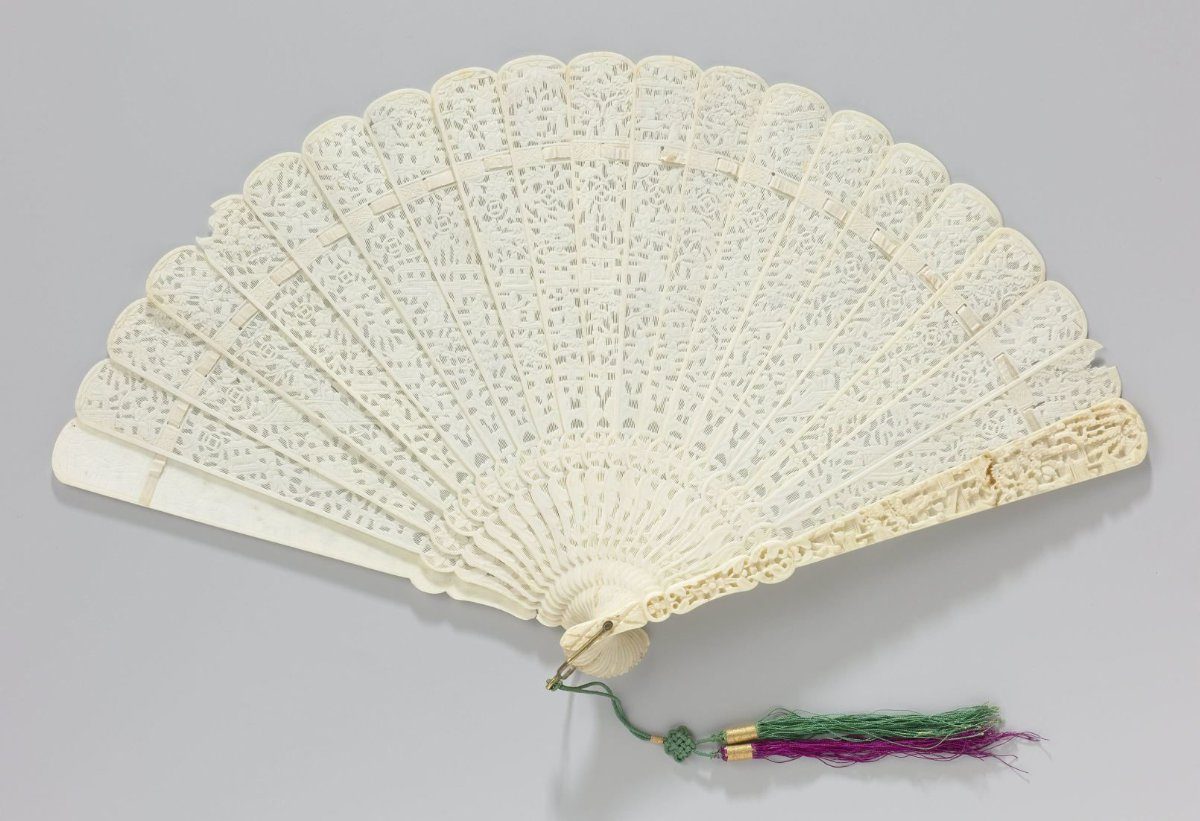
Brisé fan of bone (?) with pierced and relief-carved sticks, on both sides of which are Chinese figures, houses and plant and floral motifs
c. 1830 - c. 1850
Brisé fan of openwork carved bone with copper pivot pin and ditto guard clip, to which a cord with a purple and a green silk tassel is attached. Model: 20 decorated sticks, which are connected to each other by means of a light pink ribbon. Decoration: the gorge section of the sticks is decorated with an openwork carved pattern of scenes with figures alternating with diaper-work. The decoration of the handle is formed by a rosette and leaf and floral motifs, both alternating with diaper-work. On the guards, three scenes with figures are depicted one above the other in relief, below which are palmettes and rosettes. A green silk cord is tied to the pivot pin, from which hangs a Gordian knot from which a green and a purple tassel hang, both wound with gold thread. The Rijksmuseum, Amsterdam, holds this object as BK-1995-21; its record gives material recorded as copper (metal), bone (material), silk; technique cutting, drawn thread work; measurements length 26 cm x span 46 cm. Description translated from the museum's Dutch catalogue text; details are those of this museum object, and how far it represents a wider type has not been independently verified.
Partial type record
Rijksmuseum, Amsterdam
fans
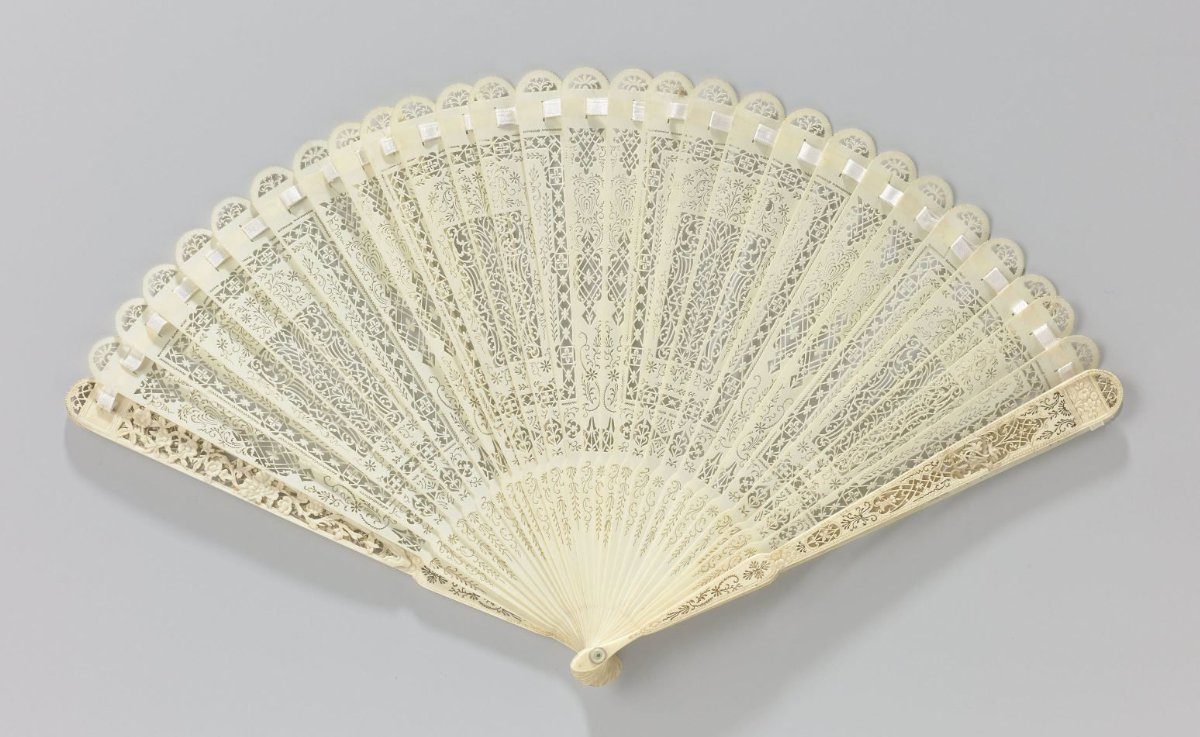
Brisé fan of carved ivory with a symmetrically structured pattern and on the guards a marriage altar below two birds near a trophy
c. 1815 - c. 1825
Brisé fan of carved ivory with a symmetrically structured pattern provided with four rectangles filled with acanthus leaves and diaper-work framed by stacked ornaments with quatrefoils, diaper-work and floral motifs, on the guards a marriage altar with two flaming hearts and an arrow below two birds near a trophy with lyre and bagpipe. Copper pivot pin with mother-of-pearl roundel. The Rijksmuseum, Amsterdam, holds this object as BK-2008-104; its record gives material recorded as ivory, copper (metal), mother of pearl; technique cutting; measurements length 24 cm x span 43 cm. Description translated from the museum's Dutch catalogue text; details are those of this museum object, and how far it represents a wider type has not been independently verified.
Partial type record
Rijksmuseum, Amsterdam
fans
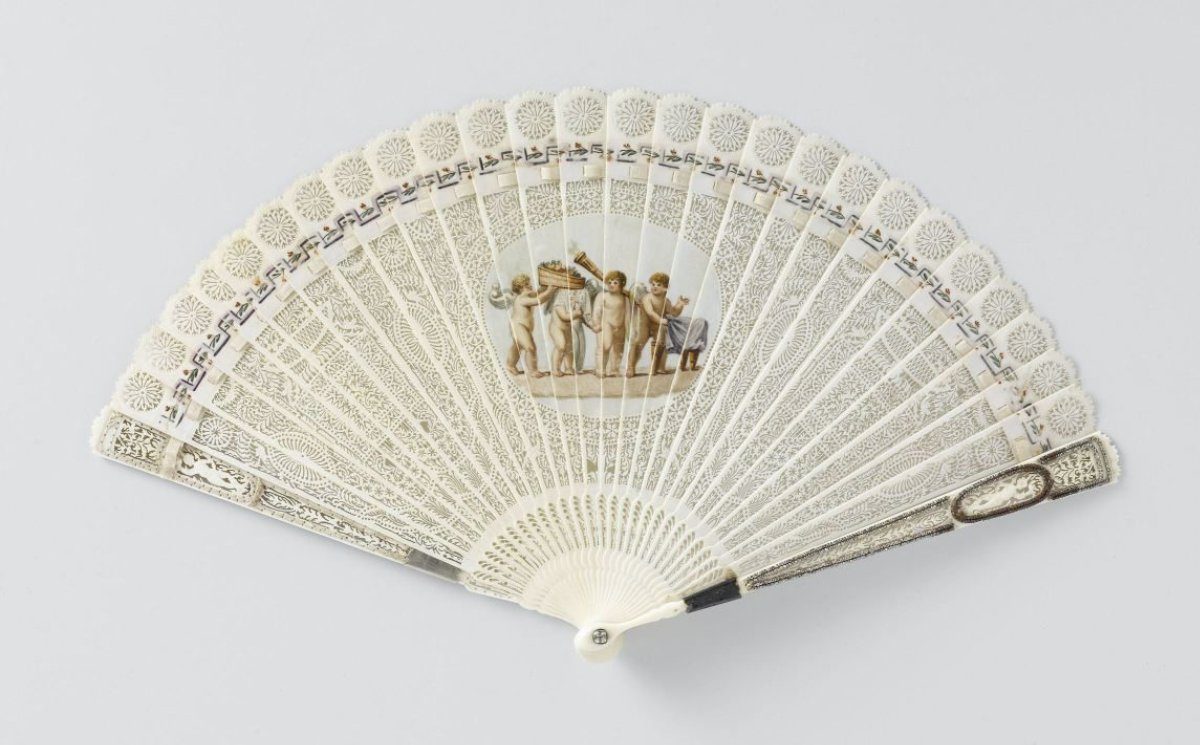
Brisé fan of carved ivory, with a central medallion on which the marriage of Cupid and Psyche is painted in watercolour, steel and silver decoration on the guard sticks
c. 1777 - c. 1800
Brisé fan, sticks consisting of 28 connected ivory sticks pierced and carved. On the guard sticks a border decoration of steel beads. On the guard sticks a small silver band, for reinforcement or decoration? Steel pivot pin with paste button. Decoration: in the centre a medallion painted in watercolour with a depiction of the mystical marriage of Cupid and Psyche. This image is modelled after a sardonyx cameo signed in Greek 'Tryphon made this', which in the 18th century was in the collection of the Duke of Marlborough. On the medallion, the veiled couple is shown being led by a putto with a torch on a knotted cord to the bridal bed, which is being turned down by another putto. The third putto holds a 'liknon' or sacred basket, in which the first fruits of the field were offered to the gods, above the couple's heads. Wedding fan. The Rijksmuseum, Amsterdam, holds this object as BK-1960-57; its record gives material recorded as ivory, metal, silver (metal), watercolor (paint), steel (alloy), glass, silk; technique cutting, aquarelle, weaving, painting technique. Description translated from the museum's Dutch catalogue text; details are those of this museum object, and how far it represents a wider type has not been independently verified.
Partial type record
Rijksmuseum, Amsterdam
fans
Brisé fan of ivory, carved in relief with flowers and scrolls, and fitted with three oval medallions, the central one bearing 'Sacred to Love'
c. 1780 - c. 1790
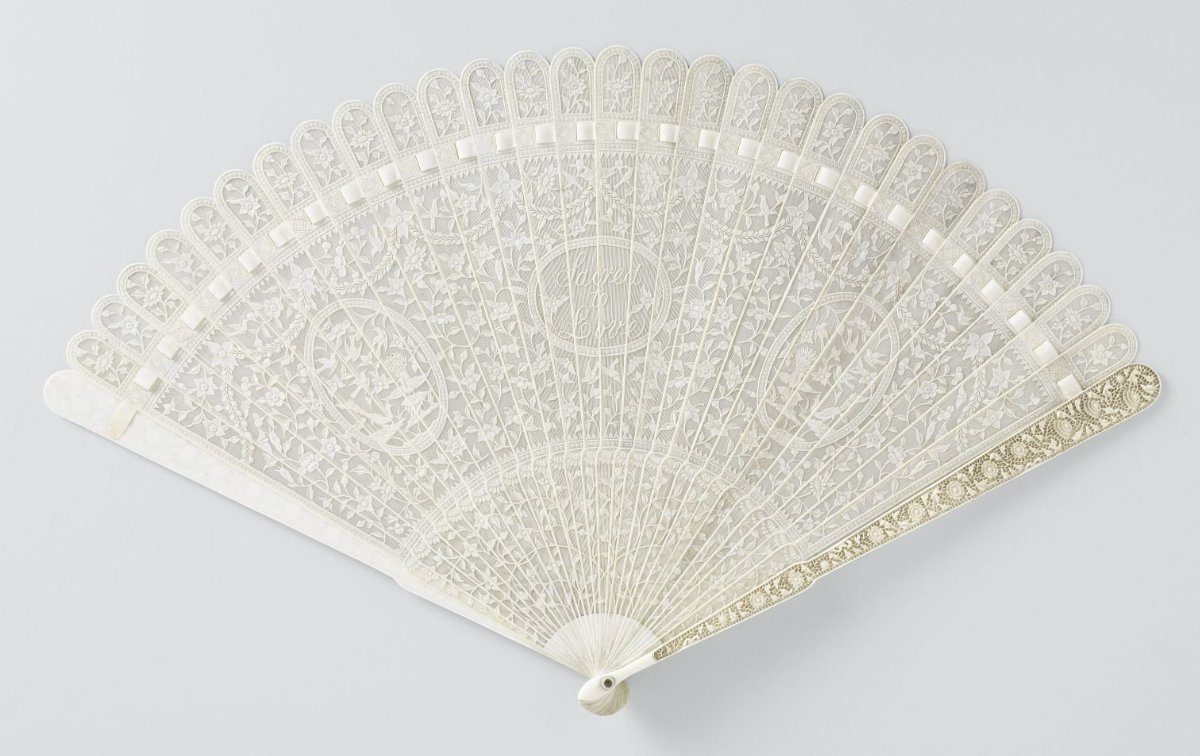
Brisé fan of ivory, carved in relief with flowers and scrolls, and fitted with three oval medallions, the central one bearing 'Sacred to Love'. 30 contiguous sticks carved and worked on one side in relief with flowers and scrolls. Unlike other examples from this period, this fan does not have a monogram in the central medallion but a motto. From this (the language) one may conclude that the fan was intended for the English market and was most likely shipped to Europe by the English trading company. A flower and leaf motif is applied over the entire fan, alternated only along the edge of the openings for the ribbon with diaper work. This decoration is enlivened by butterflies, small birds, peacocks, and hummingbird-like birds. The Rijksmuseum, Amsterdam, holds this object as BK-NM-7007; its record gives material recorded as ivory, copper (metal), mother of pearl, cotton (textile); technique cutting, weaving. Description translated from the museum's Dutch catalogue text; details are those of this museum object, and how far it represents a wider type has not been independently verified.
Partial type record
Rijksmuseum, Amsterdam
fans
Brisé fan of ivory, painted with tempera and gold paint, with central cartouche depicting Zephyrus and Flora, surrounded by Chinoiseries
c. 1720
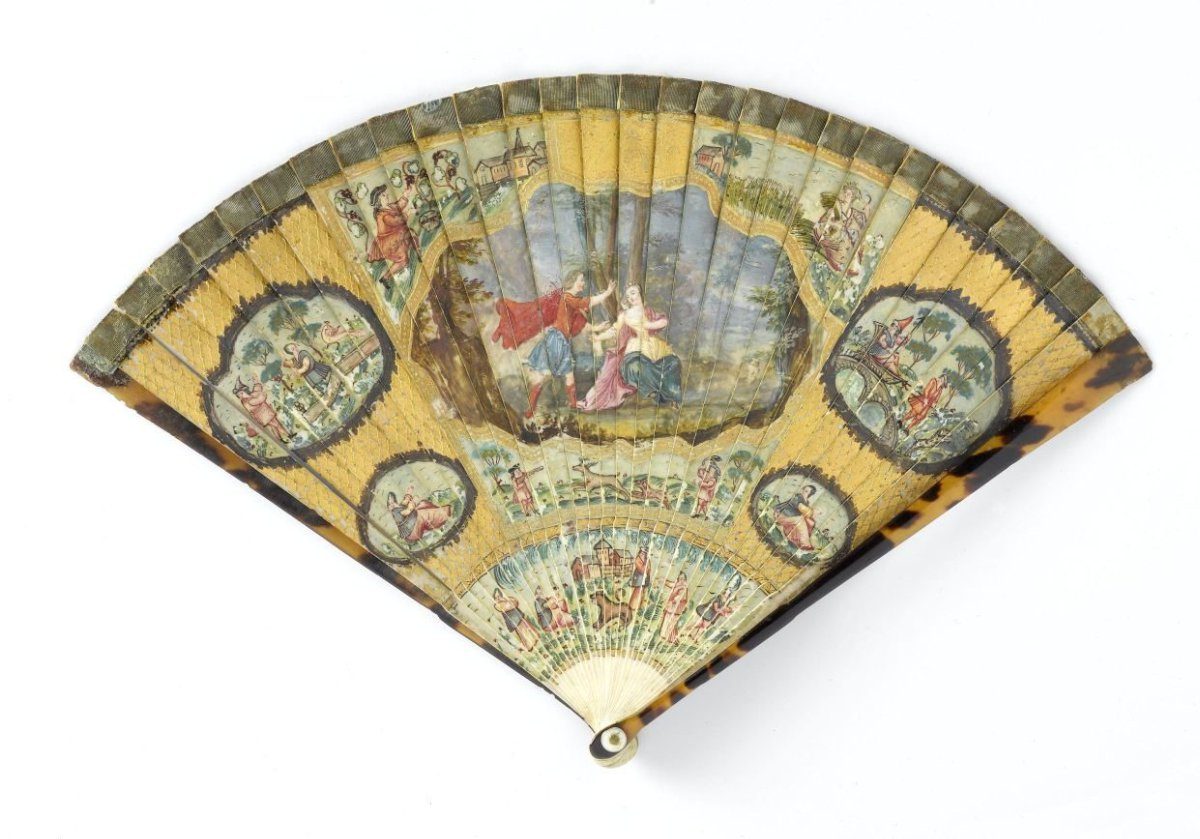
Fan, so-called brisé fan of ivory painted with tempera, mythological scene amid medallions and cartouches with chinoiseries. Model: brisé fan with 28 ivory sticks and two undecorated tortoiseshell guards. The sticks are held together by a green rib ribbon. Mother-of-pearl washer around brass rivet. Decoration: the gold-coloured background has reserved spaces for the various cartouches. Around the central cartouche a beaded rim in relief, above which a gold field with leaf and flower motifs in relief. Furthermore, the gold background features a diamond pattern with dots. The cartouches to the left and right had a silver(?) rim, which has now turned black/grey. The central scene is formed by a winged young man in classical attire raising his hands to a young woman seated on the ground before a tree, with a floral wreath on her head. It is a scene from the 'Fasti' of the poet Ovid (43 BC–AD 18) in which Zephyrus, the god of the west wind, holds a floral wreath above Flora as a token of his love. This fan painter has chosen the moment after Zephyrus has placed the floral wreath on Flora's head. Love between these two must have been a popular theme in the 1720s, as it appears more frequently on fans from this period (cf. BK-NM-10463, reverse). To the upper left of Zephyrus is a cartouche containing a man picking grapes (Bacchus, the god of grapes, wine and joy) near a village with a church tower. To the upper right of Flora, a cartouche in which a woman with a sheaf of wheat in her right hand and a sickle in her left hand (Ceres, the goddess of agriculture, harvest, grain and fertility) is seated in a wheat field with a building (farmhouse?) in the background. Beneath the central scene is a hunt scene with a beater driving a dog after a deer, straight into the line of sight (field of fire) of a man with a gun. The lower section (gorge) is painted with an outdoor scene of a group of women in Chinese(?) dress with a large seated animal (dog?). In the background a village. In the left cartouches: above, a man and woman in a garden with a peacock; below, a seated woman with outstretched arms looking back. In the right cartouches: a woman with lance or spear seated in a carriage drawn by a man, accompanied by a spotted dog (dalmatian?); below, a seated woman looking back. On the back of the fan, leaf and flower motifs and the contours of the cartouches are painted in gold. The lower section features a multicoloured leaf and flower pattern. The Rijksmuseum, Amsterdam, holds this object as BK-1993-8; its record gives material recorded as ivory, tortoise shell, copper (metal), mother of pearl, gilt paint, tempera; technique paint, cutting. Description translated from the museum's Dutch catalogue text; details are those of this museum object, and how far it represents a wider type has not been independently verified.
Partial type record
Rijksmuseum, Amsterdam
fans
Brisé fan of ivory, pierced and carved, on both sides Chinese scenes in relief, centrally in the middle a monogram with PMH
c. 1830 - c. 1840
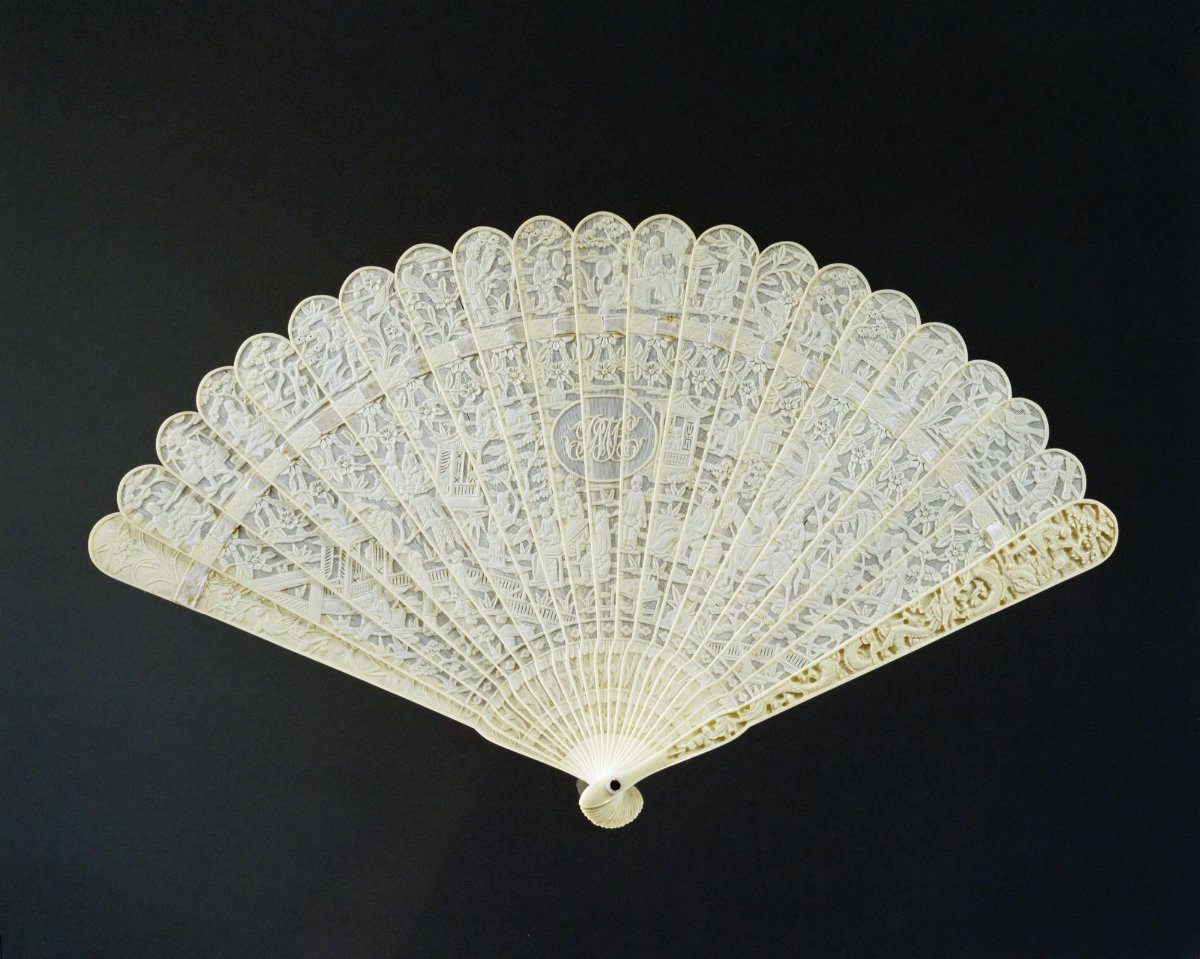
Brisé fan of ivory, pierced and carved, on both sides Chinese scenes carved in relief, centrally in the middle a monogram with PMH. The 21 contiguous sticks in relief are held together by a satin ribbon. Both guard sticks are carved in relief with a dragon. Mother-of-pearl washer at the rivet. The Rijksmuseum, Amsterdam, holds this object as BK-1960-55-A; its record gives material recorded as ivory, copper (metal), satin, mother of pearl; technique cutting. Description translated from the museum's Dutch catalogue text; details are those of this museum object, and how far it represents a wider type has not been independently verified.
Partial type record
Rijksmuseum, Amsterdam
fans
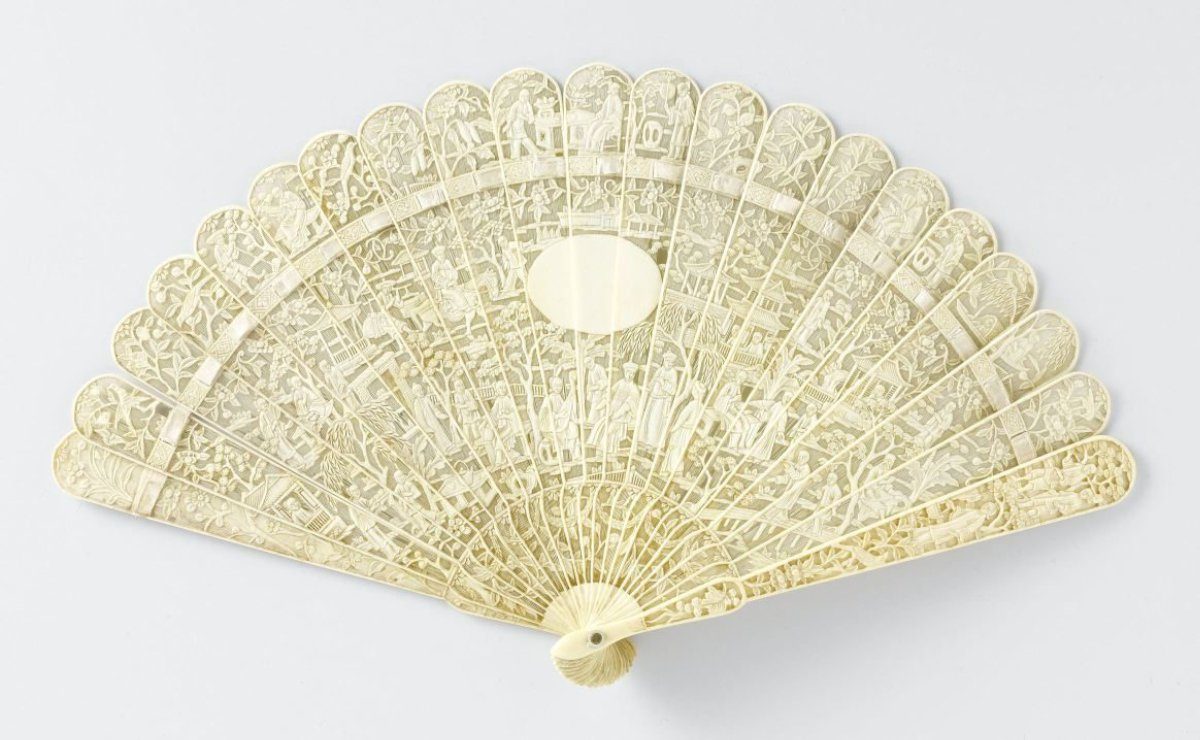
Brisé fan of ivory, scored and with openwork- and relief-carved sticks showing a Chinese landscape, mountains, pavilions, birds, and an undecorated medallion in the center
c. 1800 - c. 1820
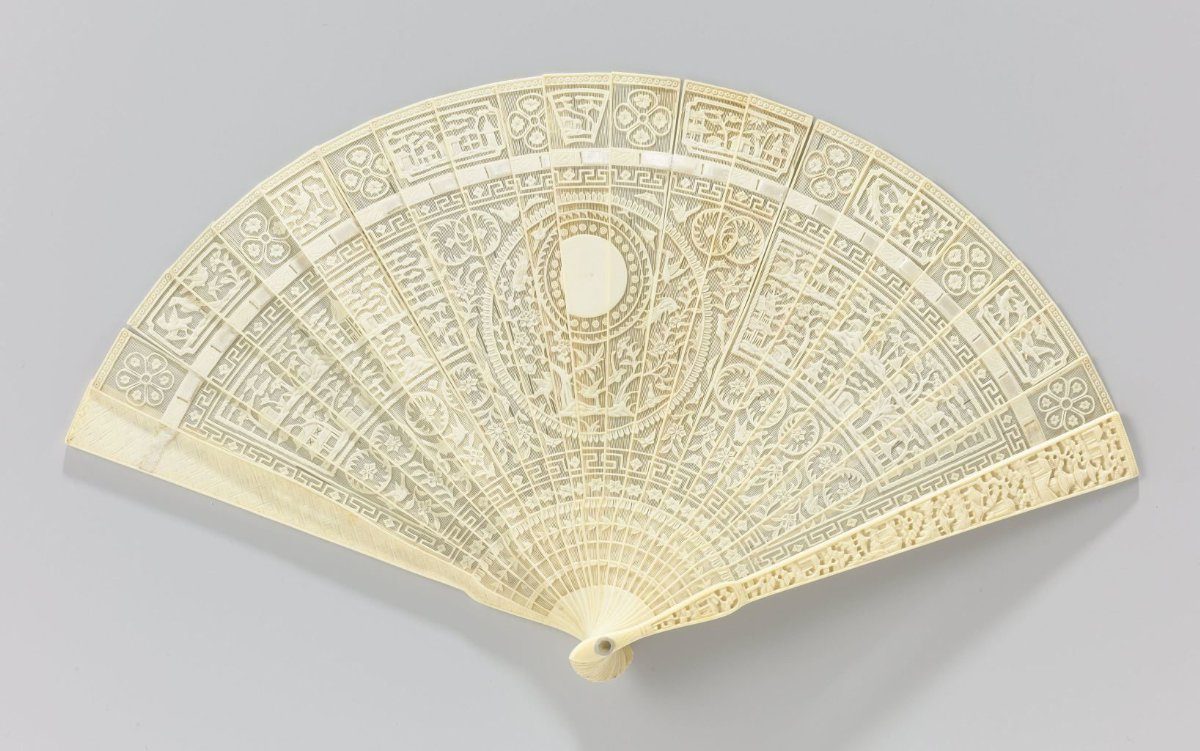
The ivory brisé fan is scored and carved in openwork and relief with a Chinese landscape, mountains, pavilions, birds, and floral motifs. In the center of the fan is an unworked medallion. The back of the fan is undecorated. The 22 contiguous sticks are held together by a threaded ribbon. At the rivet is a mother-of-pearl washer. The Rijksmuseum, Amsterdam, holds this object as BK-1978-324; its record gives material recorded as ivory, copper (metal), satin, mother of pearl; technique cutting, drawn thread work. Description translated from the museum's Dutch catalogue text; details are those of this museum object, and how far it represents a wider type has not been independently verified.
Partial type record
Rijksmuseum, Amsterdam
fans
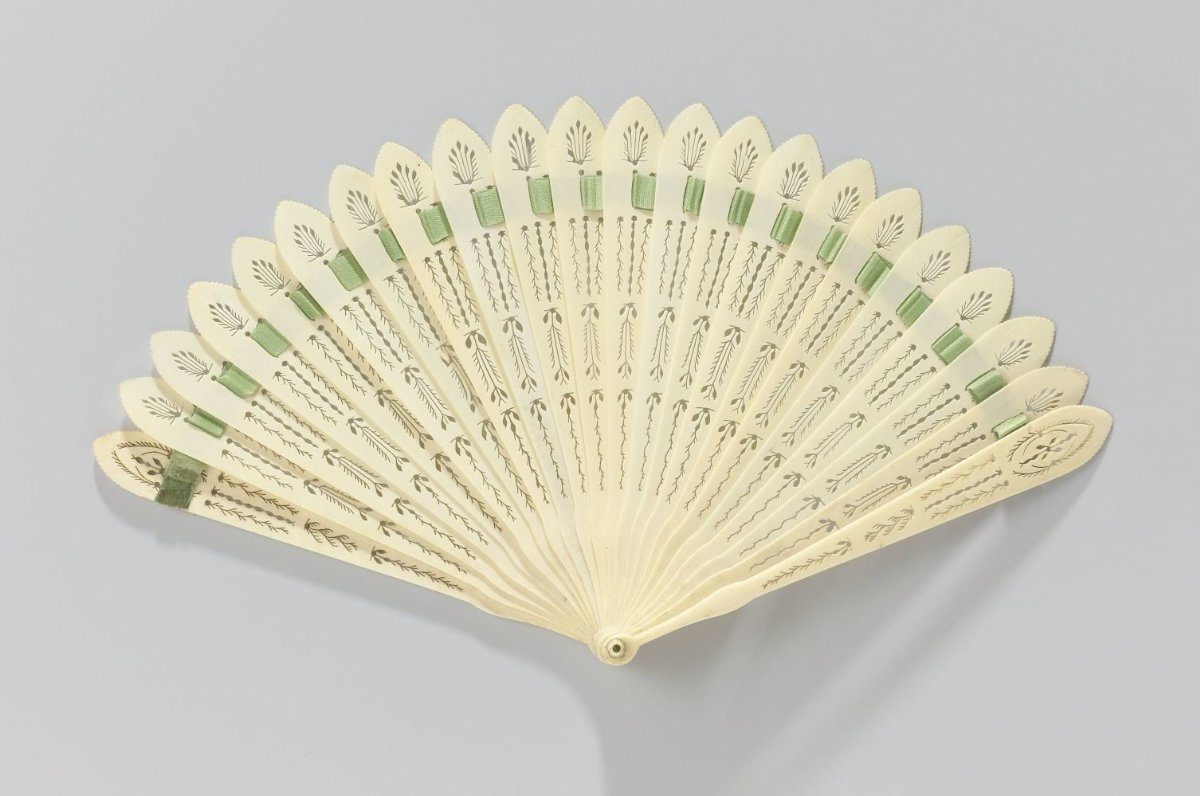
Brisé fan of openwork and relief-carved ivory featuring scenes from Chinese life with pagodas, houses, trees, and an undecorated oval medallion in the centre
c. 1800 - c. 1820
Brisé fan of openwork and relief-carved ivory featuring scenes from Chinese life with pagodas, houses, trees, and an undecorated oval medallion in the centre. Model: 21 contiguous sticks. Brass rivet surrounded by a mother-of-pearl washer. Decoration: below the oval medallion, fairly central, is a seated man with a seated woman playing music to his left. Both are surrounded by standing figures and trees. To the right in the background, a pagoda. Up to the ribbon, the sticks are filled with scenes from Chinese life, both indoors and outdoors. The scalloped upper border above the ribbon is alternately filled with figures, birds, leaf and floral motifs, and on the right a sampan (partially covered Asian boat). The Rijksmuseum, Amsterdam, holds this object as BK-1978-325; its record gives material recorded as ivory, copper (metal), mother of pearl; technique cutting, drawn thread work. Description translated from the museum's Dutch catalogue text; details are those of this museum object, and how far it represents a wider type has not been independently verified.
Partial type record
Rijksmuseum, Amsterdam
fans
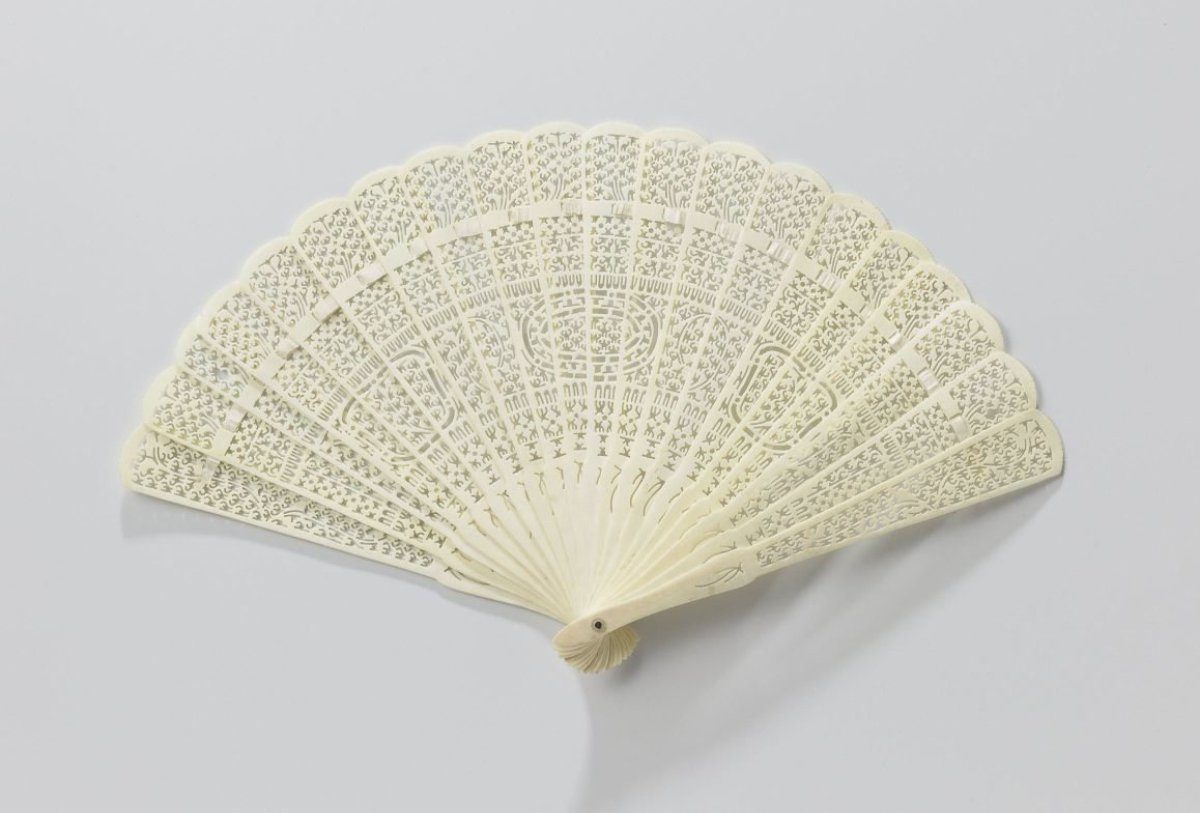
Brisé fan of openwork carved bone, held together with a green satin ribbon
c. 1815 - c. 1820
Brisé fan of openwork carved bone. The pointed ends of the sticks are slightly serrated. The 22 sticks are held together by a green satin ribbon threaded through the upper part of the mount. The washer near the copper rivet is made of bone. The Rijksmuseum, Amsterdam, holds this object as BK-1994-10; its record gives material recorded as copper (metal), bone (material), silk; technique cutting, drawn thread work, weaving; measurements length 13.5 cm. Description translated from the museum's Dutch catalogue text; details are those of this museum object, and how far it represents a wider type has not been independently verified.
Partial type record
Rijksmuseum, Amsterdam
fans
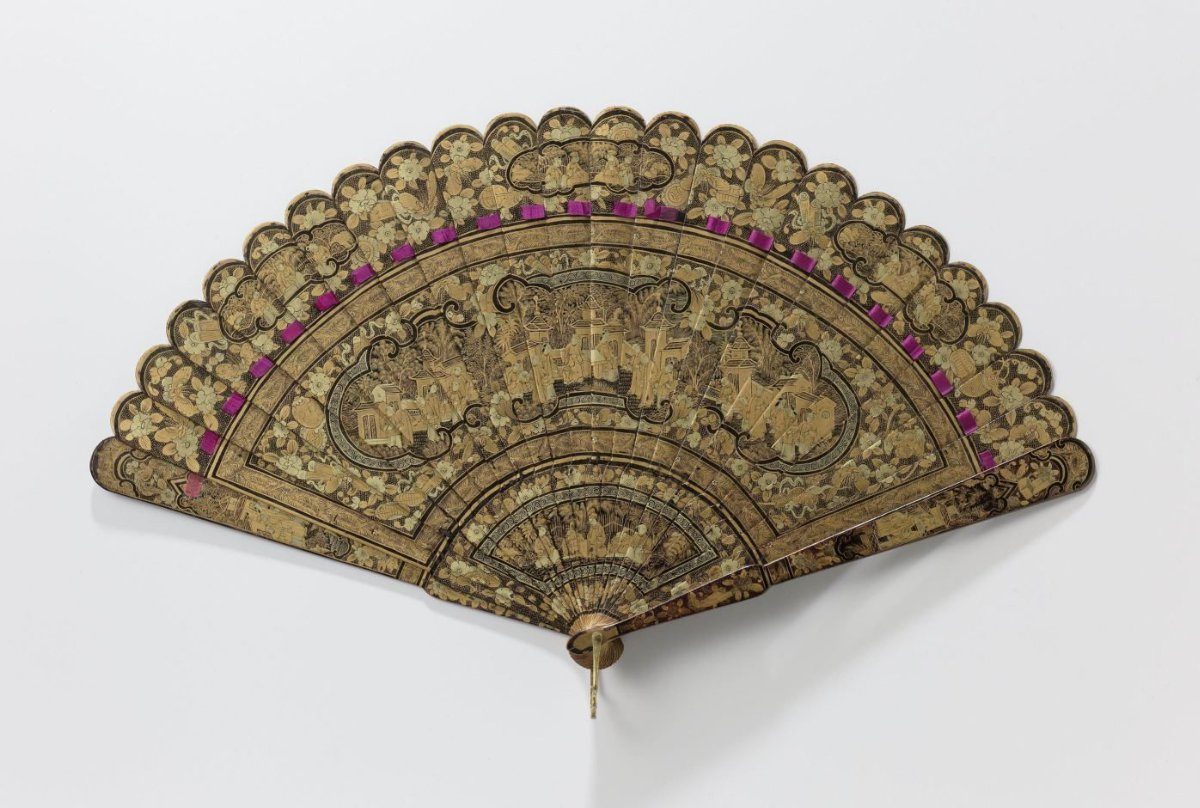
Brisé fan of pierced white bone
c. 1800 - c. 1899
Brisé fan of white bone carved à jour. The 20 connected sticks are 1/3 plain, and 2/3 fully openwork with three geometric forms. The sequence of openings creates three medallions within circular arches. The Rijksmuseum, Amsterdam, holds this object as BK-18306; its record gives material recorded as metal, mother of pearl, bone (material), silk; technique cutting. Description translated from the museum's Dutch catalogue text; details are those of this museum object, and how far it represents a wider type has not been independently verified.
Partial type record
Rijksmuseum, Amsterdam
fans
Brisé fan of wood with a Chinese scene on both sides in a cartouche in lacquerwork of two colours of gold on a black ground
c. 1840
Brisé fan of wood on which on both sides a Chinese scene [in] a cartouche in lacquerwork of two colours of gold on a black ground. The fan has 24 contiguous sticks held together with a purple satin ribbon. The three small cartouches near the upper edge and the large central cartouche contain Chinese figures near pavilions. The compartments are framed with a band containing feathers or spiral-like shapes. The background of the fan consists of a brownish-black grain and with large red-gold flowers. The difference between the front and the back of the fan is only a detail: a round or a square table. The fan loop is made of metal. The Rijksmuseum, Amsterdam, holds this object as BK-18309-A; its record gives material recorded as copper (metal), wood (plant material), lacquer (coating), silk; technique lacquering, cutting, weaving. Description translated from the museum's Dutch catalogue text; details are those of this museum object, and how far it represents a wider type has not been independently verified.
Partial type record
Rijksmuseum, Amsterdam
fans
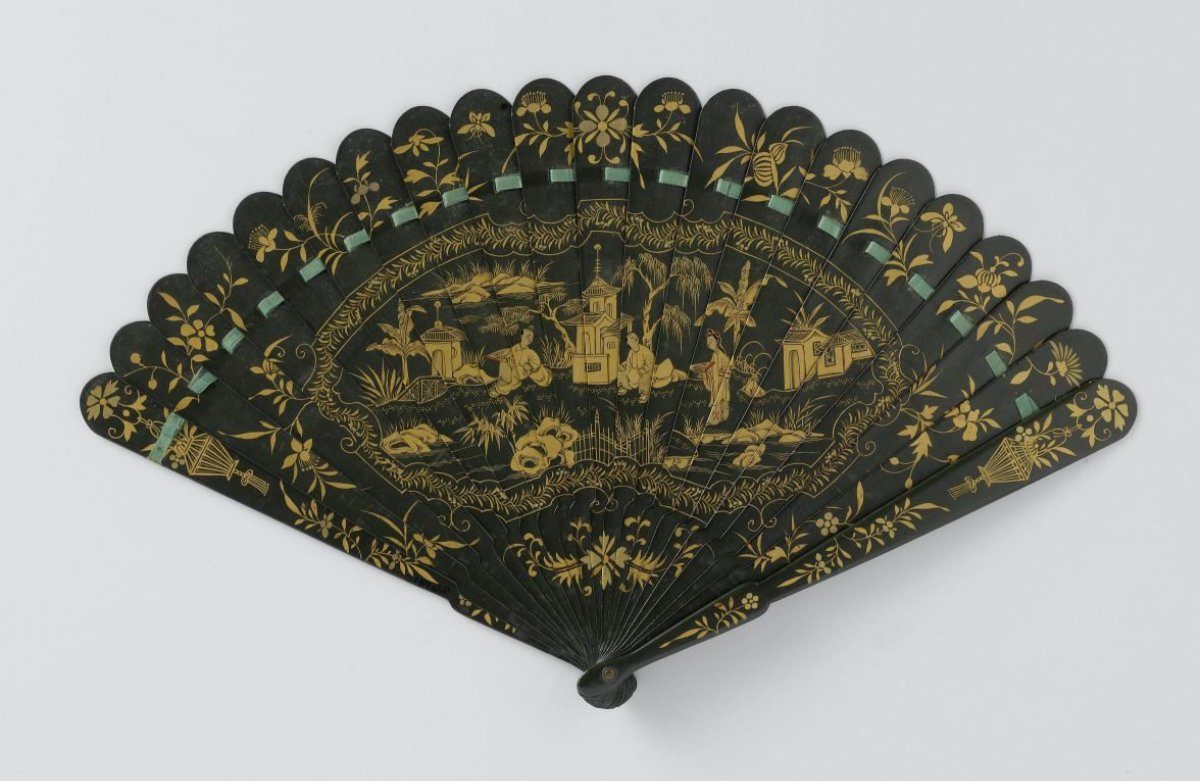
Brisé Fan with Gold Lacquer on a Ground of Green Lacquer with a Central Cartouche Containing Figures in a Landscape or Garden with Pavilions, Surrounded by Leaf and Flower Motifs
c. 1880
On the front: within the central cartouche a landscape with weeping willow, banana trees, bamboo and prunus with fanning branches. In the foreground water with rocks. Of the three figures, one man and one woman hold a fan in their hand; the other man (with moustache) sits between them on a rock and appears to watch the interaction between the others. The woman wears an elaborate hairstyle and is highlighted in various places with red paint. On the back: within a similar landscape, a walled hut is visible on the right with the woman looking over the low wall. In the centre, the man with moustache sits on a stool and looks at the woman, while on the left a man with a filled dish walks away looking back. Again a few touches of red in the figures. The border decoration of leaf and flower motifs is identical on the front and back, as well as on the guards. Metal rivet with metal washer. The Rijksmuseum, Amsterdam, holds this object as BK-18308-A; its record gives material recorded as wood (plant material), lacquer (coating), gilt paint; technique lacquering, paint, cutting. Description translated from the museum's Dutch catalogue text; details are those of this museum object, and how far it represents a wider type has not been independently verified.
Partial type record
Rijksmuseum, Amsterdam
fans
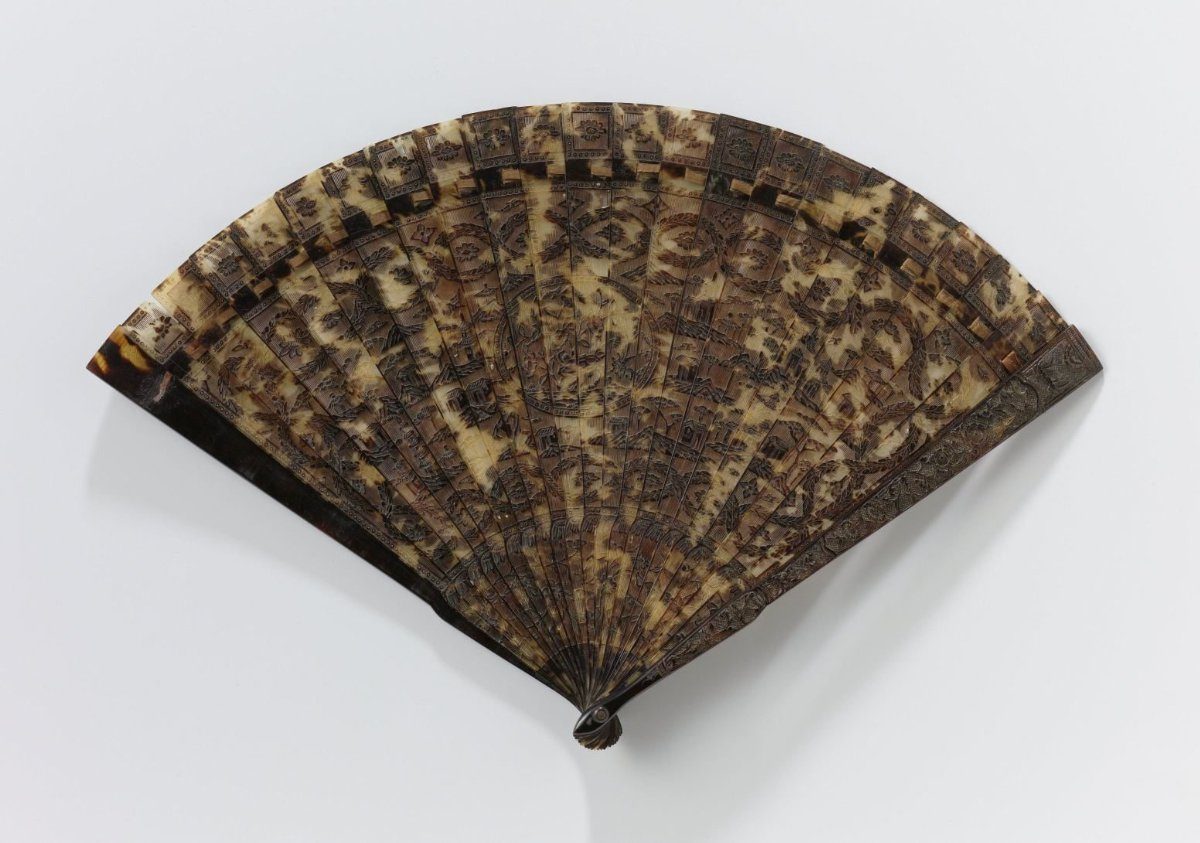
Brisé fan, c. 1800 - c. 1825
c. 1800 - c. 1825
Tortoiseshell brisé fan, pierced and carved in relief with a Chinese mountain and rock landscape, temples, and houses. The reverse of the fan is not in relief, but smooth. Along the outer edge of the sticks are squares containing a flower. Brisé fan of 23 connected sticks, with a central oval medallion with flowering branches. Around the naturalistic depiction are borders with garlands and quatrefoils. Handle section with rounded shoulder. Metal pivot pin with tortoiseshell disc. The Rijksmuseum, Amsterdam, holds this object as BK-1960-56-A; its record gives material recorded as tortoise shell, metal; technique cutting. Description translated from the museum's Dutch catalogue text; details are those of this museum object, and how far it represents a wider type has not been independently verified.
Partial type record
Rijksmuseum, Amsterdam
fans
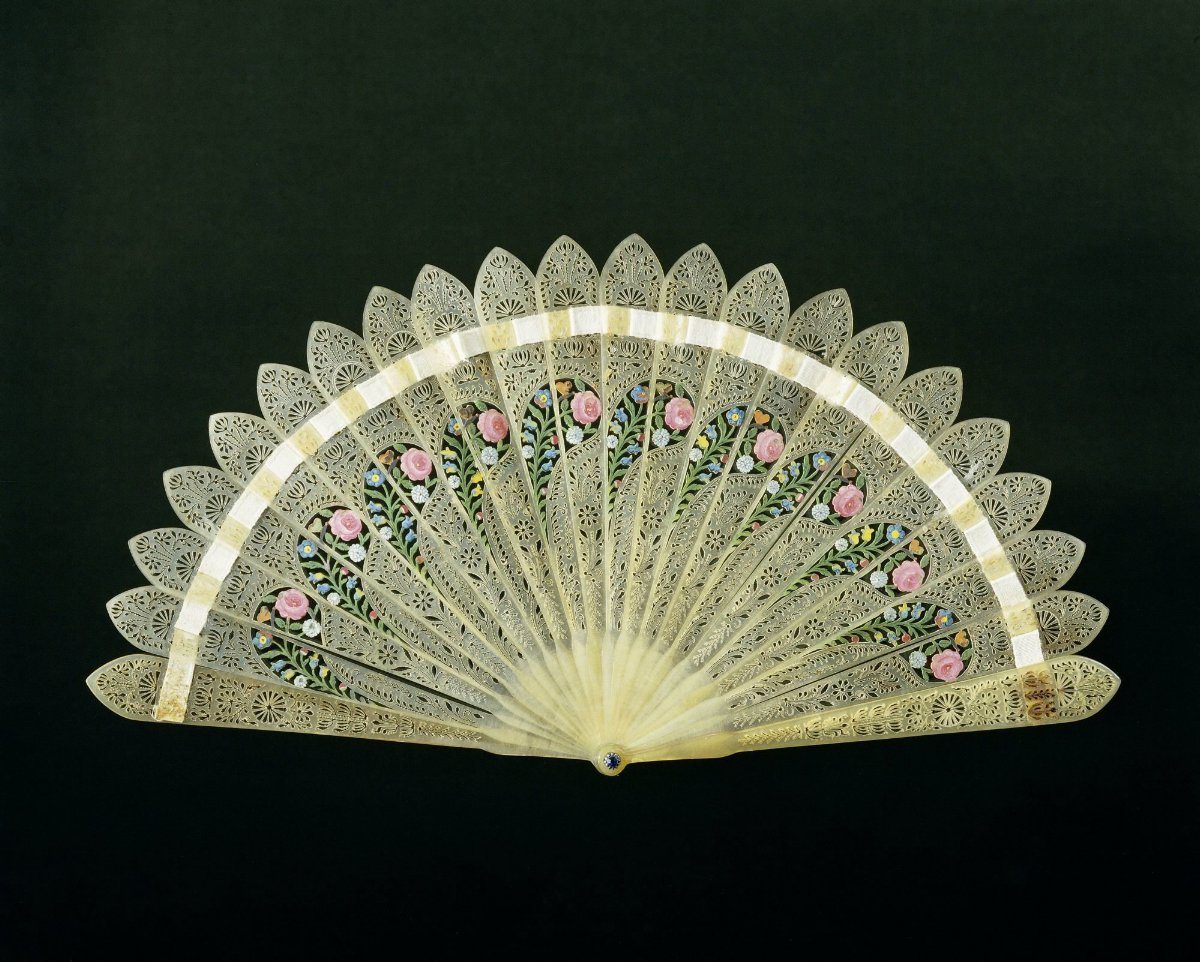
Brisé fan, c. 1815 - c. 1820
c. 1815 - c. 1820
Brisé fan of horn with rose decoration. The pointed-arch sticks are openwork-carved. On the medallions in the form of Kashmir palmettes, each spanning two sticks, is a carved and painted sprig with a pink rose, small butterfly, forget-me-not, and daisy. The reverse shows orange instead of blue. Two blue stones adorn the rivet. The Rijksmuseum, Amsterdam, holds this object as BK-1967-53; its record gives material recorded as metal, horn (animal material), glass, silk, tempera; technique grinding, paint, cutting, weaving. Description translated from the museum's Dutch catalogue text; details are those of this museum object, and how far it represents a wider type has not been independently verified.
Partial type record
© Victoria and Albert Museum, London
fans
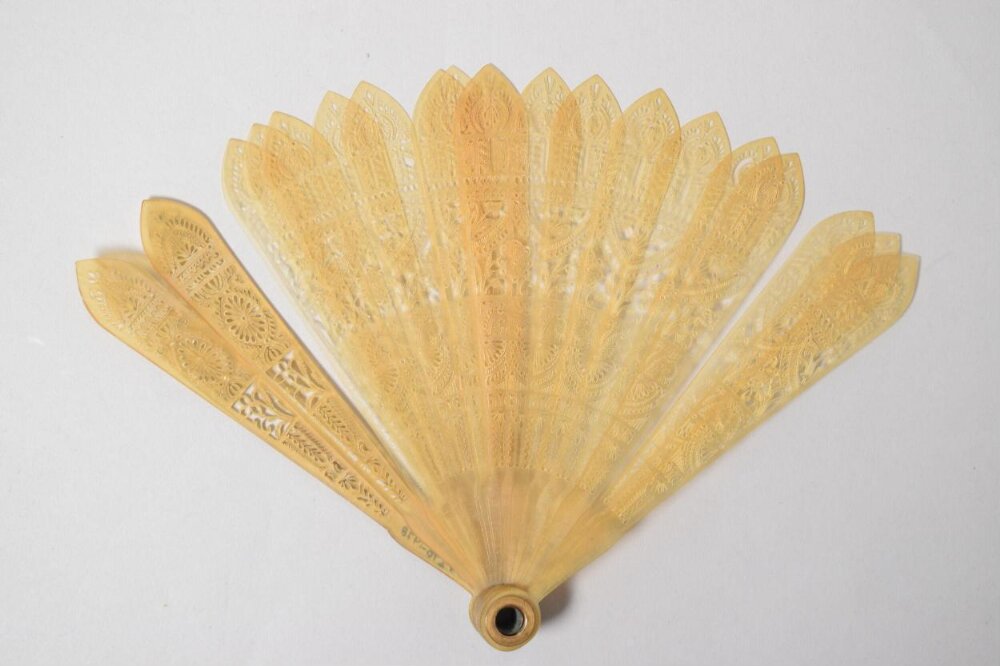
Brisé fan, England, 1800-1825
1800-1825
Brisé fan, England, 1800-1825 is an object recorded by Victoria and Albert Museum, dated 1800-1825. The museum's brief description reads: Horn brisé fan, England, 1800-1825. Museum description: Horn brisé fan consisting of 18 sticks and 2 guards. Each stick curves to a point at the top. The decoration is arranged in horizontal bands and the designs are simple, repetitive floral devices. It was originally held together at the top with a narrow silk ribbon. It has an incomplete copper-gilt spy glass which also serves as a rivet. Part of the lens is missing. The museum record gives measurements Length 6.5 in; place associated: England. These details come from the holding museum's own record; how far this object represents a wider collectible type has not yet been independently verified.
Partial type record
Rijksmuseum, Amsterdam
fans
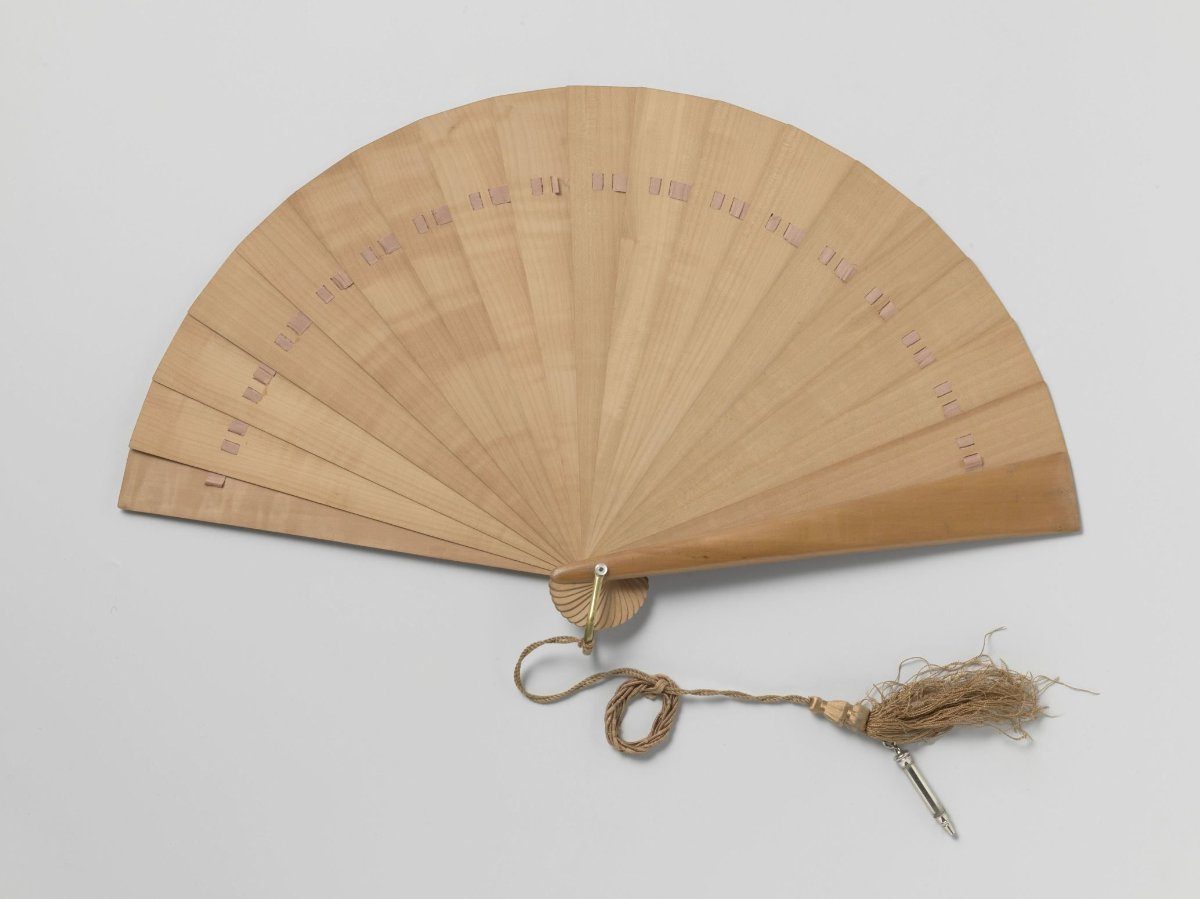
Brisé fan, for use as a dance card, of wood with a copper fan ring holding a silk cord with pencil in a nickel holder
in or before 1907
Brisé fan, for use as a dance card, of wood with a copper fan ring holding a silk cord with pencil in a nickel holder. Model: consisting of 17 blades of plain wood and two guard sticks of lacquered wood. Fan ribbon in the same pink-beige colour as the blades. Guard ring of mother-of-pearl. Twisted silk cord with tassel and ring to wear the fan on one of the fingers during dancing. Tassel with a wooden core wrapped in silk thread and ending in a bundle of twined silk threads. Nickel holder from which the pencil emerges with a twisting movement. Inscriptions and signatures have been placed on the back. The Rijksmuseum, Amsterdam, holds this object as BK-2011-16; its record gives material recorded as mother of pearl, nickel (metal), copper (metal), silk, wood (plant material); technique weaving, cutting; measurements length 26 cm x span 46 cm. Description translated from the museum's Dutch catalogue text; details are those of this museum object, and how far it represents a wider type has not been independently verified.
Partial type record
© Victoria and Albert Museum, London
fans
Brisé fan, Great Britain, ca. 1800-1825
ca. 1800-1825
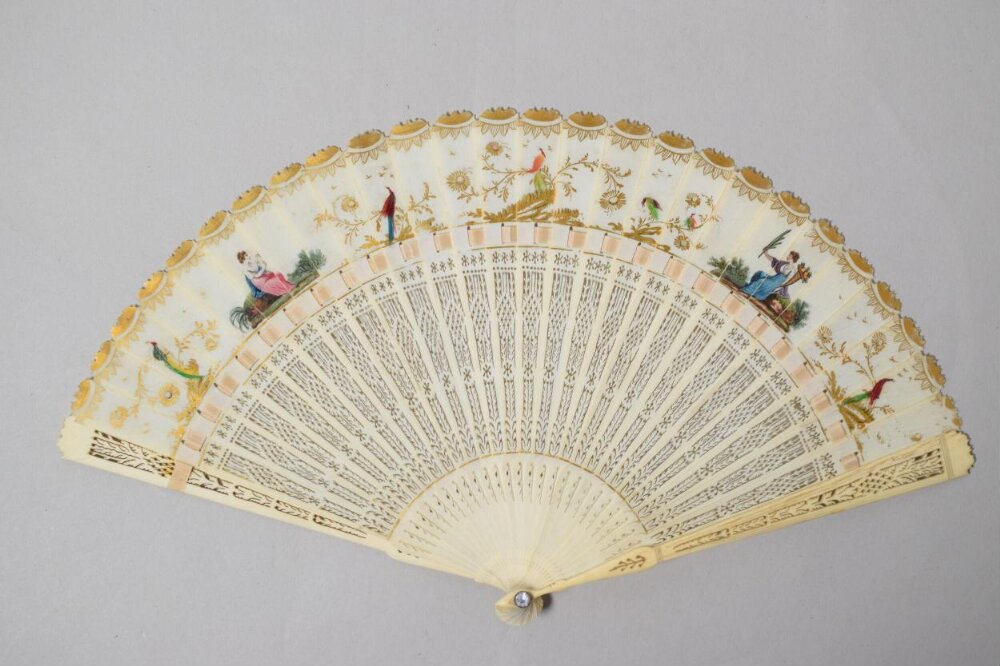
Brisé fan, Great Britain, ca. 1800-1825 is an object recorded by Victoria and Albert Museum, dated ca. 1800-1825. The museum's brief description reads: Brisé fan made of pierced ivory, Great Britain, ca. 1800-1825. Museum description: Brisé fan made of ivory with shaped tips to the blades and with fine pierced work. The tips are gilded. The unpierced outer two inches of the blades have a surface of painted decoration with ladies in classical dress and chinoiserie birds onto which pieces of feather have been pasted. Paste-set rivet. The museum record gives measurements Length 6.5 in; place associated: Great Britain. These details come from the holding museum's own record; how far this object represents a wider collectible type has not yet been independently verified.
Partial type record
© Victoria and Albert Museum, London
fans
Brisé fan, Great Britain, ca. 1840
ca. 1840
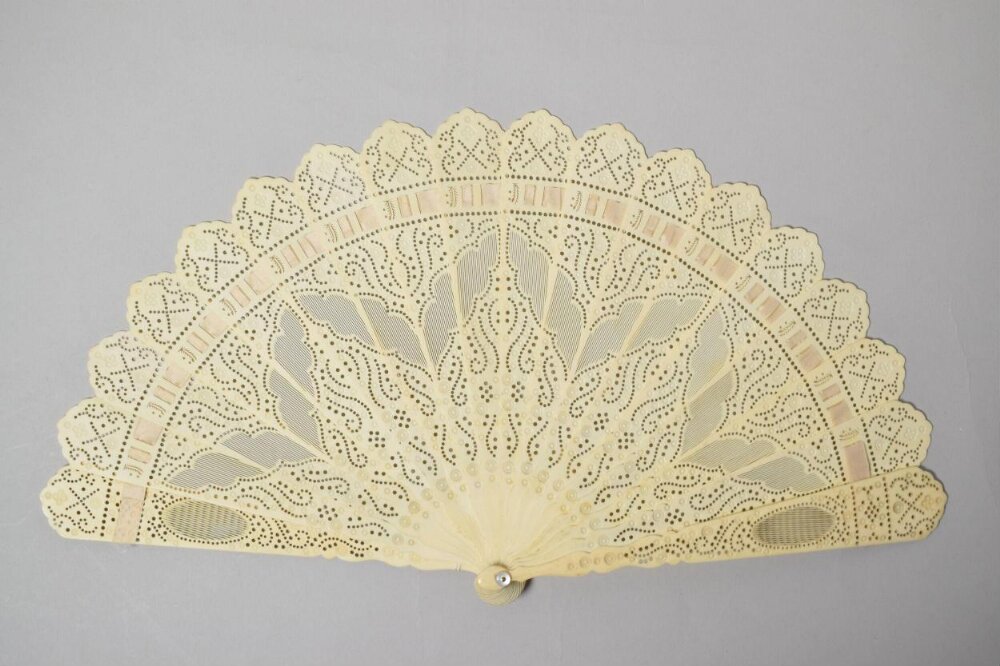
Brisé fan, Great Britain, ca. 1840 is an object recorded by Victoria and Albert Museum, dated ca. 1840. The museum's brief description reads: Brisé fan of slotted bone, Great Britain, ca. 1840. Museum description: Brisé fan of bone drilled and slotted with simple decoration. Shaped ends to the blades. Brass rivet with mother-of-pearl washers. The museum record gives measurements Length 8.25 in; place associated: Great Britain. These details come from the holding museum's own record; how far this object represents a wider collectible type has not yet been independently verified.
Partial type record
Museum Rotterdam via Europeana
fans
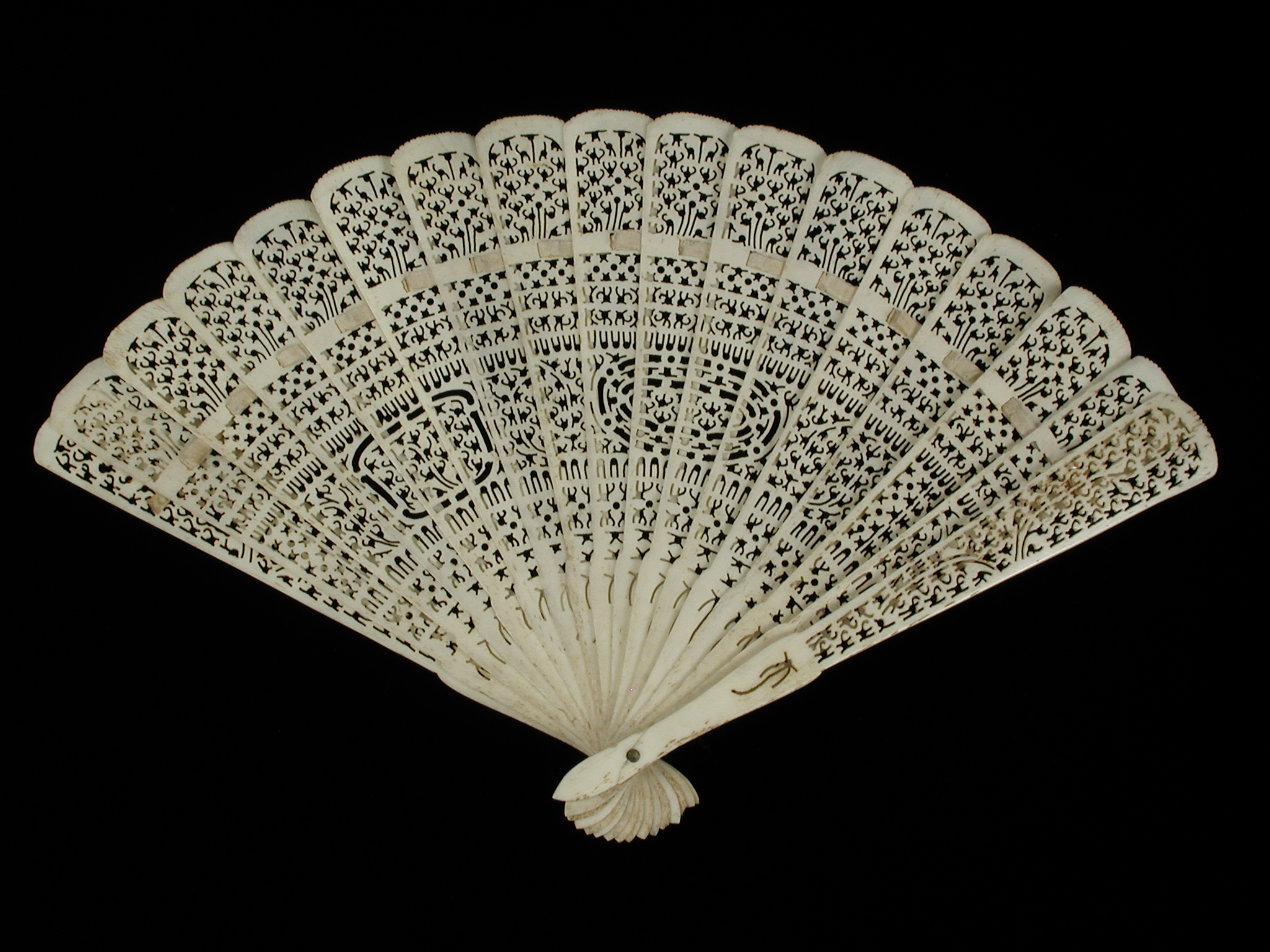
Brisé fan, sticks and blade of finely carved bone, white silk brisé ribbon, 1800
1800
Brisé fan, sticks and blade of finely carved bone, white silk brisé ribbon, 1800 is held by Museum Rotterdam, dated 1800. Museum description: Brisé fan with a guard and sticks of continuous bone with abundant and finely carved bone. Fifteen inner sticks, held together by a brisé ribbon of white silk. Pin and loop. Both the guard sticks and inner sticks are decorated with numerous, detailed and finely carved abstract motifs. Pin of copper and loop of mother-of-pearl. The museum record gives material recorded as Material: bone; Material: silk; Material: copper; Material: mother of pearl. These details come from the holding museum's own record; how far this object represents a wider collectible type has not yet been independently verified.
Partial type record
The Metropolitan Museum of Art, New York
fans
Calligraphy, China
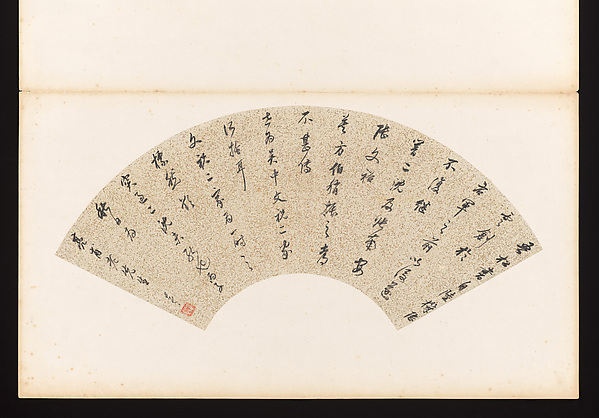
Fan in The Metropolitan Museum of Art, New York (accession 2024.549.61), catalogued by the museum's Asian Art department under the title “Calligraphy”. and records its origin as China; Qing dynasty (1644–1911). It is attributed to Zhu Angzhi (Chinese, 1764–after 1841). The museum records the medium as Folding fan mounted as album leaf; ink on paper and the dimensions as Image: 7 5/16 × 20 7/8 in. (18.5 × 53 cm). These details are transcribed from the museum's open-access record; how far this object represents a wider collectible type has not yet been independently verified.
Partial type record
Rijksmuseum, Amsterdam
fans
Carnet de bal of ivory in the form of a brisé fan, with small pencil
c. 1890 - c. 1900
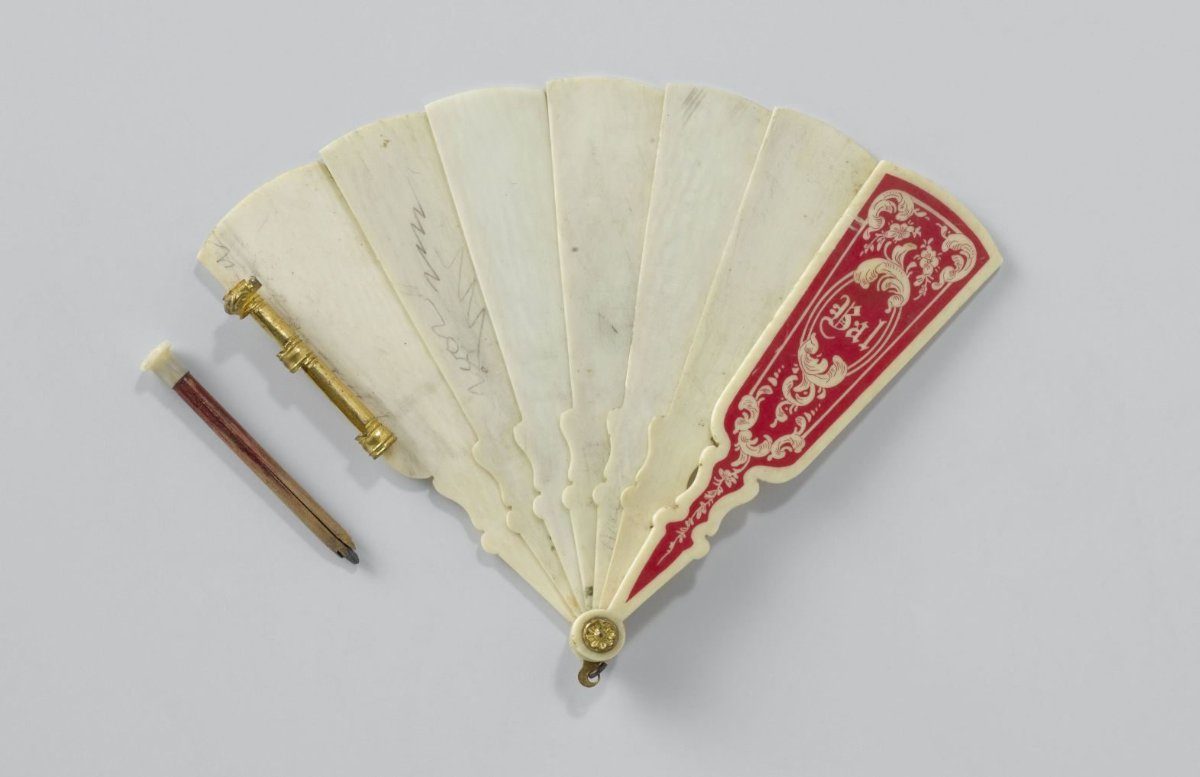
Carnet de bal of ivory in the form of a brisé fan, with small pencil. Brass flower at the pivot pin; 7 contiguous sticks; front guard in red with white rocaille ornaments, in an oval the text 'Bal', three small brass rings on the left guard, small pencil with ivory cap. Some leaves inscribed in pencil. The Rijksmuseum, Amsterdam, holds this object as BK-1978-326; its record gives material recorded as ivory, copper (metal), wood (plant material), graphite (mineral); technique casting, cutting. Description translated from the museum's Dutch catalogue text; details are those of this museum object, and how far it represents a wider type has not been independently verified.
Partial type record
Badisches Landesmuseum Karlsruhe via Europeana
fans
Chinese brisé fan for the European market
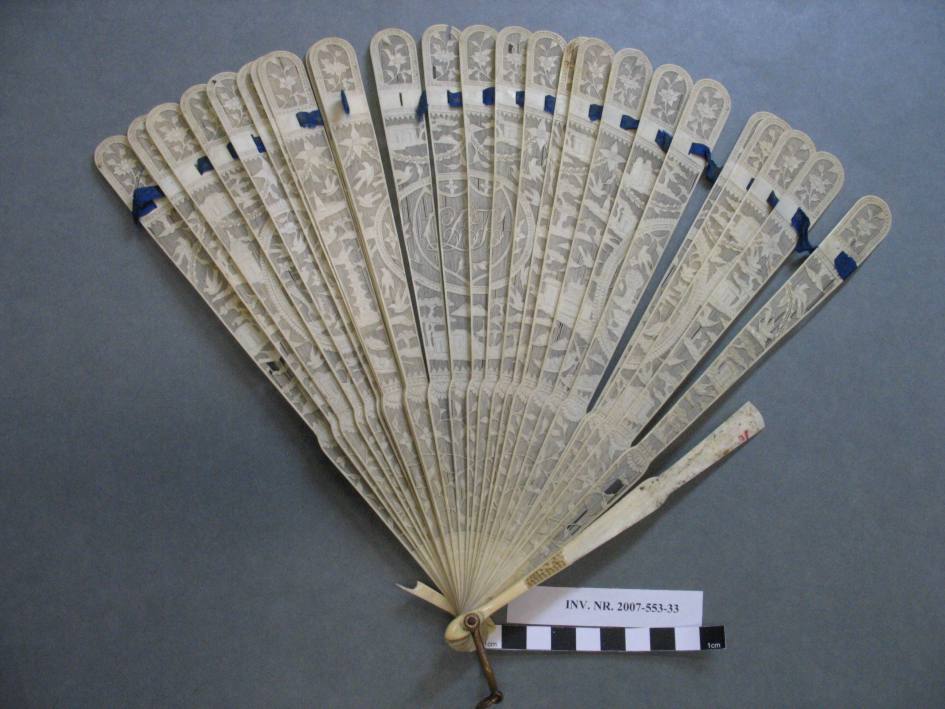
Chinese brisé fan for the European market is held by Badisches Landesmuseum Karlsruhe. Museum description: The leaf-shaped fan made of openwork carved bone is a so-called "brisé fan". Its rounded sticks are held together in the upper third by a blue silk ribbon. When opened, motifs such as birds and floral tendrils unfold in the midst of a garden. In the centre appears the ligated monogram "KL". The folding fan consists of several sticks in the shape of very long wedges that can be laid upon one another. A pin is guided through a hole in the lower end, holding the sticks together. The upper ends are held together by a ribbon. This makes it possible to fold the fan to save space. Brisé fans made of wood, ivory, tortoiseshell or horn are found especially in the early 19th century. The present fan follows European taste and was presumably produced as early export ware for Europe These details come from the holding museum's own record; how far this object represents a wider collectible type has not yet been independently verified.
Partial type record
Cleveland Museum of Art, Director's Contingent Fund
fans
Embroidered Fan for Wedding Ceremony (Cleveland Museum of Art 1918.559)
1850–1918
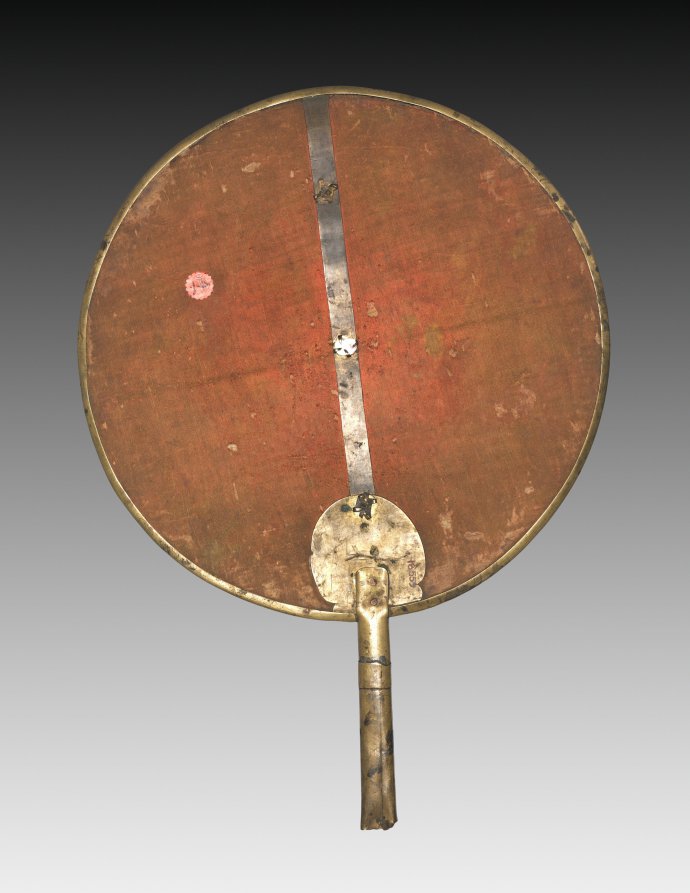
In the Joseon period, women between the ages of 14 and 20 were matched with a husband through an arranged marriage. Even during the marriage ceremony, a bride was supposed to veil her face with this type of embroidered fan as a gesture of chastity. The fan’s body is made of paper and silk trimmed with a gilded metal rim. On the front, four cranes—one pair in blue, the other in yellow—are stitched along with auspicious clouds. The back is adorned with cranes flying amid clouds and blossoms of peonies. Cleveland Museum of Art object 1918.559: Embroidered Fan for Wedding Ceremony (진주선 [眞珠扇]), 1850–1918. Korea, Joseon dynasty (1392–1910). Circular fan; copper alloy, silk, metal thread, and paper; diameter: 29.9 cm (11 3/4 in.). Details are those of this museum object; how far it represents a wider type has not been independently verified.
Partial type record
Rijksmuseum, Amsterdam
fans
Fan
c. 1795
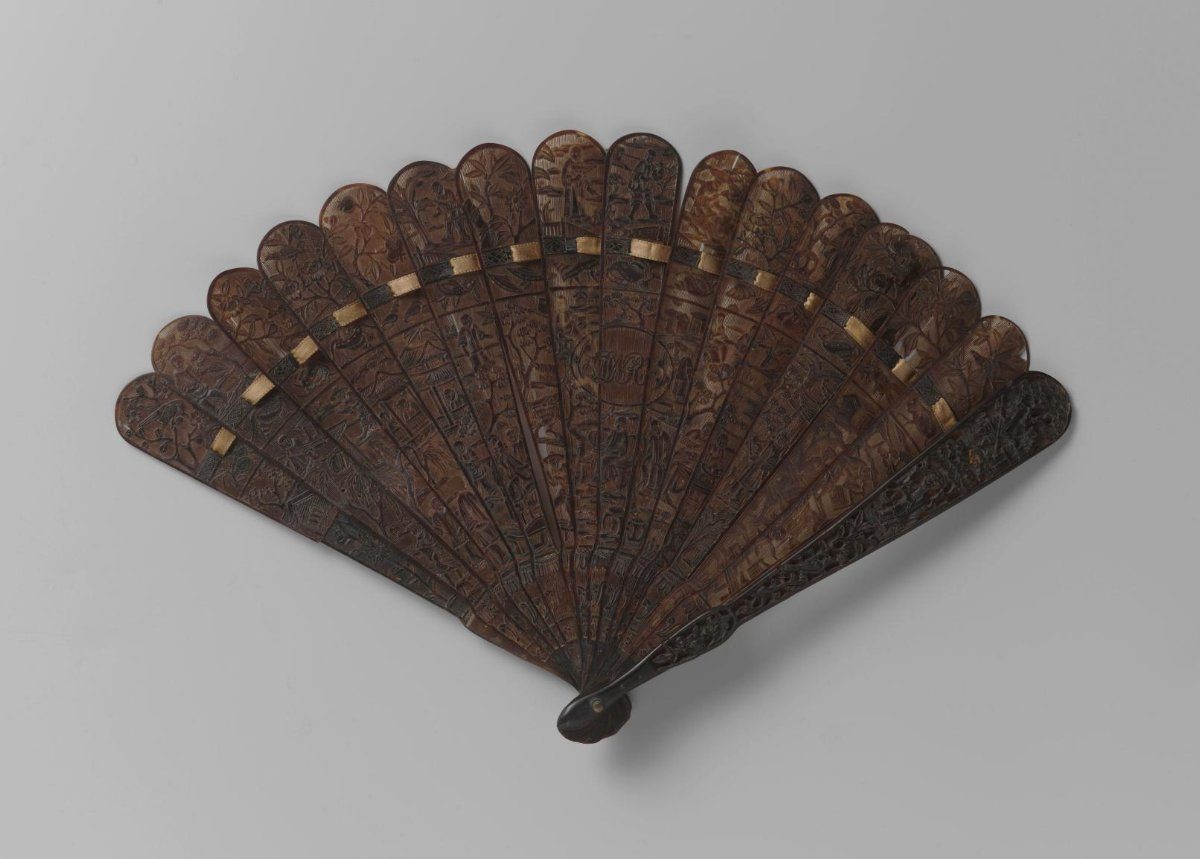
Fan — Rijksmuseum object AK-RAK-2005-4. Dated by the museum: c. 1795. Museum attribution: anonymous. Material: horn (animal material). Museum description: The fan consists of two guards and (now) 15 sticks; at least two sticks are missing and one guard has been repaired with a section of a stick. On the sticks, figures and pavilions against a background of carved pierced vertical lines. The scenes on the sticks are self-contained, but together they nevertheless form a logical whole. The fan is carved in such a way that it can be viewed from both sides. Centrally, a horizontal oval with the initials 'DWR'. In the tips above the ribbon, flowering plants, sometimes with a bird or figures near a tree. The guards are carved in high relief: tendrils with birds, merging at the top into figures under trees.
Partial type record
© Victoria and Albert Museum, London
fans
Fan — Australian Ballet Club, Australia, 1992
1992
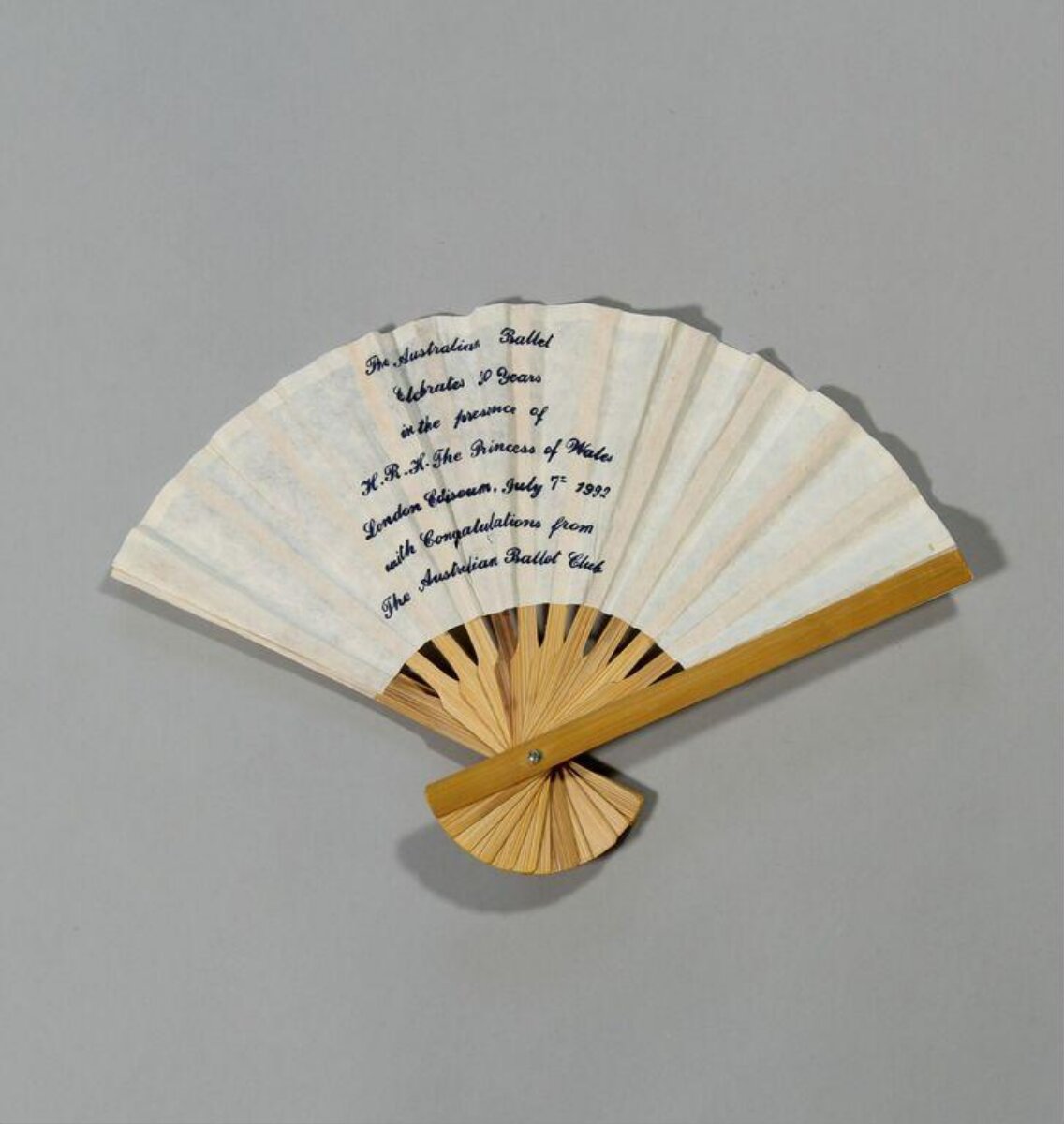
Fan in the Victoria and Albert Museum, London (museum number S.1502-21014), made in Australia, dated 1992. The museum's brief description reads: Commemorative fan issued by the Australian Ballet Club commemorating the 30th anniversary of the Australian Ballet. Issued as a souvenir at the London Coliseum Theatre for the gala performance of Coppélia in the presence of Diana, Princess of Wales, 7 July 1992. Hand-made paper on bamboo sticks…. Museum description: Fan comprising a leaf of cream hand-made paper on nine bamboo sticks and two guards, the leaf printed in blue ink: 'The Australian Ballet Celebrates 30 Years in the presence of H.R.H. The Princess of Wales London Coliseum, July 1st 1992 with Congratulations from The Australian Ballet Club'. The museum records it as Handmade paper on bamboo sticks and guards, measuring Width 36.5 cm; Height 23.0 cm; Height 22.9 cm. These details come from the museum's own record; how far this object represents a wider collectible type has not yet been independently verified.
Partial type record
© Victoria and Albert Museum, London
fans
Fan — Autographed wooden fan, belonging to John Gielgud, Great Britain, pre 1881
pre 1881
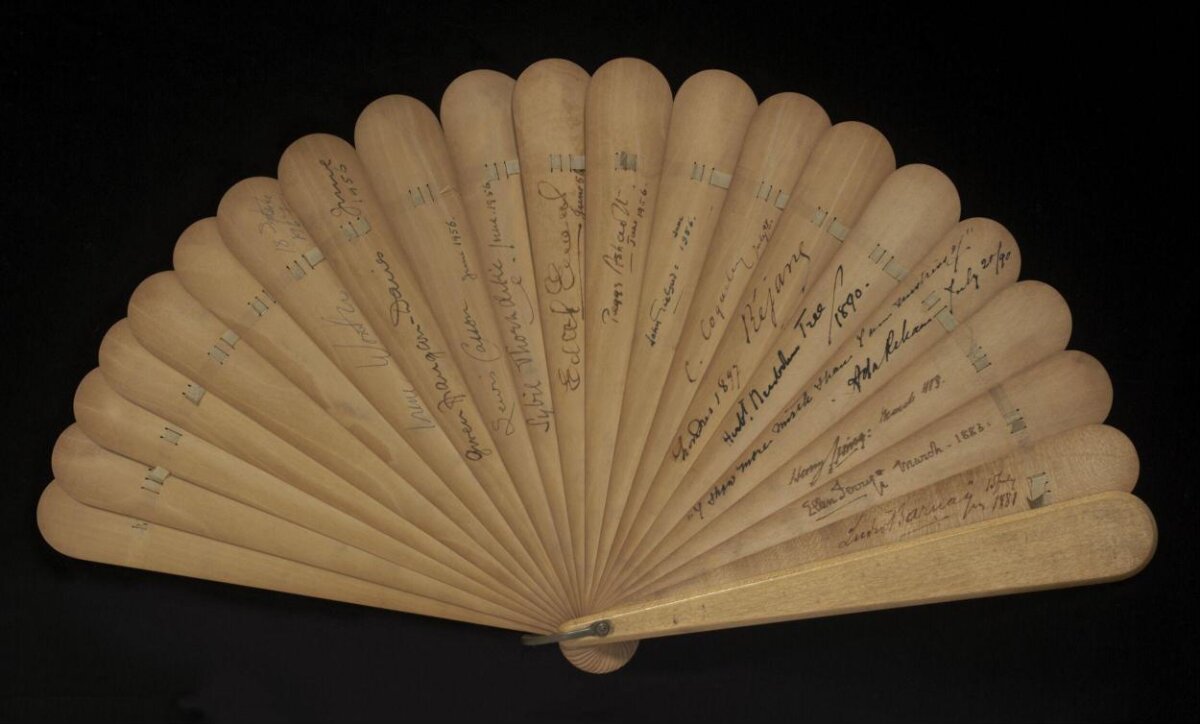
Fan in the Victoria and Albert Museum, London (museum number S.1224-1984), made in Great Britain, dated pre 1881. The museum's brief description reads: Wooden fan, the sticks autographed by actors and actresses, late 19th-mid 20th century, including Ellen Terry, Henry Irving, Herbert Beerbohm Tree, John Gielgud, Peggy Ashcroft, Edith Evans, Sybil Thorndike, Gwen Ffrangcon-Davies and Irene Worth, belonging to John Gielgud. Probably originally…. Museum description: Wooden fan, of overlapping sticks held together by ribbon, with individual sticks autographed and dated in ink by actors and actresses, from right, Ellen Terry, March 1882; Henry Irving, March 1883; Herbert Beerbohm Tree, 1890; Réjane, November [?] 1897; C. Coquelin, July 1898; John Gielgud, June 1956; Peggy Ashcroft, June 1956; Edith Evans, June 1956; Sybil Thorndike, June 1956; Lewis Casson, June1956; Gwen Ffrangcon-Davies, June 1956; and Irene Worth, 18 September 1967. The museum records it as Wood, metal and ribbon, autographed in ink, measuring Height 28.5 cm; Width 4 cm; Depth 3.5 cm. These details come from the museum's own record; how far this object represents a wider collectible type has not yet been independently verified.
Partial type record
© Victoria and Albert Museum, London
fans
Fan — Autographed wooden fan, belonging to John Gielgud, Great Britain, pre 1887
pre 1887
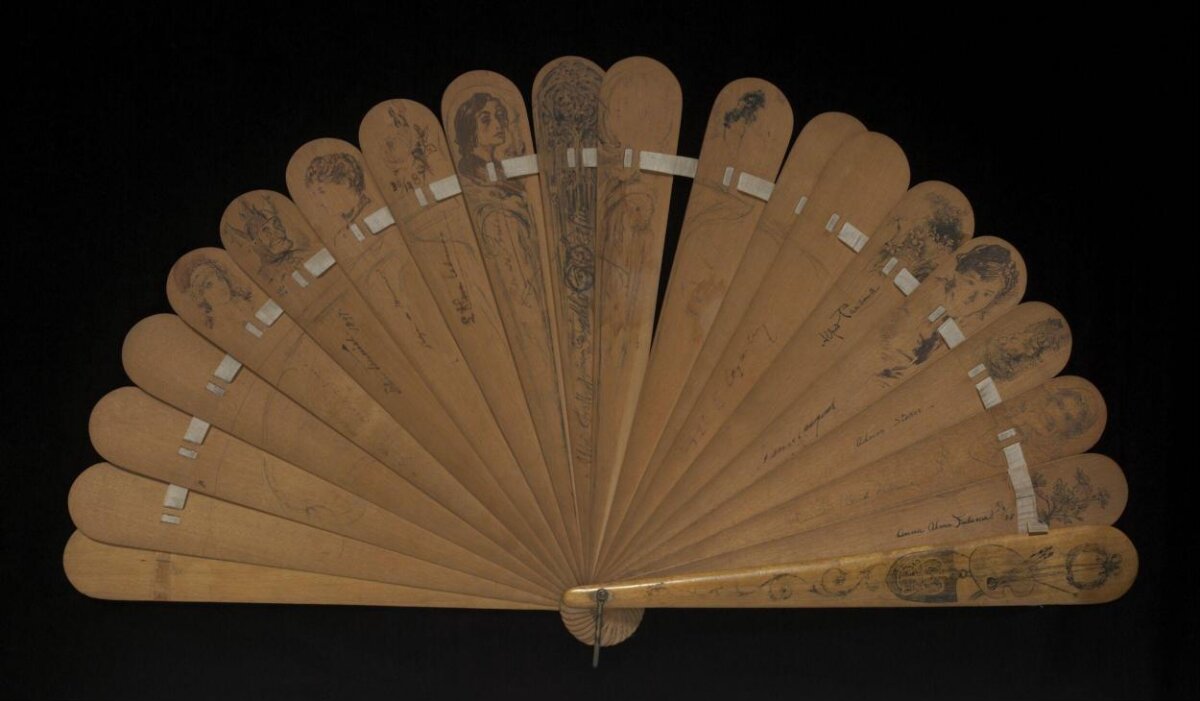
Fan in the Victoria and Albert Museum, London (museum number S.1223-1984), made in Great Britain, dated pre 1887, attributed to Alma-Tadema, Anna. The museum's brief description reads: Wooden fan with designs on the guards, probably by Laurence or Anna Alma Tadema (1867-1943), the sticks autographed by various actors and personalities, late 19th-early 20th century, signed for Mabel Terry-Lewis, belonging to John Gielgud.. Museum description: Wooden fan, of overlapping sticks held together by ribbon, one of the guards decorated with Classical designs of a wreath, comedy and tragedy masks and musical instruments, the other with a wreath, an artist's palette and a shield. The individual sticks are autographed and dated, on both sides of the fan, by various actors, actresses and personalities, including Henry Irving, Fred Terry, John Hare, Alma Tadema and John Gielgud, some with dedications to 'Mabel'. On one side the majority of the sticks are decorated in ink with portraits, flowers, and trees. The museum records it as Wood, metal and ribbon, autographed in ink, measuring Height 28 cm; Width 4.5 cm; Width 52.5 cm; Depth 3 cm. These details come from the museum's own record; how far this object represents a wider collectible type has not yet been independently verified.
Partial type record
© Victoria and Albert Museum, London
fans
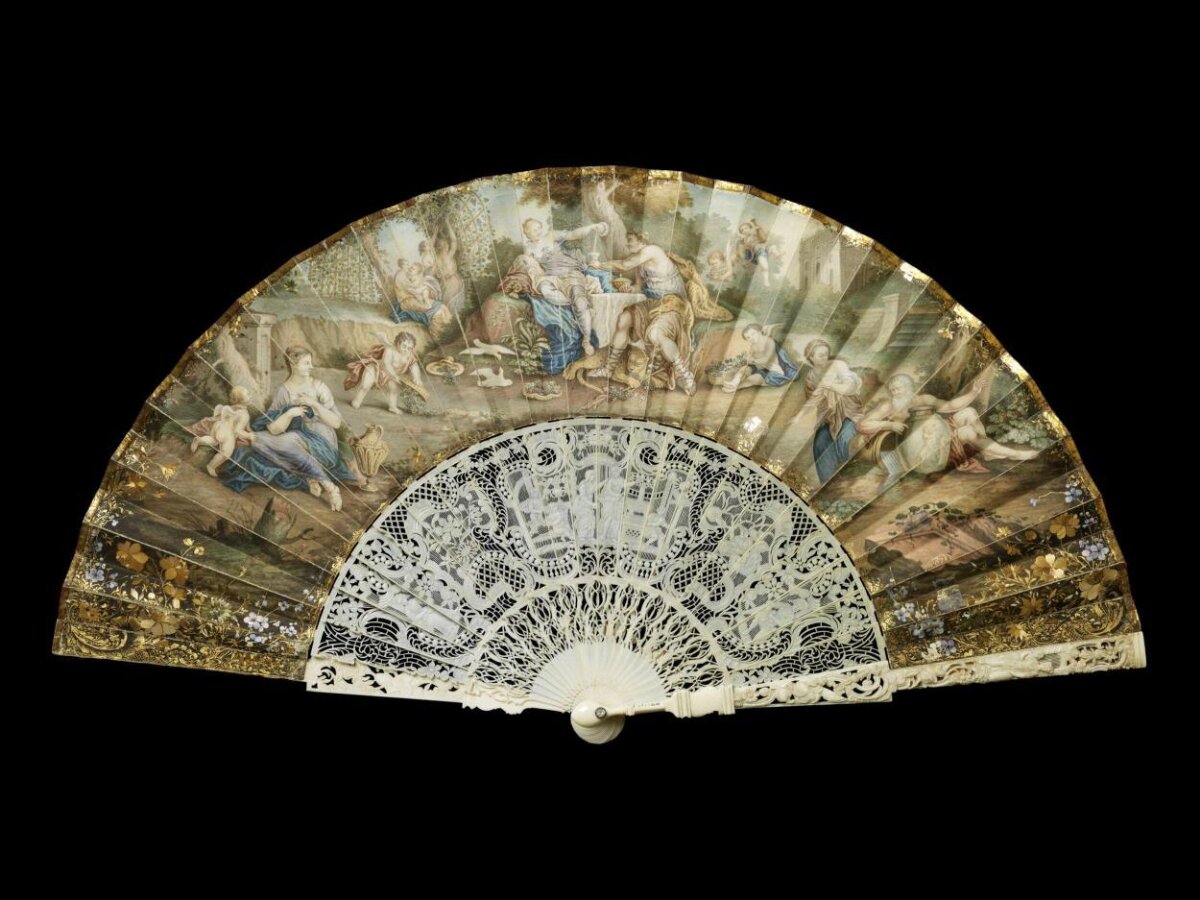
Fan — Bacchus and Ariadne, England, France, c. 1740
c. 1740
Fan in the Victoria and Albert Museum, London (museum number 531-1869), made in England, France, dated c. 1740. The museum's brief description reads: Gouache on vellum with applied cut straw and mother of pearl, and ivory sticks, England, mid-18th century. Museum description: Gouache on vellum with the subject of Bacchus and Ariadne. The top edge of the mount has a gold painted border. Amongst painted flowers at either side of the leaf, additional decoration by cut dyed (green) and natural straw, and mother of pearl in shape of petals forming flowers. The back of the mount display chinoiserie scene of painted sprigs of cherry blossoms, colourful flowers and a black and red bird perching on one of the branches. The ivory sticks are richly carved and pierced showing classical motifs, and musical instruments on the guards. The museum records it as Gouache on vellum, with applied cut rye straw and mother-of-pearl (probably Haliotis varia), and carved ivory sticks (Loxodonta sp.) Caroline Cartwright, Senior Scientist, Department of Scientific…, measuring Length 274 mm; Width 516 mm. These details come from the museum's own record; how far this object represents a wider collectible type has not yet been independently verified.
Partial type record
© Victoria and Albert Museum, London
fans
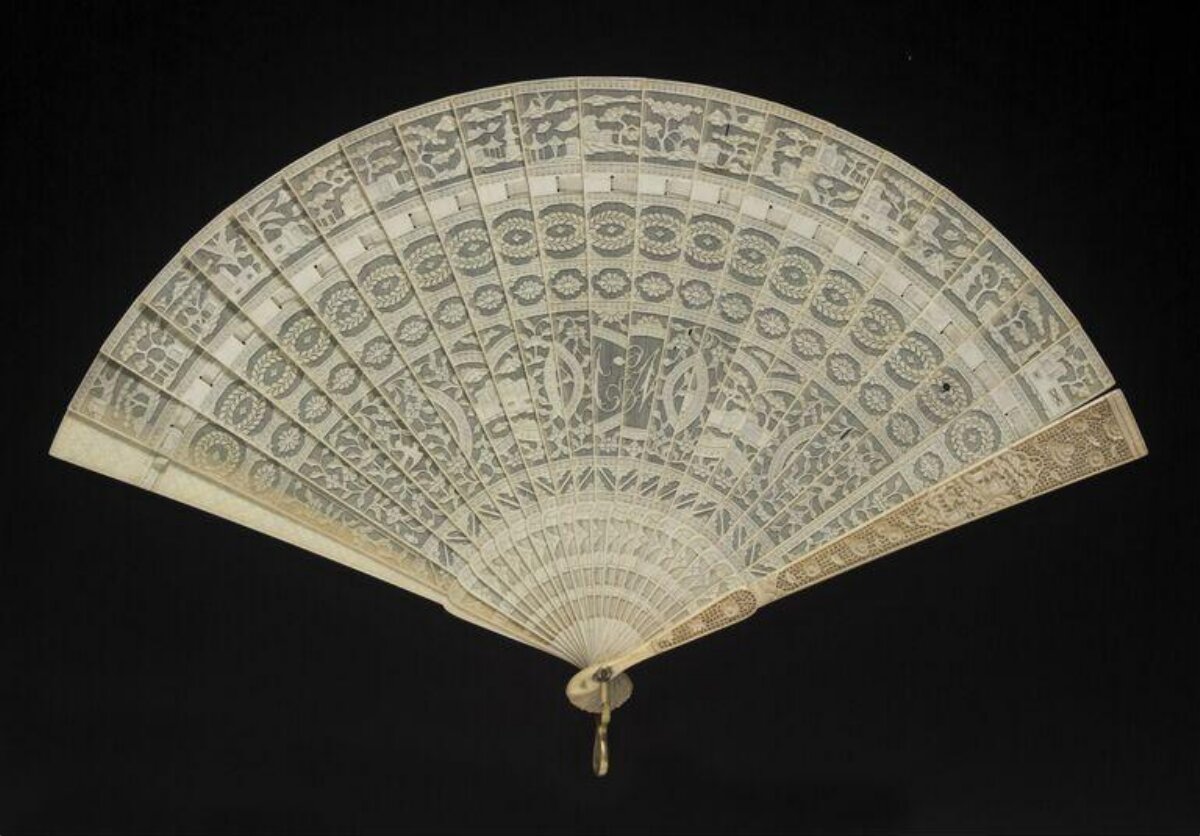
Fan — Fan belonging to actress Ethel Griffies, China, 1920s
1920s
Fan in the Victoria and Albert Museum, London (museum number S.1278-1984), made in China, dated 1920s, attributed to unknown. The museum's brief description reads: Chinese ivory brisé fan, owned by the actress Ethel Griffies (1878-1975), probably 1920s. Museum description: Ivory brisé fan, the sticks held together by ribbon, with pierced and carved decoration in Chinese style. The museum records it as Carved and pierced ivory, ribbon and metal, measuring Height 18.5 cm; Width 3.5 cm; Width 32 cm; Depth 2 cm. These details come from the museum's own record; how far this object represents a wider collectible type has not yet been independently verified.
Partial type record
© Victoria and Albert Museum, London
fans
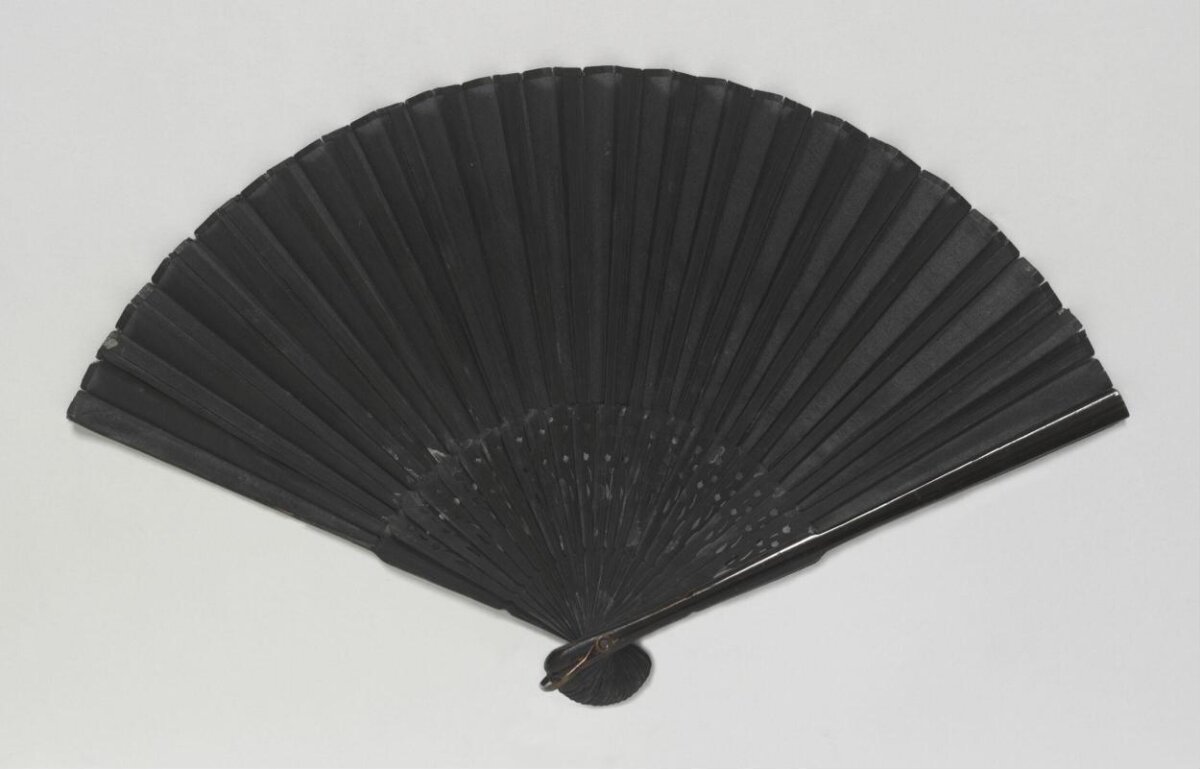
Fan — Fan belonging to actress Ethel Griffies, Great Britain, 1920s
1920s
Fan in the Victoria and Albert Museum, London (museum number S.1280-1984), made in Great Britain, dated 1920s. The museum's brief description reads: Black gauze fan, owned by the actress Ethel Griffies (1878-1975), probably 1920s. Museum description: Fan of black gauze with plain black wooden guards, the sticks of black wood with cut decoration. The museum records it as Gauze, metal and wood, measuring Height 18 cm; Width 2.2 cm; Width 30 cm; Depth 1 cm. These details come from the museum's own record; how far this object represents a wider collectible type has not yet been independently verified.
Partial type record
© Victoria and Albert Museum, London
fans
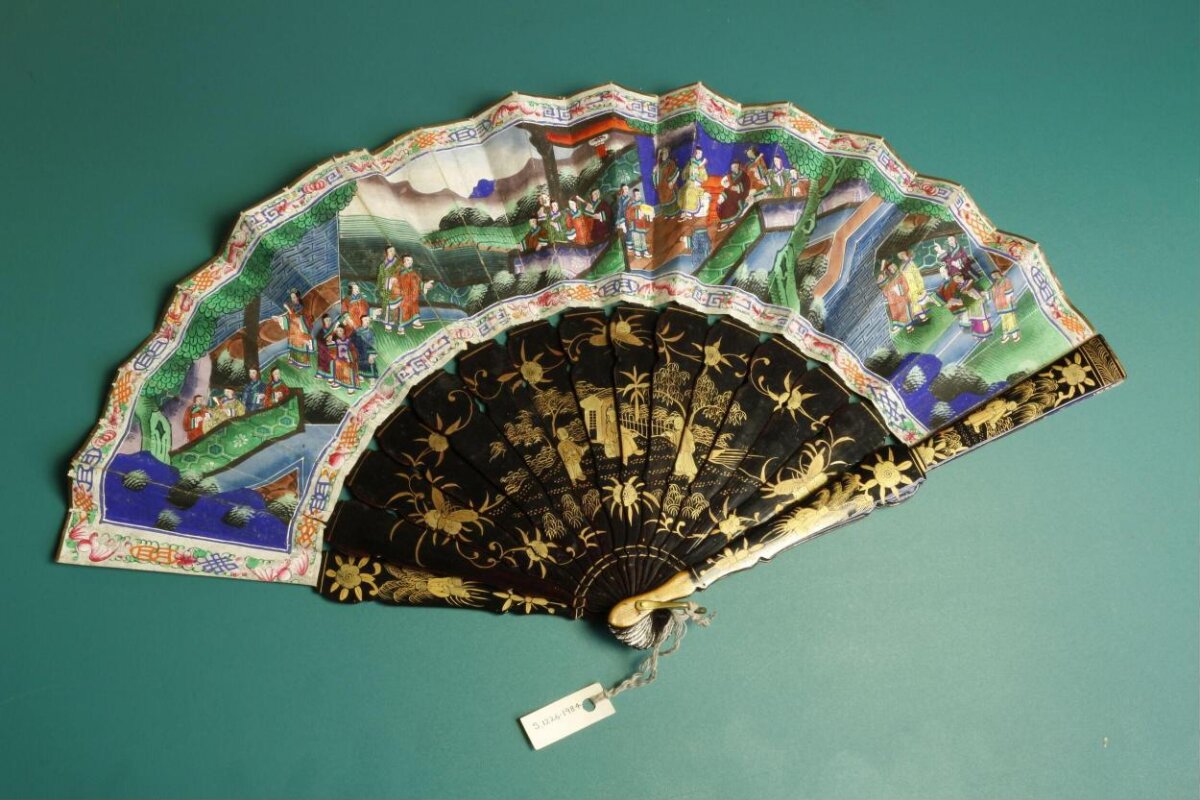
Fan — Fan belonging to Julia Neilson, China, ca.1900
ca.1900
Fan in the Victoria and Albert Museum, London (museum number S.1226&A-1984), made in China, dated ca.1900, attributed to unknown. The museum's brief description reads: Fan used by Julia Neilson (1868-1957) as Nell Gwyn in the play Sweet Nell of Old Drury, Haymarket Theatre, 1900, and as Lady Blakeney in the stage version of The Scarlet Pimpernel, New Theatre, 1905, with original box. Museum description: Fan with painted lacquer sticks and guards and a painted paper leaf, the sticks and guards decorated with gold paint. When open the decoration on the sticks forms a Chinese scene of figures and trees, framed with flowers and butterflies. The sticks are decorated with figures standing beneath willow trees. The paper leaf shows Chinese scenes, with a different image on each side. With metal hanging loop. Wooden fan box with hinged lid, the bespoke interior lined with red satin. The exterior painted black and decorated in gold paint, with three Chinese figures on the lid and foliage on three sides. On the left hand side is an attached paper label with Chinese characters. The museum records it as Painted lacquer and painted paper, with painted wooden box, measuring Height 28 cm; Width 49.5 cm; Height 29.3 cm; Height 28 cm; Width 2.7 cm; Height 5.1 cm; Width 31.8 cm; Depth 6 cm. These details come from the museum's own record; how far this object represents a wider collectible type has not yet been independently verified.
Partial type record
© Victoria and Albert Museum, London
fans
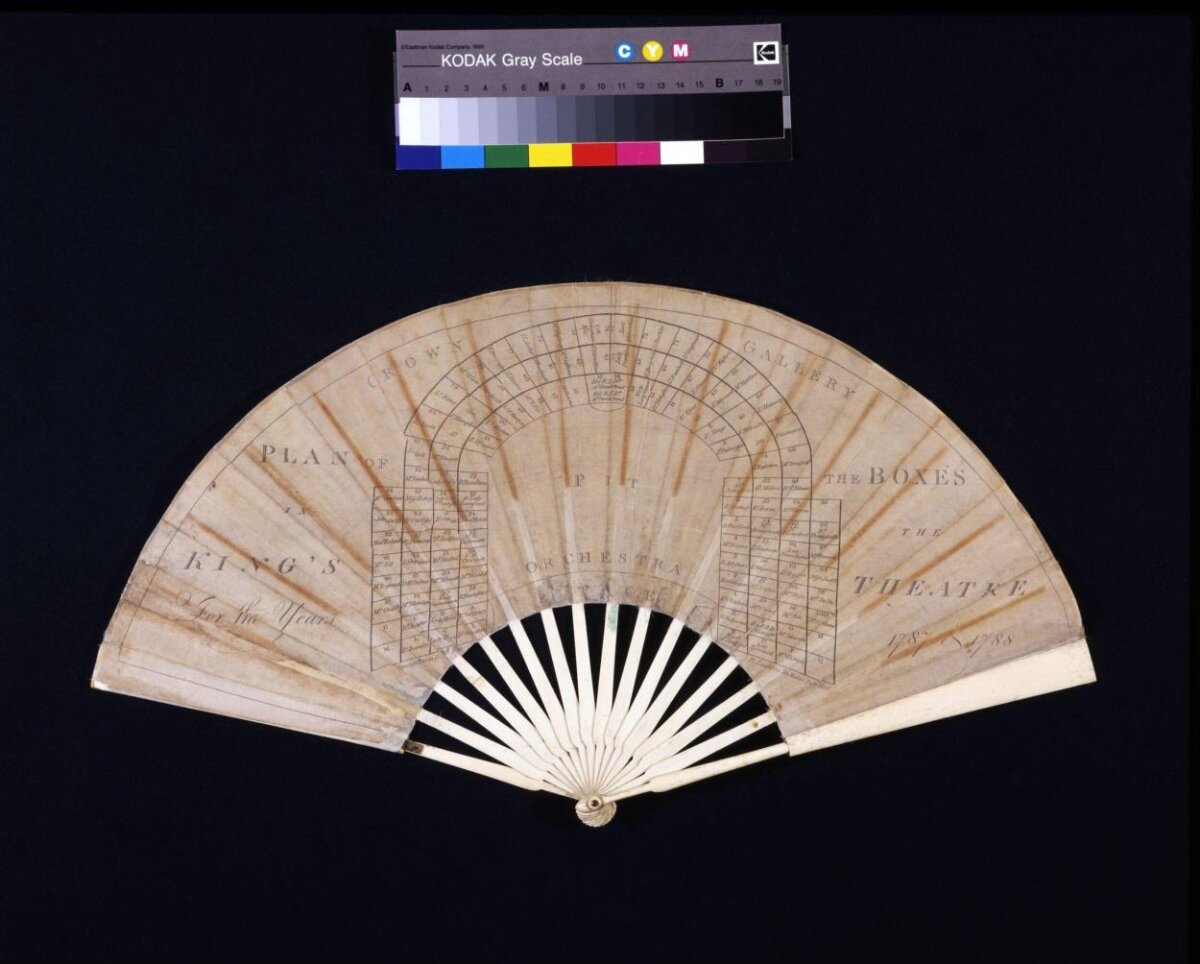
Fan — Fan printed with a plan of the boxes and names of the subscribers for the 1787 and 1788 seasons at the King's Theatre, London, 1787
1787
Fan in the Victoria and Albert Museum, London (museum number S.396-1985), made in London, dated 1787, attributed to Laurance, H. The museum's brief description reads: Fan printed with a plan of the boxes and names of the subscribers for the 1787 and 1788 seasons at the King's Theatre. Paper leaf with ivory sticks, published in London 1st June 1778 by H. Laurance, Pall Mall. Museum description: Paper and ivory folding fan, printed on one side with a seating plan of the King's Theatre, London, and a plan of the subscribers' boxes on the other. The museum records it as Printed paper with ivory sticks and guards, measuring Height 32 cm; Width 53 cm; Depth 4 cm. These details come from the museum's own record; how far this object represents a wider collectible type has not yet been independently verified.
Partial type record
© Victoria and Albert Museum, London
fans
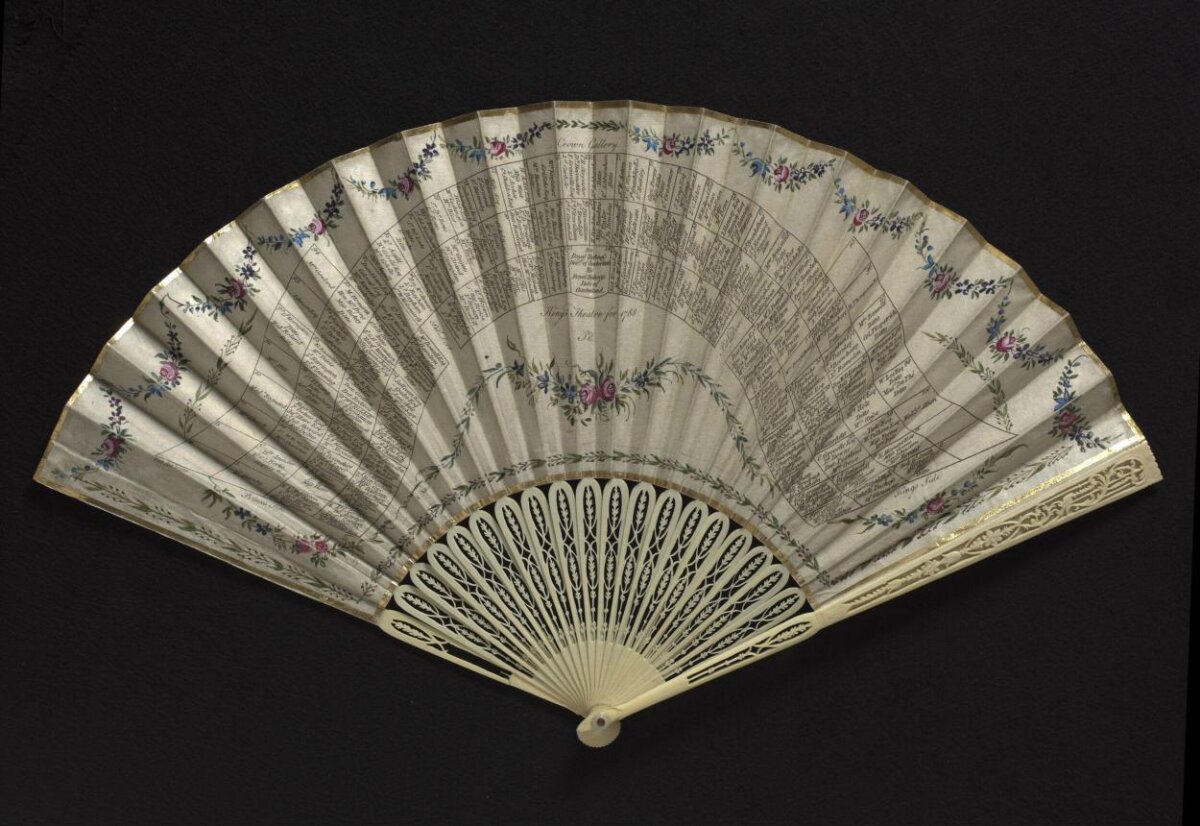
Fan — Fan printed with the names of the subscribers to the boxes for the 1788 season at the Kings Theatre, London; with original box, London, 1788
1788
Fan in the Victoria and Albert Museum, London (museum number S.1623:1 to 3-2014), made in London, dated 1788. The museum's brief description reads: Fan printed with the names of the subscribers to the boxes for the 1788 season at the Kings Theatre, London. Paper leaf with ivory sticks in its original box, made in London, 1787. Museum description: Fan in original box, the fan printed with names of the subscribers to the boxes at the King's Theatre, London, 1788 The museum records it as Paper printed with ink, painted with watercolour, and decorated with gold foil, ivory guards and sticks, measuring Depth 2.8 cm; Length 25.8 cm; Width 4 cm; Height 24.1 cm; Width 2.5 cm; Depth 1.9 cm; Height 25 cm; Width 43 cm. These details come from the museum's own record; how far this object represents a wider collectible type has not yet been independently verified.
Partial type record
© Victoria and Albert Museum, London
fans
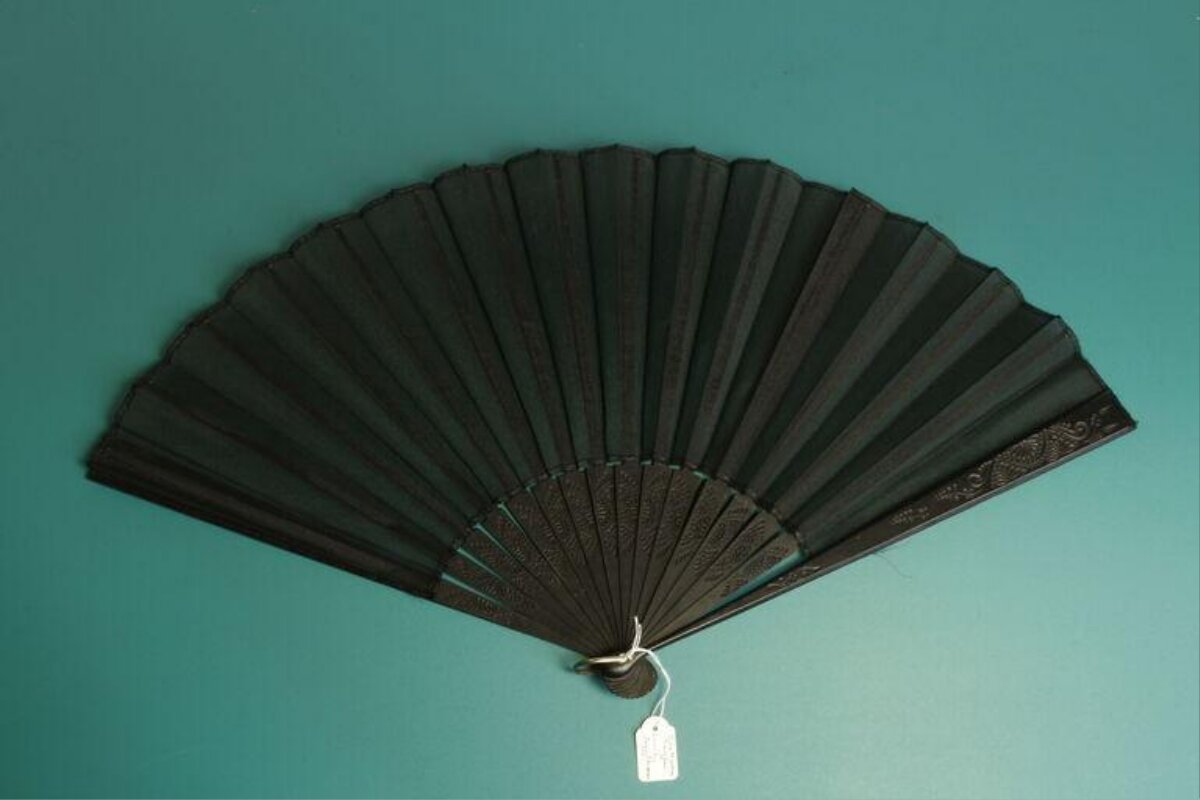
Fan — Fan used by Julia Neilson, early 20th century
early 20th century
Fan in the Victoria and Albert Museum, London (museum number S.924-1985), dated early 20th century, attributed to unknown. The museum's brief description reads: Fan with carved and painted wooden sticks and organdie leaf, belonging to Julia Neilson (1868-1957) and used by her as Lady Blakeney in The Scarlet Pimpernel, New Theatre, 1905, or as Sarah, Countess of Marlborough in The Marlboroughs, on tour, 1924, and Wimbledon Theatre, 1925.. Museum description: Fan with carved wooden sticks, painted black, and black organdie leaf. With metal hanging loop. The museum records it as Carved and painted wood and organdie, measuring Height 36 cm; Width 66 cm; Height 35.5 cm; Width 3 cm. These details come from the museum's own record; how far this object represents a wider collectible type has not yet been independently verified.
Partial type record
© Victoria and Albert Museum, London
fans
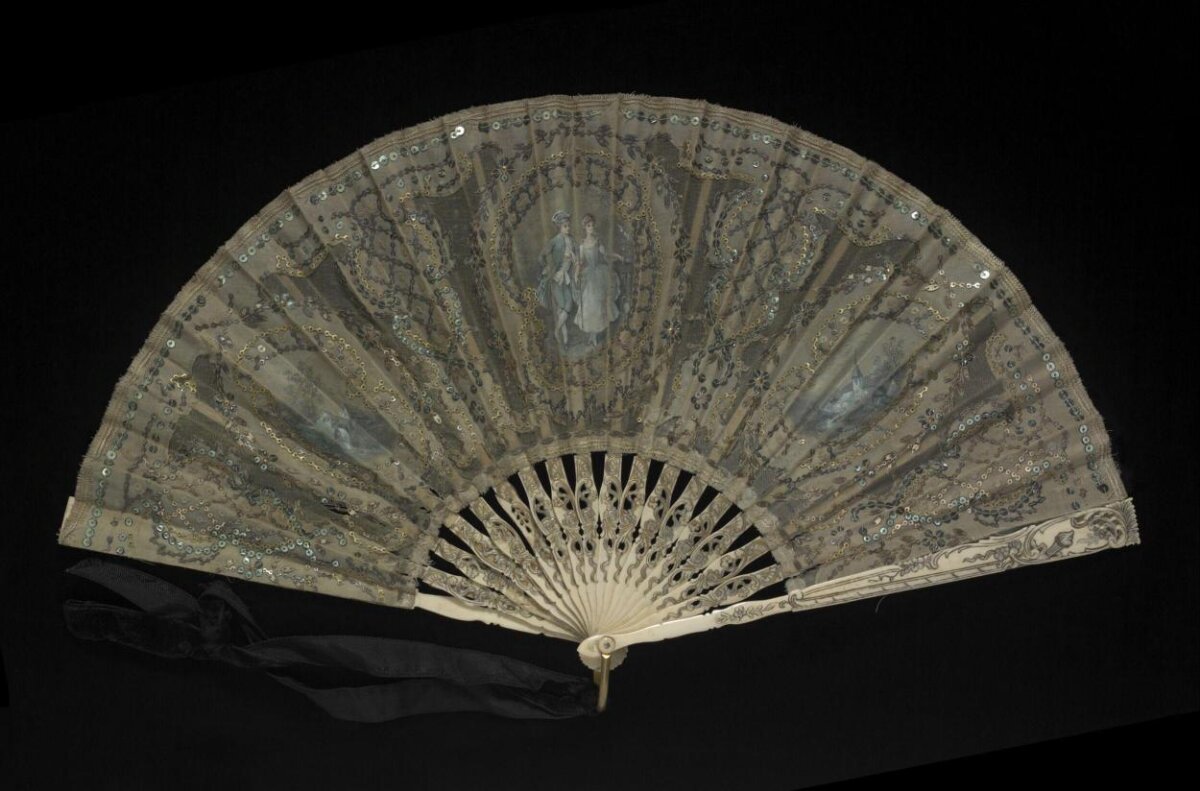
Fan — Fan used by Marie Lohr in 'The School for Scandal', Great Britain, 1909
1909
Fan in the Victoria and Albert Museum, London (museum number S.72-1988), made in Great Britain, dated 1909, attributed to unknown. The museum's brief description reads: Fan used by Marie Lohr as Lady Teazle in The School for Scandal, His Majesty's Theatre, 7 April 1909. Museum description: Fan, the organdie leaf painted on one side with a central image of a young couple in 18th century costume, with, to either side, images showing pastoral scenes, the whole leaf decorated with cut steel sequins, the sticks of carved and painted ivory, with a black velvet ribbon attached. The museum records it as Painted organdie, sequins, metal, and ivory, with velvet ribbon, measuring Height 21.5 cm; Width 4.5 cm; Width 40 cm; Depth 1.8 cm. These details come from the museum's own record; how far this object represents a wider collectible type has not yet been independently verified.
Partial type record
© Victoria and Albert Museum, London
fans
Fan — Fan used by Marie Taglioni, Russia, 1840s
1840s
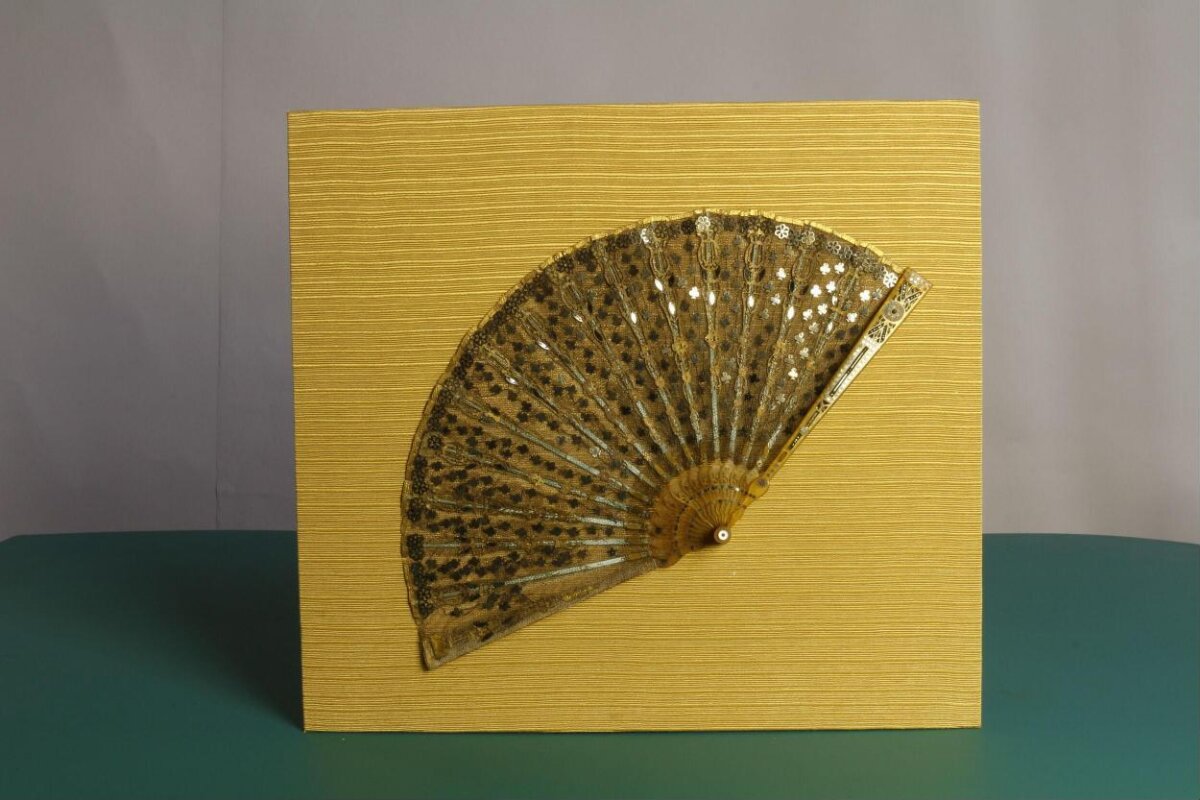
Fan in the Victoria and Albert Museum, London (museum number S.285-1978), made in Russia, dated 1840s, attributed to unknown. The museum's brief description reads: Fan used by Marie Taglioni on tour in the Imperial Russian Theatres, 1840s. Museum description: Fan, lace decorated with sequins in the form of stars, trefoils, ellipses and, along the upper edge, flowers, and with gold fabric cut in the shape of lyres, the sticks and guards of carved blonde tortoise shell set with white metal dots and stars. Mounted on a wooden board covered with ribbed fabric in old gold. The museum records it as Lace, sequins, metal, tortoise shell, wood, ribbed fabric, measuring Height 16.5 cm; Width 32 cm; Depth 3.5 cm; Height 32 cm; Width 35.2 cm; Depth 4.2 cm. These details come from the museum's own record; how far this object represents a wider collectible type has not yet been independently verified.
Partial type record
© Victoria and Albert Museum, London
fans
Fan — Fan, belonging to actress Olga Lindo, Japan, early 20th century
early 20th century
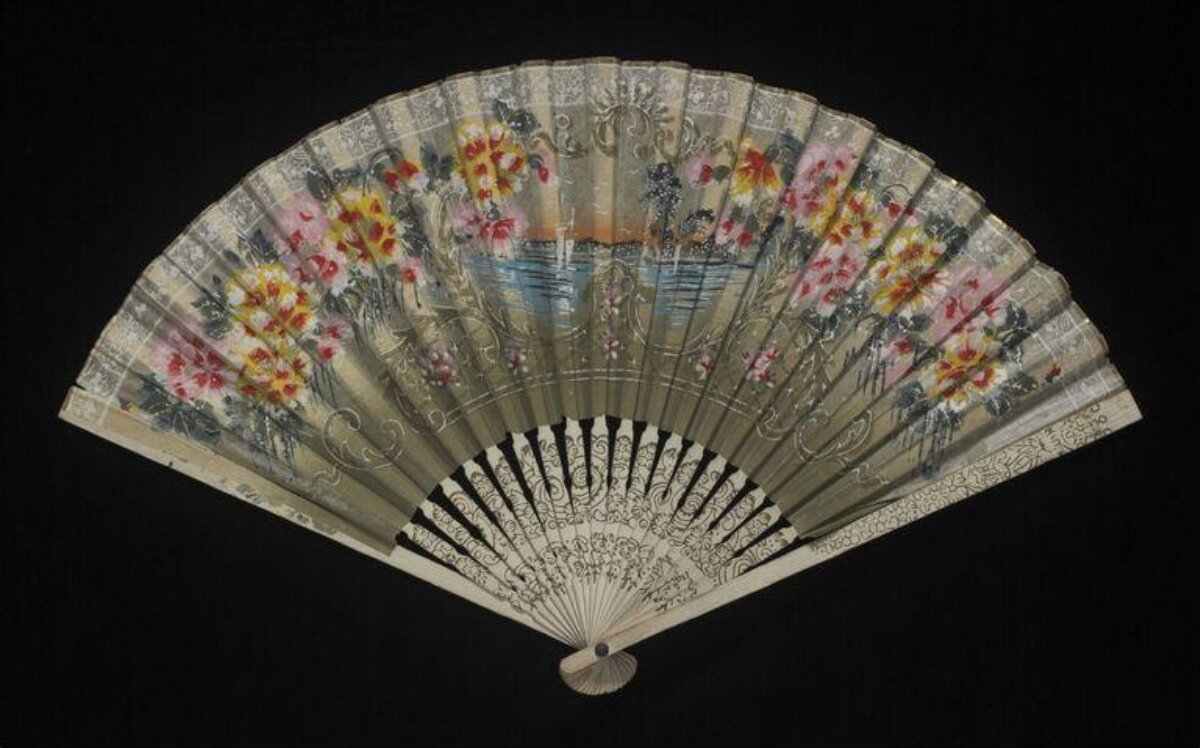
Fan in the Victoria and Albert Museum, London (museum number S.173-2015), made in Japan, dated early 20th century, attributed to unknown. The museum's brief description reads: Paper fan with wooden sticks, belonging to the actress Olga Lindo (1899-1968), early 20th century. Museum description: Paper fan, the leave painted on one side with flowers and, at centre, an impressionistic scene of water and trees, with details in gold paint. The wooden sticks and guards are decorated with a pattern of flowers in gold. The museum records it as Painted paper and wood, measuring Height 21.5 cm; Width 3 cm; Width 36 cm; Depth 1 cm. These details come from the museum's own record; how far this object represents a wider collectible type has not yet been independently verified.
Partial type record
© Victoria and Albert Museum, London
fans
Fan — Fan, given to Marie Lohr by Herbert Beerbohm Tree, France, 1750s-1760s
1750s-1760s
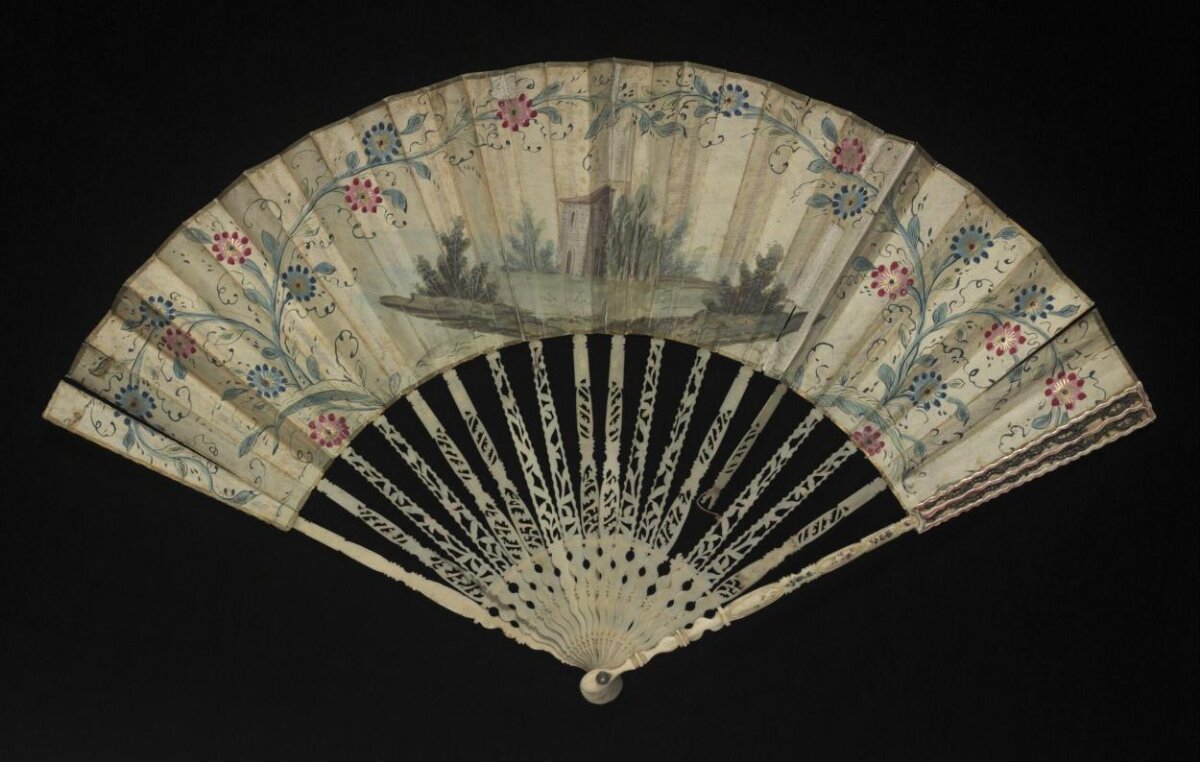
Fan in the Victoria and Albert Museum, London (museum number S.1238-1982), made in France, dated 1750s-1760s. The museum's brief description reads: Ivory and paper fan, given to Marie Lohr (1890-1975) by Herbert Beerbohm Tree, probably French, possibly 1750s-60s. Museum description: Ivory fan with narrow widely spaced sticks, carved and painted, the leave painted on both sides with Rococo pastoral scenes, with beading inset in guardsticks. The museum records it as Painted paper and carved and painted ivory with inset beading, measuring Height 26 cm; Width 3 cm; Width 39 cm; Depth 1.8 cm. These details come from the museum's own record; how far this object represents a wider collectible type has not yet been independently verified.
Partial type record
© Victoria and Albert Museum, London
fans
Fan — Giant fan possibly used in a production of <i>The Mikado</i>, Japan, ca.1885
ca.1885
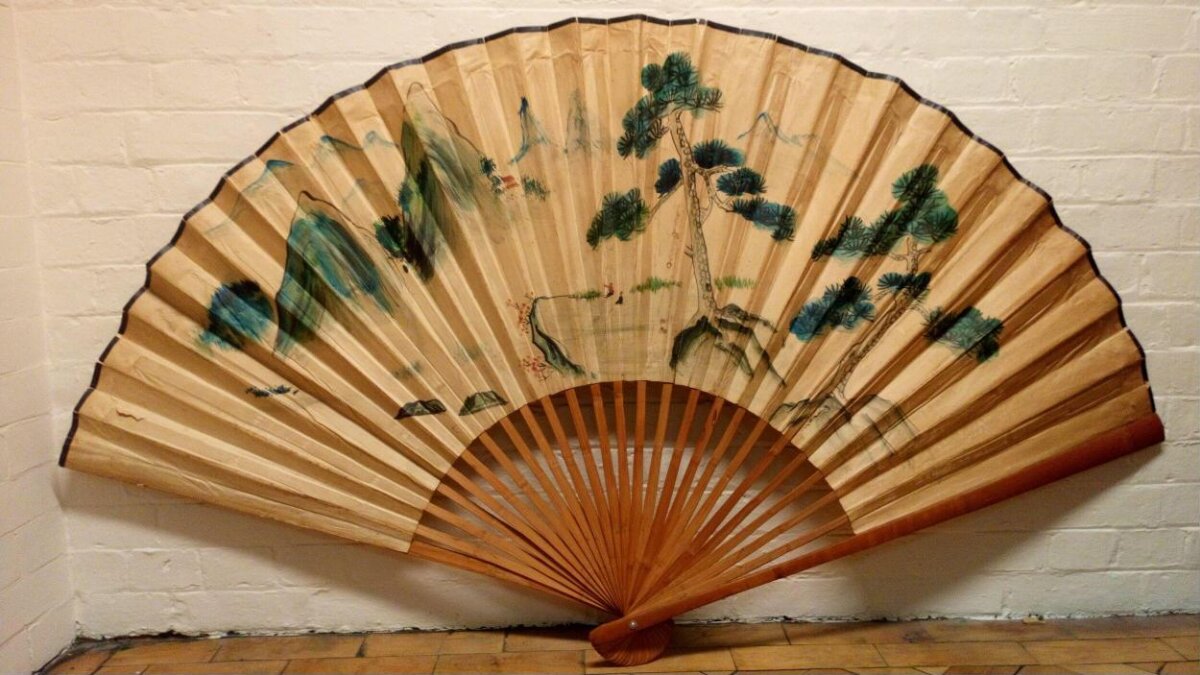
Fan in the Victoria and Albert Museum, London (museum number S.704-2019), made in Japan, dated ca.1885, attributed to unknown. The museum's brief description reads: Hand-painted giant fan possibly used as a stage property in an early production of Gilbert & Sullivan's comic opera The Mikado. Watercolour on paper with bamboo sticks and guards, probably Japanese, ca.1885. Museum description: Giant fan, hand-painted with a Japanese landscape featuring mountains, trees, people and buildings in black, green, blue and red watercolour on a paper leaf. Edged with a narrow strip of black paper, mounted on bamboo sticks, with polished bamboo guards The museum records it as painted paper, measuring Height 99.5 cm; Width 190.0 cm; Length 99.0 cm; Height 54.9 cm. These details come from the museum's own record; how far this object represents a wider collectible type has not yet been independently verified.
Partial type record
© Victoria and Albert Museum, London
fans
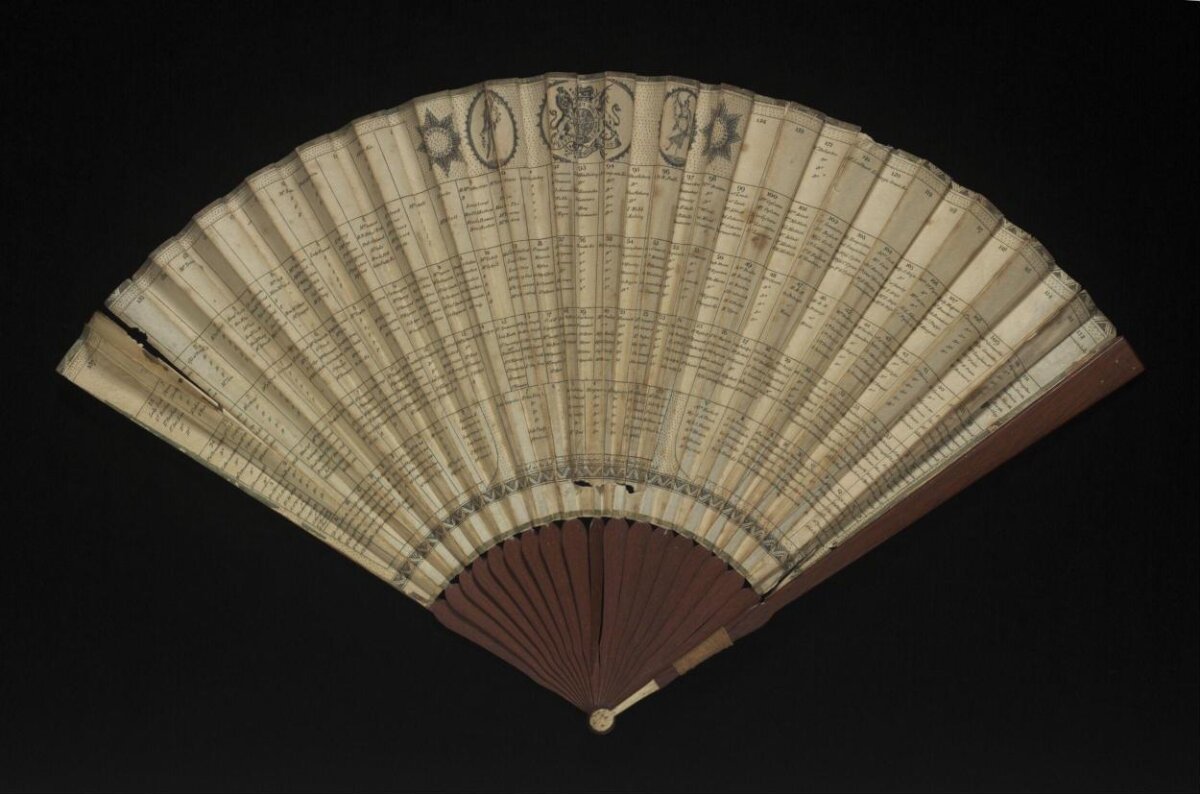
Fan — King's Theatre, Haymarket, Fan, London, ca. 1796
ca. 1796
Fan in the Victoria and Albert Museum, London (museum number S.395-1978), made in London, dated ca. 1796, attributed to unknown. The museum's brief description reads: Paper fan, with box numbers and renters' names for the 1796 season at The King's Theatre, Haymarket. Museum description: Laid pulp paper fan, with rosewood sticks and guards, the leaves decorated on one side. At the centre, top, an engraved image of the the Royal Coat of Arms within a border, and, to each side an image of a dancer within an oval border and a 'sun', above a plan showing the box numbers and renters' names for the 1796 season at The King's Theatre, Haymarket. Engraved initials 'H.W.' at the base of the fan leaf. An old break to one of the guards is bound with cotton thread. The museum records it as Printed paper with rosewood sticks and guards, measuring Height 25 cm; Width 4 cm; Depth 2 cm. These details come from the museum's own record; how far this object represents a wider collectible type has not yet been independently verified.
Partial type record
© Victoria and Albert Museum, London
fans
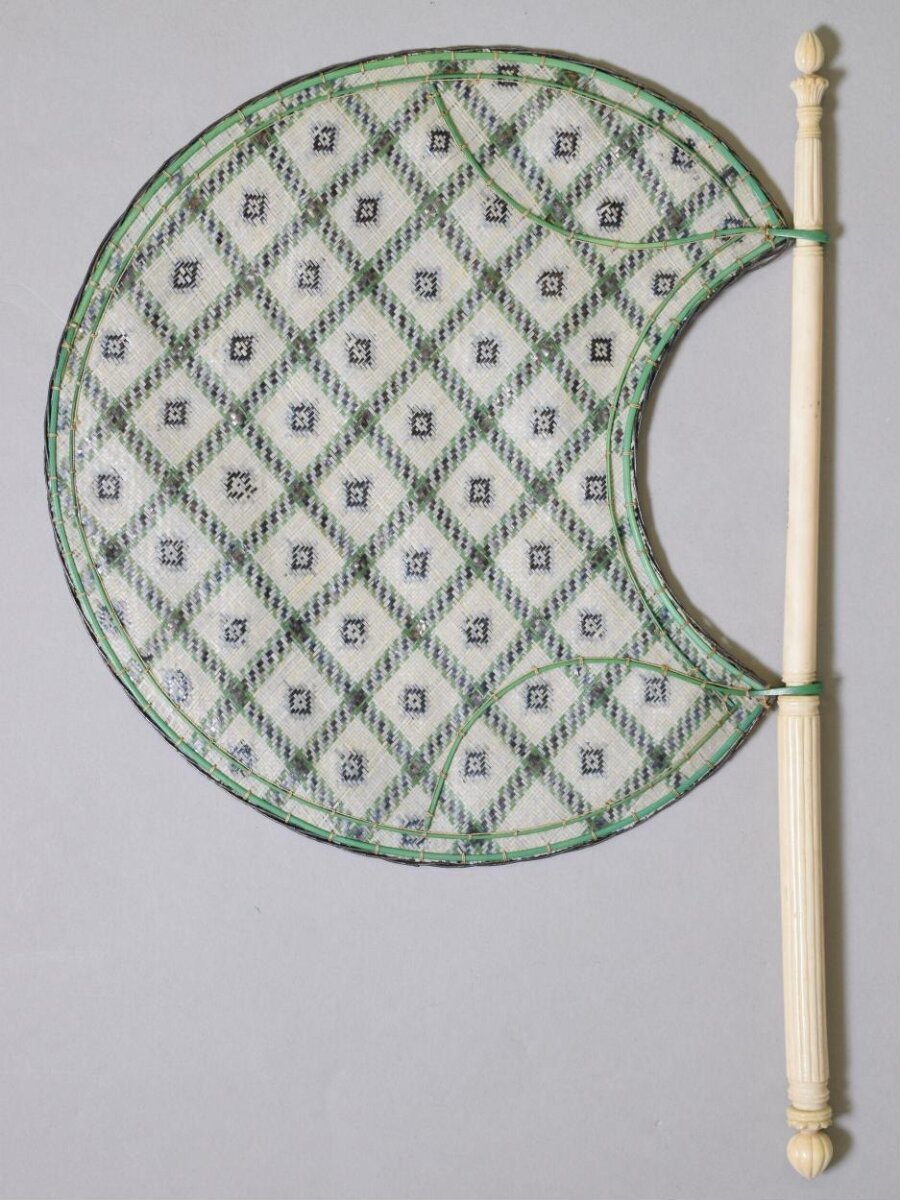
Fan — Panka (fan), Sylhet, mid-19th century
mid-19th century
Fan in the Victoria and Albert Museum, London (museum number 09252(IS)), made in Sylhet, dated mid-19th century. The museum's brief description reads: Costume, ivory silver, woven, Sylhet, C19; Textile. Museum description: The face of the hand fan is made from split ivory and silver thread woven together in diaper pattern. The pattern consists of broad diagonal lines forming lozenges. Each lozenge in turn is decorated with a rosette. Handle of the fan is made of turned ivory. The museum records it as Ivory and metal, measuring Height 37.5 cm; Width 25.4 cm. These details come from the museum's own record; how far this object represents a wider collectible type has not yet been independently verified.
Partial type record
© Victoria and Albert Museum, London
fans
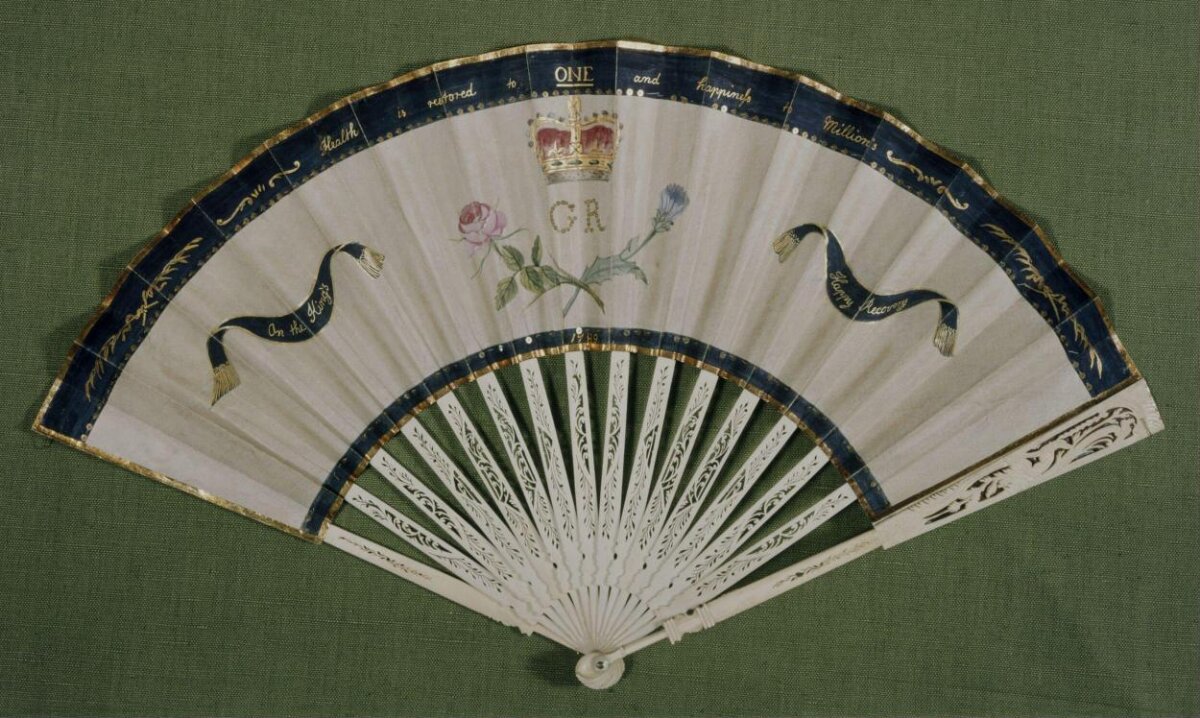
Fan — Recovery of George III from Illness, Great Britain, 1789
1789
Fan in the Victoria and Albert Museum, London (museum number T.203-1959), made in Great Britain, dated 1789. The museum's brief description reads: Fan 'Recovery of George III from Illness' made of paper painted with gouache, and carved and pierced ivory sticks and guards, Great Britain, 1789. Museum description: Fan made of paper painted with gouache, and carved and pierced ivory sticks and guards. Painted with a crown below which are a rose and thistle. Along the top edge, which is blue, is written 'Health is restored to ONE and happiness to Millions'. On two blue scrolls is also inscribed 'On the King's' and 'Happy Recovery'. Under the arm is the cypher 'G.R.' worked in sequins. Brass rivet, and mother-of-pearl washers. The museum records it as Gouache painted on paper, pleated, carved and pierced ivory, brass, mother-of-pearl, measuring Length 10.5 in. These details come from the museum's own record; how far this object represents a wider collectible type has not yet been independently verified.
Partial type record
© Victoria and Albert Museum, London
fans
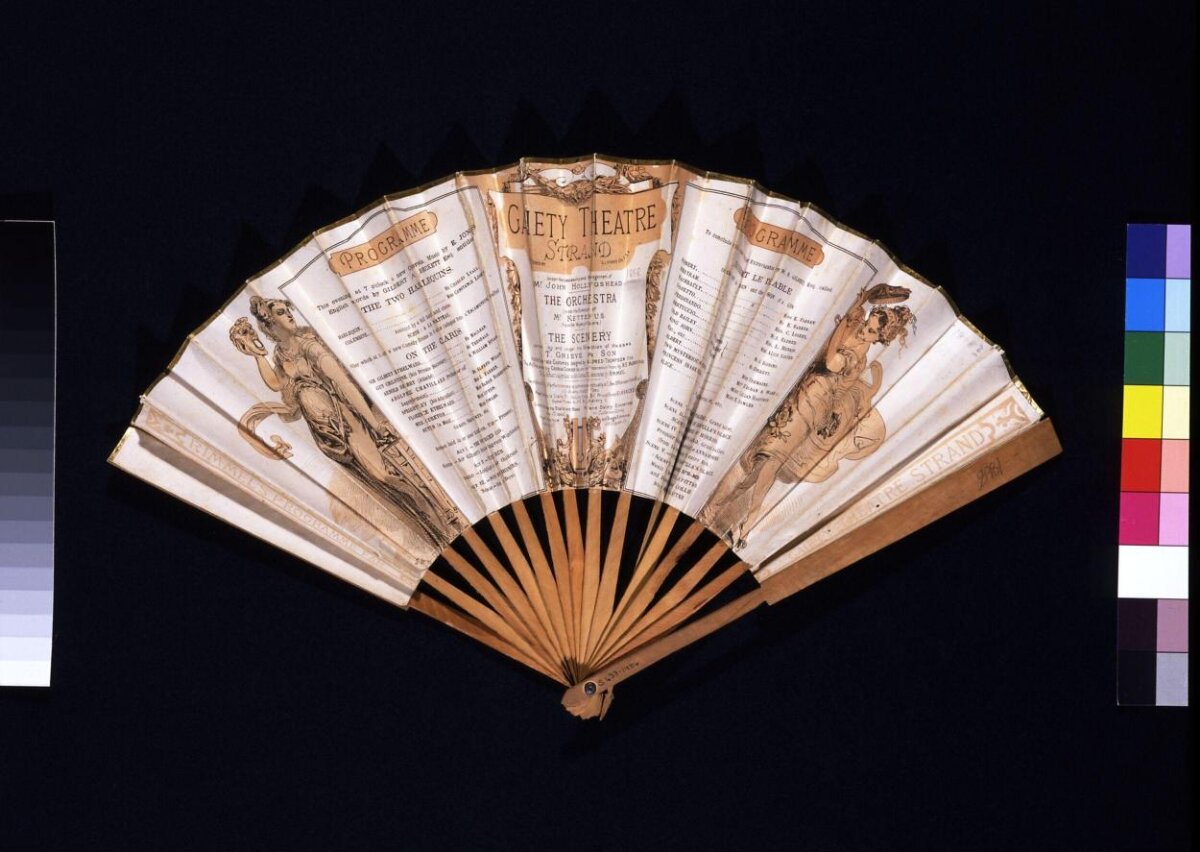
Fan — Rimmel's programme fan, London, 1868
1868
Fan in the Victoria and Albert Museum, London (museum number S.433-1984), made in London, dated 1868. The museum's brief description reads: 'Rimmel's programme fan', produced as a souvenir programme for the opening of the rebuilt Gaiety Theatre, 21 December 1868, with the programme for W.S. Gilbert's Robert Le Diable, the operetta The Two Harlequins and the comedy On the Cards.. Museum description: Souvenir fan printed with the programme for the Gaiety Theatre, 21 December 1868. Recto printed with the cast lists and credits for W.S. Gilbert's Robert Le Diable, the operetta The Two Harlequins and the comedy On the Cards, with line drawings of female figures to each side, the figures and headings in apricot. Verso printed with an advertisement for Rimmel's Perfumery, with line drawings of female figures to each side, the figures and headings in pale green. Printed, left, on both sides, the words 'Rimmel's Programme Fan' and, printed right, on both sides, 'Gaiety Theatre Strand'. The museum records it as Printed paper and wood, measuring Height 23.5 cm; Width 3.5 cm; Width 43 cm; Depth 1.7 cm. These details come from the museum's own record; how far this object represents a wider collectible type has not yet been independently verified.
Partial type record