Section
Numismatics — coins, tokens and medals
Struck and cast currency of all periods, from Greek and Roman issues to modern machine-struck national coinage, classified by issuing authority, mint and denomination.
How to research an object in this section
Step 1
Observe
Record every visible mark, inscription, measurement and material before forming an opinion.
Step 2
Classify
Choose the sub-field below and narrow by issuer or maker, era and type.
Step 3
Compare
Match against photographed records and the evidence checks further down this page.
Step 4
Cite
Keep the source behind each fact; mark anything unconfirmed as research required.
Sub-fields
Historical, commemorative, prize and award medals documented in institutional collections. Medals are not currency.
1,138 records
Reckoning counters (rekenpenningen) and jetons issued by accounting chambers, cities and rulers, documented in institutional collections.
725 records
Lead tax seals, dog-tax tokens, alms, bread and peat tokens documented in institutional collections. These are not currency.
160 records
Love tokens, trade and advertising tokens, admission passes and checks. Separate from reckoning jetons, lead tokens and tax seals.
12 records
Photographed records
Entries in this section with a real-object photograph held on this site. The record lists its credit, source and stated rights status.
Rijksmuseum, Amsterdam
medals
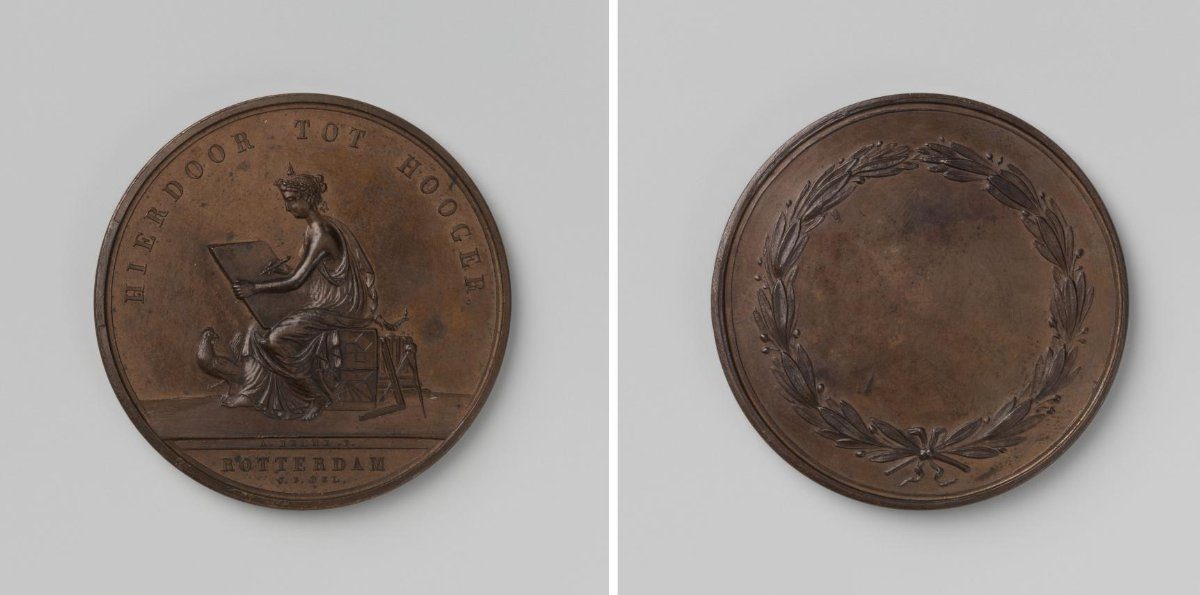
'Hierdoor tot Hooger' Drawing Academy in Rotterdam, medal of the first size
1820
'Hierdoor tot Hooger' Drawing Academy in Rotterdam, medal of the first size, 1820. Bronze medal. Obverse: seated woman with flame on her head, representing the Art of Drawing, drawing on canvas that she holds on her knees; before her a rooster, behind her pair of compasses and set square, leaning against a truncated column on which stands a burning lamp, within an inscription; exergue: inscription. Reverse: blank field within a wreath of olive branches. The Rijksmuseum, Amsterdam, holds this object as NG-VG-6-15; its record gives material recorded as bronze (metal); technique striking (metalworking); measurements diameter 5.2 cm x weight 58.7 g.
Partial type record
Rijksmuseum, Amsterdam
modern coins
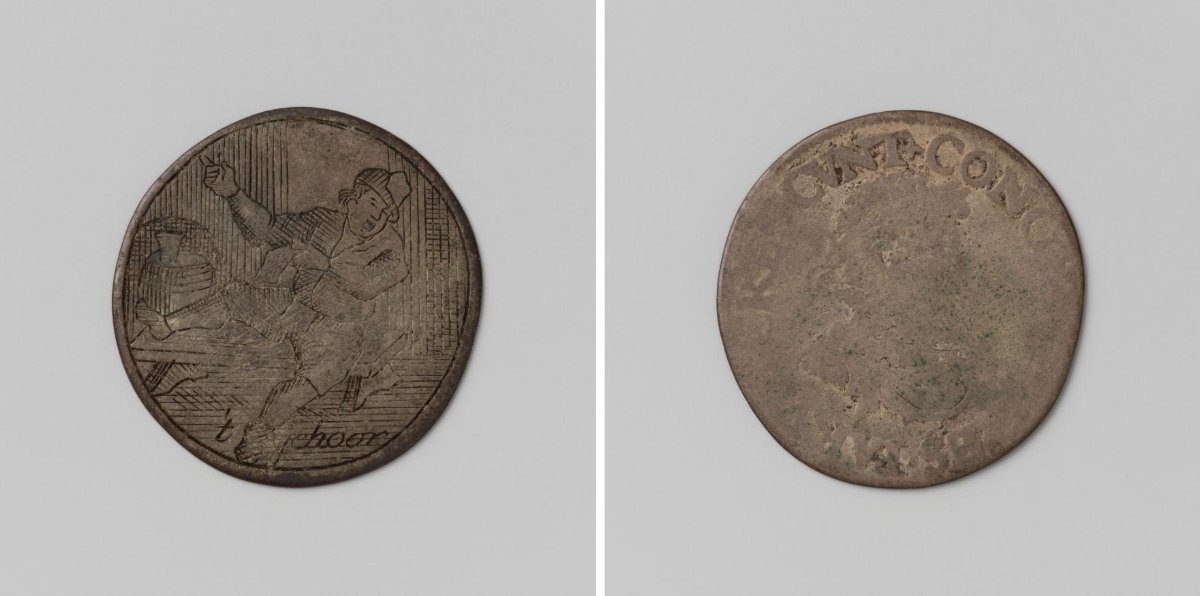
't Gehoor, scene engraved on a Leicester stoter
1586 - 1597
Silver medal. Obverse: with mouth wide open, a man sits on a bench, points into the air with the finger of his raised right hand, and holds a piece of paper in his left hand; at the same time he raises his left leg; on his head he wears a cap; in the background: a barrel above an inscription. Reverse: original design: bust of a man facing left with laurel wreath within circumscription. Possibly a stoter. The Rijksmuseum, Amsterdam, holds this object as NG-VG-16-129; its record gives material recorded as silver (metal); technique striking (metalworking), engraving; measurements diameter 2.5 cm x weight 2.39 g.
Partial type record
Rijksmuseum, Amsterdam
modern coins
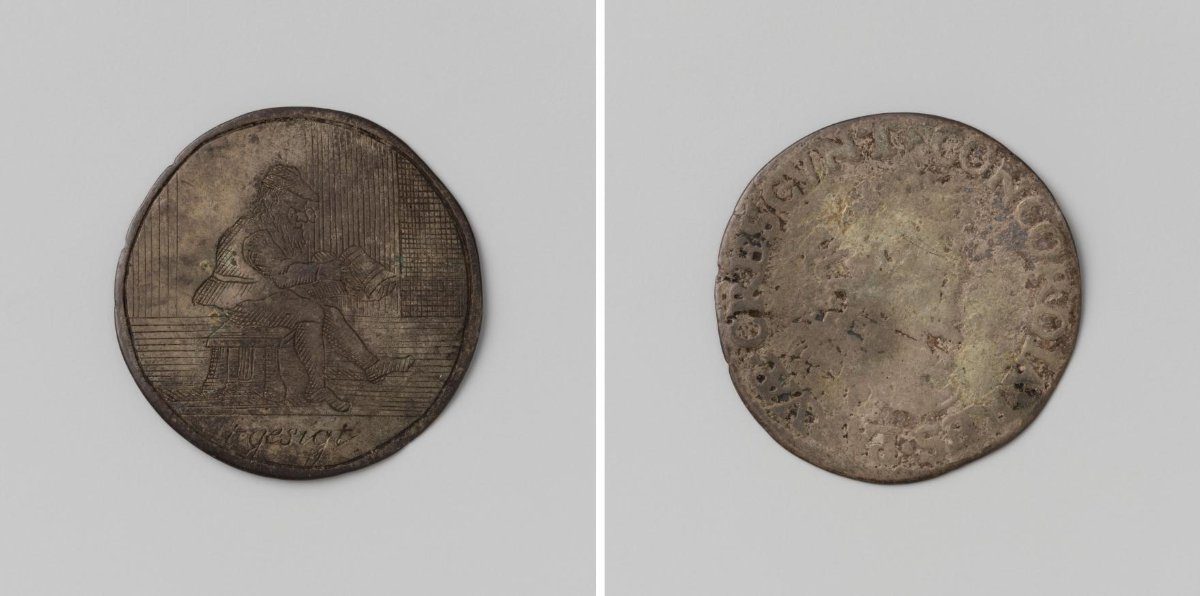
't Gesigt, scene engraved on a Leicester stoter
1586 - 1597
Silver medal. Obverse: man facing right with spectacles and cap sits reading; exergue: inscription. Reverse: original design: bust of a man facing left with laurel wreath within circumscription. Possibly a stoter. The Rijksmuseum, Amsterdam, holds this object as NG-VG-16-127; its record gives material recorded as silver (metal); technique striking (metalworking), engraving; measurements diameter 2.5 cm x weight 1.8 g.
Partial type record
Rijksmuseum, Amsterdam
modern coins
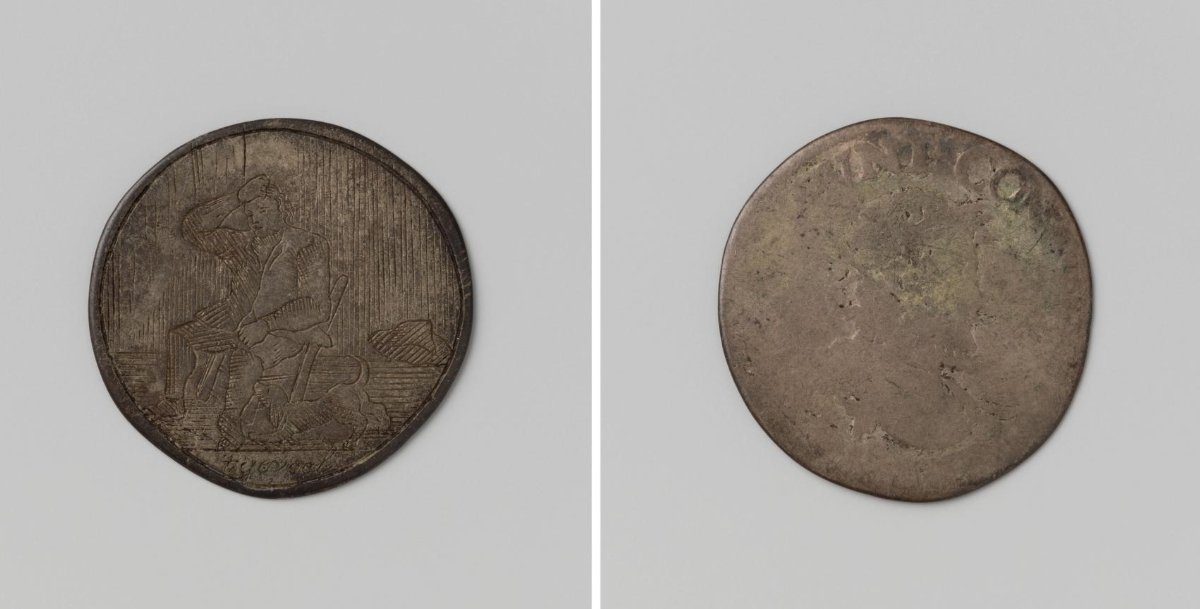
't Gevoel, scene engraved on a Leicester stoter
1586 - 1597
Silver medal. Obverse: seated man facing left clutches his head with his right hand; at his feet a dog, in the background on the right: a hat; exergue: inscription. Reverse: original design: bust of a man facing left with laurel wreath within circumscription. Possibly a stoter. The Rijksmuseum, Amsterdam, holds this object as NG-VG-16-126; its record gives material recorded as silver (metal); technique striking (metalworking), engraving; measurements diameter 2.5 cm x weight 2.43 g.
Partial type record
The Metropolitan Museum of Art — Gift of The Mark and Lottie Salton Trust, 2021
jetons
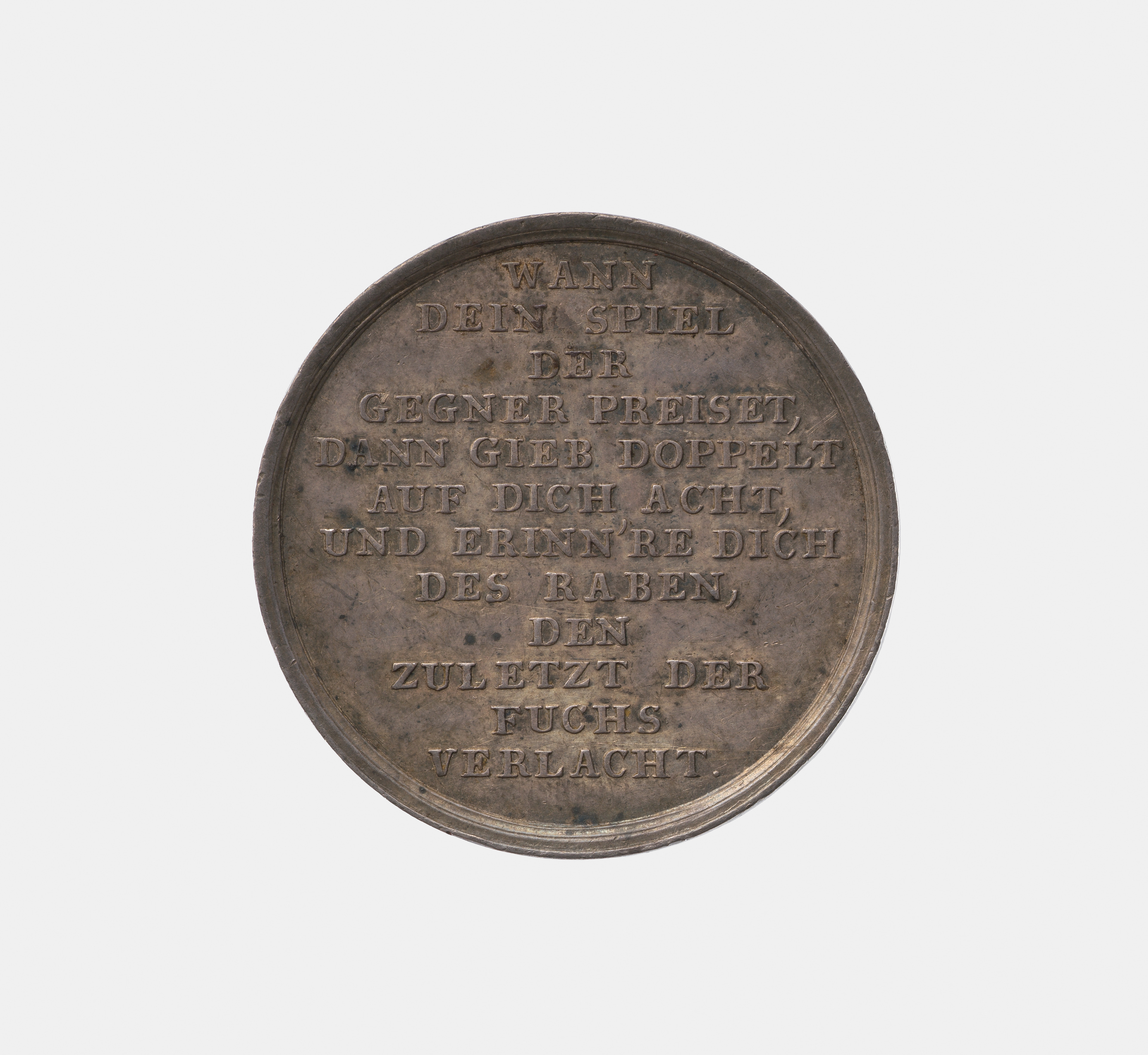
"Fox and Raven" after Aesop fable, Johann Jakob Lauer, 18th century
18th century
"Fox and Raven" after Aesop fable made by Possibly Johann Jakob Lauer (German, 1788–1823), dated 18th century, from probably German. The museum records its materials as: Silver. Recorded dimensions: Diameter (Confirmed): 1 1/8 in. × 1/16 in. (28.3 × 1.5 mm).
Partial type record
The Metropolitan Museum of Art, New York
medals
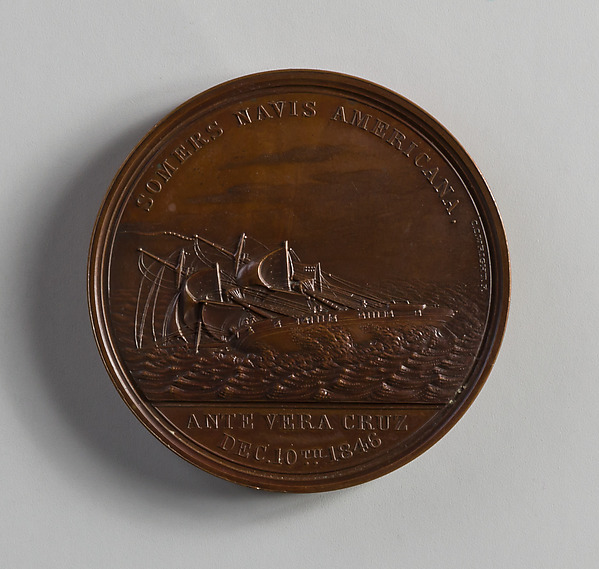
"Somers Medal", 1830–70
1830–70
Medal in The Metropolitan Museum of Art, New York (accession 83.2.389), catalogued by the museum's The American Wing department under the title “"Somers Medal"”. The museum dates it 1830–70. It is attributed to Charles Cushing Wright. The museum records the medium as Bronze and the dimensions as Diam. 2 1/4 in. (5.7 cm). Subject tags assigned by the museum: Ships.
Partial type record
Published records by sub-field
- Coins0
- Commemorative and Award Medals1,138
- Jetons and Reckoning Counters725
- Lead Tokens and Tax Seals160
- Tokens, Passes and Checks12
Counts reflect the catalogue's current classification, not the number of types that exist worldwide. Nested fields may overlap.
Identification evidence at a glance
- Both faces and legend
- Record and compareTranscribe each face separately; mark illegible letters and compare portrait direction, reverse attributes and legend breaks.
- Limits of the evidenceA similar portrait or reverse alone is not a type match. Wear can hide the decisive letter.
- Issuer, mint and date
- Record and compareKeep the historical authority, original calendar, mint symbol and its exact position together in the comparison.
- Limits of the evidenceAn event date or ruler's name is not proof of a striking date; mint abbreviations need a dated reference.
- Mass and dimensions
- Record and compareRecord measured mass, maximum diameter and measuring equipment; compare with the source's stated range, if any.
- Limits of the evidenceWear, corrosion and clipping change measurements. Neither a matching weight nor a photograph authenticates a coin.
- Edge and die alignment
- Record and compareRecord lettering, reeds, seams and orientation of the reverse relative to the upright obverse.
- Limits of the evidenceFront photographs cannot establish the edge or die axis. Do not infer either from a catalogue description.
- Type versus variety
- Record and compareRequire agreement on denomination, designs, legend, date and mint before considering die or privy-mark varieties.
- Limits of the evidenceA museum accession is not a standard type number. Catalogue edition and exact locator must be supplied independently.
Collecting, value research and care
Issuing authorities and makers
Objects stay filed under the historical entity that issued or made them, not its modern successor.
What this section covers
- Ancient coinage: Greek, Roman, Byzantine, Celtic, Persian, Indian and Chinese issues.
- Modern world coins struck from the nineteenth century onwards.
- Tokens, medals and jetons documented as distinct types.
- Each type carries its issuing authority, mint, metal, denomination and reference where documented.
Common questions
- Are these coins for sale?
- No. This is a reference catalogue of coin types. It records how types are identified and documented, never prices, valuations or offers.
- Why do some coin records have no weight?
- A figure is published only when transcribed from a documented reference. Photographs show real specimens and list their rights status; some await clearance. Missing data is marked research required rather than estimated.
- Where do the coin photographs come from?
- From institutional collections and supplementary auction sources, each credited on the record with its source object page and stated reuse terms.
Where a date, weight, catalogue number or photograph has not been verified against a documented source, the record says so rather than estimating. See the editorial method and the coverage audit.