Catalogue
Emergency & Inflation Issues
Notgeld, hyperinflation issues and locally authorised substitutes for currency.
Scope
Notgeld, hyperinflation notes and other locally authorised substitutes for currency issued when official money was scarce or failing.
A small foundational section; individual local series are not imported in bulk.
What to record when identifying
- Issuing town, firm or authority
- Validity period printed on the note
- Denomination and printed date
- Printer and paper or material
Published entries
29
Individual types and documented families
With photographs
100%
29 with a credited real-object photo
Dated span
1689 – 1968
29 entries with their own date
Verified or well documented
1
Highest two confidence levels
Catalogue entries (29)
Filter by era, country, maker or material1–29 of 29 entries
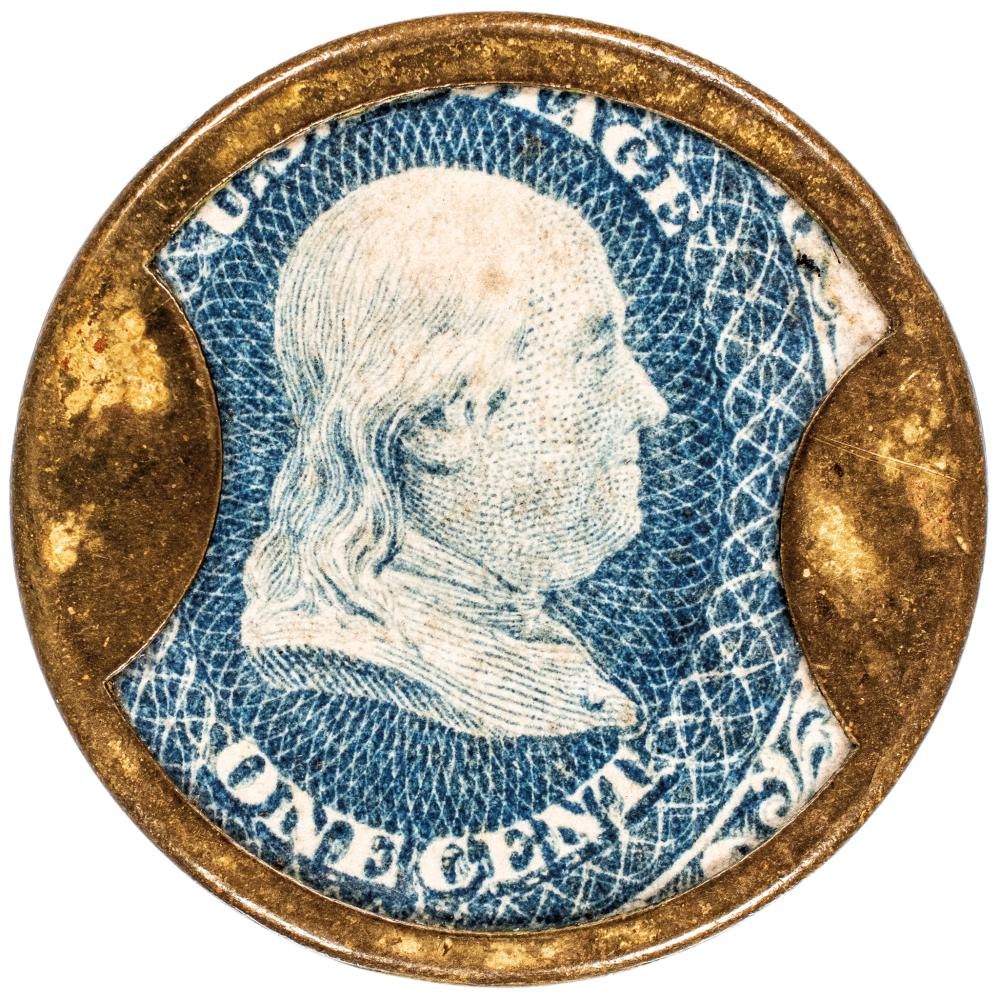
Auction house “Early American History Auctions”, via Invaluable
emergency money
1862 Civil War Aerated Bread Company one cent encased postage stamp
1862
Encased postage stamps served as emergency currency during a period of coin shortage in the United States. This specimen features a bold blue 1861 U.S. one cent Benjamin Franklin postage stamp protected by a metal case with a clear, unbroken mica cover. The case is constructed of metal with a chestnut-toned surface.…
Partial type record
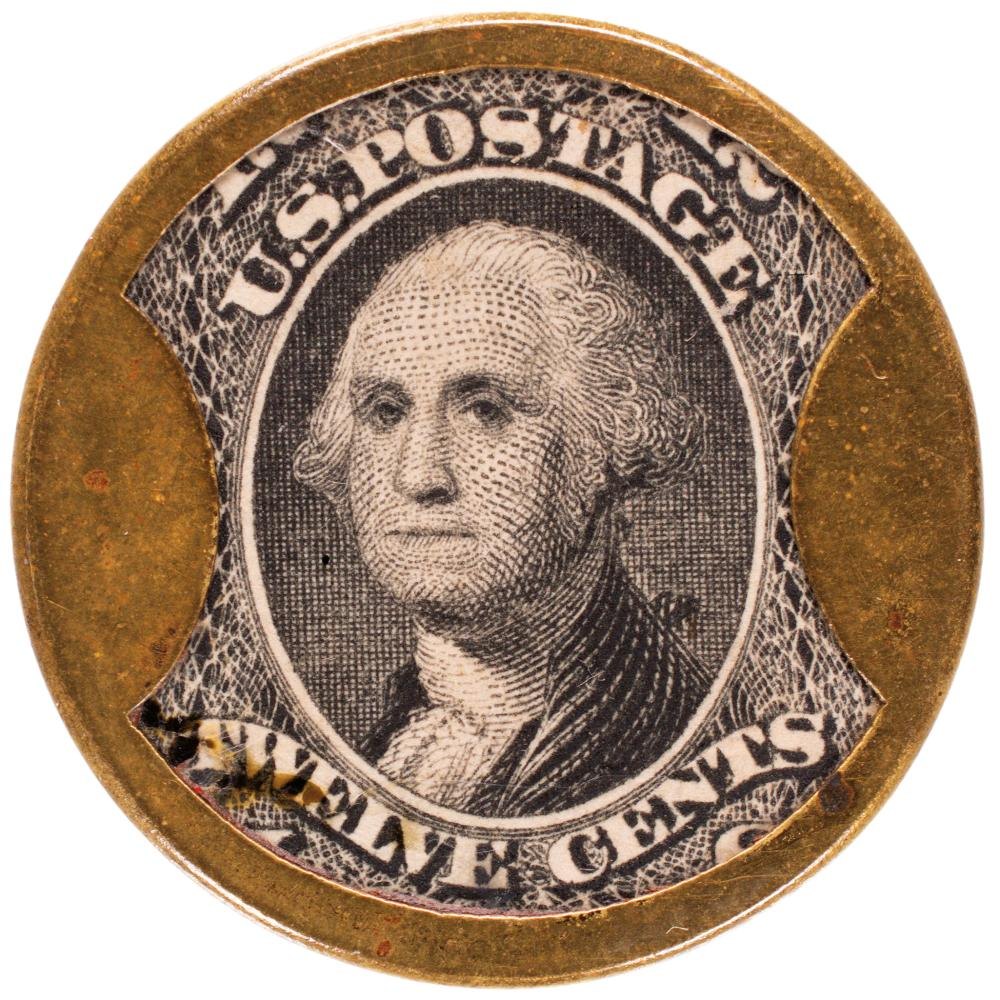
Auction house “Early American History Auctions”, via Invaluable
emergency money
1862 Civil War era encased postage stamp, 12 cents, Take Ayer's Pills
1862
Developed as a solution to the shortage of metallic coinage during the American Civil War, these items were created by placing a stamp behind a circular sheet of mica, which is held in place by a metal frame. This specific specimen features the advertising legend "TAKE AYER'S PILLS" on its reverse, promoting a popul…
Partial type record
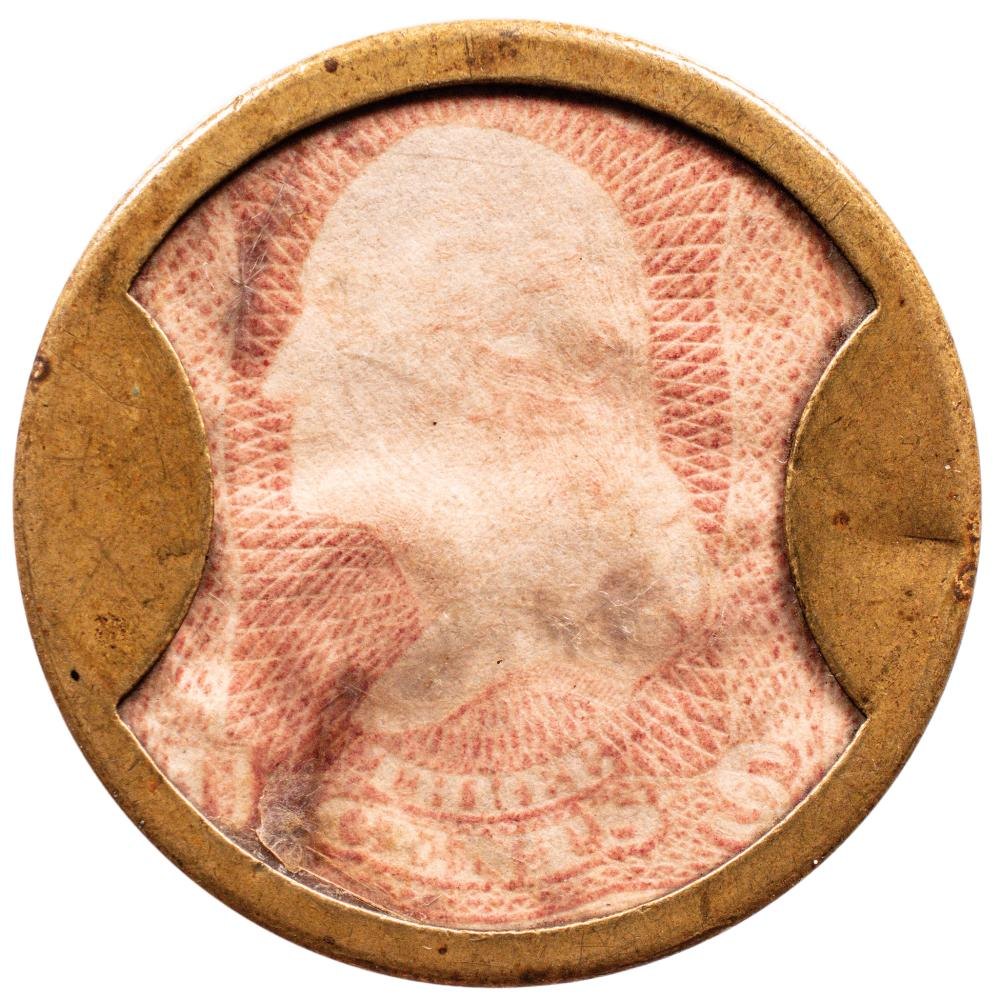
Auction house “Early American History Auctions”, via Invaluable
emergency money
1862 Dougan the Hatter three cents encased postage stamp
1862
The object consists of an 1861 three-cent George Washington red U.S. postage stamp protected by a circular, light chestnut-toned brass case. The stamp is covered by a piece of protective mica, which remains unbroken despite some internal crazing. The brass casing features a unique reverse vignette depicting a top ha…
Partial type record
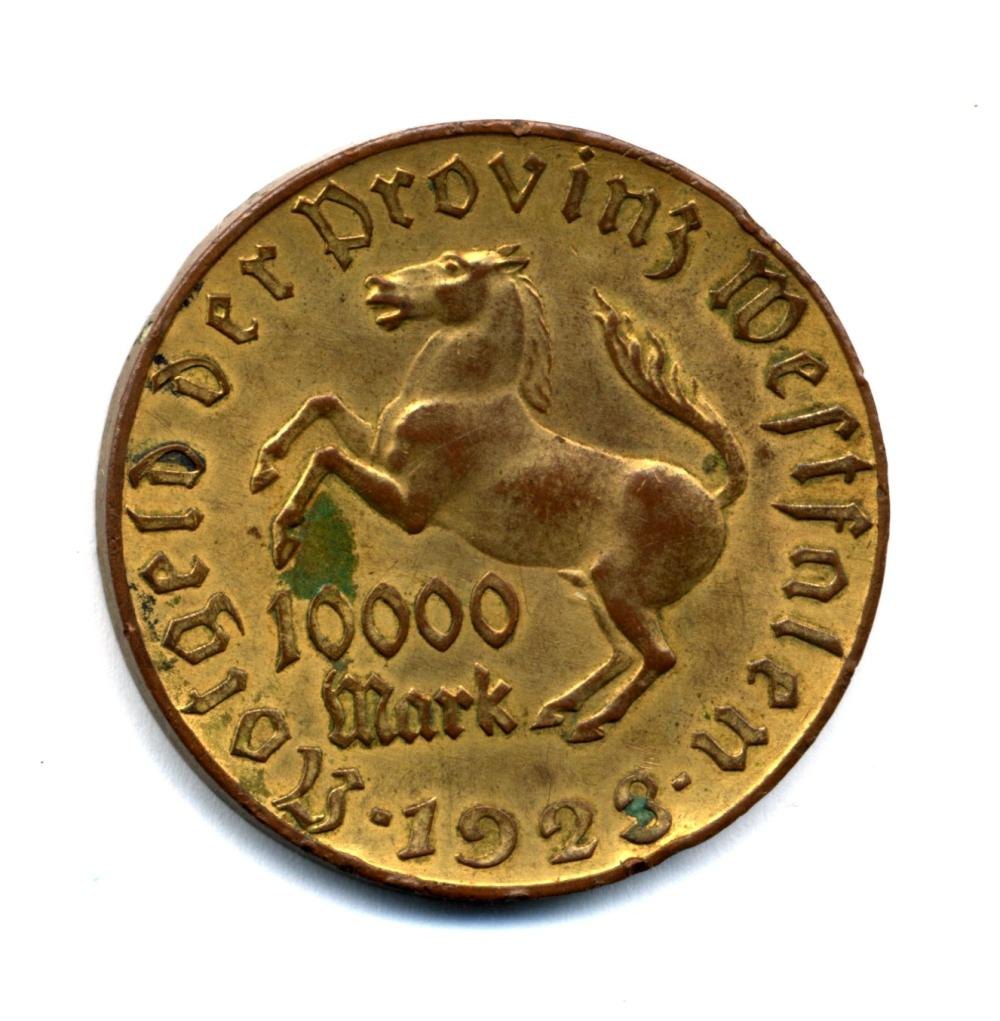
Auction house “Mebane Antique Auction”, via Invaluable
emergency money
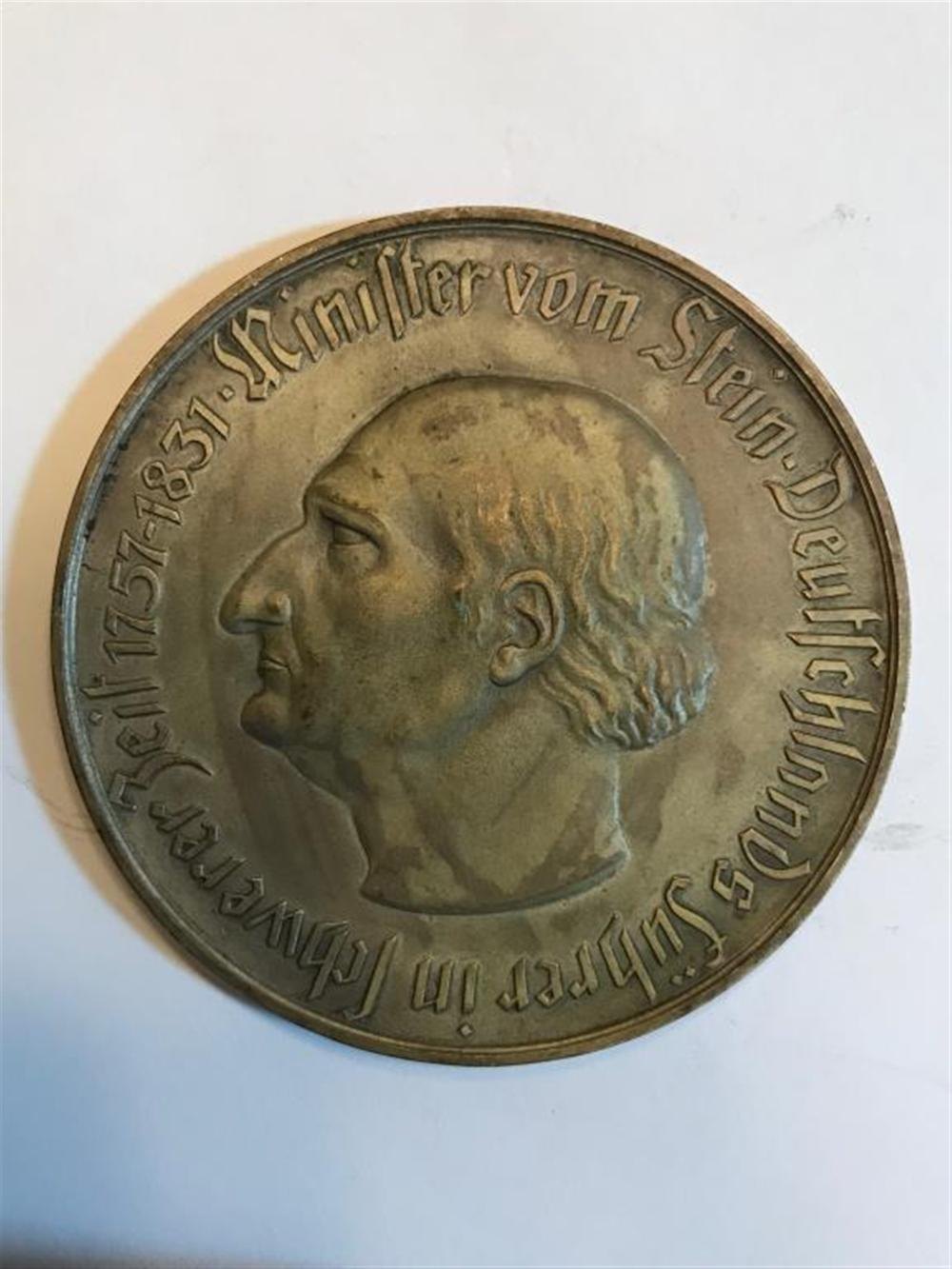
1923 Germany 10,000 Mark Westfalen Notgeld Coin
1923
This collectible piece is a 1923 10,000 Mark coin, specifically classified as Notgeld, or emergency money, issued by the province of Westfalen in Germany. Such currency was produced during the period of hyperinflation following the First World War. This specific commemorative issue features a design honoring Freiher…
Partial type record
Auction house “Sarasota Estate Auction”, via Invaluable
emergency money
1923 Westphalia German Notgeld 1 Billion Mark Coin
1923
This object is a 1923 German Notgeld coin from the province of Westphalia, issued during a period of severe economic crisis. Notgeld, or emergency money, was produced by various local towns and provinces across Germany in diverse forms, including banknotes, coins, porcelain, and wood, to serve as currency when the n…
Partial type record
Auction house “Early American History Auctions”, via Invaluable
emergency money
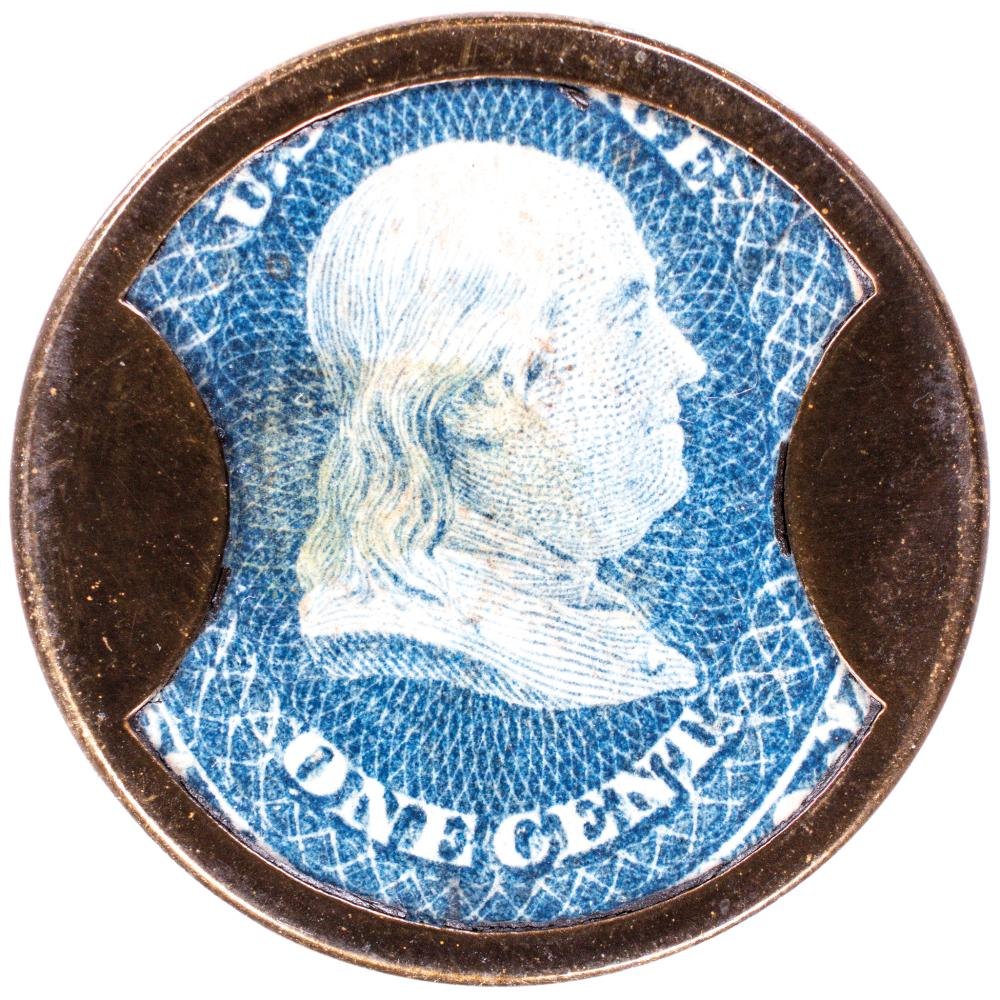
Arthur M. Claflin one cent encased postage stamp, 1862
1862
Claflin merchant type. Encased postage stamps were a form of emergency currency used during the American Civil War when metal coinage was frequently hoarded. This specimen features a standard United States one-cent postage stamp depicting Benjamin Franklin, encased in a protective metallic frame. The stamp is charac…
Partial type record
Auction house “Auktionshaus Schramm”, via Invaluable
emergency money
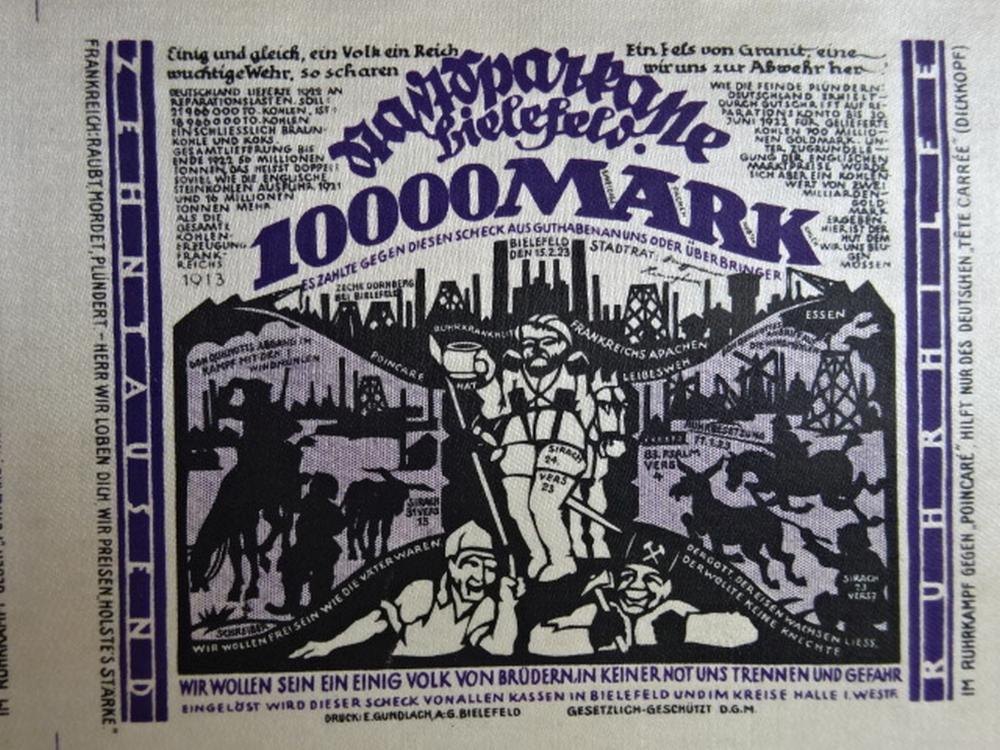
Bielefeld German Notgeld sheets on silk, 1921 and 1923
1921 or 1923
This collection consists of two sheets of German Notgeld, or emergency money, printed on silk. The sheets contain between 6 and 12 colored notes each. The first sheet is a 25 Mark note issued by the Bielefeld Municipal Savings Bank to commemorate the 700th anniversary of the city of Bielefeld, dating to 1921. The se…
Partial type record
Auction house “Dynasty”, via Invaluable
emergency money
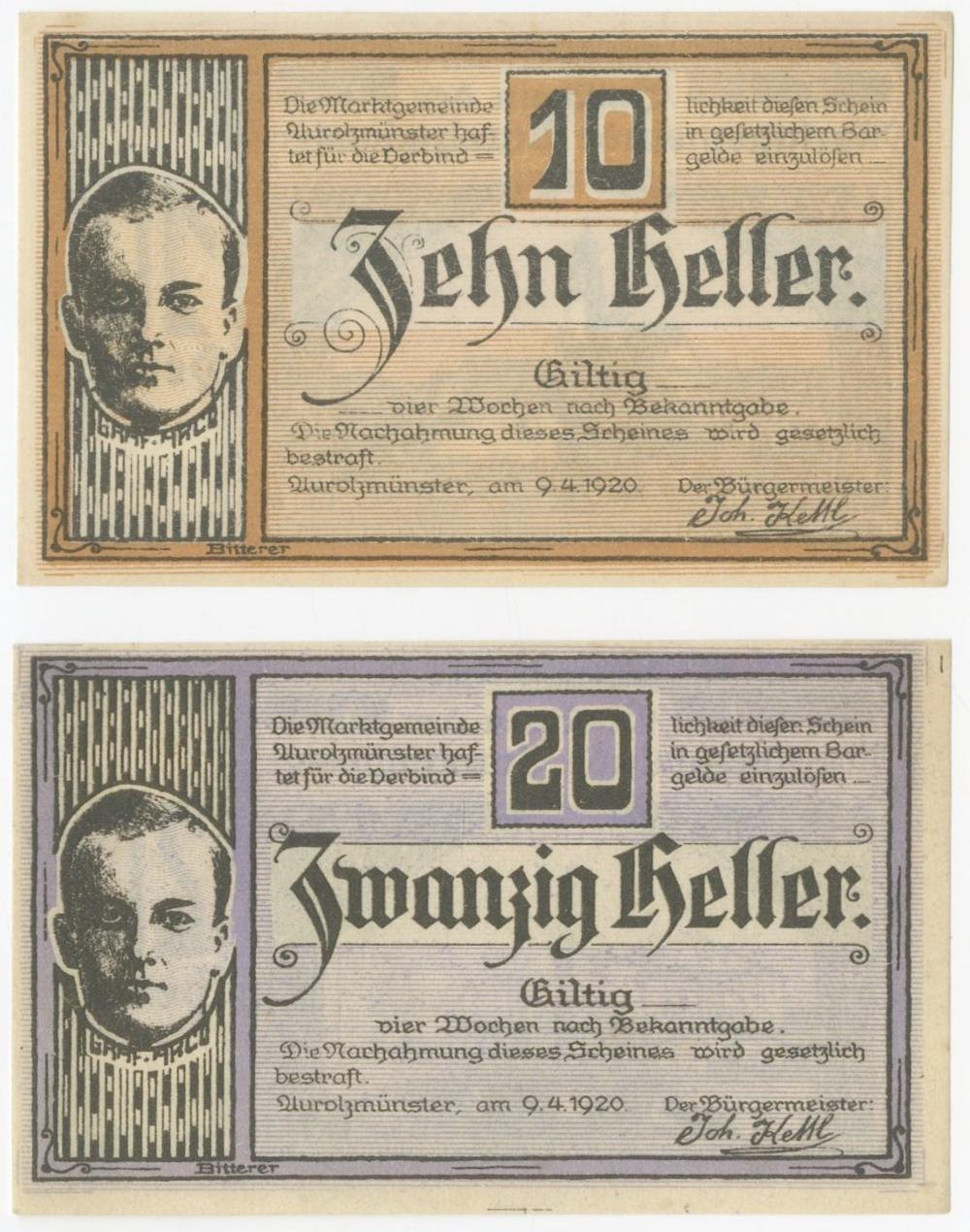
German 1920 Notgeld banknotes for 10 and 20 Heller, Nurolzmünster
April 1920
These notes are significant for their thematic content, featuring a portrait of Anton Graf von Arco-Valley, who gained notoriety for the 1919 assassination of the Bavarian revolutionary leader Kurt Eisner. Printed in a stylized format with distinct background coloring for each denomination—ochre for the 10 Heller an…
Partial type record
Auction house “The Coin Cabinet”, via Invaluable
emergency money
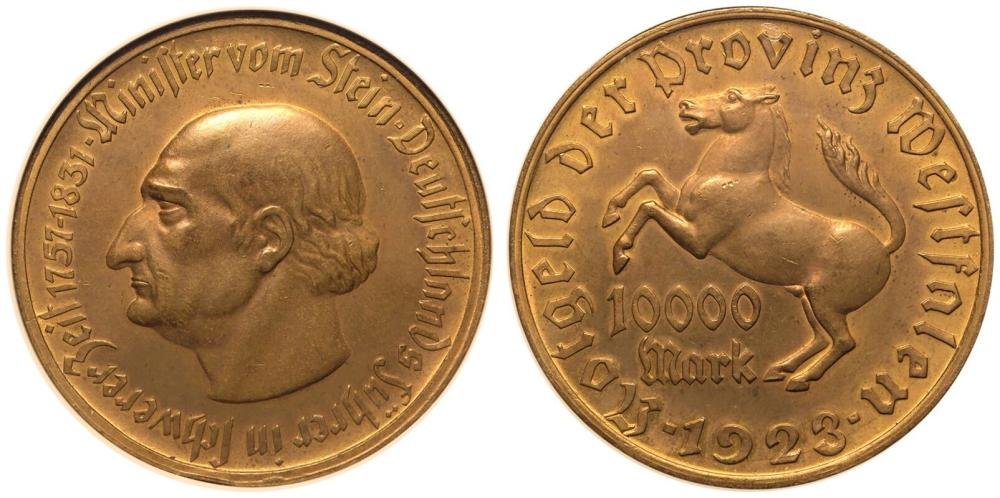
German 1923 Landesbank der Provinz Westfalen 10000 Mark Gilt Bronze Notgeld
1923
This piece of German emergency money, or Notgeld, was issued by the Landesbank der Provinz Westfalen in 1923 during the Weimar Republic period. Struck in gilt bronze, this specimen measures 45 mm in diameter and weighs 31.7 grams. The obverse features a central depiction of a rampant horse, surrounded by the inscrip…
Partial type record
Scanned from original by 5snake5
emergency money
German Notgeld
c. 1914–1923
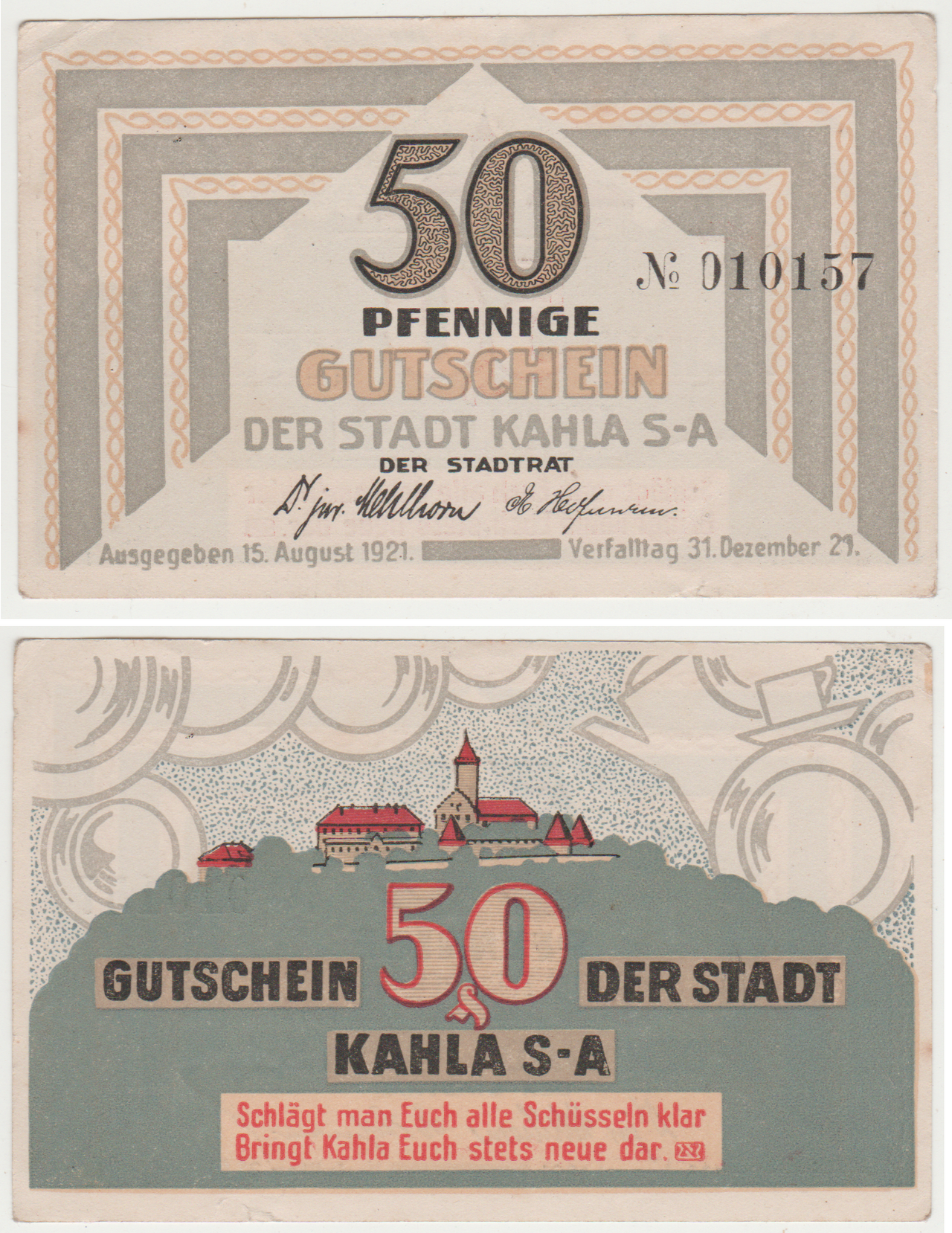
German Notgeld, meaning emergency or necessity money, comprises substitute currency produced during economic and political crises when insufficient official money was supplied by the central bank. Produced without sanction from central government, it was issued by town savings banks, municipalities, and private or s…
Partial type record
Auction house “Dynasty”, via Invaluable
emergency money
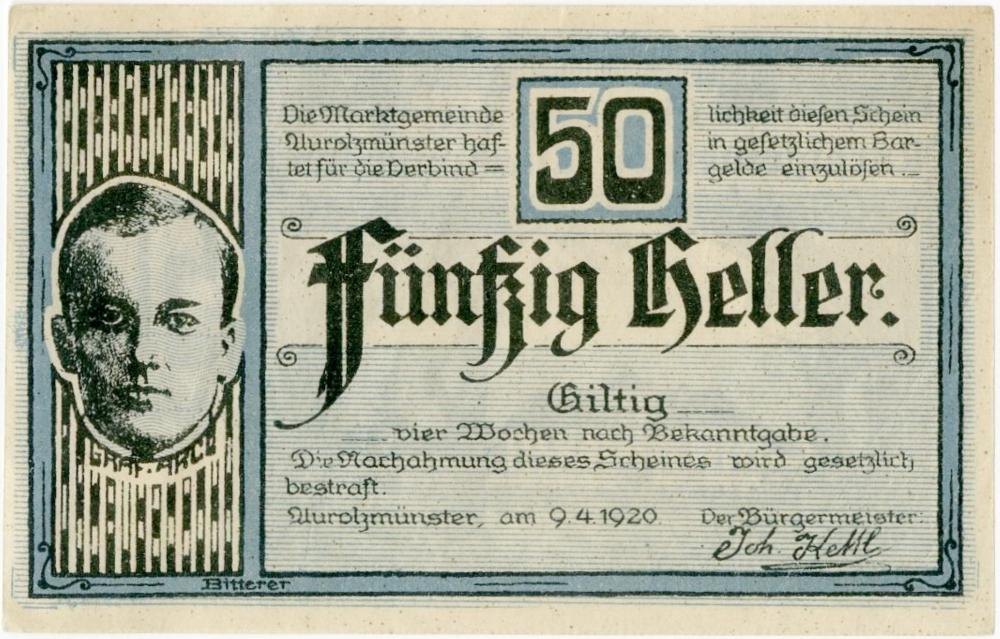
German Notgeld banknote, 50 Heller, Aurolzmünster, 1920
April 9, 1920
The note is notable for its inclusion of a portrait of Anton Graf von Arco auf Valley, the aristocratic nationalist and assassin of the Bavarian socialist leader Kurt Eisner. Measuring 10 by 7 cm, the obverse features a portrait of von Arco-Valley on the left, flanked by geometric vertical lines, with the denominati…
Partial type record
Auction house “The Coin Cabinet”, via Invaluable
emergency money
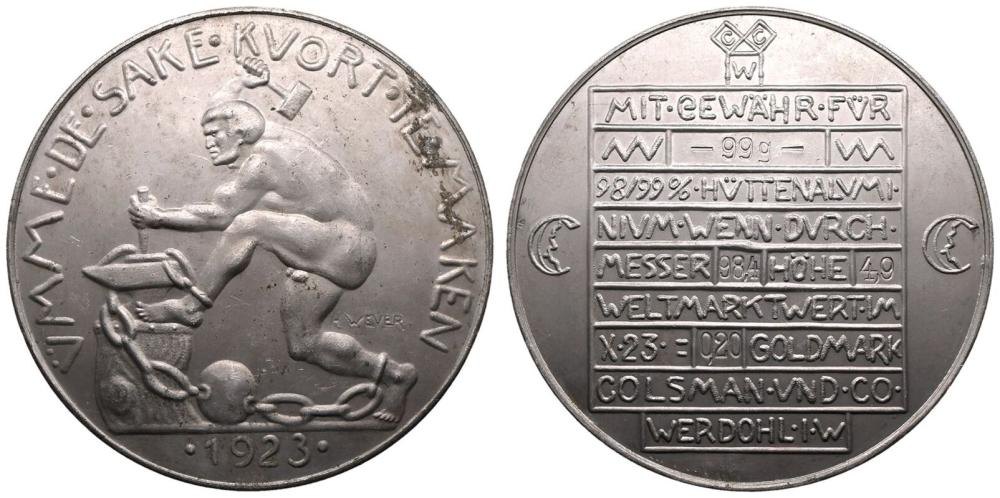
German Westphalia 1923 Aluminum Notgeld 0.2 Goldmark, Golsman & Co.
1923
This German emergency money, or Notgeld, was issued in 1923 by Golsman & Co. in Werdohl during the period of hyperinflation. Struck in aluminum, this large disc measures 98 mm in diameter and weighs 99 grams. The obverse depicts a naked male figure, representing liberated labor, sitting on an anvil while breaking ch…
Partial type record
Auction house “The Coin Cabinet”, via Invaluable
emergency money
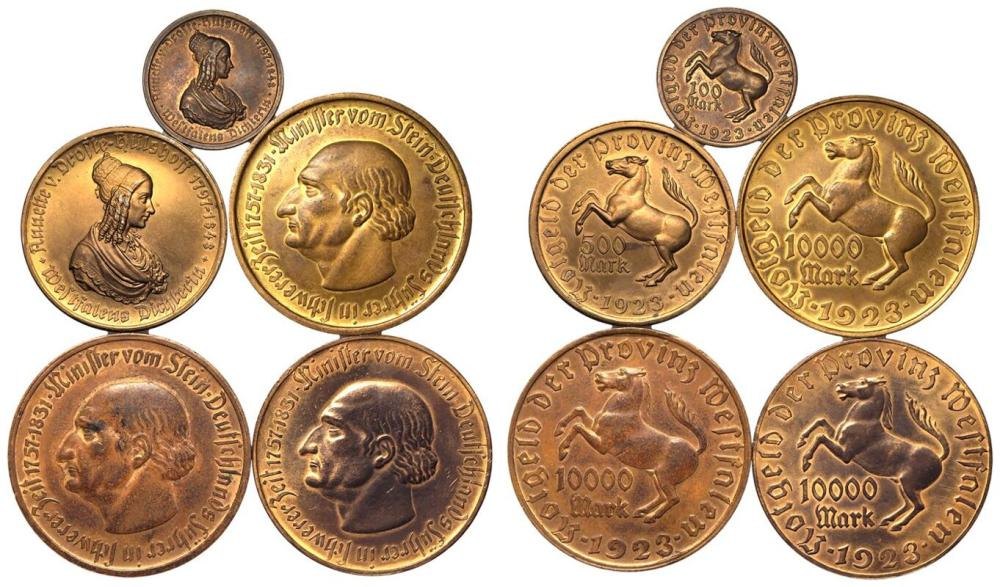
German Westphalia 1923 Notgeld gold-plated tombac set
1923
This collection features a set of five Notgeld emergency money pieces issued by the Prussian Province of Westphalia during the German Weimar Republic period in 1923. The group includes three 10,000 Mark denominations, one 500 Mark denomination, and one 100 Mark denomination. These items are composed of gold-plated t…
Partial type record
Auction house “The Coin Cabinet”, via Invaluable
emergency money
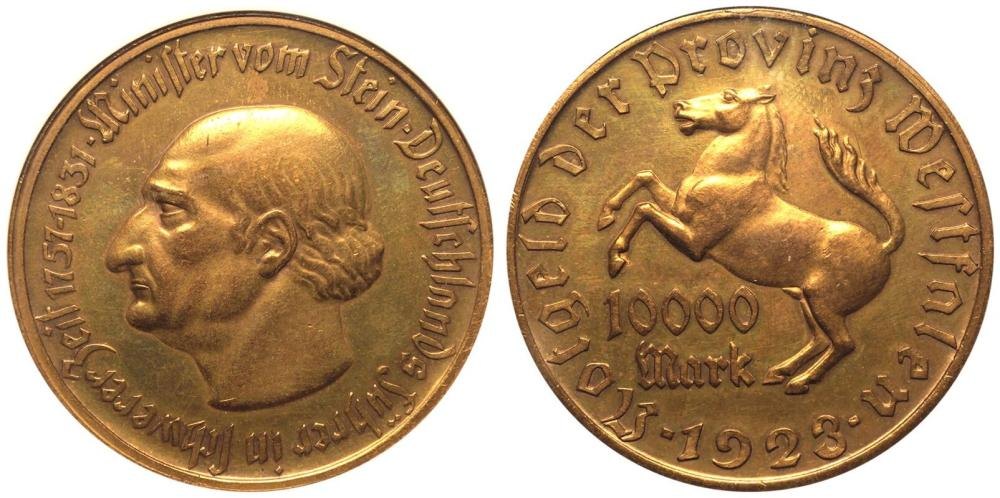
Germany, Landesbank der Provinz Westfalen 10000 Mark 1923 Gilt Bronze Notgeld
1923
This 1923 German Notgeld (emergency money) piece was issued by the Landesbank der Provinz Westfalen during the Weimar Republic period. Struck in gilt bronze, this specimen measures 45 mm in diameter and weighs 31.7 grams. The obverse features the denomination '10000 Mark' beneath a central depiction of a horse, surr…
Partial type record
Auction house “The Coin Cabinet”, via Invaluable
emergency money
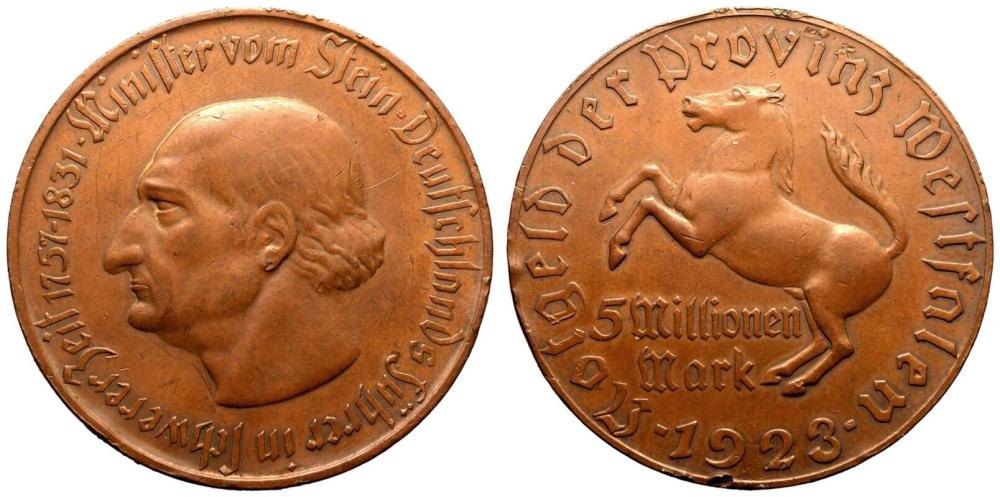
Germany, Weimar Republic 1923 Brass 50 Millionen Mark Notgeld, Landesbank der Provinz Westfalen
1923
This brass emergency money piece, or Notgeld, is a 50 Millionen Mark coin issued by the Landesbank der Provinz Westfalen in Germany during the Weimar Republic period. Dated 1923, the piece measures 33.1 mm in diameter and weighs 12.73 g. The design commemorates the statesman Freiherr vom Stein. The obverse displays…
Partial type record
Auction house “The Coin Cabinet”, via Invaluable
emergency money
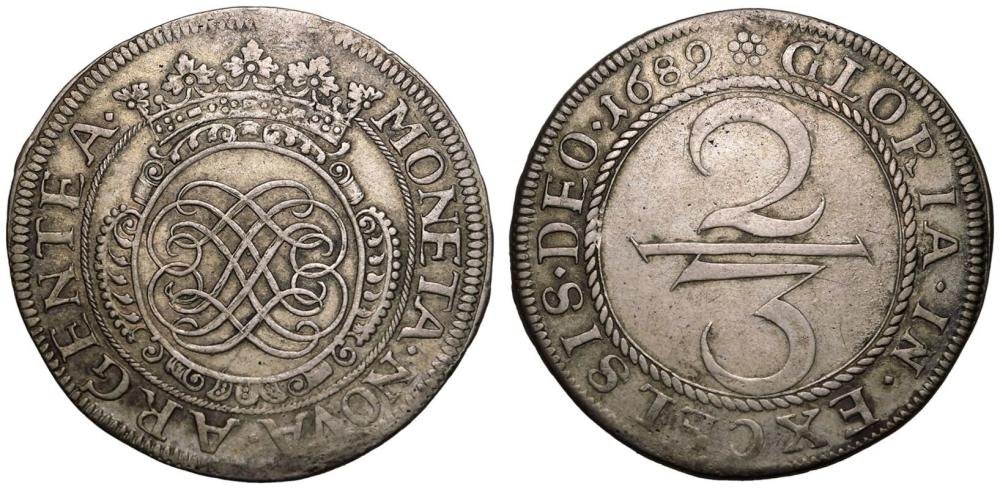
Mainz 1689 silver 2/3 Taler emergency coinage
1689
This 1689 silver 2/3 Taler is a significant example of emergency coinage issued during the siege of Mainz. Commissioned by the French Commander Marquis d'Uxelles, the coin was struck during the occupation of the city by French forces. Minted using silver confiscated from local citizens and church treasures, this cur…
Partial type record
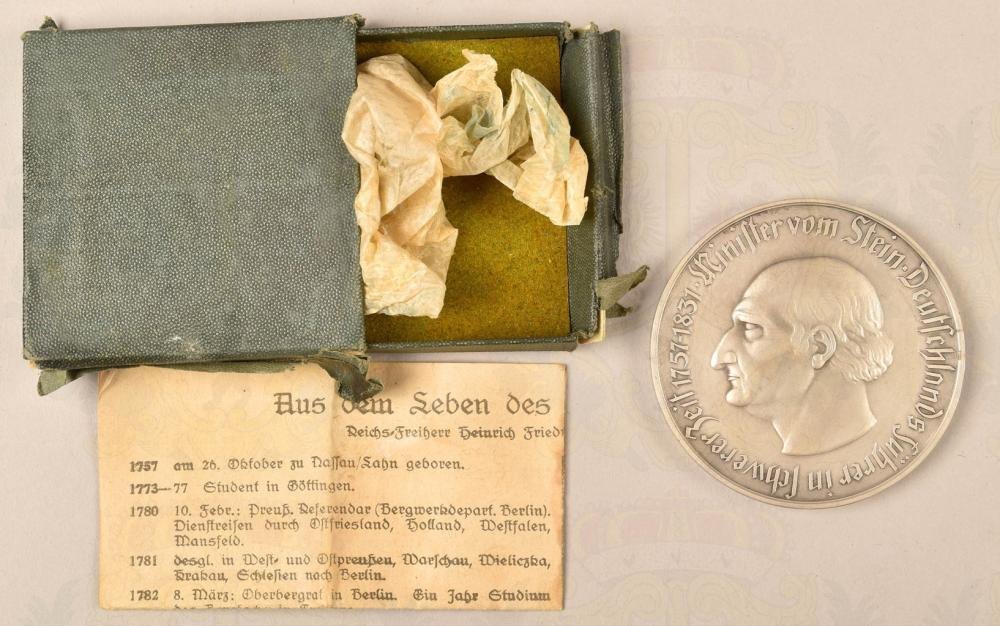
Auction house “Berliner Auktionshaus GmbH & Co. KG”, via Invaluable
emergency money
Province of Westphalia 1 Billion Mark 1923 emergency coin
1923
This German emergency money piece, issued by the Province of Westphalia in 1923, is a notable specimen of the hyperinflation era. The coin is struck in copper-nickel and measures 60mm in diameter. The obverse features a prancing horse, a traditional heraldic symbol of Westphalia, encircled by the denomination inscri…
Partial type record
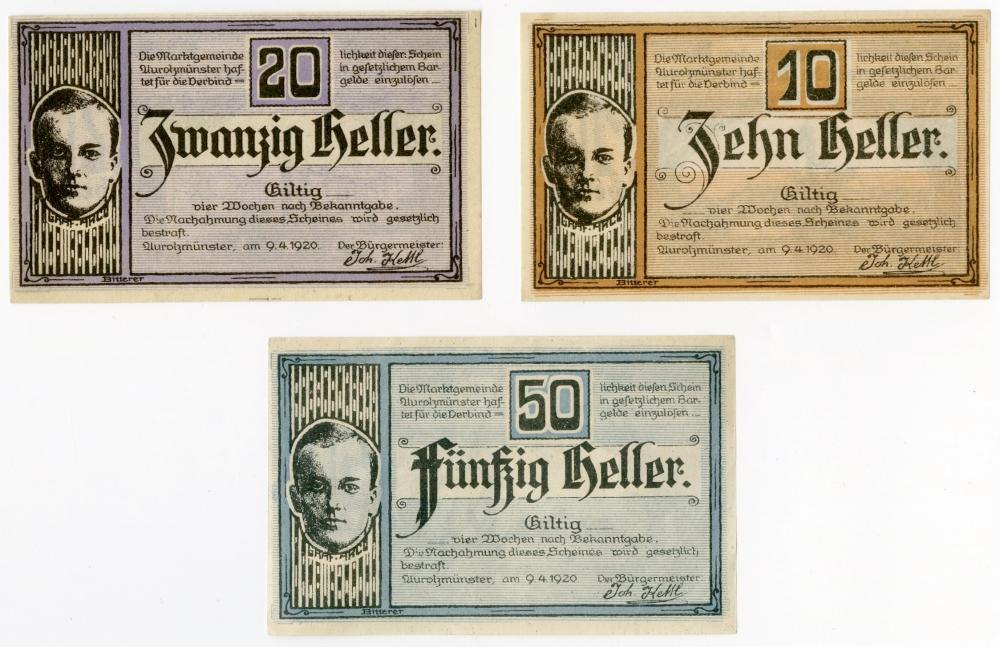
Auction house “Dynasty”, via Invaluable
emergency money
Set of three German 1920 Notgeld banknotes from Aurolzmünster
April 1920
This set of three German emergency money (Notgeld) banknotes originates from the market town of Aurolzmünster, dated April 9, 1920. The denominations included are 10, 20, and 50 Heller. These paper notes are printed in distinct color schemes for each denomination, with orange for the 10 Heller, violet for the 20 Hel…
Partial type record
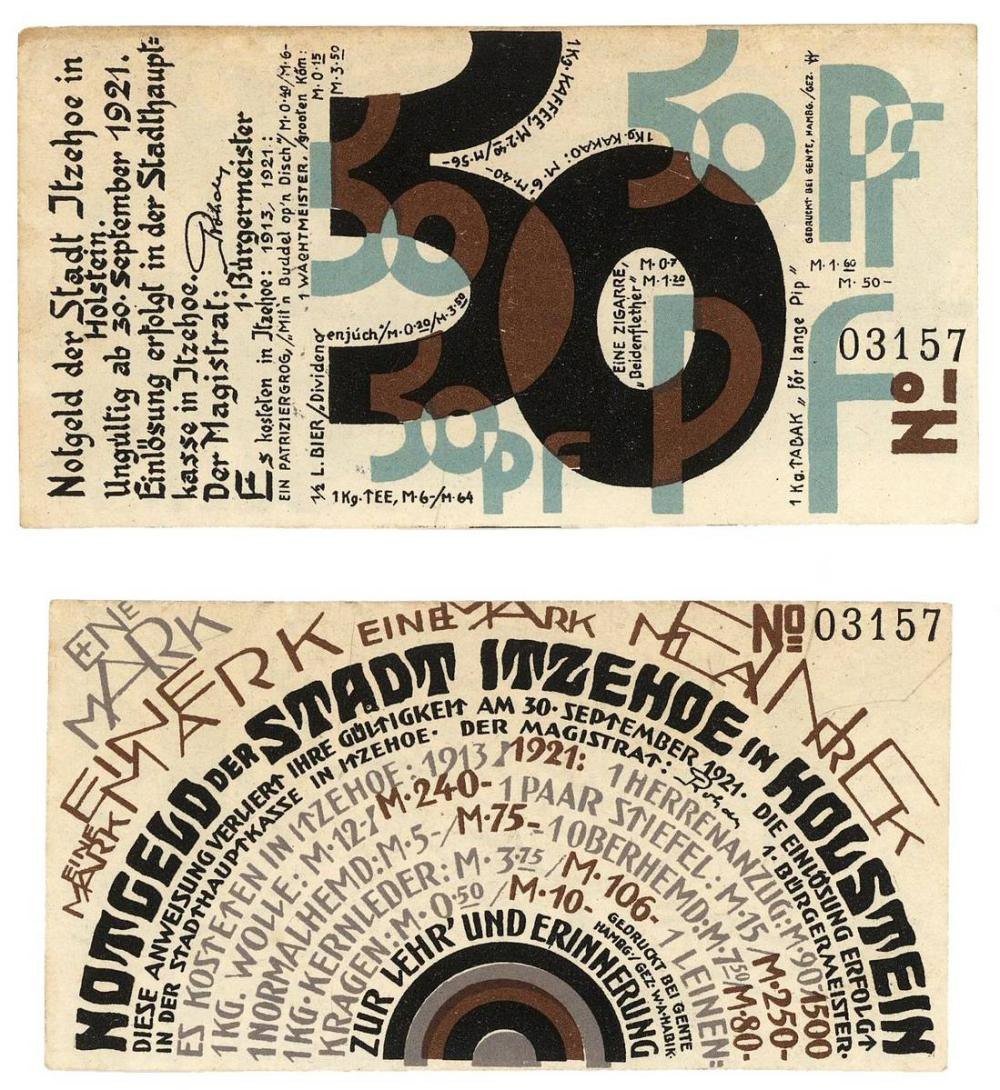
Auction house “Bubb > Kuyper: Auctioneers of Books, Fine Arts & Manuscripts”, via Invaluable
emergency money
Set of two Wenzel Hablik designed Notgeld banknotes for the city of Itzehoe, 1921
1921
This set consists of two emergency money banknotes (Notgeld) issued by the city of Itzehoe, Holstein, in 1921. The pieces were designed by the artist Wenzel Hablik. The set includes a 50 Pfennig denomination measuring 5.9 x 11.2 cm and a 1 Mark denomination measuring 5.5 x 10.5 cm. Both banknotes are printed on rect…
Partial type record
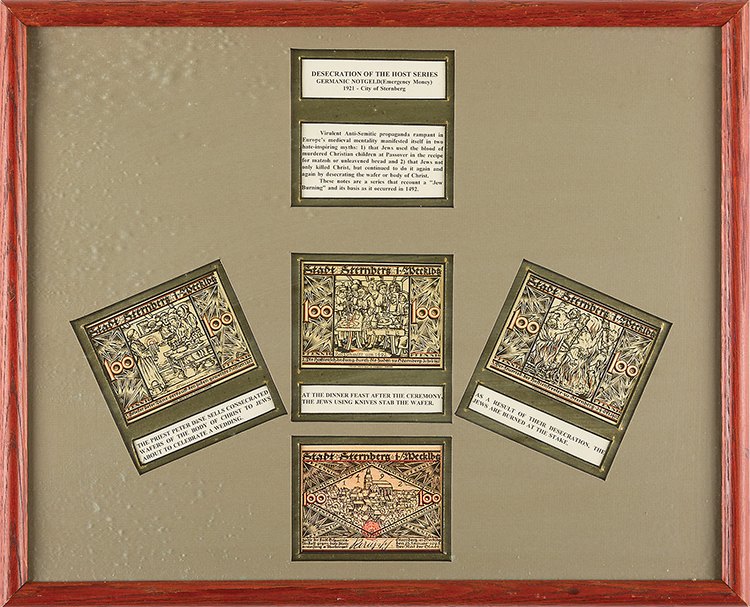
Auction house “Kestenbaum & Company”, via Invaluable
emergency money
Sternberg 100-pfennig Notgeld emergency currency series, 1922
1922
This collection features a set of three 100-pfennig Notgeld notes issued by the city of Sternberg, Germany, in 1922 during a period of hyperinflation. Notgeld, or emergency money, was produced as a localized substitute for currency when insufficient state-issued money was available from the central bank. These speci…
Partial type record
Auction house “The Bidder”, via Invaluable
emergency money
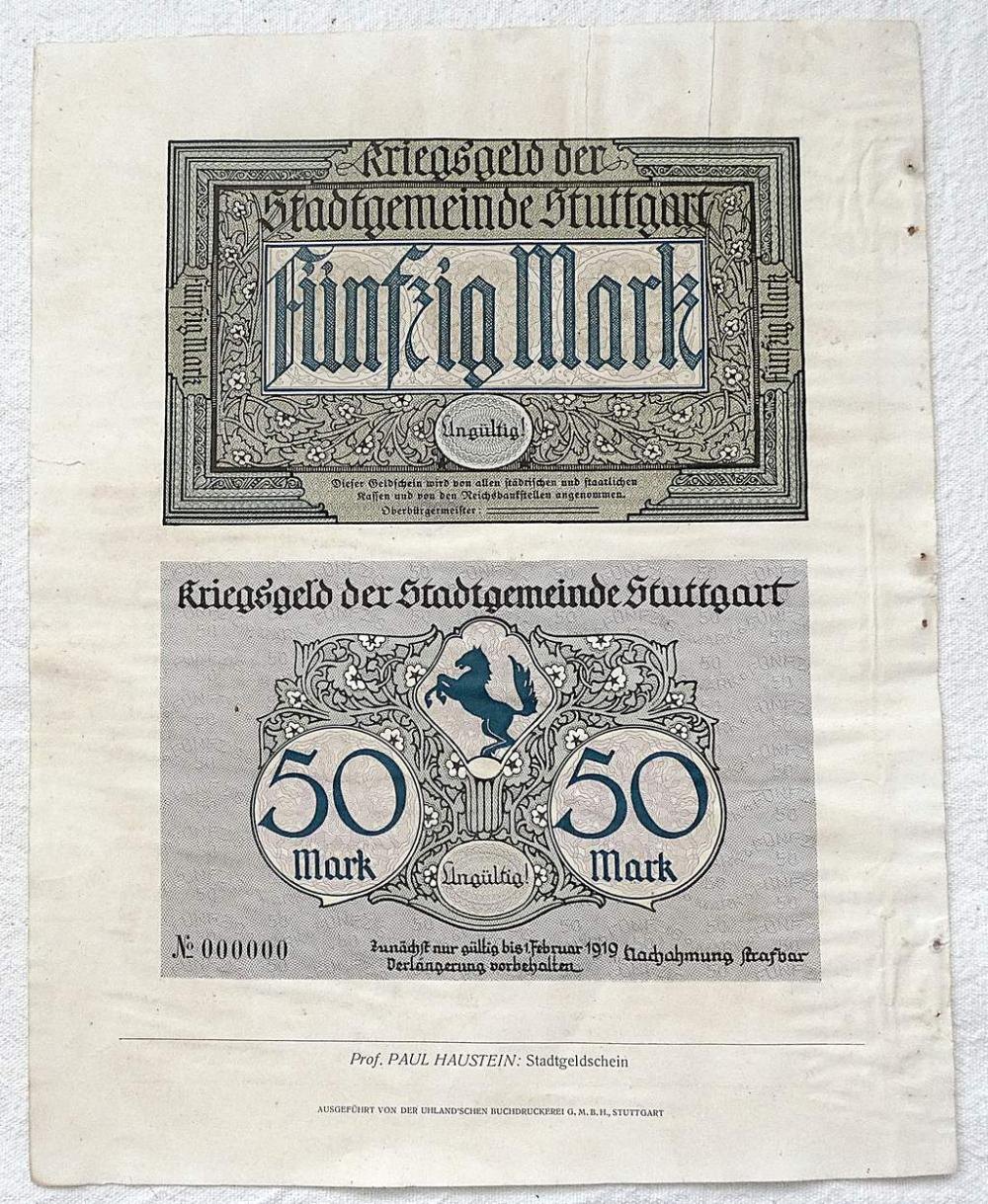
Stuttgart 50 Mark Kriegsgeld specimen sheet by Paul Haustein, 1921
1921
This specimen sheet features two distinct design variations for 50 Mark Kriegsgeld (emergency war money) issued by the Stuttgart Municipality. Measuring 29 x 22.2 cm, the sheet is a trial or pre-production piece identified by the serial number 000000. It includes the artistic work of Prof. Paul Haustein, who designe…
Partial type record
Auction house “Kunst- und Auktionshaus Quedlinburg”, via Invaluable
emergency money
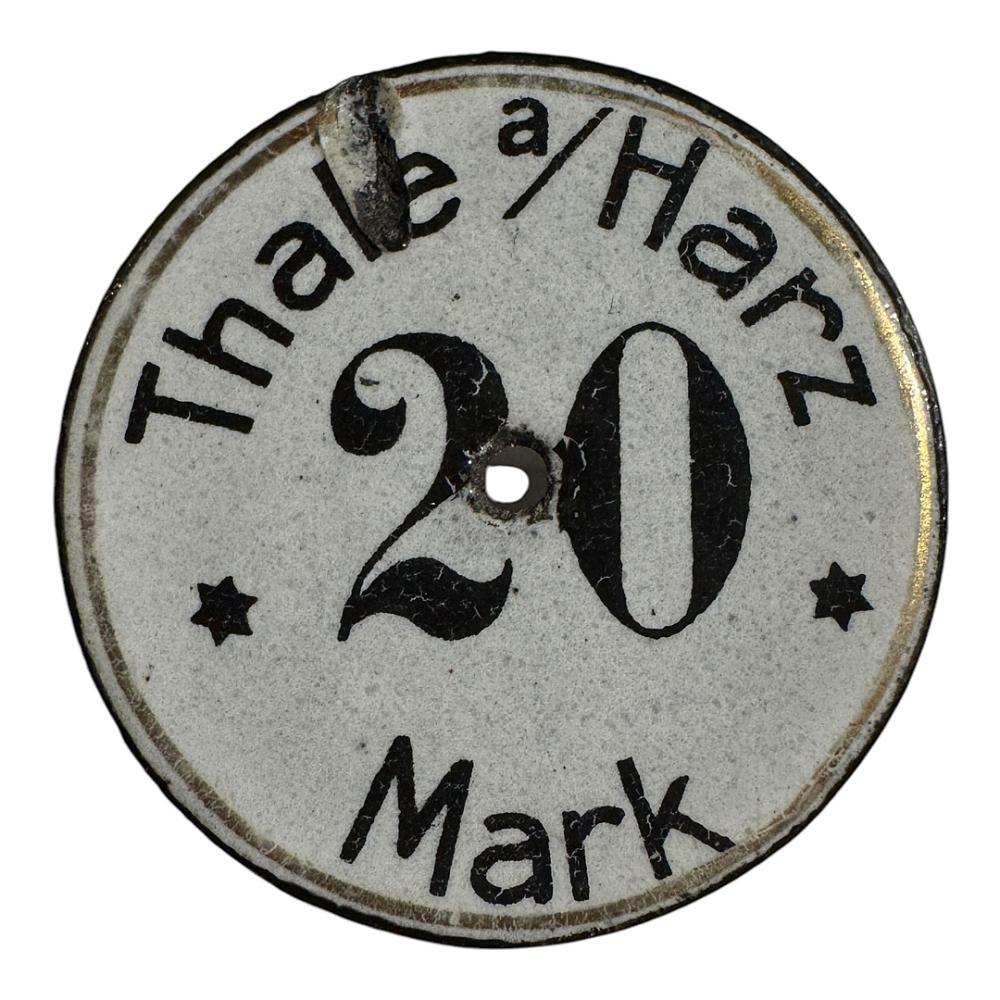
Thale am Harz 20 Mark emergency money token, 1918
1918
This German emergency money (Notgeld) token from 1918 was issued in Thale am Harz. Struck from iron sheet metal, the piece is finished with an enamel coating. It features a circular design with a central hole. The obverse displays the city name "Thale a/Harz" arched across the top, above the denomination "20" and "M…
Partial type record
Museums Victoria / Photographer: Naomi Andrzejeski
emergency money
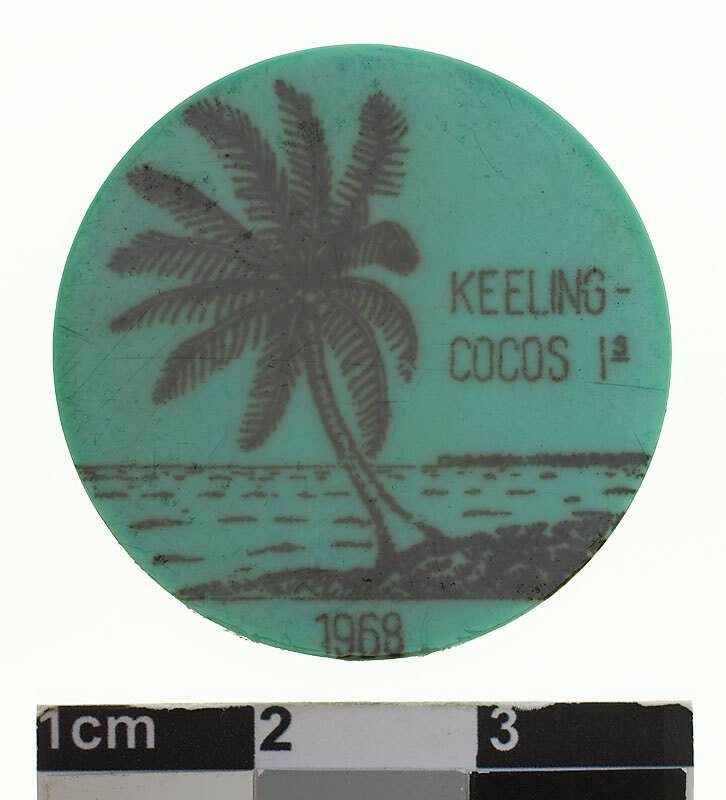
Token, Clunies Ross, Cocos (Keeling) Islands, 1968
1968 AD
Australia Cocos (Keeling) Islands Twenty Five Cent 1968 Green plastic token Clunies Ross family A round green plastic token (28 mm diameter) printed in black; on the obverse a palm tree growing from an island with ocean in background, at right, KEELING COCOS IS with the date 1968 in exergue; and on the reverse withi…
Partial type record
Museums Victoria
emergency money
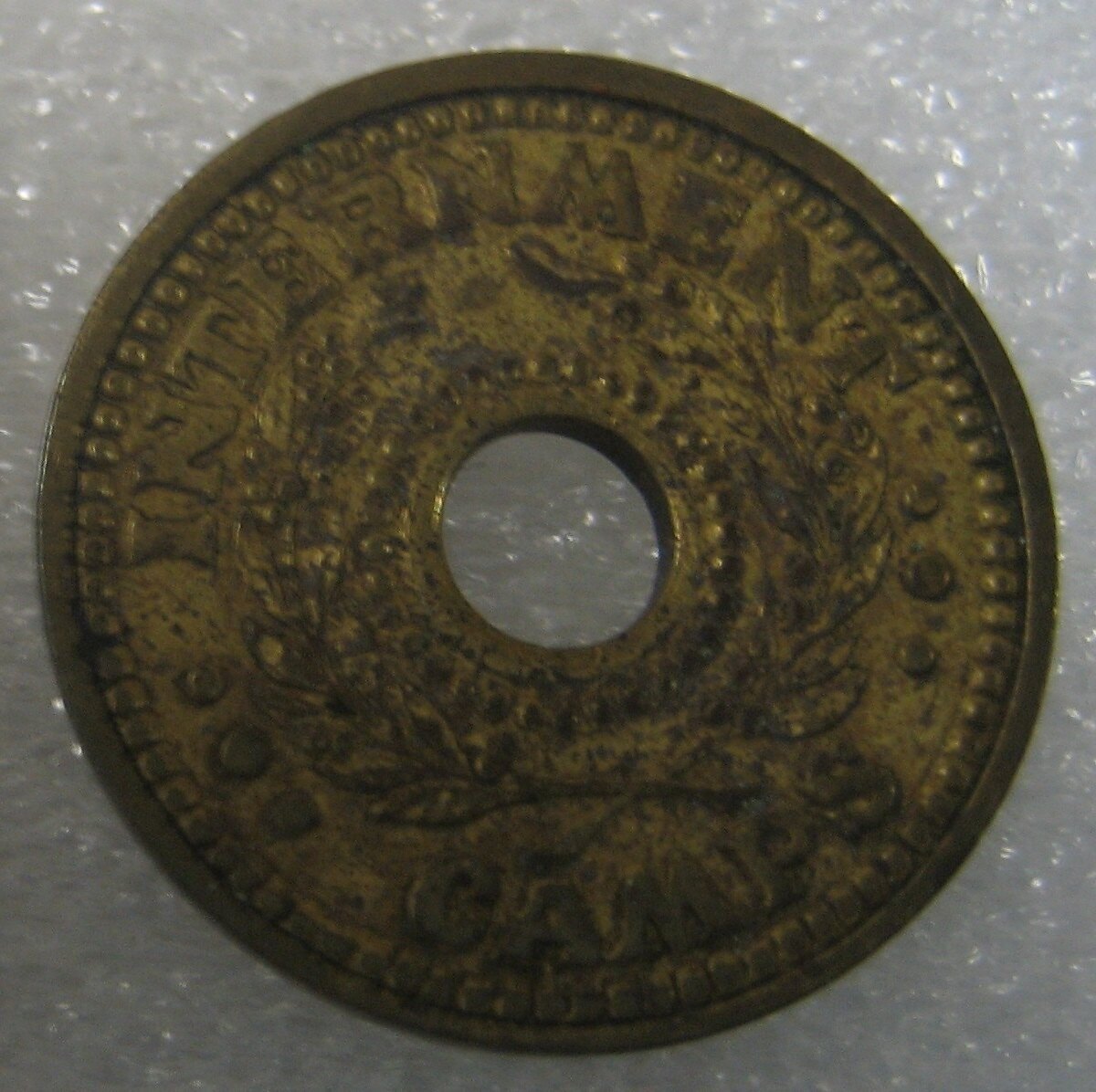
Token, Tatura Internment Camp, Australia, 1940-1945
1940-1945 AD
This is an internment camp token - one penny - issued for use as currency in internment camps, during the 1940s. It belonged to Karl Muffler. Karl was interned as a German enemy alien at Tatura Internment Camp from 1939 to 1944, and was then released to the Civil Aliens Corp Melbourne on 27th June 1944. He was then…
Partial type record
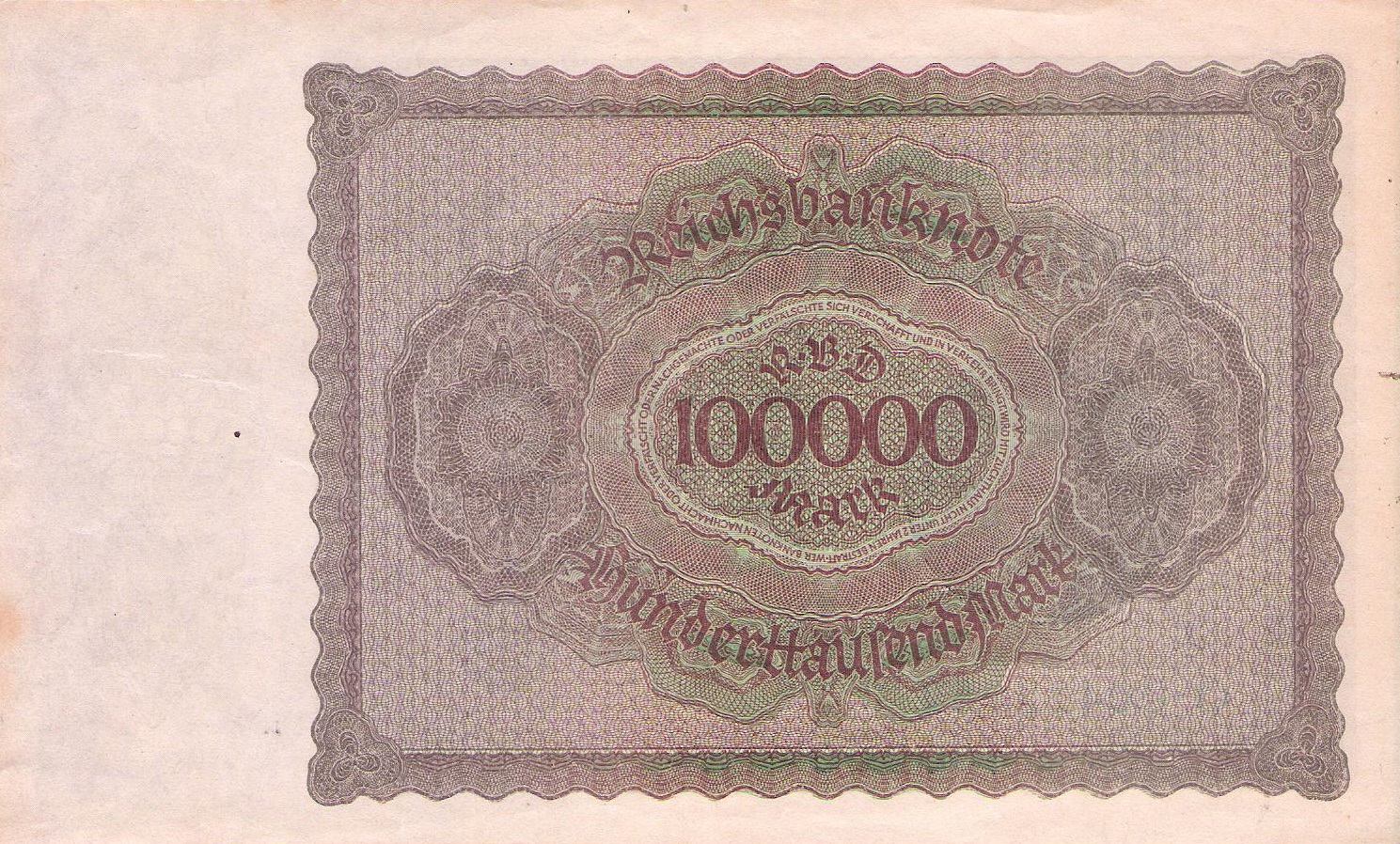
Numista catalogue (photo contributor credited on the source page)
emergency money
Weimar Republic — Reichsbanknote — 100,000 Mark — 1923
1923
The Weimar Republic 100,000 Mark Reichsbanknote is a high-denomination paper currency issue introduced by the Reichsbank in 1923 during the period of German hyperinflation. Denominated as "Einhunderttausend Mark", the banknote was produced to supply circulation as the purchasing power of the Papiermark collapsed. T…
Partial type record
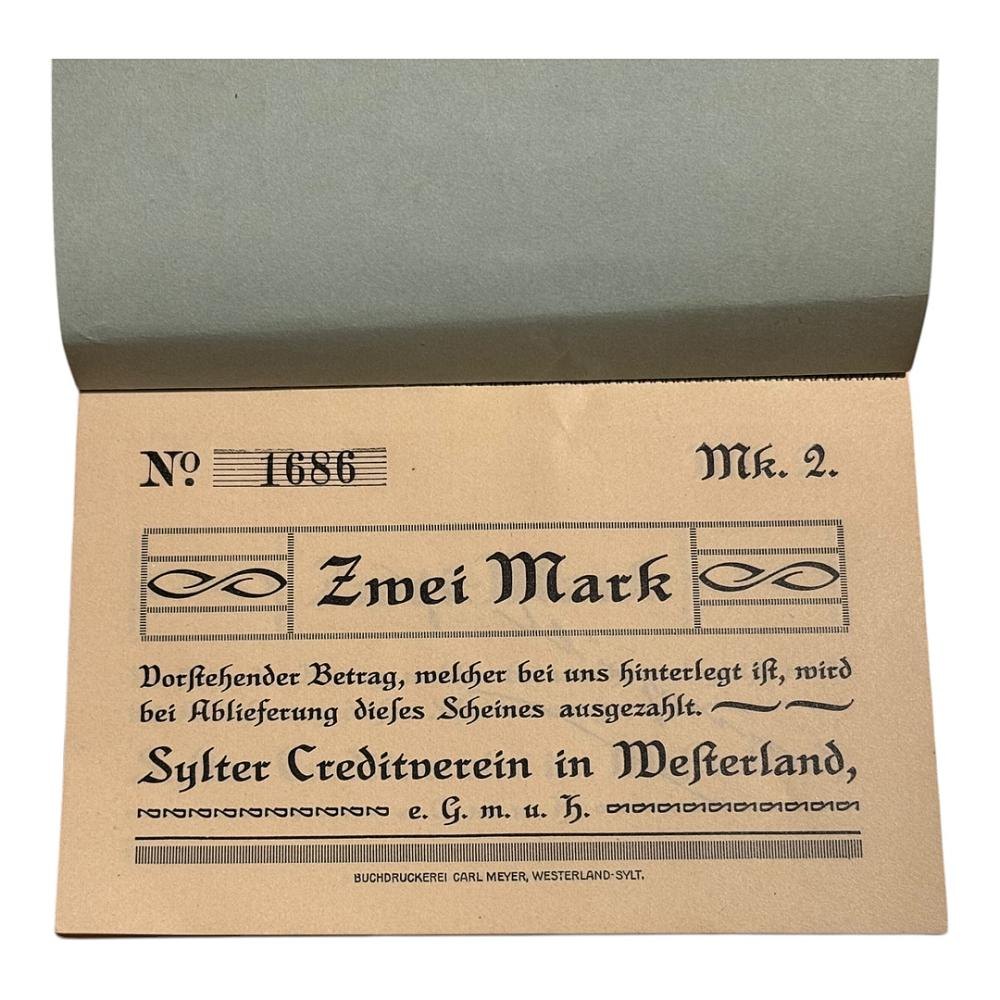
Auction house “Kunst- und Auktionshaus Quedlinburg”, via Invaluable
emergency money
Westerland/Sylt 1920 emergency money tear-off block, Sylter Creditverein
1920
This collectible is an original emergency money (Notgeld) tear-off block issued by the Sylter Creditverein located in Westerland, Sylt, in 1920. The collection comprises a series of paper notes bound together in a block, with an associated cover sheet labeled 'O.V. 1916'. The individual notes within the block featur…
Partial type record
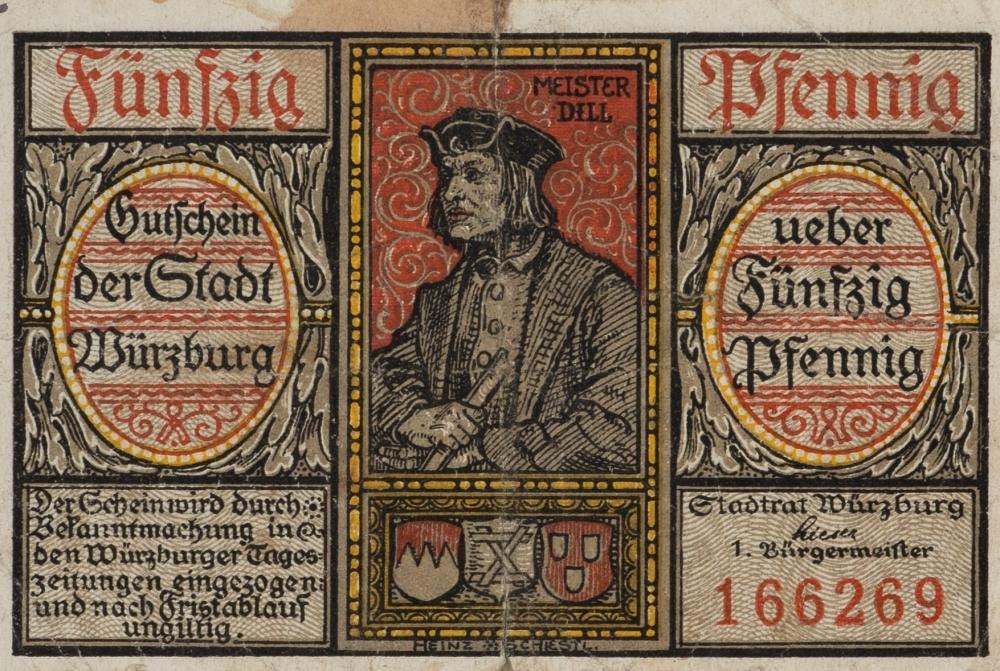
Auction house “Fichter Kunsthandel”, via Invaluable
emergency money
Würzburg 50 pfennig emergency currency voucher, c. 1920
c. 1920
This piece is a historical 50 pfennig emergency currency voucher (Notgeld) issued by the city of Würzburg, Germany, dating to approximately 1920. Produced using the chromolithograph technique on paper, the voucher features a highly decorative, illustrative design typical of the period. A central rectangular panel de…
Partial type record
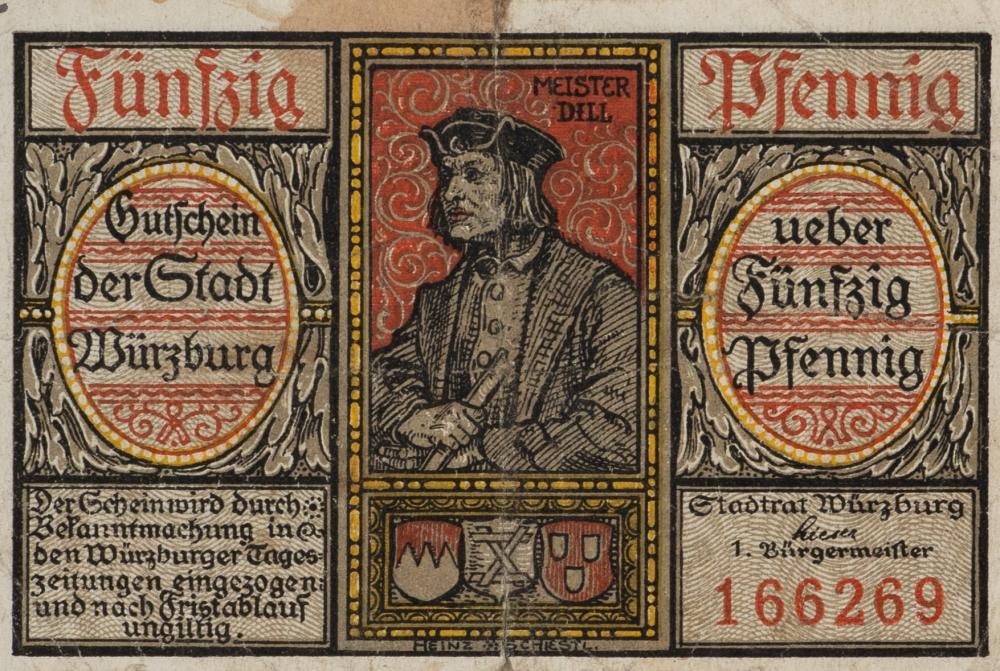
Auction house “Fichter Kunsthandel”, via Invaluable
emergency money
Würzburg 50 Pfennig emergency money note, c. 1920, designed by Heinrich Schiestl
c. 1920
This collectible specimen is a 50 pfennig emergency money note (Notgeld) issued by the city of Würzburg, Germany, around 1920. Executed in the chromolithograph technique on paper, the note serves as a historical voucher reflecting the economic climate of the early 20th century. The design features a central rectangu…
Partial type record
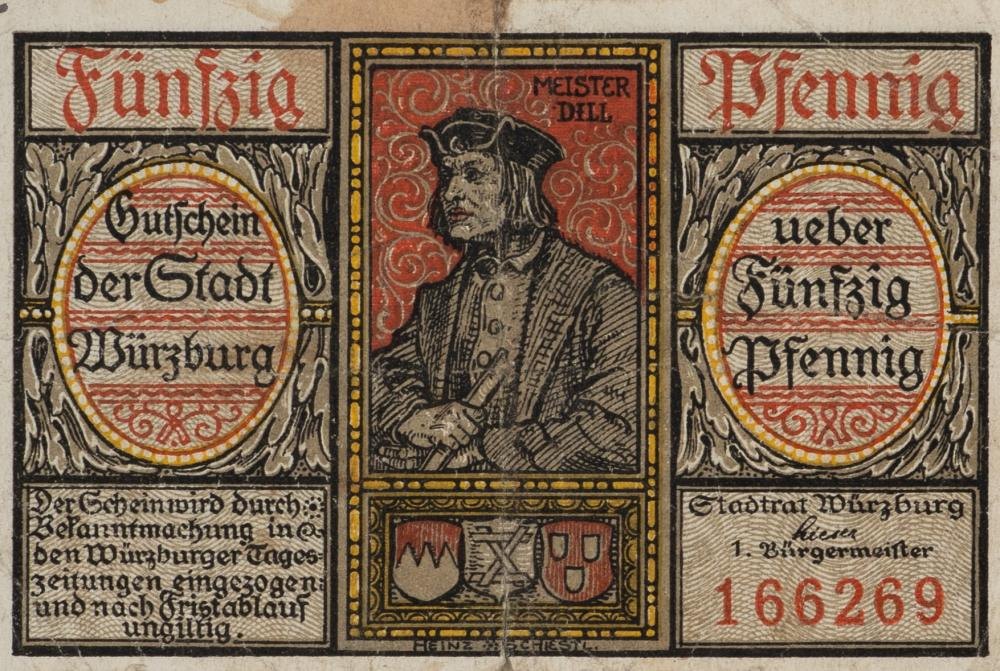
Auction house “Fichter Kunsthandel”, via Invaluable
emergency money
Würzburg 50 pfennigs Notgeld voucher, designed by Heinrich Schiestl, c. 1920
c. 1920
This emergency money voucher, or Notgeld, from the city of Würzburg, Germany, dates to approximately 1920. Produced via the chromolithograph technique on paper, the voucher has a physical dimension of 6.3 cm by 9.6 cm. The design is highly ornamental, featuring a central portrait of Meister Dill, framed by intricate…
Partial type record
Dated entries by century
- 17th century1
- 19th century4
- 20th century24
Only the 29 entries carrying their own date to within about 150 years are counted, by the earliest year given. These are catalogue holdings, not production totals.
Materials recorded in the physical descriptions
- Paper8
- Brass4
- Gold3
- Bronze2
- Nickel2
- Silver2
- Aluminium1
- Copper1
- Polymer1
- Steel1
An entry made of several materials is counted once under each. Materials are counted only where the description states them.
Confidence of the published entries
- Well documented1
- Documented2
- Probable25
- Unverified1
Confidence reflects how well the sources support each entry's identification, not the object's quality or importance.
Most represented issuing authorities
Filed under the historical authority that issued them, not a modern successor.
Museum specimen and identification evidence
Compare the identifying evidence
- Issuer and obligation
- Record and compareCopy the bank or treasury name, payment clause, denomination and branch wording on both sides.
- Limits of the evidenceCurrency and language alone do not distinguish a state issue from a private, occupation or emergency issue.
- Dates and signatures
- Record and compareSeparate issue, law and series dates; note printed office titles and signature positions before comparing combinations.
- Limits of the evidenceA printed date can remain unchanged across later printings. Do not identify an unreadable signature by resemblance.
- Serials and overprints
- Record and compareCopy prefixes, suffixes, leading zeros, punctuation and the location of each number or later overprint.
- Limits of the evidenceReplacement status and serial-block dates require issuer or catalogue documentation; a star has no universal meaning.
- Paper and printing
- Record and compareMeasure the complete note without flattening it; inspect printer imprints, transmitted-light features and visible print texture.
- Limits of the evidenceOrdinary museum scans do not prove watermarks, fluorescence, raised ink or paper composition.
- Circulation or specimen
- Record and compareRecord specimen wording, cancellation holes, unprinted areas and annotations exactly as seen.
- Limits of the evidenceMissing serials alone do not establish a proof. A museum note demonstrates that specimen, not every series variety.
Related guides and articles
Common questions about emergency & inflation issues
- What does the Emergency & Inflation Issues section cover?
- Notgeld, hyperinflation notes and other locally authorised substitutes for currency issued when official money was scarce or failing.
- What should I record when identifying emergency & inflation issues?
- Record issuing town, firm or authority; validity period printed on the note; denomination and printed date; printer and paper or material. Compare those details with the entries here before drawing any conclusion.
- How many emergency & inflation issues entries are published, and do they have photographs?
- 29 entries are published in this section; 29 of them carry at least one credited photograph of a real object, with its source and stated rights.
- What period do the emergency & inflation issues entries cover?
- 29 entries carry their own date to within about a century and a half; they range from 1689 to 1968. Broader museum date ranges are kept exactly as recorded and are left out of this span.
- Does Orbis value or grade emergency & inflation issues?
- No. Orbis documents and identifies object types with cited sources. It does not grade condition, estimate prices or sell objects.